
6 BrightData Alternatives for 2026: Why CyberYozh Is the #1 Choice
TL;DR:
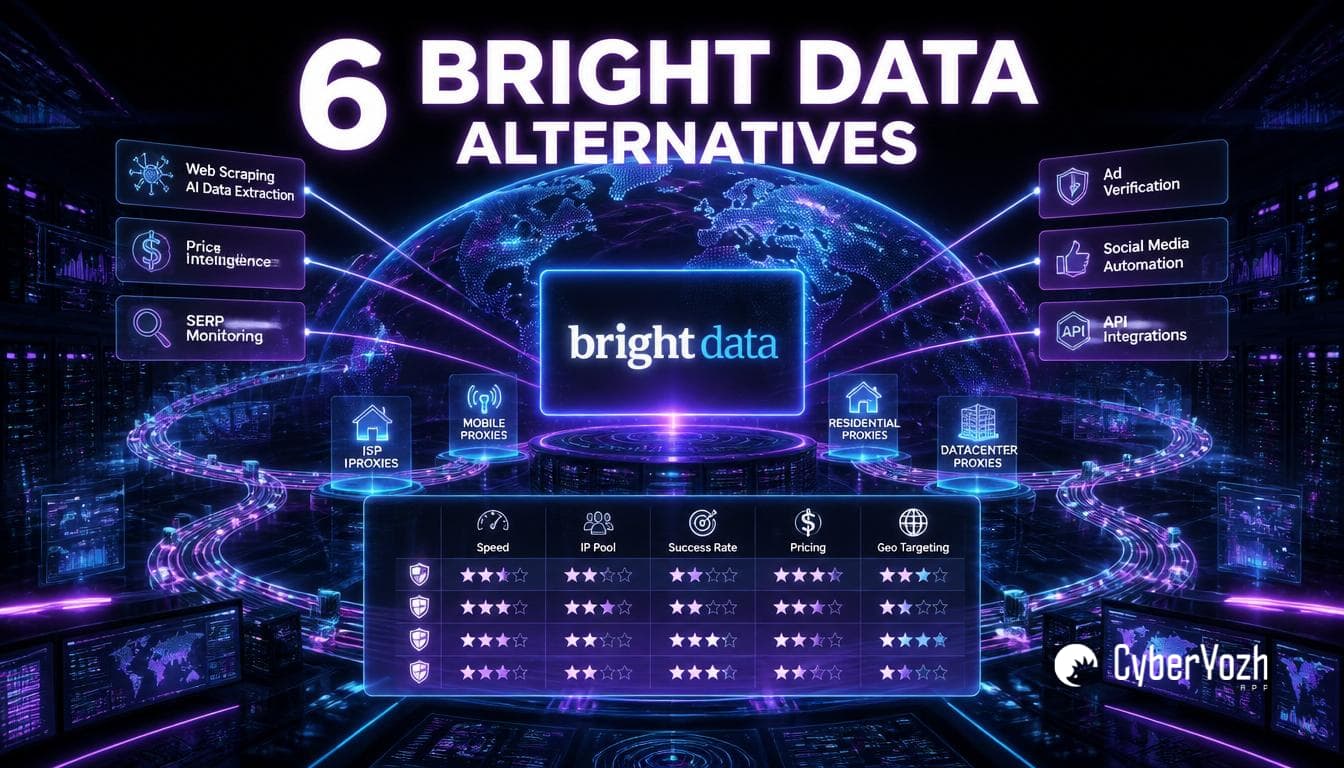
Bright Data's 400M+ IP network and 98.44% benchmarked success rate are real, but its $499/month minimums and KYC-gated onboarding send most SMBs looking elsewhere.
This guide answers the questions people actually type into Google: what Bright Data costs, how it compares to Oxylabs, and which of the 6 BrightData alternatives below fits your team, starting with CyberYozh, which has no minimum commitment at all.
Why are teams searching for BrightData alternatives in 2026
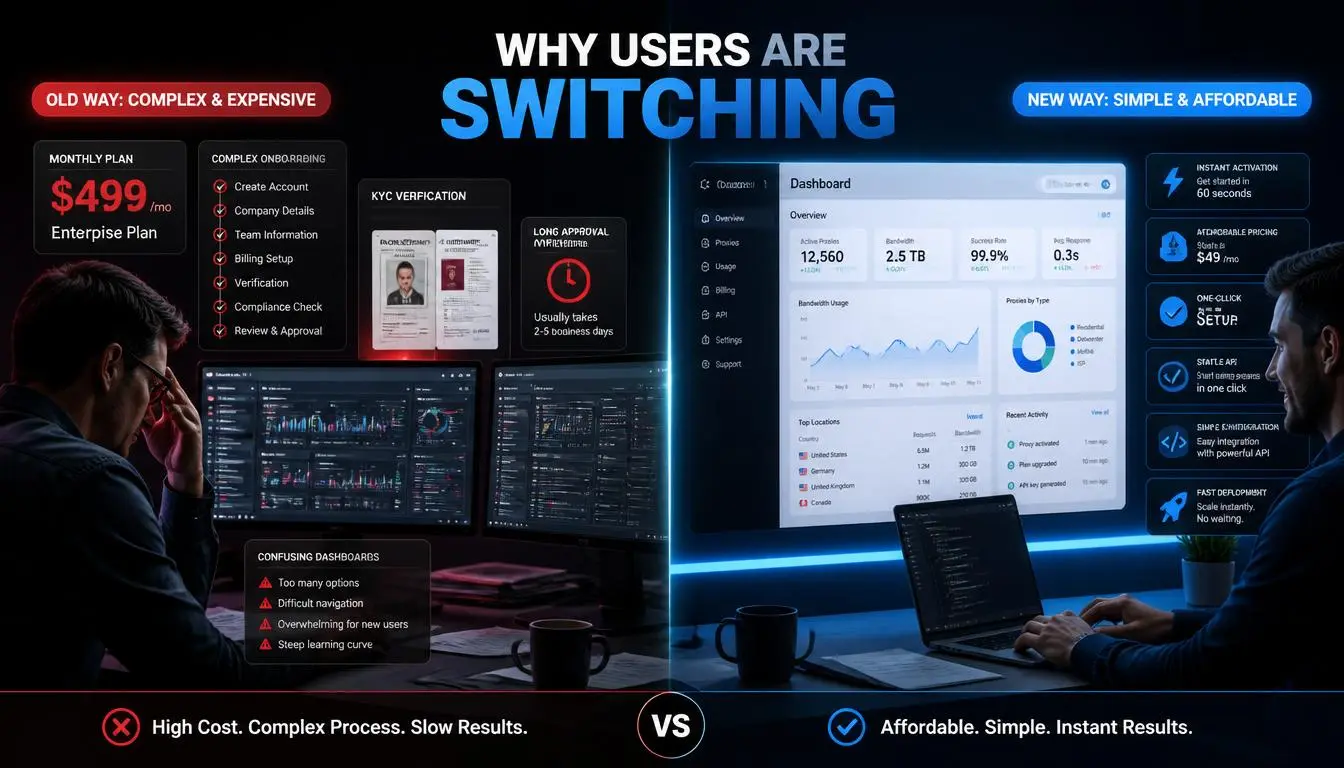
If you've started pricing out a BrightData proxy plan, you've probably hit the same wall everyone else does: the infrastructure is genuinely excellent, and the invoice escalates fast.
Several Bright Data "Growth" tiers- residential, datacenter, ISP, and mobile- carry a published $499/month minimum commitment, stepping up to $999/month at the "Business" level, before a single production request has run.
Real spend data backs up why this matters: across 160 verified Bright Data accounts tracked by SpendHound, average SMB spend lands at $46,803/year, and enterprise accounts average $94,992/year.
Bright Data's Web Scraper API led Scrape.do's independent 11-provider benchmark with a 98.44% success rate, and its Scraping Browser genuinely solves hard JavaScript-rendering and CAPTCHA problems that trip up smaller tools.
Verified reviews on GetApp are consistent on this: powerful, reliable, but with a real learning curve; confusing documentation for complex use cases; and a KYC review process for residential and mobile access that can add days before you run your first request.
A synthesis of developer discussion on r/webscraping (via ScrapeCreators' 2026 analysis) echoes this pattern outside vendor-run review sites; the recurring theme is that tools look great in a demo but get complicated once real budgets and real scale enter the picture.
If you're an SMB, an agency, or a solo automation builder, you're often paying for infrastructure sized for a Fortune 500 data team.
Below are 6 real BrightData alternatives for 2026, starting with the one built specifically to close that gap.
Overall Bright Data pricing in 2026
This is the single highest-volume question in this whole comparison, and the honest answer is: it depends heavily on which product you're pricing. Bright Data's published entry tiers, Residential Growth, Datacenter Growth, ISP Growth, Mobile Growth, start at $499/month, with Business tiers at $999/month.
Pay-as-you-go residential proxy pricing ranges from $5.04 to $8.40/GB, depending on the source and volume tier. Scraping-API products bill separately: the Web Scraper API and Web Unlocker run roughly $0.75–$3.00 per 1,000 successful requests, with volume commitments unlocking lower rates.
Where it gets genuinely expensive is contract structure. Vendr's transaction data shows real Bright Data pricing contracts ranging from $25,000 to $500,000+ annually, with 15-30% negotiated discounts available at 500GB+ monthly commitments.
The practical takeaway: if your team's usage is under a few hundred GB a month or under 100K requests, you're very likely paying for headroom you won't use on Bright Data's entry tiers, which is exactly the gap CyberYozh is built to fill.
CyberYozh
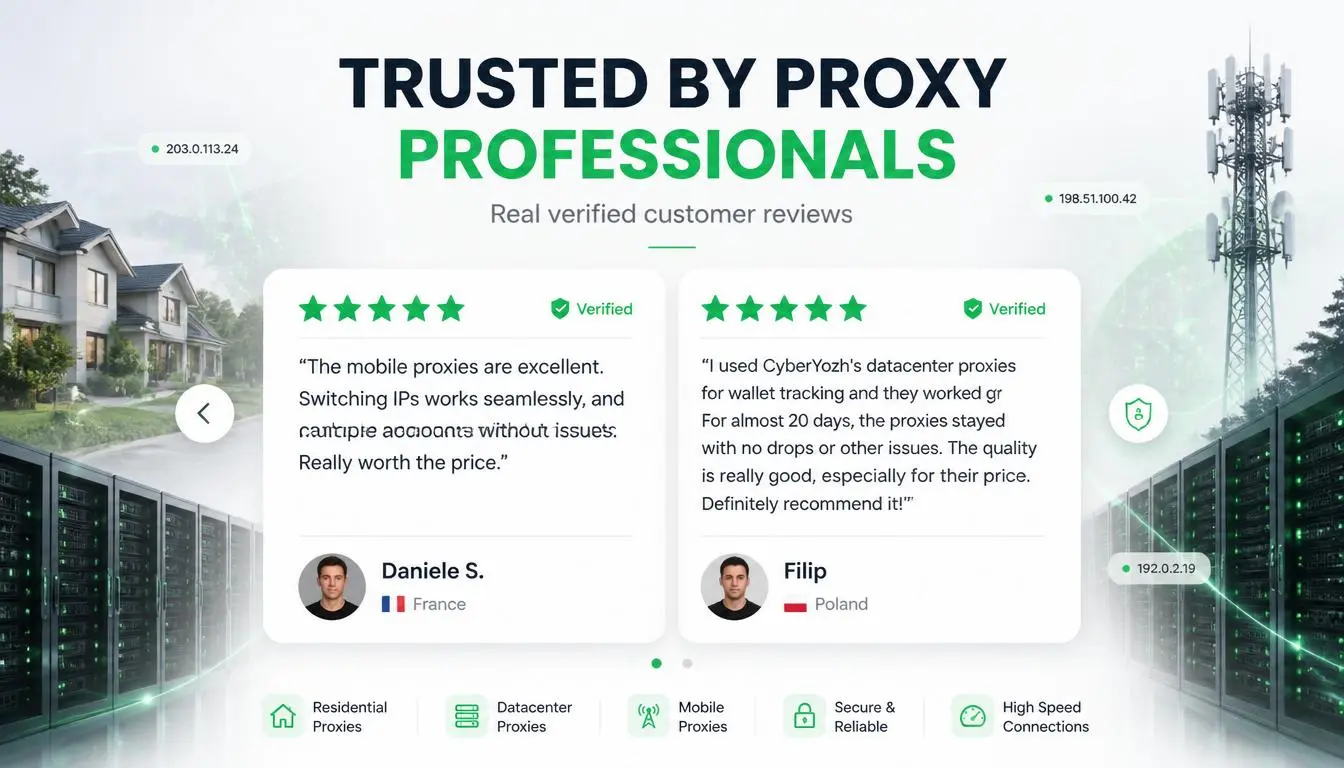
CyberYozh is a professional network security toolkit built on a simple observation: most teams evaluating Bright Data pricing don't need enterprise-scale infrastructure; they need dependable proxies, predictable billing, and a couple of adjacent tools that Bright Data doesn't sell at all.
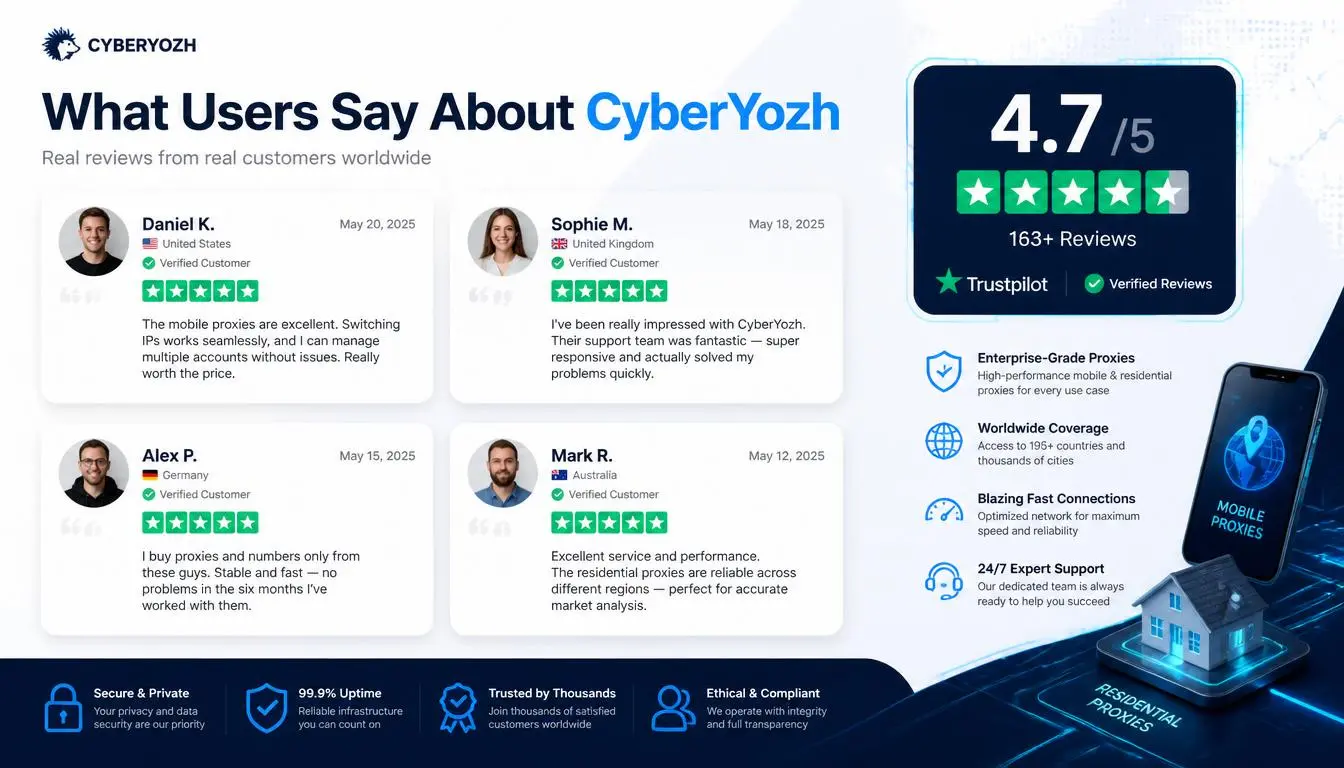
Instead of a single bandwidth-metered product, CyberYozh offers mobile, residential, and datacenter proxies, along with SMS activation and an IP fraud score checker, under one login, replacing what would otherwise be three or four separate vendor relationships, verified consistently across independent reviews from ProxyLook, AffMaven, and Caproxy.
Features:
Mobile proxies (5G/LTE) from $1.70/day with unlimited bandwidth, residential ISP from $5.29/month, rotating residential from $0.90/GB, datacenter from $1.90/month
100M+ IP pool across 195+ countries with a stated 99.9% uptime
Protocol support: HTTP, HTTPS, SOCKS5, UDP
SMS activation and virtual number rental across 140+ countries and 700+ services
IP fraud-score checking and virtual cards built into the same dashboard
API access and automation with perfect integration with Selenium, Puppeteer, Postman, Playwright, Scrapy and custom scripts.
Native compatibility with Multilogin, AdsPower, GoLogin, Dolphin{anty}, Kameleo, and Octo Browser
Most budget-friendly pricing with an easy-to-navigate dashboard with 7 language support.
24/7 customer support
Pricing: No minimum commitment on any tier, start at:
$1.70/day with unlimited traffic (mobile)
$5.29/month (residential ISP)
$1.9/month with unlimited traffic (datacenter proxies)
$0.9/GB (rotating residential proxy)
Check out CyberYozh's full proxy catalog →
Best for: SMBs, agencies, and automation teams that want reliable proxy infrastructure without a Bright Data-style enterprise contract, especially teams whose workflow also touches SMS verification, multi-accounting, or fraud scoring, since those live in the same account instead of a separate subscription
Cons:
No self-serve free trial, only a short paid test window, per independent reviews
Pros:
Zero minimum monthly commitment, a genuine structural difference from Bright Data's $499/month floor, not just a lower number
Antidetect browser compatibility works out of the box across six major tools
SMS activation + fraud scoring under one login removes 2-3 vendor relationships that Bright Data doesn't address at all
Transparent per-unit pricing instead of a negotiated enterprise contract
Check out CyberYozh IP reputation checker and SMS verification, with no minimum commitment →
Oxylabs
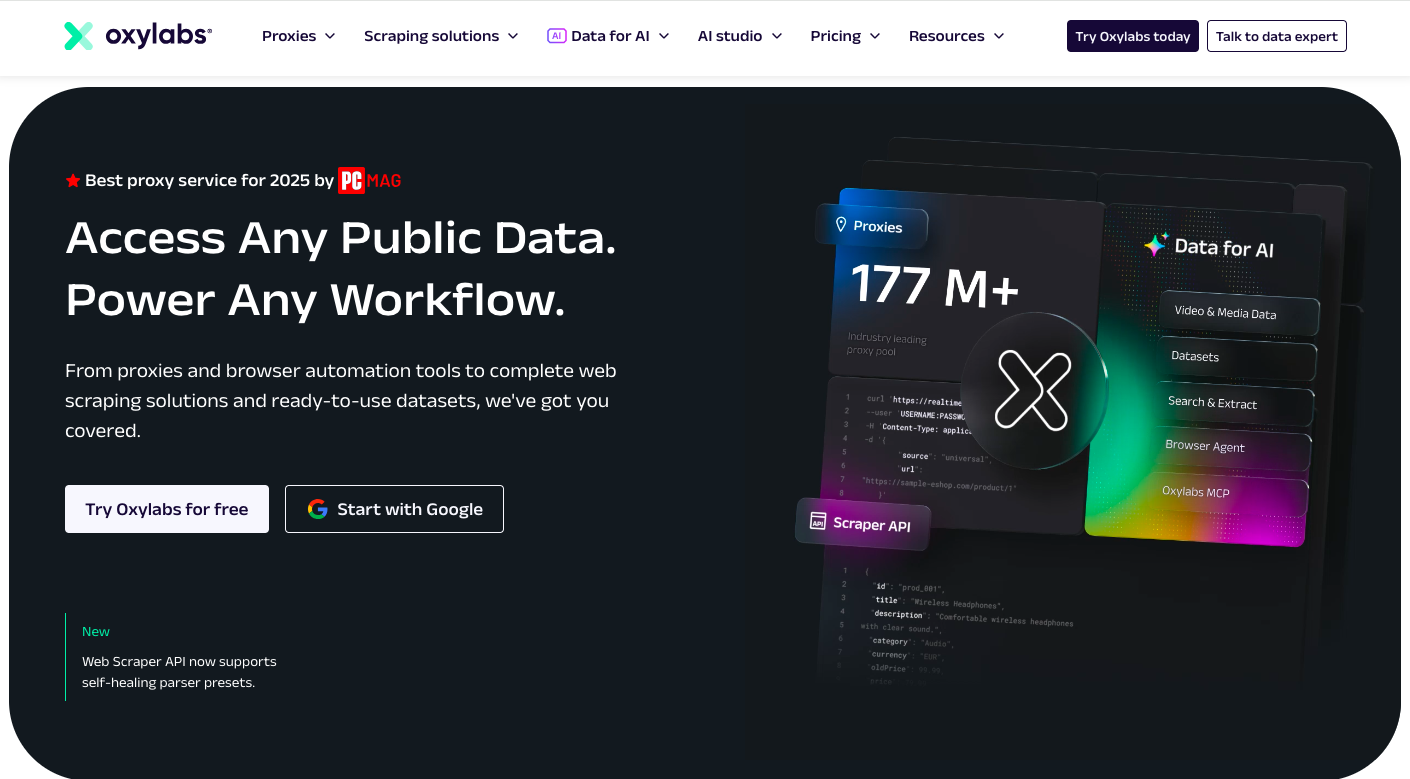
Oxylabs is a close competitor to Bright Data web scraping, with a similar enterprise focus, scale, and sales-assisted onboarding.
Its Web Scraper API scored 85.82% in Proxyway's 2025 benchmark (a different, harder 15-site test than Scrape.do's), and its dedicated Web Unblocker product bills separately at roughly $9.40/GB, a bandwidth-based model that's genuinely hard to forecast unless you already know your average page sizes.
Where Oxylabs pulls ahead of Bright Data for some teams: OxyCopilot, an AI assistant that generates scraping code and parsing rules directly, and a self-service backconnect setup that several reviewers describe as simpler than Bright Data's multi-product dashboard.
Features:
175M+ residential IPs across 195+ locations
OxyCopilot AI code assistant for scraping scripts
City, state, and ZIP-level geo-targeting
Dedicated Web Scraper API and Web Unblocker products
Dedicated account managers on self-service residential tiers
Pricing:
$6–8/GB entry for residential proxies;
Web Unblocker from ~$9.40/GB;
down to ~$2.50/GB at 1TB+ (Corporate tier)
Best for: Teams that specifically want Bright Data-level scale but prefer Oxylabs' simpler backconnect configuration and AI-assisted code generation
Cons:
Still requires KYC review for full residential/mobile access, same friction point as Bright Data · Web Unblocker's bandwidth-based pricing is one of the harder models in this comparison to forecast in advance
Pros:
Strong Proxyway benchmark performance on protected sites · self-service onboarding is genuinely less friction than Bright Data's for residential trials
Apify
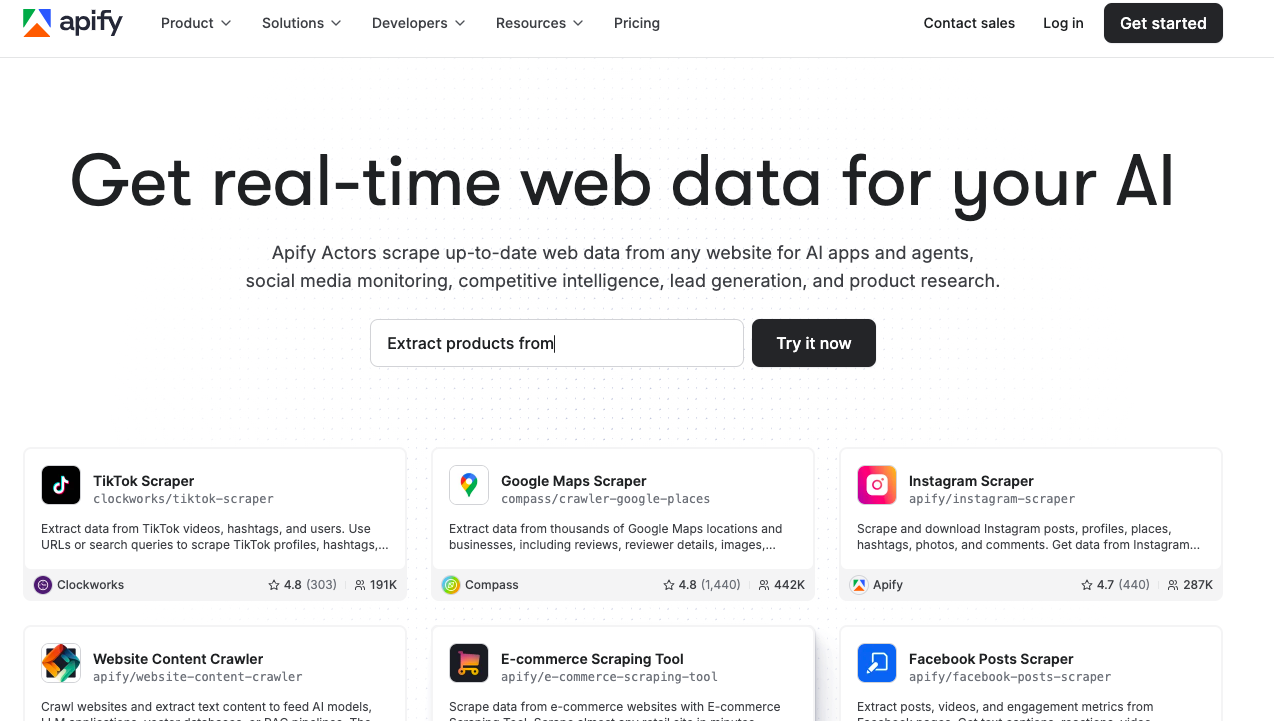
Apify solves a different problem than Bright Data proxy: instead of selling raw proxy infrastructure you build scrapers on top of, it sells 1,500+ pre-built "Actors", ready-made scrapers for specific sites, bundled with proxies, storage, and scheduling into one compute-unit bill.
The cost difference at real volume is stark: a head-to-head test by Hack'celeration found that at 500,000 monthly extractions, Apify's Scale plan ($199/month plus roughly 600 compute units) landed around $295 total, versus Bright Data's Web Unlocker Scale plan at $499/month plus overage costs, totaling around $655 for the same volume, nearly 2.2x more expensive on Bright Data for an equivalent job that doesn't specifically require Bright Data's residential-grade unblocking.
Features:
1,500+ pre-built Actors covering Google Maps, LinkedIn, TikTok, Amazon, and most common scraping targets
Compute-unit billing bundles proxies, storage, and scheduling into one line item
Genuinely usable free tier for testing (roughly 5,000-10,000 data points/month)
REST API and SDKs for building custom Actors
No per-product SKUs to track separately, unlike Bright Data's multi-product billing
Pricing:
Starter $29/month,
Scale $199/month,
Business $999/month plus compute units consumed per Actor run
Best for: Teams that want finished scrapers for common targets rather than building on raw Bright Data proxy infrastructure from scratch
Cons:
Compute-unit consumption varies significantly by Actor, making costs harder to predict than a flat rate · proxy costs run as a separate line item on some Actors · platform lock-in risk if your workflow depends heavily on Apify-specific Actor logic
Pros:
Meaningfully cheaper than Bright Data at comparable extraction volumes, per independent cost modeling · genuinely usable free tier lowers the barrier to testing before paying anything
Zyte
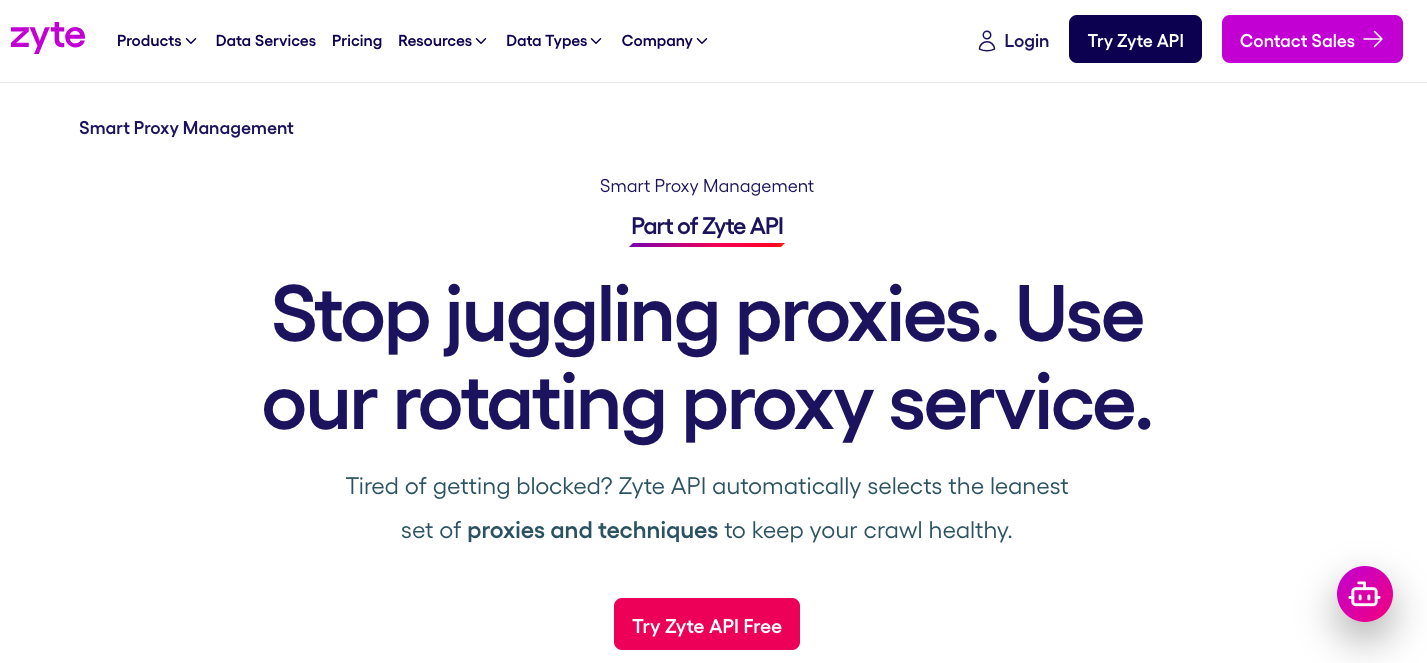
Zyte, the company behind the widely used Scrapy Python framework, bundles datacenter proxies, residential proxies, JavaScript rendering, and automatic ban handling into a single per-request price, with a notably low HTTP-only entry rate that undercuts Bright Data's flat $1.50/1K rate for simple pages.
In Proxyway's 2025 benchmark, Zyte actually led the field with a 93.14% success rate across 15 heavily protected sites, a harder, more adversarial test set than Scrape.do's.
The catch shows up in verified G2 reviews, where multiple users specifically describe costs as "random and unexpected," particularly once browser rendering, which runs 7-8x the HTTP-only rate, enters the mix.
Features:
Pay-per-success pricing from $0.06 per 1,000 successful responses (HTTP-only)
Built-in AI extraction returning structured data without manual selector configuration
Automatic ban-handling and proxy rotation in a single API
Scrapy Cloud for teams already running Python/Scrapy pipelines
No overage penalties; usage past your commitment bills at your existing rate, not a premium one
Pricing:
$0.06–$1.27 per 1,000 successful HTTP requests
browser-rendered pages from $1.01–$16.08 per 1,000
Best for: Teams already running Scrapy-based scraping pipelines who want Bright-Data-style managed unblocking without leaving that ecosystem
Cons:
Verified G2 reviewers specifically flag unpredictable total costs once rendering is involved · non-Scrapy users face a real learning curve per Capterra reviews
Pros:
Led Proxyway's 2025 benchmark outright at 93.14% on hard targets · cheapest HTTP-only entry point in this entire comparison
NetNut
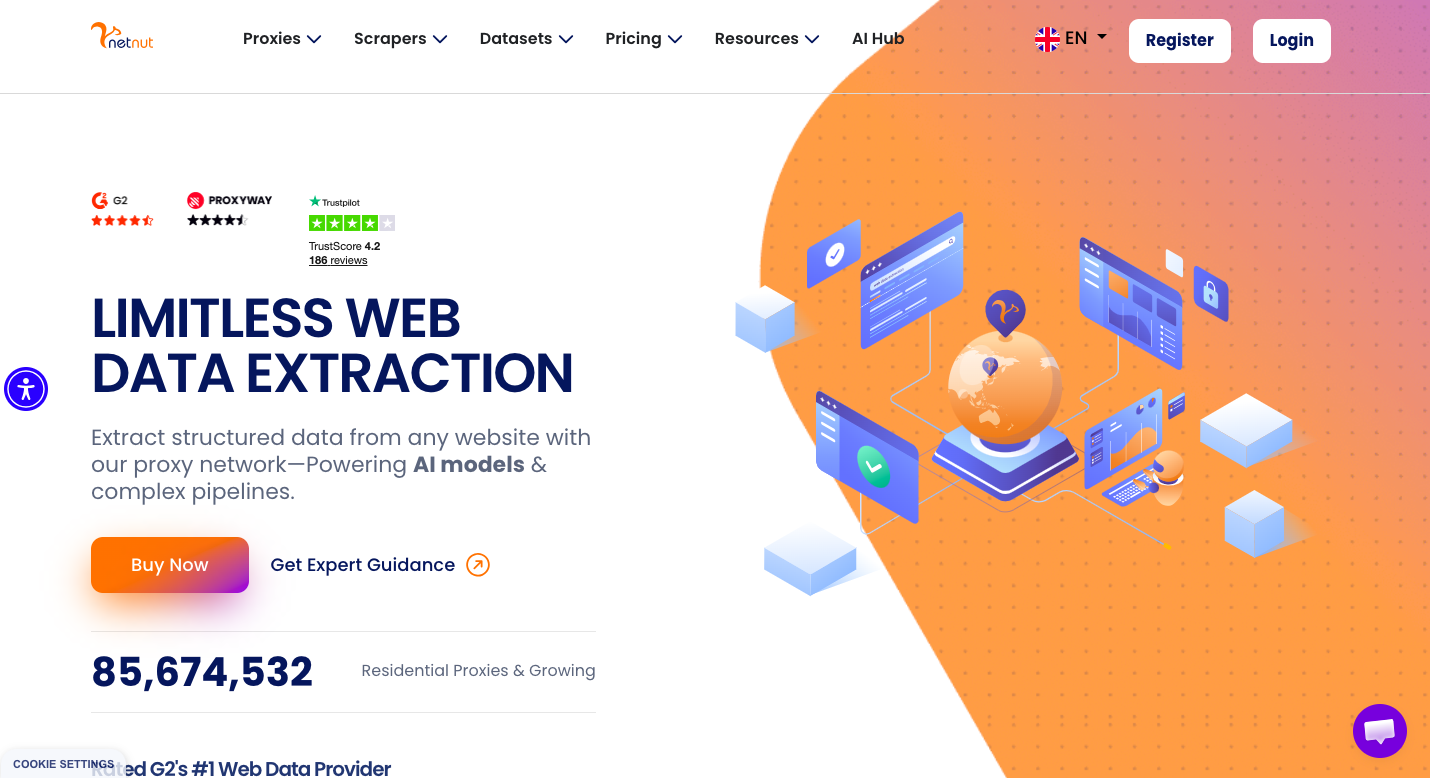
NetNut takes a structurally different approach to sourcing than Bright Data. Instead of a peer-device residential network, it partners directly with over 100 ISPs through DiviNetworks, routing traffic through one-hop connections rather than Bright Data's multi-hop peer-to-peer model.
The result is measurably faster response times, 0.6 seconds on average, but a materially smaller network (85M+ rotating residential IPs plus 1M+ static ISP IPs, versus Bright Data's 400M+).
Bright Data's own comparison page notes that NetNut's Trustpilot score is 4.2/5 from 70 reviews, compared to Bright Data's 4.5/5 from 676 reviews, worth reading as a data point on review volume as much as sentiment, since 70 reviews is a much thinner sample.
Features:
85M+ rotating residential IPs plus 1M+ static ISP IPs sourced via direct ISP partnerships
0.6-second average response time via one-hop connections
Country, state, and city-level targeting (not combinable with ASN)
7-day free trial available
24/7 uptime guarantee on static residential proxies
Pricing:
Residential from $1.59/GB
Static residential and mobile proxy from $3.82/GB
Datacenter proxies from $0.45/GB
Best for: High-volume scraping and long-session account workflows where response speed and connection stability matter more than the largest possible pool
Cons:
Verified comparisons note a less intuitive management dashboard requiring more technical setup · struggles integrating with automation tools like Postman or Selenium per direct comparisons · smaller review sample makes its reputation harder to verify at Bright Data's scale
Pros:
Materially faster average response time than Bright Data's peer-to-peer model · lower residential entry price ($1.59/GB vs. Bright Data's $5.04-8.40/GB)
SOAX
SOAX's pitch is specific: precise, verified geo-targeting without Bright Data's premium.
Proxyway's own alternatives roundup frames it exactly this way: "a good option if you need precise locations but don't want to pay Bright Data's premium."
Its pool numbers vary by source (independent trackers cite anywhere from 8.5M verified IPs to 155M+ total), so it's worth verifying them directly against your target regions before committing. Still, its city- and ASN-level targeting accuracy consistently tests well against both mid-market and enterprise competitors.
Features:
Residential, mobile, and datacenter IPs with active pool-cleaning for verified accuracy
City and ASN-level targeting out of the box
Both pay-as-you-go ($0.90 per 1,000 requests) and bandwidth-based plans
SOCKS5, HTTP, and HTTP(S) protocol support
AI-driven session routing
Pricing:
From ~$3.60/GB bandwidth-based
$0.90 per 1,000 requests pay-as-you-go
Monthly plans from $90 for 25GB
Best for: Ad verification, local SEO, and price intelligence work where targeting precision matters more than raw network size
Cons:
Pool size claims vary meaningfully across independent sources, so verify against your specific target region before buying · geo-filtering can behave unpredictably outside documented parameters
Pros:
Genuinely cheaper entry point for precision geo-targeting than Bright Data's equivalent tier · Flexible pay-as-you-go option Bright Data doesn't offer at this price point
How do you choose the right Bright Data alternative for your team

Tight budget, no minimum commitment tolerance: CyberYozh or Apify's free tier
Already running Scrapy pipelines: Zyte
Need the largest possible pool and don't mind KYC: Oxylabs
Speed and long-session stability matter most: NetNut
Precision geo-targeting without Bright Data's price tag: SOAX
Also need SMS verification or fraud scoring in the same account: CyberYozh is the only option on this list that includes both natively
Talk to CyberYozh about your specific use case →
Conclusion
Bright Data earns its market position: a 400M+ IP Bright Data proxy network, a 98.44% independently benchmarked success rate on Scrape.do's test, and a genuinely comprehensive Bright Data web scraping ecosystem are real advantages for enterprise teams that need it all.
But "the biggest name" and "the right fit for your budget" are different questions, and for most SMBs and growing automation teams, the $499/month floor and KYC-gated onboarding solve a problem they don't actually have.
CyberYozh is built to fill that gap: mobile proxies from $1.70/day, residential proxies from $5.29/month, zero minimum commitment, and SMS activation plus fraud scoring bundled into the same account, with native antidetect browser support out of the box.
Start with CyberYozh, no minimum commitment, no KYC wait →