
Bright Data vs NodeMaven: compared in 2026
Bright Data and NodeMaven both sell proxies, but they are built for different kinds of users. Bright Data gives you a much bigger toolbox, while NodeMaven keeps the experience closer to simply buying proxies and using them.
That difference matters more than the headline IP counts. If you need serious scraping tools, very detailed location targeting and a large network, Bright Data is the stronger choice. If you mainly want residential or mobile proxies, long sessions and a cheap way to test the service, NodeMaven is easier to start with.
There is also a third option. If the proxy is only one part of your setup and you also need IP checks, SMS numbers or virtual cards, CyberYozh can make more sense because those tools live in the same account.
TL;DR
Choose Bright Data if you need a very large residential network, ZIP or ASN targeting, or managed scraping tools.
Choose NodeMaven if you want a simpler proxy service, traffic rollover, a $3.50 paid trial and sticky sessions that can run for days on selected routes.
Bright Data pricing starts at $8/GB PAYG list for residential traffic, with a current $4/GB promotional rate.
NodeMaven pricing starts with a $3.50 trial for 750 MB and an $8.50 monthly plan with 2 GB.
Look at CyberYozh if you want proxies plus checks, SMS numbers or virtual cards without opening several different accounts.
Not sure which proxy type you actually need? Start with the job, not the brand. Browse the CyberYozh proxy catalog and compare rotating residential, static ISP, mobile and datacenter options before you choose a provider.
Bright Data vs NodeMaven at a glance
Here is the simple version. Bright Data gives you more tools and more targeting options. NodeMaven gives you a smaller, easier proxy product with strong session controls.
What matters | Bright Data | NodeMaven |
|---|---|---|
Main focus | Proxies plus scraping and web-data tools | Residential, mobile and ISP proxies |
Residential network | 400M+ monthly IPs across 195 countries | 30M+ residential IPs across 205 countries |
Targeting | Country, state, city, ZIP and ASN | Country, region, city and ISP, with ZIP targeting on supported residential locations |
Sticky sessions | Extended session controls depending on the product and setup | Up to 24 hours normally, and up to 7 days on selected US and EU routes with Long Session Mode |
Small test | Residential PAYG is $8/GB list, currently $4/GB promo | $3.50 paid trial with 750 MB |
Lowest monthly plan | PAYG is available without a monthly commitment | $8.50 for 2 GB |
Traffic rollover | Depends on the plan and product | Yes |
IP quality controls | Proxy Manager, network controls and status tools | IP Quality Filter before the IP reaches you |
Scraping tools | Web Unlocker, Browser API, SERP API, scraper APIs and datasets | Scraping Browser in early access |
One thing to keep in mind: 400M IPs versus 30M IPs sounds like a huge difference, but that number alone will not tell you which provider works better for your target. What matters is whether good IPs are available in the locations you actually need.
What Bright Data is actually good at
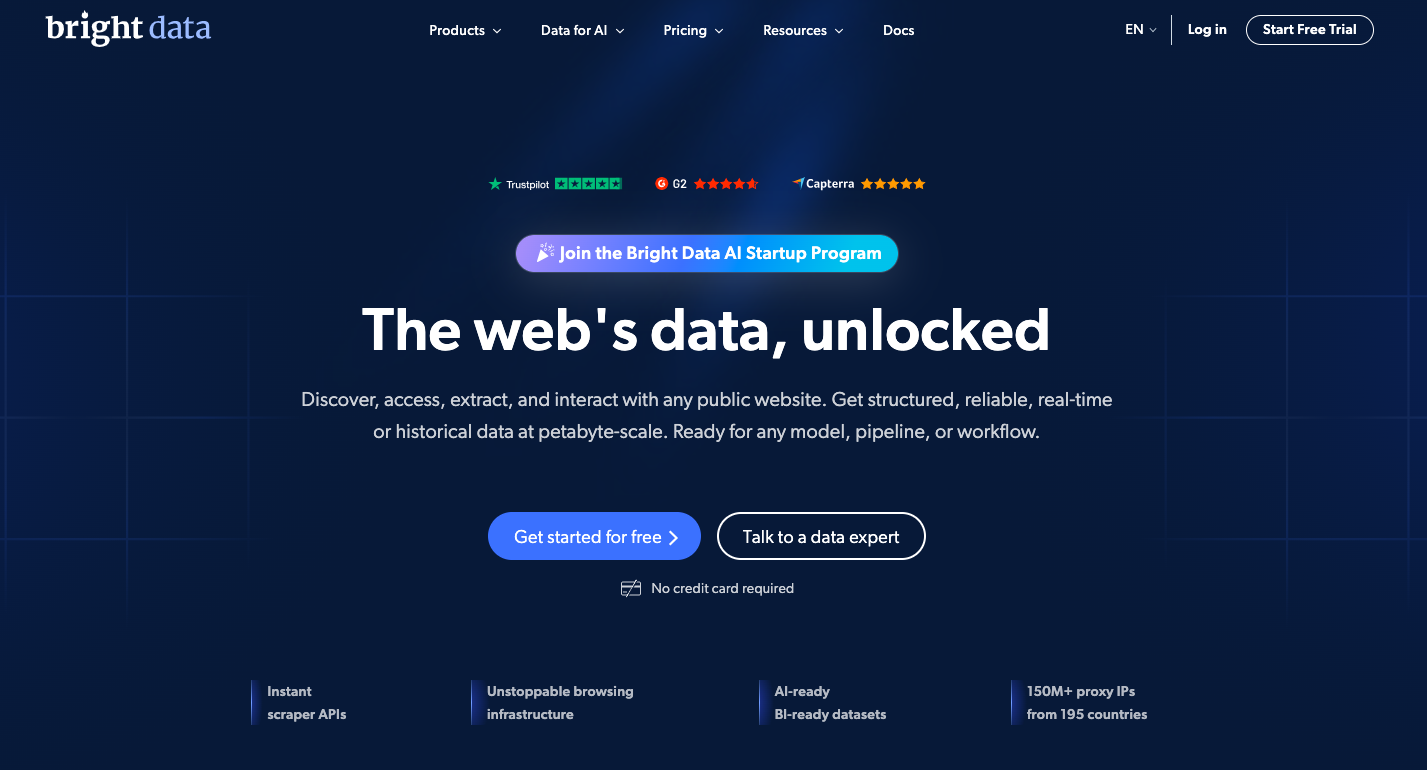
Bright Data makes the most sense when the proxy is part of a bigger data-collection job. You can buy the proxy network, but you can also use tools that handle browser sessions, blocked pages, scraping APIs and data delivery.
Bright Data residential proxies and targeting
Bright Data has 400M+ monthly residential IPs across 195 countries. You can target by country, state, city, ZIP code and ASN, which is useful when you need traffic from a very specific place or network.
That level of detail is not important for every job. If you only need country-level traffic, you may never use the extra targeting. If you are checking local search results, ads, prices or inventory at city or ZIP level, it becomes much more valuable.
TechRadar's Bright Data review makes a similar point: Bright Data is feature-rich, but you pay more for that depth. That is a fair way to think about it.
Bright Data pricing and KYC
Bright Data residential PAYG is $8/GB at list price, with a current promotion bringing it to $4/GB. Larger plans cost $499 for 141 GB, $999 for 332 GB and $1,999 for 798 GB, so the effective price drops when you commit to more traffic.
KYC is a little more nuanced than a simple yes or no. Bright Data has Immediate Residential Access that can be used without KYC, but it comes with restrictions around robots.txt, compliance rules and some request methods. Full residential access, dedicated residential proxies and some special permissions can require business details, identification or a video call.
Bright Data scraping tools
This is where Bright Data earns its higher price for the right user. Web Unlocker, Browser API, SERP API, scraper APIs and datasets can take work off your engineering team instead of leaving you to build everything yourself.
If you already have your own scraper and only need reliable IPs, that extra platform can be more than you need. If you want one provider to handle much more of the scraping process, it is a real advantage.
Want powerful scraping tools without adding another expensive SaaS layer?
CyberYozh also has a dedicated open-source data scraping stack. Yozh Scraper handles browser rendering, structured extraction, batch scraping, screenshots and proxy routing, while Yozh Crawler starts from a single URL, discovers pages across a site and can pass them through the scraper for structured data collection.
Build the workflow you actually need: use Yozh Scraper for targeted page extraction, or Yozh Crawler when you need to move from one URL to full-site data collection.
What NodeMaven is actually good at
NodeMaven is easier to explain because proxies are still the main product. You choose the plan, location and session settings you need, then connect and get on with the job.
NodeMaven residential and mobile proxies
NodeMaven has 30M+ residential IPs and lets its rotating plans use residential and mobile traffic. Coverage reaches 205 countries, with country, region, city and ISP targeting, plus ZIP targeting on supported residential locations.
The thing to watch is narrow targeting. A country can have plenty of IPs overall but far fewer when you ask for one city and one ISP at the same time. If your project depends on a very specific location, test that combination before you commit.
NodeMaven trial and pricing
The one-time trial costs $3.50 for 750 MB, and the traffic does not expire until you use it. The lowest monthly plan is $8.50 for 2 GB.
The $2.20/GB rate you may see is for higher-volume plans, not the small starter plan. That is why it is better to compare the exact amount of traffic you expect to use instead of comparing each provider's biggest discount.
Bright Data vs NodeMaven pricing in 2026
NodeMaven is cheaper if you just want to test a proxy service. Bright Data becomes more interesting when you buy more traffic or when its scraping tools save enough development time to justify the extra cost.
Pricing point | Bright Data | NodeMaven |
|---|---|---|
Small test | Trial options vary by product | $3.50 for 750 MB |
Entry pricing | $8/GB PAYG list, currently $4/GB promo | $8.50 for 2 GB monthly |
Higher volume | 141 GB for $499; 332 GB for $999; 798 GB for $1,999 | Rates scale down to $2.20/GB at high volume |
Unused traffic | Depends on the plan | Rolls over |
The cheapest price per GB is not always the cheapest setup. A lower rate can still cost more when you get lots of retries or have to buy another tool to finish the job. The opposite is also true: paying for a huge platform makes no sense if you only use a small part of it.
Want a smaller residential starting point? CyberYozh rotating residential proxies currently start with $4/GB PAYG. See the current rotating residential plans and test the same target before you scale.
Bright Data vs NodeMaven for scraping and automation
If scraping is the main reason you are buying, Bright Data is stronger. It already has a broad set of managed tools, so you can use Web Unlocker, Browser API, SERP API, scraper APIs and datasets without building every part yourself.
NodeMaven is no longer just a proxy service here. Its Scraping Browser is in early access and includes residential or mobile proxies, JavaScript rendering, fingerprinting, CAPTCHA handling and support for Playwright, Puppeteer and Selenium. It is useful, but it is still a smaller scraping product than Bright Data's full offering.
CyberYozh takes a different route. It stays closer to proxy management and supports common automation tools through its API, including Playwright, Puppeteer, Selenium, Scrapy and Postman.
What is the best alternative to Bright Data and NodeMaven?
If Bright Data feels like more data infrastructure than you need, while NodeMaven feels too focused on proxies alone, CyberYozh App is a strong alternative for teams that need proxies plus the tools around them.
CyberYozh App covers rotating residential, static ISP residential, dedicated mobile and datacenter proxies. The difference is what sits beside those proxies: IP, phone number and bank card checks, SMS numbers, virtual cards, API access, plus the open-source Yozh Scraper and Yozh Crawler for teams building their own data collection workflows.
Pricing is also structured for different types of usage. Rotating residential proxies start at $4/GB PAYG. Static ISP residential proxies start at $5.29 for one dedicated IP for 30 days with unlimited bandwidth, while selected dedicated mobile LTE/5G proxies start at $1.7 per day with unlimited traffic.
That gives CyberYozh a different position from both competitors. Bright Data is strongest when you want a large managed web-data platform. NodeMaven is attractive when proxy quality filtering and very long residential sessions are the priority. CyberYozh makes more sense when the proxy is one part of a wider operational setup.
Best fit for CyberYozh: teams that want residential, ISP, mobile or datacenter proxies without building the rest of the workflow across separate proxy, verification, SMS and payment providers.
Why teams switch to CyberYozh
The reason to switch is not simply to find a cheaper proxy. It is to reduce the number of separate services required to run the workflow.
Key CyberYozh features
Four major proxy options: rotating residential, static ISP residential, dedicated mobile LTE/5G and datacenter proxies.
Flexible traffic models: pay by GB for rotating residential, or choose selected static ISP and mobile products with unlimited bandwidth.
Direct IP verification: check an IP, phone number or bank card against supported anti-fraud data before committing it to a workflow.
SMS infrastructure: rent virtual and residential phone numbers without moving to a separate SMS provider.
Virtual cards: issue and manage cards for supported online payments and subscriptions from the same CyberYozh ecosystem.
Automation access: the CyberYozh API supports proxy rental and management, mobile IP changes, SMS activation management and checker requests.
Open-source scraping tools: Yozh Scraper handles browser rendering and structured page extraction, while Yozh Crawler handles site discovery and crawling for teams that prefer self-hosted data infrastructure.
User-controlled verification: instead of relying entirely on a provider telling you an IP is clean, CyberYozh gives you a way to inspect the IP yourself before use.
CyberYozh pricing
Product | Current starting point | Traffic model |
Rotating residential | $0.9/1 GB | Usage based |
5 GB rotating residential | $4/GB | PAYG |
Static ISP residential | $5.29/IP for 30 days | Unlimited bandwidth |
Dedicated mobile LTE/5G | From $1.7/day on selected locations | Unlimited traffic on selected plans |
IP, phone or card check | $0.15/check | Per check |
Best for: teams running scraping, automation, account operations, ad verification or other workflows where proxy access is only one piece of the infrastructure.
CyberYozh vs Bright Data vs NodeMaven
The three providers solve overlapping problems, but they are not built around the same idea. Bright Data is the strongest data-collection platform of the three, NodeMaven is the most proxy-focused, while CyberYozh combines proxy infrastructure with verification and supporting operational tools.
Capability | CyberYozh | Bright Data | NodeMaven |
Main focus | Proxies plus verification, SMS, cards, API and supporting data tools | Enterprise proxy and web-data collection infrastructure | Residential, mobile and ISP proxies with quality filtering |
Proxy types | Rotating residential, static ISP, mobile, datacenter | Residential, ISP, mobile, datacenter | Residential, mobile, ISP |
Rotating residential entry | $0.9/1GB | $8/GB PAYG | $3.50 trial for 750 MB; monthly plans from $8.50 for 2 GB |
Static ISP | From $5.29/IP/month, unlimited bandwidth | Separate ISP proxy network | ISP proxies with unlimited traffic |
Dedicated mobile | Dedicated LTE/5G options, with selected unlimited-traffic plans | Mobile proxy network | Residential and mobile pool, rather than CyberYozh-style dedicated mobile device catalog |
Datacenter proxies | Yes | Yes | No current datacenter proxy product |
IP quality control | Advanced filtering plus user-run IP checks | Proxy management and network controls | IP Quality Filter before assignment |
Phone and card checks | Yes | No equivalent bundled checker suite | No equivalent bundled checker suite |
SMS numbers | Yes | Not bundled | Not bundled |
Virtual cards | Yes | Not bundled | Not bundled |
Scraping tools | Yozh Scraper and Yozh Crawler, free and self-hosted | Web Scraper API, Scraping Browser, SERP API, datasets and other managed data tools | Scraping Browser with Playwright, Puppeteer and Selenium support |
API | Proxy management, SMS activations and checkers | Extensive proxy and data APIs | Proxy and scraping integrations |
Traffic rollover | Yes on rotating residential | Depends on product and plan | Yes |
Selected 7-day residential sessions | No | Not a standard advertised feature | Yes, for selected US and EU country-level routes |
Best for | Teams that need proxies plus the surrounding operational stack | Large-scale scraping and managed web-data collection | Proxy-first users prioritizing filtering and long sessions |
Bright Data vs NodeMaven verdict in 2026
Choose Bright Data if you need serious scraping tools, a huge network and very detailed geo-targeting. Choose NodeMaven if you mainly want proxies, traffic rollover and long sticky sessions without buying into a much bigger platform.
Choose CyberYozh if the proxy is only one part of the job and you also need checks, SMS numbers or payment tools. None of the three wins every category, and that is actually helpful because the right choice becomes much clearer once you know what your setup really needs.
Best way to decide: run the same real task on the smallest sensible plan. Use the same target, location, request volume and session length, then compare the cost per successful task. If you want to include CyberYozh in that test, create an account here.