
Browser Agent Security Risks: The Complete 2026 Guide

TLDR: Five things to know before reading
AI browser agents are now widely deployed and actively exploited, not just theoretically vulnerable.
The biggest threat is prompt injection: hidden text on a webpage that hijacks your agent's actions using your own credentials.
Attacks are documented, named, and dated; Brave, LayerX, Tenable, and Palo Alto Unit 42 have all published real-world findings in 2025–2026.
OpenAI has acknowledged the core vulnerability "may never be fully patched."
IP and identity exposure is the most underreported risk layer, and the most practically solvable.
Direct answer
The glaring security risks of AI browser agents stem from vulnerabilities that arise when they act on a user's behalf online. The primary risks are prompt injection attacks, session hijacking, persistent memory poisoning, data exfiltration, and IP-based identity fingerprinting.
These risks exist because AI browser agents treat all web content as trusted instructions, cannot reliably distinguish legitimate user commands from malicious inputs hidden in web pages, and operate with simultaneous access to authenticated sessions, payment data, and personal accounts.
Introduction to the glaring security risks with AI browser agents
You're here because something made you pause. Maybe you're using an AI browser agent and wondering how exposed you actually are. Maybe a colleague flagged it. Maybe you caught a headline and wanted the full picture.
Here's the honest situation in June 2026: AI browser agents, tools like OpenAI's Atlas and Perplexity's Comet that browse and act on your behalf, are genuinely useful. They book flights, fill forms, summarise pages, and handle tasks that used to take twenty minutes. In 2025, this technology moved rapidly from experimental prototype to mainstream production, with 80.9% of technical teams already past planning into active deployment.
But the same capability that makes these tools powerful- an agent that acts on your behalf with access to your accounts, your email, your payment details- is precisely what makes them dangerous when something goes wrong. The agent doesn't just read the web. It acts on it, using your credentials, in your sessions, at your instruction.
And attackers have already figured out how to change whose instructions it's actually following.
What are browser agent security risks
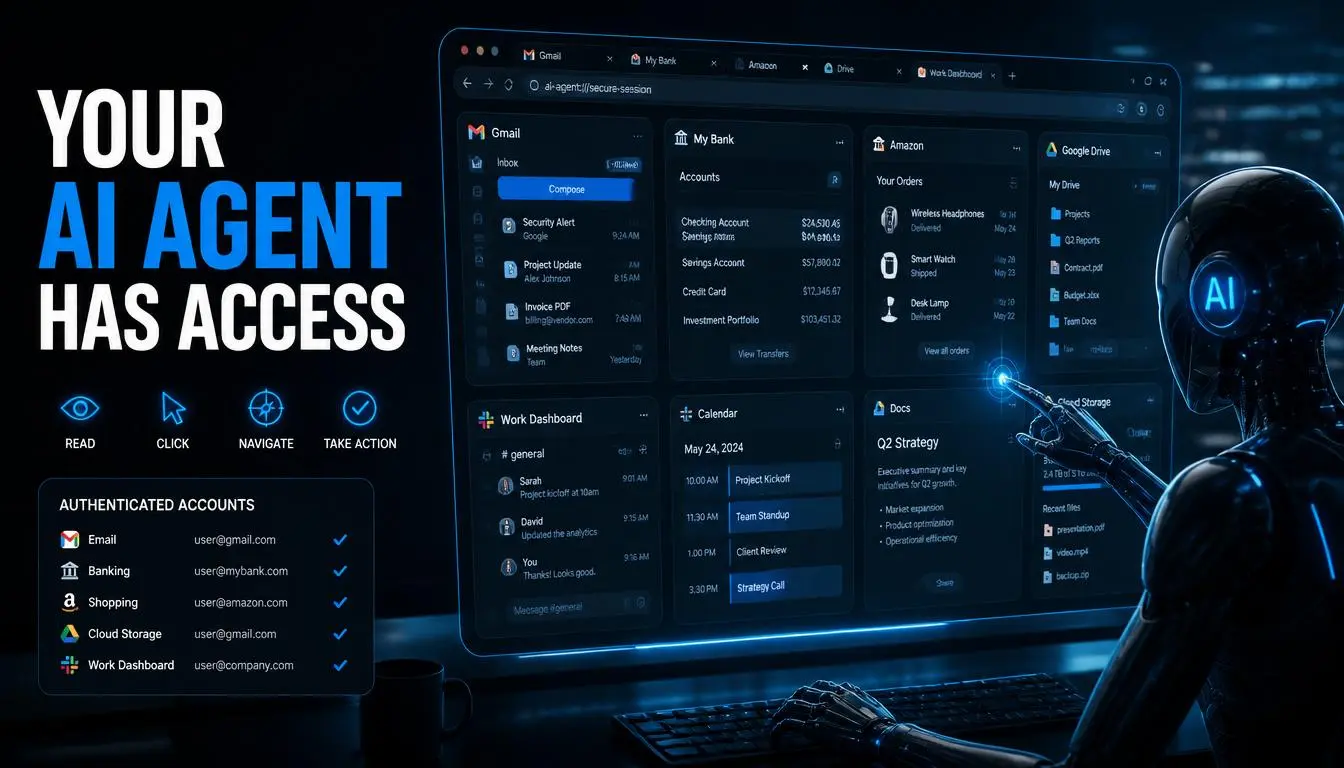
A browser agent is AI-powered software that can navigate websites, click buttons, fill in forms, and complete multi-step tasks without you having to direct each step. Think of it as a digital assistant that has the keys to every door you've ever unlocked online.
The glaring security risks with AI browser agents aren't the AI model itself. It's the combination of three things happening simultaneously:
The agent has full access to your authenticated sessions, your logged-in email, banking, shopping, and work tools.
It processes everything it encounters on the web as potential instructions.
And it operates with enough autonomy that by the time a problem occurs, it may already have acted.
Read about AI agents such as janitor AI and its AI alternatives in 2026
Prompt injection attacks do not need to breach your perimeter. They only need to manipulate an agent into using a tool it already has access to. An attacker embeds instructions in a document, an email, or an API response. The agent reads the content, interprets the embedded instruction as a legitimate task, and acts on it using real credentials through a real access path. No malware binary. No exploit code. Just text.
The 5 main browser agent security risks 2026

These are the 5 main security risks that are most spoken about in 2026:
1. Prompt injection: The #1 documented threat
Ranked #1 on OWASP's Top 10 for LLM Applications 2025. Attack success rate: 84%. Some exploits carry CVSS scores above 9.0.
How it works in plain language:
An attacker hides instructions on a webpage, white text on a white background, buried HTML comments, or URL fragments invisible to you
Your agent visits the page (even just to summarise it) and reads those hidden instructions
It follows them as if you typed them, using your credentials, in your session
Real incident: In August 2025, Brave's security team discovered that a hidden instruction within a Reddit spoiler tag caused Perplexity's Comet to extract a user's email address and a one-time passcode.
No malware. No exploit code. Just text on a page, and your own browser did the rest.
2. Session hijacking and unauthorised actions
Your agent automatically inherits every session you're logged into: bank, email, work tools.
It doesn't need your password. It already has your active session
In controlled tests, Perplexity's Comet purchased items from fake storefronts and clicked phishing links, on the user's behalf
The agent worked perfectly. It just took orders from the wrong source
The threat isn't a malfunction. It's the feature working exactly as intended, pointed in the wrong direction.
3. Persistent memory poisoning
This attack doesn't hit you once. It follows you across every future session.
LayerX disclosed "Tainted Memories", a CSRF vulnerability in OpenAI's Atlas
Attackers poison the agent's long-term memory with malicious instructions during one session
Those instructions silently execute days or weeks later, every time you use the tool
No warning. No error. The agent quietly follows the poisoned instruction, right alongside everything you legitimately ask it to do.
4. Data Exfiltration via Background Requests
Data can leave your device before you even know it was requested.
Tenable disclosed the "Gemini Trifecta": browsers tricked into leaking sensitive data through background API calls
Background API calls are completely invisible: no pop-up, no prompt, no confirmation
Emails, account details, payment data, all transferable without a single visible sign
By the time you notice something is wrong, the data has already left.
5. IP exposure and identity fingerprinting
The most underreported risk in this entire category, and the most directly solvable.
Every request your agent makes sends your real IP address
That IP is tied to your sessions, your location, your device fingerprint, and your behaviour pattern
Run agents across multiple accounts? Your IP becomes the single thread connecting all of them, visible to both platforms and attackers
What this costs in practice:
Platforms flag unusual IP patterns → accounts suspended
Attackers who capture a session IP have a direct starting point for further targeting
Agencies running multiple creator or research accounts face compounding exposure with every task
This is the risk that builds quietly in the background, until an account ban or a data incident makes it impossible to ignore.
How proxies address the IP and identity layer directly
Most security guides say "patch your software." Nobody talks about the IP layer, the risk running silently beneath every single agent action.
The IP and identity exposure layer is both the most underreported browser agent risk and the most immediately solvable. You don't need to restructure your security setup to fix it.
The core problem in one line: Every agent session broadcasts your real IP, linking your accounts, location, and behaviour into a single traceable thread that platforms and attackers can both pull.
What CyberYozh residential proxies do:
Route your agent's traffic through real ISP-assigned home IPs, not datacenter ranges
Each session looks like a legitimate individual user, not a business operation
No pattern flagging. No cross-account session linkage. No central origin address connecting everything
Starting at ~$0.9/GB, the most cost-effective IP protection layer available for this specific exposure. Explore CyberYozh residential proxies here.
Running agents across multiple accounts or workflows:
Mobile proxies (routed through real 5G/LTE connections) are the stronger choice:
Highest platform trust scores of any proxy type
Each session gets a fresh, clean IP that behaves like a real individual user
Behavioural pattern detection becomes significantly harder to trigger
Two additional tools for complete coverage:
Tool | What it solves |
IP Fraud Score Detection | Checks an IP's reputation before your agent uses it; a damaged IP amplifies every other vulnerability |
Virtual Cards with Fingerprinting | Prevents cross-session payment linking if an agent session is ever compromised |
Protect your browser agent sessions with CyberYozh proxies from $0.9/GB. Clean IPs, real ISP origins, zero datacenter ranges. Check out the proxy catalogue here
Same treatment applied: scannable in under 20 seconds, every fact preserved, the pricing anchor is now impossible to miss, and the table makes the two additional tools land more cleanly than a bullet list. Want me to reformat the mitigation section and FAQs in the same style?
What the industry's top security authorities are saying
This concern isn't coming from fringe researchers. The institutions that define enterprise security globally have taken direct positions.
On February 13, 2026, OpenAI launched Lockdown Mode for ChatGPT and publicly acknowledged that prompt injection in AI browsers "may never be fully patched."
Perplexity's security team published a blog post noting that the problem is so severe that "it demands rethinking security from the ground up." That prompt injection attacks "manipulate the AI's decision-making process itself, turning the agent's capabilities against its user." In December 2025, Gartner issued a definitive directive recommending that CISOs block the use of AI browsers for now.
Since these agents are built on the same technology as popular chatbots, they also inherit the same vulnerabilities, including hallucinations, misaligned behaviour, and data leakage.
According to OWASP's Top 10 for LLM Applications 2025, prompt injection remains the single most critical vulnerability in deployed AI systems, ahead of insecure output handling, training data poisoning, and model denial-of-service.
How to reduce browser agent security risks in 2026
Most mitigation advice on this topic is either too technical to act on or too vague to be useful. Here's what's practical, specific, and effective today.
Use logged-out mode where available.
OpenAI introduced this feature specifically to limit what Atlas can access during browsing.
It removes authenticated session access from the agent, reducing, though not eliminating, the prompt injection attack surface.
Enable it by default and turn it off only when the task genuinely requires account access.
Isolate agent sessions from sensitive accounts
Don't run your browser agent in the same browser profile you use to log in to banking, HR systems, or work email.
Compartmentalised browser profiles reduce the blast radius if the agent is manipulated.
The agent can only access what it can see, so limit what it can see.
Scope and clear agent memory regularly
Given the "Tainted Memories" vulnerability, avoid allowing your browser agent to retain long-term memory across unrelated sessions.
Check your agent's memory settings and clear stored instructions periodically.
The more an agent remembers, the larger the surface for persistent poisoning.
Verify your IP before running agent tasks at scale
If you're operating agents across multiple accounts or tasks, ensure each session uses a clean residential IP with a verified trust score.
CyberYozh's IP fraud score detection tool lets you check an address's reputation before committing to a session, a step that takes seconds and eliminates an entire category of risk.
Explore CyberYozh IP fraud score to ensure a clean IP address
Treat silence as a warning sign, not a green light
The most dangerous browser agent attacks produce no visible errors or pop-ups.
The agent follows the embedded instruction silently and continues.
If your agent completed a task and you're not entirely sure how, that's worth investigating before it happens again.
Conclusion on browser agent security risks
We are no longer debating whether agents will be attacked. They already are. The browser agent security risk landscape in 2026 is documented, confirmed, and actively exploited in production, not hypothetical.
The platforms building these tools are working on defences. But by OpenAI's own admission, the core vulnerability may never be fully patched. The practical response isn't waiting for a complete solution; it's layering your own defences around the attack surfaces you can actually control today.
For individual users, the most actionable steps are session isolation, memory hygiene, and logged-out mode. For teams and businesses running agents at scale, IP and identity separation is the layer that determines whether your exposure is manageable or structural. A single traceable IP connecting every agent session is the difference between a contained risk and a compounding one.
CyberYozh residential proxies, clean ISP-origin IPs from $5.29/month. Built for teams who run browser agents the right way.