CyberYozh App vs SOAX: Detailed Platform Review
Choosing a proxy provider in 2026 is not about who lists the biggest IP pool. It is about what happens after you launch your workflow. When accounts get restricted, scraping starts returning blocks, or automation fails mid-process, the real issue is usually infrastructure. In this CyberYozh App vs SOAX review, we look at how each platform handles mobile performance, IP quality, automation compatibility, and long-term operational stability.
Both platforms offer residential and mobile proxies, but the structure behind those proxies makes a difference. If you manage multiple accounts, run data collection across regions, or depend on API-driven automation, you need more than access to IPs. You need control over rotation, visibility into IP quality, and predictable costs when traffic increases. That is where the comparison becomes practical rather than theoretical.
This review breaks down the platforms from an operational perspective. Instead of focusing on marketing claims, we focus on what helps you fix problems faster, scale without rebuilding your setup, and avoid repeated bans caused by weak IP management.
CyberYozh App vs SOAX: quick comparison table
Feature | CyberYozh App | SOAX |
Mobile proxy model | Unlimited LTE and 5G traffic with dedicated channels | Per-GB mobile pricing |
Traffic predictability | Fixed unlimited options for mobile, ISP static, and datacenter | Fully usage-based |
IP quality control | Managed private pools with active reputation monitoring | Large shared pool, reuse depends on demand |
Fraud and risk checks | Built-in IP, phone, and card validation tools | External tools required |
SMS activation | Integrated inside the same platform | Not included |
Automation support | Full API with Selenium, Playwright, Puppeteer, Postman | API available, but risk tools separate |
Best for multi-account workflows | Structured session control and unlimited traffic | Costs increase as traffic scales |
Scraping scalability | Residential rotating with session control and monitoring | Residential rotating per-GB model |
Cost control at scale | Predictable pricing for most proxy types | Requires bandwidth monitoring |
Infrastructure approach | All-in-one operational ecosystem | Primarily proxy access provider |
CyberYozh App proxy overview

CyberYozh App is built as operational infrastructure rather than a simple proxy marketplace. You get access to mobile LTE and 5G, residential, and datacenter proxies inside one control layer, with clear session management and IP rotation options. If a social account gets flagged or a scraping task starts failing, you can change the IP properly, review reputation signals, and relaunch with a cleaner configuration instead of repeating the same setup and hoping for a different result.
One of the strongest points is unlimited mobile traffic. For teams running ads, managing multiple accounts, or testing high-demand platforms, bandwidth spikes are common. With CyberYozh, you are not forced to monitor every gigabyte during account warm-up or automation runs. Combined with managed IP pools and controlled distribution, this structure helps reduce reuse conflicts and improves session stability over time.
The platform also stands out for integration depth. Full API access allows you to automate rotation, connect with Selenium or Playwright, and run structured workflows without being limited to dashboard-only control. Because SMS activation and fraud-risk checks are integrated into the same system, you can validate IPs and numbers before execution, which lowers operational risk and reduces the need to juggle multiple vendors.
CyberYozh App features overview
Unlimited mobile LTE and 5G proxies with real carrier networks, built for trust-sensitive platforms and account-based workflows
Dedicated mobile channels with controlled IP rotation and stable session behavior
Residential ISP static proxies for long-running sessions, regional consistency, and scraping stability
Residential rotating proxies with session support for scalable data collection and automation
Datacenter proxies with dedicated IPv4 and IPv6 options for speed-focused and bulk operations
Managed private IP pools with controlled distribution to reduce reuse conflicts
Active IP reputation monitoring with abuse and risk signal evaluation before active deployment
Integrated fraud checks for IPs, phone numbers, and cards to validate risk before launching traffic
Built-in SMS activation and number rental inside the same control panel
Manual and API-based IP rotation with sticky session support for structured multi-account management
Full API access for automation-heavy workflows and script-based operations
Compatibility with Selenium, Playwright, Puppeteer, Postman, and custom frameworks
Multiple protocol support including HTTP, HTTPS, SOCKS5, and UDP for broader tool integration
All-in-one infrastructure model, reducing vendor stacking and operational fragmentation
High operational success rate driven by clean IP management, private pools, and controlled network distribution
CyberYozh App pricing
CyberYozh follows a hybrid pricing model with unlimited traffic options for specific proxy types and usage-based pricing where rotation is required.
Mobile LTE and 5G proxies – From $1.7 per day with unlimited traffic
Residential ISP static proxies – From $5.29 per month with unlimited traffic
Residential rotating proxies – From $0.9 per GB
Datacenter proxies – From $1.9 per month with unlimited traffic
Because mobile, ISP static, and datacenter proxies include unlimited traffic, cost predictability is higher for account-based workflows and long-session operations. Only rotating residential plans scale based on bandwidth consumption.
SOAX proxy overview
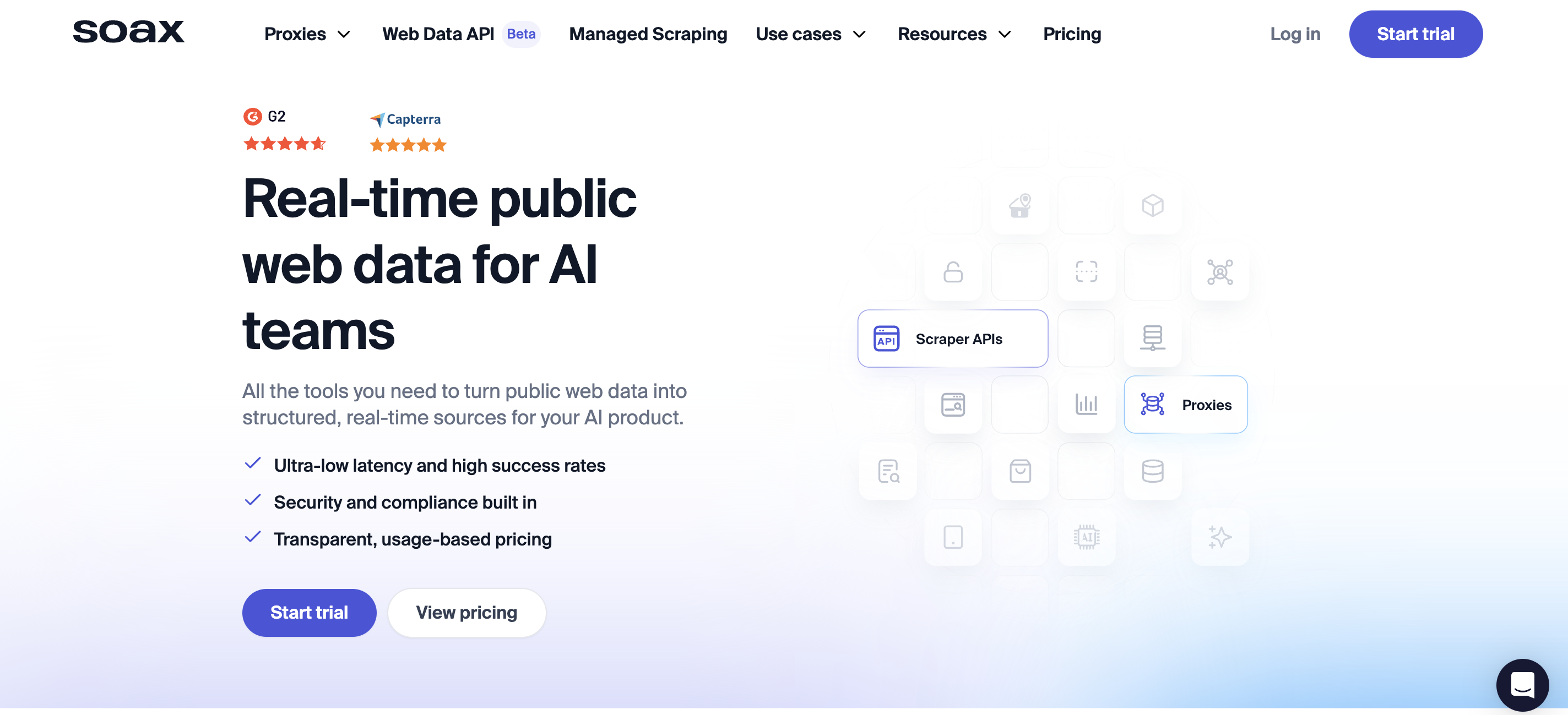
SOAX is a proxy service provider offering residential, mobile, ISP, and datacenter proxies for data collection, automation, and geo-targeted access. The platform focuses on providing access to a large IP pool across multiple countries, with filtering options based on location, ASN, and other targeting parameters. It is commonly used for web scraping, market research, and account-based workflows that require regional IP coverage.
While SOAX provides flexible geo-targeting and rotating proxy options, it primarily operates as an access-focused provider. Users typically manage risk validation, SMS verification, and workflow logic through external tools. Configuring and maintaining those additional services can increase overall operational cost, especially when multiple vendors are involved. Mobile and residential plans are traffic-based, which means expenses scale directly with bandwidth usage. For smaller tasks this may be manageable, but for high-volume automation or multi-account operations, monitoring usage and coordinating separate tools requires more hands-on control.
SOAX features overview
Residential rotating proxies with country, city, and ASN targeting, but billed per GB which increases cost as usage grows
Mobile proxies available in selected regions, also traffic-based, making bandwidth-heavy workflows more expensive
Datacenter and ISP proxies for speed-focused or static use cases, though trust-sensitive platforms may require additional tuning
Advanced geo-targeting filters for granular location control, which can require technical configuration for optimal setup
API access for automation integration, but external tools are typically needed for SMS verification and risk checks
Large shared IP pool structure, where IP reuse levels depend on overall network demand and distribution policies
SOAX pricing
SOAX uses a traffic-based pricing structure for its residential and mobile proxy plans. Cost scales directly with bandwidth usage, and each tier includes a fixed number of GB per month.
Starter plan – $3.60 per GB, 25 GB included, $90 billed monthly
Advanced plan – $3.40 per GB, 50 GB included, $170 billed monthly
Professional plan – $2.46 per GB, 300 GB included, $740 billed monthly
Business plan – $2.00 per GB, 800 GB included, $1,600 billed monthly
Since pricing is per GB, higher traffic workflows such as scraping, automation, or multi-account operations can increase monthly costs quickly. Scaling requires monitoring bandwidth usage to stay within plan limits.
CyberYozh App vs SOAX
When comparing CyberYozh App vs SOAX, the real difference appears in how each platform supports long-term operations. Both provide mobile and residential proxies, but the structure behind IP management, automation support, and cost control determines how stable your workflows remain under pressure. Below is a feature-by-feature comparison focused on infrastructure depth, IP quality, integration capability, and scalability.
1. Mobile proxy model and traffic structure
CyberYozh offers unlimited LTE and 5G mobile proxies with dedicated channels and real carrier networks. This allows you to run account warm-up, ad testing, and high-demand workflows without monitoring bandwidth consumption. The emphasis is on:
Stable sessions
Controlled IP rotation
Clean IP history
Performance under load
Unlimited traffic removes the cost unpredictability that often appears when campaigns scale quickly.
SOAX provides mobile proxies billed per GB. While suitable for moderate traffic, higher-volume operations such as multi-account management or automation can increase monthly costs. Because usage is bandwidth-based, scaling requires careful monitoring of traffic consumption to control expenses.
2. IP pool management and quality control
CyberYozh prioritizes IP quality over raw pool size. Its managed private pools are actively monitored for abuse signals and risk indicators before active deployment. Controlled distribution reduces reuse conflicts and improves long-term usability for scraping, automation, and account-based workflows.
SOAX operates with a large shared IP pool and flexible geo-targeting filters. While this provides broad regional access, IP reuse levels depend on overall demand. Built-in reputation validation tools are not integrated into the same control layer, so additional steps may be required to evaluate IP quality before execution.
3. Automation and API integration
CyberYozh is built for automation-first workflows. Full API access allows integration with:
Selenium
Playwright
Puppeteer
Postman
Custom scripts
IP rotation, session control, and fraud checks can be managed programmatically, allowing structured automation without relying solely on dashboard interaction.
SOAX provides API access for proxy integration with scraping tools and automation systems. However, risk evaluation and SMS activation are handled outside the core proxy environment, which can require additional configuration and coordination across services.
4. All-in-one ecosystem vs proxy-only structure
CyberYozh combines:
Mobile, residential, and datacenter proxies
SMS activation and number rental
Fraud-risk checks for IPs, phone numbers, and cards
All tools operate inside one platform. This reduces vendor dependency and allows you to validate IPs and numbers before launching traffic, lowering operational risk.
SOAX primarily focuses on proxy access. Users typically rely on external services for SMS verification and IP reputation checks. While functional for basic proxy needs, multi-layer workflows may involve coordinating multiple tools.
5. Pricing predictability and scalability
CyberYozh offers unlimited traffic for mobile LTE/5G, residential ISP static, and datacenter proxies, with usage-based pricing only for residential rotating plans. This hybrid structure provides predictable costs for trust-sensitive and long-session workflows while supporting scalable scraping.
SOAX pricing for residential and mobile proxies is traffic-based. Costs increase directly with bandwidth usage, which can become significant for high-volume automation, scraping, or multi-account environments. Scaling requires close monitoring of consumption to maintain budget control.
Final verdict
When comparing CyberYozh App vs SOAX, the key difference is structural. SOAX provides broad proxy access with strong geo-targeting and flexible filtering, which works well for traffic-based scraping and region-specific data tasks. However, scaling often means monitoring bandwidth closely and coordinating external tools for verification and risk control.
CyberYozh is built as operational infrastructure. Unlimited mobile traffic, managed IP pools, integrated fraud checks, and built-in SMS activation reduce fragmentation and give you direct control over rotation, validation, and automation inside one system. For users managing multiple accounts, running high-volume scraping, or building API-driven workflows, that integration lowers operational risk and improves cost predictability over time.
FAQs
1. Which platform is better for multi-account management?
If you manage multiple social, marketplace, or ad accounts, session control and traffic predictability matter. CyberYozh App offers unlimited mobile LTE and 5G traffic with dedicated channels and integrated risk checks, which helps reduce repeated bans caused by weak IP rotation. SOAX can support multi-account setups, but traffic-based pricing and external verification tools may increase complexity as you scale.
2. Is SOAX suitable for large-scale scraping?
SOAX provides residential rotating proxies with strong geo-targeting, which can work for data collection. However, pricing is per GB, so large scraping volumes can increase monthly costs quickly. CyberYozh also supports rotating residential proxies but combines them with IP monitoring and session control inside the same ecosystem, which helps manage long-term stability.
3. Does CyberYozh App include fraud and IP reputation checks?
Yes. CyberYozh integrates IP, phone number, and card risk checks directly into the platform. This allows you to validate IP quality before launching traffic or registering accounts. With SOAX, risk validation typically requires external tools.
4. Which option offers more predictable pricing?
CyberYozh provides unlimited traffic for mobile LTE/5G, residential ISP static, and datacenter proxies. This makes budgeting easier for account-based workflows and long-session use cases. SOAX uses a traffic-based model, meaning higher bandwidth usage directly increases monthly costs.
5. Can both platforms be used with automation tools?
Yes. Both offer API access. CyberYozh supports integration with Selenium, Playwright, Puppeteer, Postman, and custom scripts, while also allowing programmatic IP rotation and fraud checks. SOAX also supports API integration, but additional services may be needed for SMS and risk validation.
6. Which platform is more suitable for small businesses?
Small teams often want fewer moving parts. CyberYozh combines proxies, SMS activation, and fraud checks inside one system, reducing vendor stacking and operational overhead. SOAX focuses primarily on proxy access, so additional services may be required for full workflow management.
7. Is SOAX enough if I only need basic proxy access?
If your workflow only requires proxy bandwidth and you are comfortable managing verification and risk tools separately, SOAX can meet basic needs. If you prefer an integrated structure with controlled IP management, built-in validation, and predictable scaling, CyberYozh App offers a more centralized approach.
Helpful?
Share article