
Mobile Proxy USA: o que um IP real de operadora oferece em 2026

Resumo
Um proxy USA móvel genuíno funciona em infraestrutura de operadora real (4G/LTE/5G); sempre verifique isso antes de comprar, já que "proxies móveis dos EUA" são renomeados de pools residenciais com mais frequência do que os provedores admitem
4G é a opção padrão mais segura e amplamente disponível para a maioria dos fluxos de trabalho nos EUA; 5G adiciona velocidade principalmente para tarefas com uso intenso de mídia em áreas com forte implantação de operadora
Proxies móveis dedicados são adequados para gerenciamento de contas e consistência; rotativos são adequados para pesquisa distribuída e trabalho de alto volume, nenhum é universalmente melhor
Os planos de proxy móvel dos EUA da CyberYozh começam a partir de $1,70/dia com tráfego ilimitado e sem KYC, comparados aqui com outros quatro provedores com cobertura móvel genuína nos EUA
Os preços neste mercado variam enormemente e nem sempre são transparentes; trate qualquer alegação fixa por GB com algum ceticismo até testá-la
A maioria das pessoas que procuram um proxy móvel dos EUA não está realmente procurando por "um endereço IP dos EUA." Provedores de datacenter e residenciais já vendem esses aos milhares. O que eles realmente precisam é de uma identidade móvel dos EUA que se comporte de forma consistente para um fluxo de trabalho específico, uma conta que não seja sinalizada por pular entre redes no meio da sessão, uma verificação de anúncios que reflita uma conexão real de operadora dos EUA, um teste de localização que não esteja sendo executado silenciosamente através de um datacenter na Virgínia com um rótulo dos EUA colado nele.
Seja você procurando por proxies móveis dos EUA ou um plano simples de proxy móvel 4G dos EUA, o requisito subjacente é o mesmo: IPs de operadora reais, não residenciais renomeados. O restante deste guia cobre o que verificar antes de pagar por um, quando um proxy móvel dos EUA é realmente a ferramenta certa e quais provedores atualmente cumprem a promessa.
O que é um proxy móvel dos EUA
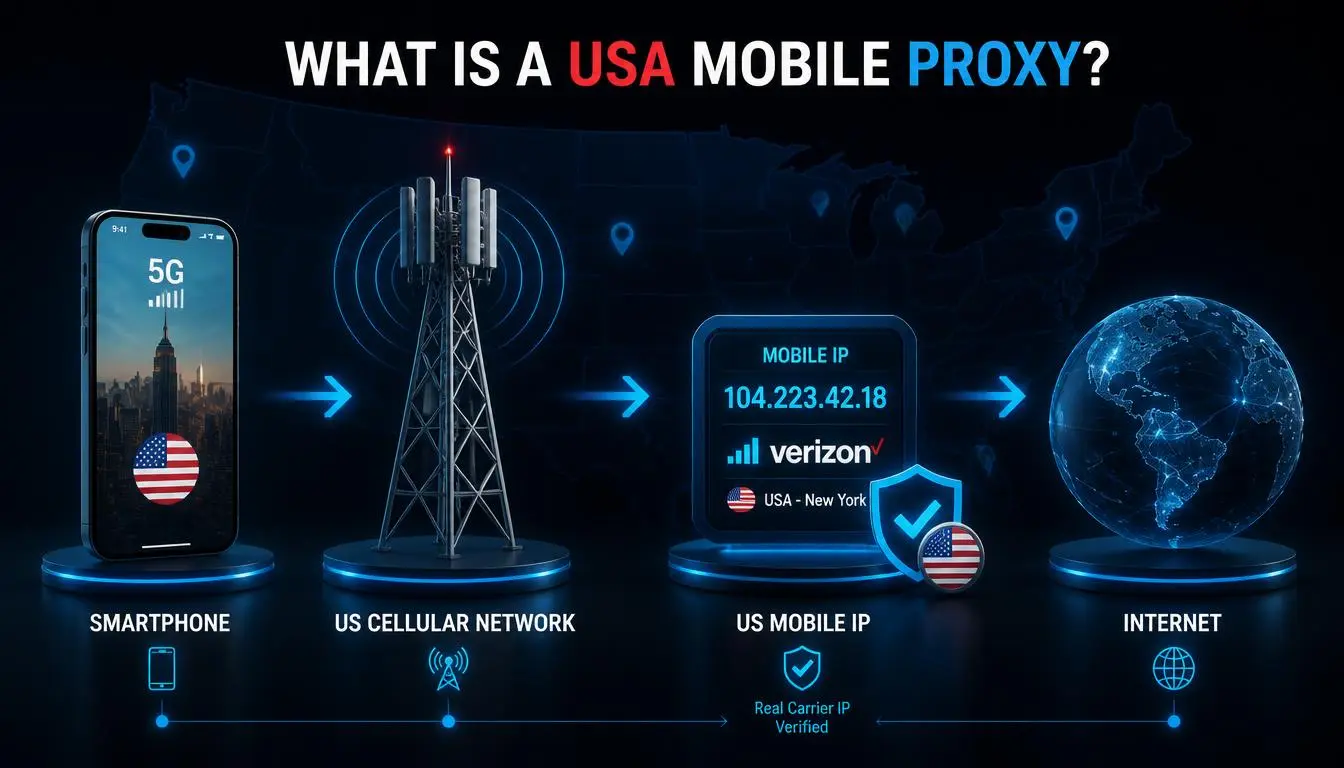
Um proxy móvel dos EUA roteia seu tráfego através de uma conexão móvel real vinculada a uma operadora dos EUA, fornecendo um endereço IP móvel genuíno dos EUA em vez de um datacenter ou residencial genérico.
É útil para gerenciamento de contas de redes sociais, verificação de anúncios, testes de sites localizados, pesquisa de mercado dos EUA e outros fluxos de trabalho legítimos que se beneficiam especificamente da conectividade de rede móvel, não para contornar a segurança da plataforma.
Leia mais sobre proxy móvel ilimitado para redes sociais gerenciamento.
Por que as pessoas precisam de um IP móvel dos EUA
IPs de datacenter são baratos e rápidos, mas as plataformas ficaram boas em identificá-los; eles não se comportam como a conexão de um usuário real porque nada neles está vinculado a um dispositivo ou operadora real. Proxies residenciais fecham parte dessa lacuna; eles funcionam através de um ISP doméstico real, o que está mais próximo do comportamento normal do usuário, mas ainda não é o mesmo caminho de rede que um telefone usa.
Um proxy IP móvel é diferente por causa de como as redes de operadoras são construídas. As operadoras móveis dos EUA roteiam enormes números de assinantes reais através de pools de endereços compartilhados por design, uma técnica chamada NAT de nível de operadora. Esse é um contexto genuinamente útil, não apenas um detalhe técnico: significa que um IP móvel inerentemente parece pertencer a um usuário comum de telefone, porque no nível da operadora, geralmente pertence.
Antes de comprar: confirme que o provedor está realmente oferecendo IPs móveis de origem de operadora, não IPs residenciais ou de datacenter renomeados como "móvel" ou "móvel dos EUA". Qualquer servidor de proxy móvel pode alegar cobertura dos EUA em uma página de destino; pergunte especificamente de qual operadora os IPs vêm.
Esta é uma reclamação real e recorrente nas comunidades de usuários de proxy, e é a maneira mais comum pela qual as pessoas acabam desapontadas com uma compra de proxy móvel dos EUA.
Proxy móvel EUA vs residencial vs datacenter
Recurso | Datacenter | Residencial | Móvel (EUA) |
Origem do IP | Servidor em nuvem | Conexão ISP residencial | Rede de operadora real dos EUA |
Sinal de confiança típico | Mais baixo | Mais alto | Mais alto, mas não garantido |
Velocidade | Mais rápida | Boa | Mais lenta, limites de rede móvel se aplicam |
Melhor para | Tarefas em massa de alta velocidade, baixos requisitos de confiança | Fluxos de trabalho de navegação geral | Gestão de contas, testes específicos para dispositivos móveis |
Custo | Mais baixo | Moderado | Mais alto por GB ou por dia |
Nenhum desses tipos de IP garante nada sobre detecção de plataforma por si só; padrões de comportamento, fingerprints de dispositivo e histórico de conta são todos fatores que influenciam como uma plataforma avalia uma conexão, além do próprio tipo de IP.
Proxies móveis 4G vs 5G dos EUA
Um proxy móvel 4G continua sendo o padrão amplamente disponível e consistente para a maioria dos fluxos de trabalho nos EUA, gestão de contas, navegação geral e a maioria dos casos de uso empresarial funcionam bem com um proxy 4G LTE.
Um proxy móvel 5G, ou proxy 5G de forma abreviada, pode ajudar especificamente com trabalhos que exigem muita largura de banda, como verificação de anúncios ricos em mídia ou testes de aplicativos, mas apenas onde a implementação real de 5G da operadora o suporta.
Os próprios dados de cobertura móvel da FCC mostram que os proxies móveis 4G em todo o território dos EUA têm uma cobertura nacional muito mais consistente do que o 5G, que permanece concentrado em áreas metropolitanas, um fator real quando um provedor afirma ter "5G nacional" para um plano de proxy móvel dos EUA.
Proxies móveis rotativos, incluindo proxies rotativos 4G que alternam automaticamente através de um pool de IPs de operadoras LTE, são adequados para pesquisas distribuídas ou fluxos de trabalho de alto volume.
Mas a rotação pode trabalhar contra você em qualquer situação que precise parecer o mesmo usuário retornando; mudanças constantes de IP no meio da sessão são um sinal de inconsistência, não um recurso de segurança.
Melhores provedores de mobile proxy dos EUA
Uma comparação dos principais provedores de mobile proxy dos EUA que entregam conexões celulares autênticas:
CyberYozh
Oferece mobile proxies dos EUA dedicados e compartilhados em conexões de operadoras 4G/LTE e 5G/LTE reais, a partir de $1,70/dia com tráfego ilimitado e sem limite de dados.
Oferece redes de operadoras reais como Verizon, T-Mobile e Vodafone.
Nenhum KYC é necessário para se cadastrar; pagamentos em cripto são aceitos, e sessões sticky com rotação manual ou automática significam que nada força uma mudança de identidade no meio da tarefa.
Pool de mais de 100M de IPs em mais de 195 países com 99,8% de uptime.
Preços: mobile proxies compartilhados, tráfego ilimitado por $1,70/dia e mobile proxies privados por $3,5/dia
NetNut
Opera uma arquitetura híbrida com IPs móveis em redes de operadoras 3G/4G/5G/LTE em mais de 100 países, incluindo os EUA.
Os preços são relatados de forma inconsistente entre as fontes, variando de aproximadamente $3,80 a $8/GB dependendo do plano e da fonte.
Vale destacar diretamente: plataformas de avaliação independentes registraram reclamações de usuários neste mercado descrevendo pools "móveis" que acabaram contendo IPs do tipo ISP em vez de conexões puras de operadoras; um relato em primeira pessoa no G2 descreve o mesmo padrão quase que literalmente ("alugue um IP de datacenter, falsifique os cabeçalhos, chame de 4G").
MobileHop
É um especialista específico dos EUA: modems 5G de nível empresarial na Verizon e AT&T, cobrindo mais de 47 cidades dos EUA, visando um padrão de 99,9% de uptime.
Baseado em Wyoming e focado inteiramente em IPs móveis dos EUA em vez de tratar os EUA como uma região entre muitas globalmente, um ajuste genuíno se a cobertura exclusiva dos EUA for a prioridade.
O preço não pôde ser confirmado de forma independente no momento da redação.
Proxidize
Vende mobile proxies 4G LTE e 5G dedicados baseados nos EUA cobrados por proxy ou por GB, além do hardware e painel para executar sua própria rede.
Por sua própria admissão em sua pesquisa comparativa, "a taxa 'a partir de' mais barata anunciada raramente é o valor que um novo cliente paga, uma cautela que vale a pena aplicar em todo o setor, não apenas aqui, e que a FTC aplicou quando o preço 'ilimitado' não correspondia à realidade.
DataImpulse
Cobre mais de 16M de IPs móveis em mais de 195 locais, incluindo os EUA, com suporte a 3G/4G/5G/LTE, rotação por solicitação e sessões sticky.
Preço inicial avaliado de forma independente em torno de $1,60/GB com tráfego sem expiração, uma opção genuinamente competitiva em termos de orçamento e bem documentada para testes de baixo volume nos EUA.
Provedor | IPs móveis dos EUA | 4G/5G | Rotação | Opção dedicada | Melhor para | Preço inicial |
CyberYozh | Sim (Verizon + AT&T) | Ambos | Manual + automática | Sim | Uso móvel completo nos EUA, sem KYC | $1,70/dia, ilimitado |
Sim | Ambos | Automática | Limitada | Opção consolidada de médio porte | ~$3,80–$8/GB, varia conforme a fonte | |
MobileHop | Sim | Focado em 5G | Manual | Sim | Especialista exclusivo nos EUA, 47+ cidades | Não confirmado de forma independente |
Proxidize | Sim | Ambos | Automática | Sim | Equipes construindo infraestrutura própria | Por proxy/por GB, taxa "a partir de" ≠ custo real |
Sim | Ambos | Por solicitação + sticky | Limitado | Testes nos EUA com orçamento limitado, preços verificados | $1,60/GB, sem expiração |
Se um IP móvel dos EUA estável e sem KYC com tráfego ilimitado for a prioridade, compare os planos atuais de mobile proxy da CyberYozh com o fluxo de trabalho que você está realmente executando.
Como escolher um mobile proxy dos EUA
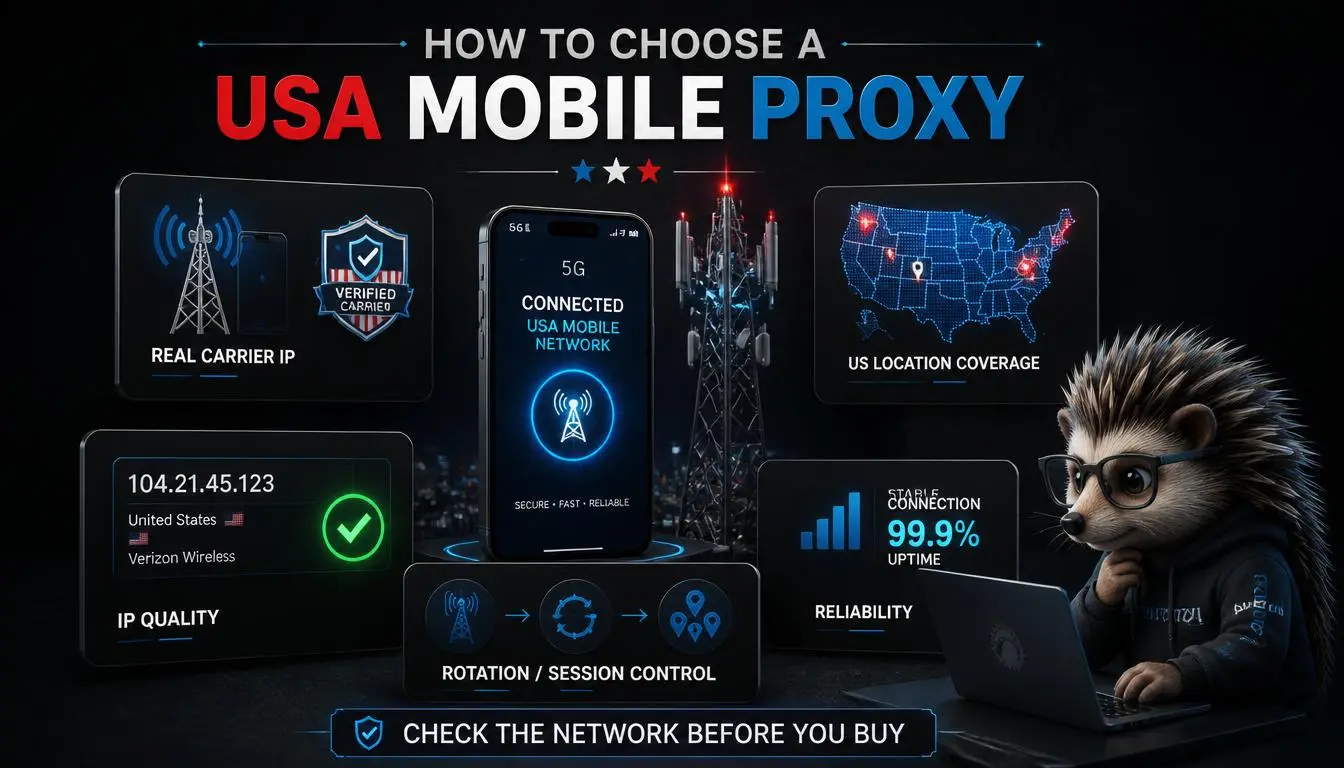
Confirme que o IP é genuinamente proveniente de operadora, não tráfego residencial ou de datacenter renomeado.
Verifique a cobertura real de operadoras dos EUA nos estados ou cidades específicos que você precisa, não apenas uma alegação de "cobertura nacional".
Decida se o seu fluxo de trabalho precisa de um IP dedicado ou rotação genuína, e escolha o plano adequadamente.
Verifique se a largura de banda é realmente ilimitada ou medida por GB, e leia os termos de uso justo de qualquer forma.
Confirme que o método de autenticação e o suporte de API se adequam às suas ferramentas existentes. Teste em pequena escala antes de se comprometer com um plano mais longo ou volume maior.
Problemas comuns com mobile proxies dos EUA
A reclamação mais repetida em avaliações independentes não é sobre velocidades lentas ou preços altos; são provedores vendendo IPs residenciais ou de datacenter renomeados como "móveis".
Duas fontes não relacionadas descrevem o padrão idêntico com palavras diferentes, o que é um sinal mais forte do que qualquer uma isoladamente.
Além disso: preços promocionais "a partir deque não correspondem ao que uma conta real realmente paga (confirmado pelo próprio blog de um provedor, e o comportamento exato pelo qual a FTC multou uma operadora dos EUA em $40 milhões em um contexto similar), cobertura concentrada em um punhado de grandes cidades apesar do marketing decobertura nacional", e velocidades móveis que são inerentemente mais lentas do que conexões de datacenter, o que surpreende compradores iniciantes mais do que deveria.
Erros a evitar com mobile proxies dos EUA
Comprar baseando-se na palavra "móvel" na listagem sem confirmar a origem da operadora.
Escolher 5G por padrão sem verificar a cobertura real nas suas localizações-alvo nos EUA.
Escolher proxies rotativos para um fluxo de trabalho de gerenciamento de contas que realmente precisa de um IP dedicado e estável.
Presumir que qualquer tipo de proxy previne a aplicação de regras da plataforma; isso não acontece, e nenhum provedor legítimo deveria alegar o contrário.
Pular um teste em pequena escala antes de se comprometer com um plano de volume maior.
Vale a pena ter um mobile proxy dos EUA
Para os fluxos de trabalho que este guia cobre: gerenciamento de contas, verificação de anúncios, testes de localização, pesquisa específica dos EUA, sim, um mobile proxy genuíno dos EUA geralmente vale o prêmio sobre alternativas de datacenter ou residenciais, porque o sinal de confiança e o realismo da rede móvel são difíceis de replicar de outra forma.
Para navegação ocasional de baixo volume ou simples desbloqueio geográfico, não vale o custo ou as velocidades mais lentas; um proxy residencial mais barato faz esse trabalho igualmente bem.
Por que o mobile proxy dos EUA da CyberYozh é uma escolha forte
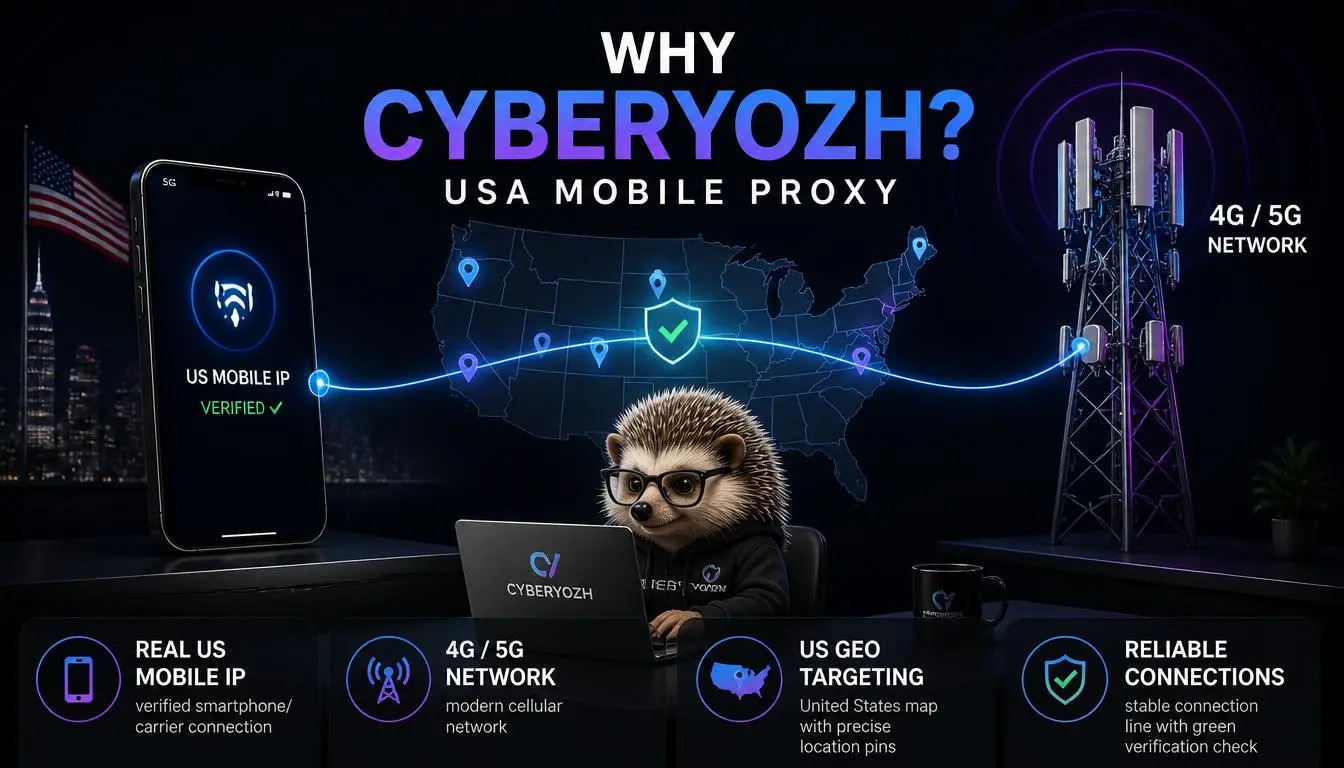
Os planos de mobile proxy dos EUA da CyberYozh funcionam em conexões reais de operadoras 4G/LTE e 5G com uma taxa fixa de $1,70/dia e sem limite de dados, tornando o orçamento previsível independentemente de quanto um fluxo de trabalho transfere.
Enquanto muitos provedores oferecem apenas IPs móveis compartilhados, a CyberYozh fornece IPs de mobile proxy dedicados e privados.
Fornece redes de nível operadora reais, incluindo Verizon, T-Mobilee Vodafone.
A ausência de requisitos KYC e o pagamento em criptomoeda eliminam atritos para equipes que não desejam enviar documentos de identidade apenas para testar um serviço.
Rotação manual ou automática, além de sessões fixas, significa que o fluxo de trabalho controla a consistência da sessão, em vez do comportamento padrão do provedor.
Verificações de reputação de IP e verificação por SMS estão na mesma conta, o que é especialmente importante para quem gerencia múltiplas contas e, caso contrário, precisaria de um fornecedor separado para verificação.
Nada disso torna o CyberYozh a resposta automática para todas as necessidades de proxy móvel dos EUA; uma empresa que executa testes ocasionais de baixo volume pode não precisar de infraestrutura dedicada, e vale a pena adequar o plano ao fluxo de trabalho real em vez de optar automaticamente pela opção mais rica em recursos.
Conclusão
Um proxy móvel dos EUA genuíno justifica seu custo por meio de gerenciamento de contas, verificação de anúncios e trabalho de localização que depende de uma conexão de operadora real; confirme a origem da operadora antes de qualquer outra coisa, pois é aí que este mercado mais frequentemente decepciona os compradores.
Entre os provedores comparados aqui, a combinação do CyberYozh de tráfego ilimitado com taxa fixa, acesso sem KYC e rotação configurável o torna o ponto de partida mais direto; ProxyGuys vale a pena considerar se a cobertura exclusiva dos EUA for a prioridade, e Proxidize é para equipes que desejam controle direto sobre infraestrutura dedicada.
Pronto para testar um proxy móvel dos EUA? Explore as opções atuais de proxy móvel do CyberYozh acima e escolha a configuração que realmente se adequa ao seu fluxo de trabalho.