Ethical Web Scraping Guide 2026: How to Collect Data Without Breaking Rules or Getting Blocked
Years back, on the internet, you could take whatever data you wanted without anyone batting an eye. Those days are long gone.
Today, web scraping has grown up. It is now the backbone of entire industries, e-commerce price monitoring, AI training, marketing analytics, and market research all depend on collecting data from websites. But with that growth has come rules, regulations, and consequences.
Here is the reality: websites have every right to protect their content and their servers. They use legal agreements (Terms of Service) and technical tools (such as robots.txt and rate limiting) to control who can access their data and how.
This guide breaks down ethical web scraping, sometimes called "white hat" parsing, in plain language. You will learn the rules, the risks, and the best practices that keep your projects running undetected while respecting the websites you depend on.
What is white hat scraping
"White hat" scraping sounds technical, but the idea is simple. It means collecting publicly available data from websites in a way that complies with both the website's rules and the law.
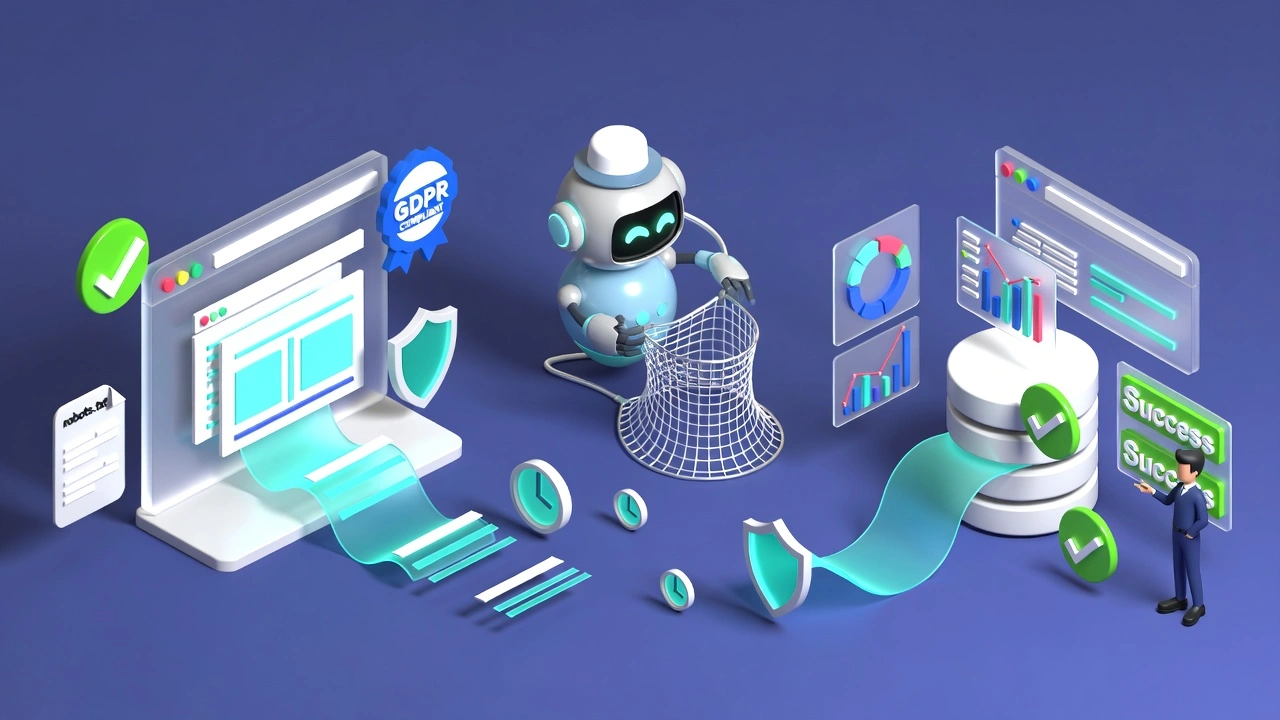
For example its like visiting a friend's house. You are welcome to come over, look around, and enjoy their space. But you would not raid their refrigerator, break their furniture, or invite strangers without asking. Three Principles of Ethical Data Collection:
Principle | What It Means | Example |
Data is public | You only collect information that anyone can see without logging in or having special access. | Product prices on an e-commerce site are public. Private user profiles are not. |
You do no harm | Your scraping activities do not overload the website's servers or ruin the experience for real visitors. | Spacing out requests so the site stays fast for everyone. |
You respect ownership | You collect facts (like prices or specifications) but do not republish protected content like articles or images. | Using competitor prices to inform your strategy is fine. Copying their product descriptions word-for-word is not. |
Important to remember that laws like GDPR in Europe and similar regulations worldwide strictly control how you can collect and use personal information. Scraping email addresses for unsolicited marketing is not just unethical, it is illegal in many places. Stick to factual, non-personal data, and you will stay on solid ground.
Robots.txt: the website's rulebook for bots
Before you write a single line of code, there is one place you absolutely must check: the website's robots.txt file. Every well-maintained website has one. You can find it by simply adding /robots.txt to the end of any domain. For example: example.com/robots.txt
Think of this file as the website's instruction manual for automated visitors, such as your scraper. It tells you exactly what is allowed and what is off-limits. What to Look For in robots.txt:
Directive | What It Means | Why It Matters |
User-agent: * | Rules that apply to all bots | If you see this, the following rules are for everyone, including you. |
Disallow: /admin/ | The /admin/ folder is off-limits | Respect this. Trying to access blocked areas will get you banned fast. |
Crawl-delay: 10 | Wait 10 seconds between requests | This protects the server. Ignoring it will trigger rate limiting. |
Allow: /products/ | The /products/ section is open for scraping | Green light! This is where you can safely collect data. |
Is robots.txt considered a law
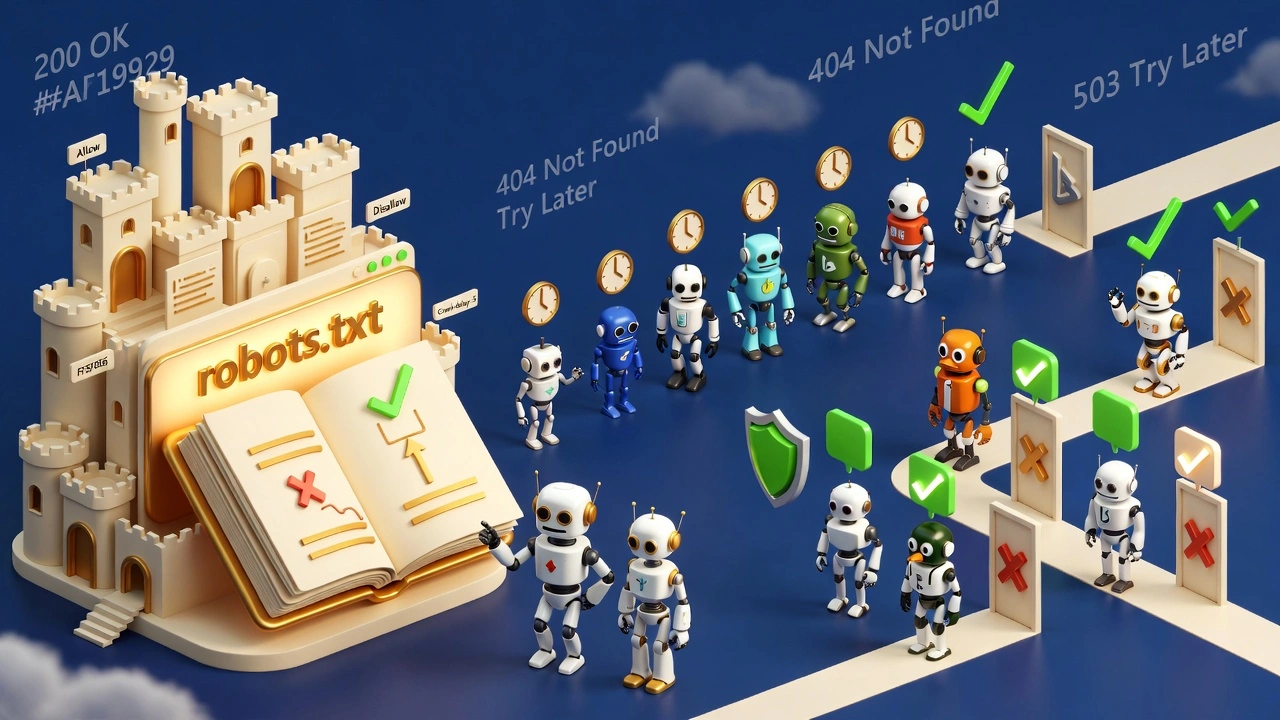
Legally, it depends on your country. Some courts have ruled that ignoring robots.txt constitutes trespassing. But more importantly, it is a technical boundary. Websites monitor for bots that ignore these rules, and they will block you. No robots.txt compliance means no data. Simple as that.
Make sure to identify yourself. When you send requests to a website, you include something called a User-Agent header. It is like a name tag that tells the site who is visiting.
Ethical scrapers use custom User-Agents with contact information. Something like:
MyPriceBot/1.0 (+http://mywebsite.com/bot-info)
This does two things:
It shows transparency, lets them know who you are, and you are not hiding what you are doing.
It gives website administrators a way to reach you if your bot is causing problems. Often, a quick conversation can prevent an outright ban.
Terms of service: the legal fine print
If robots.txt is the technical rulebook, Terms of Service (ToS) is the legal contract. Here is where things get tricky. When you visit a website, especially if you register for an account, you are usually agreeing to its terms.
Those terms often say something like: "You may not use automated tools to access our site." The Two Scenarios are:
Situation | Risk Level | What You Should Do |
| Lower risk | Focus on publicly available factual information, such as prices, product names, and specifications. |
| Higher risk | You agreed to their terms. If those terms forbid automation, you are in violation. Accounts can and will be suspended. |
Famous legal case:The HiQ labs vs. LinkedIn case

There is a famous legal case that every scraper should know. HiQ Labs was scraping publicly available LinkedIn profiles. LinkedIn told them to stop and sent a legal letter. HiQ sued. The court ruled in favor of HiQ, holding that scraping publicly available data does not violate the Computer Fraud and Abuse Act.
This was a huge win for ethical scraping. But notice the key phrase: publicly available data. The ruling does not give you permission to bypass login gates, access private information, or ignore technical protections. If data is open for anyone to see, collecting it is generally acceptable.
Simply, it's better to stick to public data. Avoid logging in. If a website's Terms of Service explicitly forbid scraping, weigh the risks carefully. For most business use cases, such as price monitoring or market research, collecting public factual data is a widely accepted practice.
What is Rate limiting
Imagine you own a small coffee shop. It is cozy and comfortable, and usually has a steady flow of customers. Then one day, someone walks in and orders 1,000 coffees all at once. Your single espresso machine cannot handle it. The line backs up. Regular customers leave frustrated. Your whole operation grinds to a halt. That is what happens when you scrape a website without rate limiting.
Rate limiting means controlling how fast you send requests to a website. Instead of firing off hundreds of requests per second, you space them out as a normal human visitor would.
Why it matters:
Server load: Every request uses the website's resources. Too many, too fast, can crash small sites.
Detection: Websites monitor request patterns. Sudden spikes from one IP address are a huge red flag.
Long-term access: If you overload a site, it will block you. And you lose all your data.
How to do It Right:
Best Practice | Why It Helps |
Add delays between requests (time.sleep() in code) | Mimics human behavior and reduces server load. |
Monitor response codes | If you see 429 Too Many Requests or 503 Service Unavailable, stop immediately and increase your delays. |
Scrape during off-peak hours. | Early mornings or late nights in the site's local time zone put less strain on their servers. |
Distribute requests across multiple IPs | Using proxies (more on this next) spreads the load so no single IP gets flagged. |
Remember to scrape at a pace that would not annoy you if you owned the website. If you do not want someone hammering your server with thousands of requests per minute, do not do it to others.
Proxies: your infrastructure for stable, ethical scraping
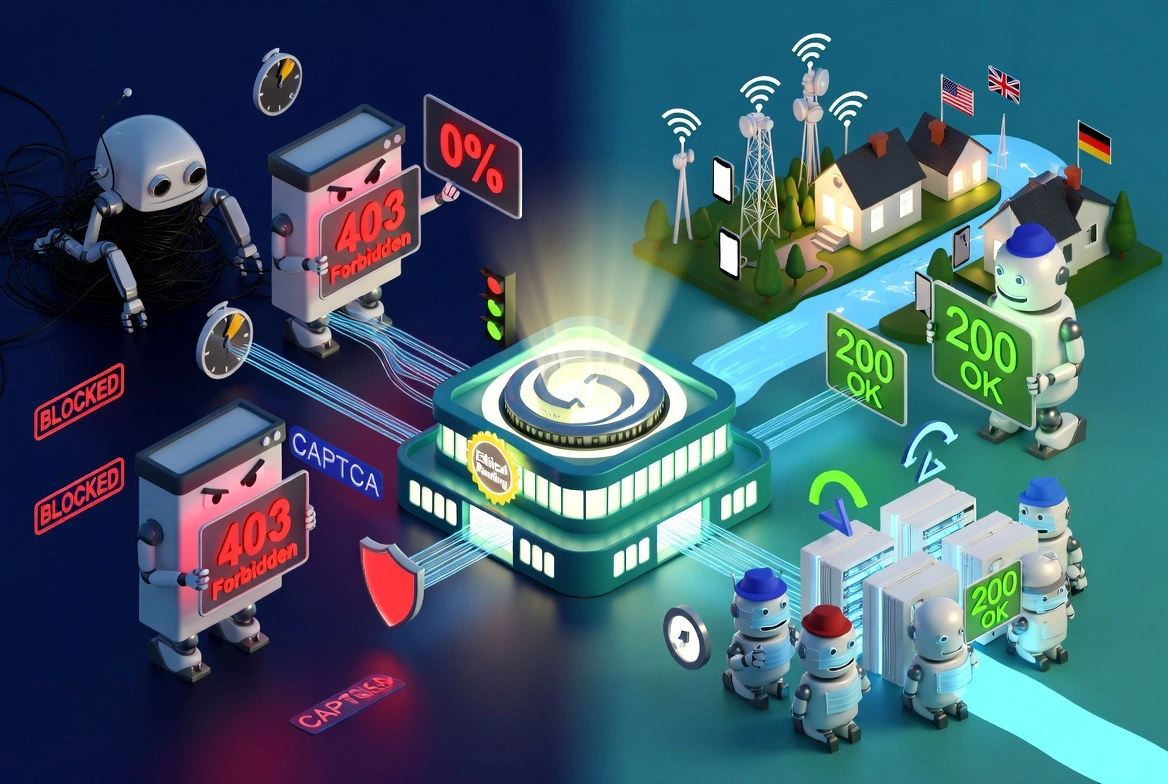
Even when you follow all the rules regarding robots.txt, limiting your rate, and sticking to public data, you might still run into problems. Because websites see lots of requests from the same IP address, you will get your account blocked.
This is where proxies come in. Think of a proxy as an intermediary that routes your requests through different IP addresses. Instead of all your traffic coming from one place, it appears to come from many different users in many different locations.
What's the best proxy type to use:
Proxy Type | Best For | Why |
Datacenter Proxies | Large-scale scraping of open catalogs and basic websites | Fast, affordable, and perfect for high-volume projects where speed matters most. |
Residential Proxies | Getting location-specific data that mimics residential-like traffic. | These IPs come from real home internet connections. They look like normal users and are great for seeing localized search results or prices. Low detection rates. |
Mobile Proxies | Testing mobile versions of websites, scraping mobile-first platforms | IPs come from real 4G/5G carriers. Essential for sites like TikTok or Instagram that prioritize mobile traffic. |
How Proxies help you scrape ethically:
IP rotation: Spreads requests across multiple IPs, preventing any single address from becoming overloaded.
Geo-targeting: See content exactly as it appears in specific cities or countries.
Stability: When one IP gets rate-limited, you rotate to a fresh one and keep going.
How CyberYozh proxies make web scraping legal, safer, and smarter
CyberYozh approaches scraping differently than almost everyone else.CyberYozh gives you everything under one roof. CyberYozh has built a complete toolkit that handles the entire lifecycle of web scraping projects. They offer mobile, residential, and datacenter proxies.
They maintain a pool of over 50 million clean IPs spread across 100 countries. More importantly, they deliver a 99.8% task completion rate. In plain English, that means nearly all your scraping jobs finish without hitting CAPTCHA, without getting blocked, and without the frustration of watching your scripts fail halfway through.
You can integrate CyberYozh directly with the tools you already use. Selenium, Puppeteer, Playwright, Postman, and custom Python scripts all work seamlessly. Their API gives you full control over IP rotation, session management, and all the other technical bits that usually require hours of tinkering with a user-friendly dashboard.
Before you even send a request, you can check whether an IP address has been flagged anywhere. Their IP reputation tools save you from inheriting someone else's ban history. If you need to verify accounts during your scraping workflow, SMS activation and virtual numbers from 140 countries are built right in.
Pricing:
Mobile LTE and 5G Proxies – from $1.7 per day with unlimited traffic
Static Residential ISP Proxies – from $5.29 per month per dedicated IP
Residential Rotating Proxies – from $0.9 per GB
Datacenter Proxies – from $1.9 per month with unlimited traffic
With web scraping, you need to respect the sites you collect from. That means controlling your request rates, rotating IPs intelligently, and never behaving like a malicious bot. CyberYozh gives you the tools to do exactly that. Sticky sessions and controlled rotation let you mimic human behavior rather than hammer servers like a typical scraper. Your projects stay running longer because you are not triggering alarms.
Conclusion
Taking shortcuts might get your data faster today. But it will also get you blocked, banned, or sued tomorrow. Ethical scraping is not about being "nice." It is about being smart. When you respect robots.txt, follow rate limits, and use quality proxy infrastructure, you build a sustainable data pipeline that keeps working month after month. Hence, avoiding suspicion, lawsuits,s and bans.
Frequently Asked Questions
1. Is web scraping legal?
Yes, scraping publicly available data is generally legal in most jurisdictions. The HiQ Labs vs. LinkedIn case established that accessing public information does not violate computer fraud laws. However, scraping data behind login gates, ignoring robots.txt, or collecting personal information may cross legal boundaries. Always check the specific laws in your country.
2. What is robots.txt, and do I have to follow it?
Robots.txt is a file that tells automated bots which parts of a website they can and cannot access. While not always legally enforceable, following it is considered standard practice for ethical scraping. Websites monitor for bots that ignore these rules and will block IPs that violate them. Think of it as respecting a "No Trespassing" sign.
3. How many requests per second is safe?
There is no single number that works for every site. A safe approach is to check the Crawl-delay directive in robots.txt. If none is specified, start with 5-10 seconds between requests and monitor response codes. If you see a 429 Too Many Requests response, slow down immediately. The goal is to collect data without impacting the site's performance for real users.
4. Do I need proxies for web scraping?
For small projects, you might not need them. But for any serious data collection, proxies are essential. They distribute your requests across multiple IPs, preventing any single address from getting rate-limited or banned. They also allow you to view geo-specific content by routing through IP addresses in different locations.
5. What is the difference between datacenter, residential, and mobile proxies?
Datacenter proxies come from cloud servers and are fast and cheap, great for high-volume scraping. Residential proxies come from real home internet connections and appear to be normal users, making them ideal for localized data collection. Mobile proxies come from cellular carriers and are the most trusted essential for mobile-first platforms like TikTok and Instagram.
6. Can I scrape data from sites that require a login?
Technically, yes, but ethically and legally it is risky. When you log in, you typically agree to the site's Terms of Service, which often forbid automated access. Violating these terms can lead to account suspension and potential legal action. Stick to publicly available data whenever possible.
Helpful?
Share article