IPv4 vs IPv6 Comparison: Features, Security, and Proxy Usage
IPv4 and IPv6 are network‑layer Internet protocol (IP) implementations that differ in address size, header format, security, and how they integrate with modern services. IPv6 is designed to replace IPv4 to solve address exhaustion and improve routing and end‑to‑end semantics, but IPv4 is still heavily used across most services. CyberYozh customers need different IP types for different tasks, so let’s explore both protocols, their security implications, and how their proxies are applied in various use cases.
IPv4 vs IPv6: A quick introduction
Every time you see an ordinary IP address, you see an IPv4 address. While IPv6 was first introduced in the late 1990s and finally implemented in the 2010s, most services still use IPv4 for day-to-day operations, while IPv6 may be used as an additional address alongside IPv4. Let’s overview both standards quickly:
IPv4 was first deployed in 1983 and remains the gold standard for Internet routing. Its addresses are 32 bits long, written as four decimal octets separated by dots (such as 192.168.1.1), yielding roughly 4.3 billion unique addresses.
IPv6 was designed specifically to solve IPv4's address exhaustion and modernize the protocol's architecture. It features a 128-bit address space, expressed in eight groups of hexadecimal values (such as 2001:0db8::1), providing a virtually inexhaustible number of addresses (1038 to be clear), while its fixed 40-byte header improves routing efficiency.
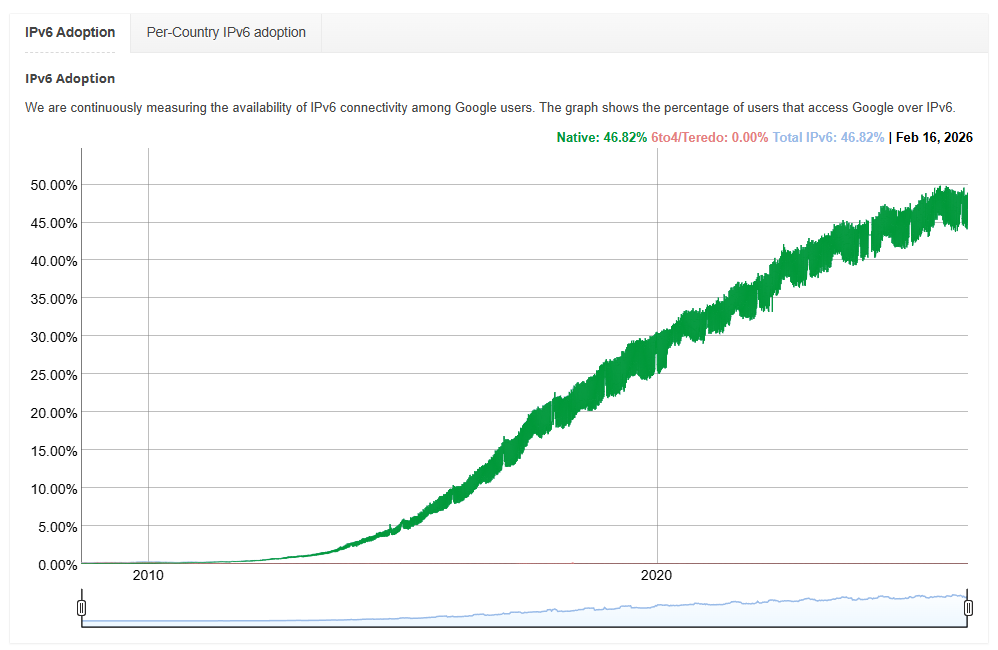
At first glance, IPv6 is better in all perspectives. However, as we’ll see, its adoption is still quite low, and additionally, IPv6 addresses are usually paired with IPv4. According to Google, approximately 45% of Internet traffic runs over IPv6 as of early 2026, and adoption is growing steadily. Most services still prefer IPv4 addresses for authentication, as it’s much easier to assess their trustworthiness given the limited IP address pool.
Read more about checkers and parsers used for working on the Web in CyberYozh’s specialized article.
IPv6 proxy services are usually much cheaper than IPv4 services due to their much larger address space. The protocol’s ongoing development offers significant opportunities for those actively working with Internet data, whether through data scraping or account management. However, for now, many services flag IPv6 addresses as less secure and reliable compared to well-established IPv4. Why is it the case, and what to do with that - let’s explore.
What is IPv4: Well-established IP address standard
To understand the topic deeper, read CyberYozh’s full overview of IPv4 proxies
IPv4 addresses are 32 bits wide, written as four decimal octets (0–255) separated by dots, yielding ~4.3 billion unique combinations. They use headers to provide metadata, such as checksums, sources, identification flags, data type, and so on.
Its specific features include:
Three modes of communication: unicast for standard one-to-one client-server interactions, multicast for one-to-many web streaming, and broadcast for sending data to all connected devices
Router-level fragmentation: if a data packet exceeds the Maximum Transmission Unit (MTU) of an intermediate link, any router along the path can split it into smaller fragments, which can be disabled by the Don't Fragment flag
Despite address exhaustion being declared since 2011, IPv4 remains the majority of global internet traffic due to its mature ecosystem, with many legacy hardware and software supporting only IPv4.
When to use an IPv4 proxy
IPv4 proxies route your traffic through an intermediate IPv4 address, masking your real IP. They remain the default choice for professional proxy use due to universal platform support and mature reputation infrastructure. In other words, when you use a reputable IPv4 proxy, websites won’t block your accounts or access.
How to know whether your proxy’s IP is reputable? Use CyberYozh’s IP Checker!
Let’s explore when the IPv4 proxy usage is highly recommended:
All social media interaction should be performed via an IPv4 mobile or residential proxy, as such platforms have strict anti-bot defenses and usually flag and limit IPv6 connections immediately
Social data scraping from media, e-commerce, and similar websites requires mobile or residential IPv4 proxies, too, as they will limit IPv6 connections for similar reasons
Market research and geotargeting require precise geolocation simulation, so IPv4 proxy servers with defined geolocation are highly preferable over IPv6 here.
Network testing requires simulating real users from different locations, so similarly, IPv4 addresses with precise geolocations are preferred here.
Many services, including various devices and residential/mobile web providers, still don’t support IPv6 at all, so they can only be accessed via IPv4 proxies.
In general, IPv4 remains the gold standard for daily web interactions due to its established reputation and geolocation accuracy. If you are unsure which version to use, always select IPv4.
However, IPv6 still offers several benefits over IPv4, making it a more advanced protocol. Let’s explore situations where it can be used with low or no risk.
What is IPv6: Innovative, but still less trusted
To understand the topic deeper, read CyberYozh’s full overview of IPv6 proxies
IPv6 was redesigned from the ground up to address not only IPv4's exhaustion problem, but its routing inefficiency, lack of native security, and manual configuration overhead. The result is a cleaner, more extensible protocol that trades backward compatibility for architectural correctness. It uses fixed 40-bit headers that make routing faster and more predictable.
Its innovative features include:
Structured address space for various address types, depending on which interfaces they’re assigned to and how they interact with other devices
Fixed primary header with optional extensions to improve request speed and consistency, while specific services may add additional metadata
Pre-defined route aggregation based on the address space structure to optimize communication between various addresses and avoid potential problems
Its structure and fixed header make IPv6 more secure than IPv4. Security issues, however, follow from the lack of a unified reputation score for IPv6 addresses, given their immense range and high anonymity. It determines their limited use cases, especially now that there is no universal security management ecosystem for IPv6.
When to use an IPv6 proxy
IPv6 proxies are not universally unsafe, but they carry specific, well-defined risks, mostly regarding platform trust. Due to the immense number of possible IPv6 addresses, many websites label them as inherently low-trust because they cannot verify them. Still, they have clear, low-risk use cases where their structural advantages outweigh those concerns.
Let’s explore them more closely.
Large-scale web scraping from public datasets and open APIs, including government data, academic studies, news aggregators, and some pricing platforms.
Internal app testing, which doesn’t require simulating real users, can be easily done via IPv6 to efficiently test application behavior.
High-anonymity workflows, including data analysis, OSINT, and other privacy-sensitive tasks, where your web presence must be minimized.
Explicit IPv6 support is implemented by more and more services, so IPv6 proxies are preferred in these cases for their speed and cost-efficiency.
While IPv4 remains the gold standard for the Web, more and more services are adopting IPv6 for its robust technical features. With new security measures and increased adoption, the range of IPv6 use cases will probably grow over the next few years.
IPv6 vs IPv4: A security comparison
The problem is in IPv6's core design: its virtually unlimited address space fundamentally breaks the IP reputation systems that the internet's fraud detection infrastructure is built on. Here is how it works:
Each large, reputable website catalogs IP addresses and assesses their reputation, abuse history, and geolocation tags to ensure they aren’t used for spam or fraud.
With the IPv6 protocol offering an immense 1038 addresses, it’s virtually impossible to track their reputation, so every IPv6 address can potentially be unsafe
This inherent vulnerability is widely used by malicious agents, who rotate IPv6 addresses to get fresh, never-seen addresses and avoid traditional website security protocols
As a result, IPv6 addresses that aren’t associated with corresponding IPv4 addresses are disproportionately flagged as spam by services from Google to Reddit
IPv6 was designed to provide greater anonymity, higher speeds, and new developer features for Web users, but it’s fundamentally incompatible with traditional security measures, such as centralized, reputation-based trust systems. Until new security practices are introduced, IPv6 addresses will continue to be associated with potentially malicious activity, and users will be forced to provide additional verification.
To ensure secure and easy account verification, you can rent a virtual number on CyberYozh for less than $1.
Let’s briefly overview both protocols and explore when each is best to use.
IPv4 proxy vs IPv6 proxy: Comparison table
To understand the differences in IPv4 and IPv6 proxy usage, let’s summarize them in the table below.
Proxy type | IPv4 proxy | IPv6 proxy |
|---|---|---|
Speed | Stable; NAT adds minor latency | Faster; no NAT, direct routing |
Cost-efficiency | Expensive; scarce address supply | Up to 20× cheaper; abundant addresses |
Usage | Dominant; universal platform support | Growing; limited to IPv6-ready targets |
Trustworthiness | High; decades of reputation data | Low; no history, often flagged as suspicious |
Use cases | E-commerce, ads, social media, SEO | Public APIs, bulk scraping, gaming P2P, testing |
Choosing IPv4 vs. IPv6: Decision factors
Nowadays, an IPv4 address acts as your digital passport, not just a connection protocol. That’s why it’s still preferable, despite being inferior compared to IPv6's innovative features. In general, IPv4 must be used for interacting with all services that have solid reputation management (such as social media and large e-commerce services) and have not announced explicit IPv6 support. It also includes legacy services, which cannot support IPv6 connections at all.
IPv4 vs IPv6: Specific use cases
Now, we can explore several specific use cases and learn how IPv4 and IPv6 proxies address these tasks based on their unique characteristics.
Web scraping
When IPv4 is better: IPv4 residential and ISP proxies remain the standard for scraping high-value targets: e-commerce platforms, social networks, and job boards. These sites run mature fraud detection tools that treat IPv4 addresses as trusted by default, backed by decades of geolocation and reputation data. With city-level geo-targeting and established session history, IPv4 proxies deliver the compatibility and trust scores that high-sensitivity scraping requires.
When IPv6 is superior: For large-scale, high-volume scraping of IPv6-native or lenient targets, including search engines, news aggregators, public APIs, and financial data feeds. Providers offer pools of multiple IPv6 addresses at a fraction of IPv4 pricing, enabling rotation that makes per-IP blocking essentially impossible. Fresh IPs with zero abuse history also achieve higher success rates on targets that haven’t used IPv6 blacklists.
Gaming and entertainment
When IPv4 is better: For interacting with online gaming platforms with account systems, including Steam, PlayStation Network, Xbox Live, and Riot Games. These platforms use IP reputation scoring and behavioral analysis to detect account fraud, andIPv6 addresses from an unknown range trigger instant suspicion. IPv4 proxies with known ISP attribution provide the stable, trusted identity needed for account longevity and consistent region-based matchmaking.
When IPv6 is superior: For raw network performance and P2P gaming, IPv6 is technically superior. It enables direct device-to-device connections, drastically reducing latency. IPv6 routing is less congested than IPv4, regularly reducing ping from triple-digit to double-digit values. Additionally, for streaming geo-restricted content, IPv6 proxy rotation across a massive address pool effectively avoids throttling and IP bans.
SEO, marketing, and advertising
When IPv4 is better: Ad verification, rank tracking, and localized SERP monitoring demand IPv4 proxies with accurate, city-level geolocation. Google Ads, Meta Ads, and affiliate networks actively flag IPv6 traffic as high-risk, and accounts that use it face restrictions or suspension. For SEO rank checkers and competitive intelligence tools monitoring regional search results, only IPv4 residential proxies provide the geolocation fidelity and platform trust these workflows need.
When IPv6 is superior: For high-frequency ad click simulation, traffic quality testing, and large-scale SERP scraping on dual-stack search infrastructure, IPv6 proxies provide near-unlimited fresh addresses at low cost, avoiding IP exhaustion. Where the goal is raw volume, such as simulating visits, testing CDN caching behavior, or crawling search indexes, IPv6's superior performance and cost-efficiency make it the better choice when the target infrastructure supports it.
Multi-Account Management
When IPv4 is better: Multi-account operations on any platform with serious fraud controls, such as social media and marketplaces, require IPv4 proxies, ideally mobile or residential. Platforms like LinkedIn, Reddit, Facebook, and Amazon cross-reference IP reputation, ASN history, and prior account associations. IPv4 proxies from reputable ISP ranges carry the "organic user" signal that keeps accounts alive, while IPv6 ranges trigger immediate linking detection and bans.
When IPv6 is superior: For managing accounts on IPv6-friendly or newer platforms with less aggressive detection, including developer portals, SaaS accounts, research tools, or internal business dashboards. IPv6 proxies provide a large pool of unique, unlinked addresses with high request speed. Combined with antidetect browsers, it’s a highly effective approach for specialized platforms that don’t ban IPv6 addresses.
Wrapping up
IPv4 remains the gold standard for tasks that require platform trust, geolocation accuracy, or compatibility with legacy services. Whenever you interact with social media, ad platforms, e-commerce sites, or account management workflows, IPv4 residential or mobile proxies are the safe, reliable default, recognized and trusted by every fraud detection system on the internet.
Still, IPv6 is the better choice when scale, speed, and cost efficiency matter more than platform reputation. For bulk scraping, internal testing, high-anonymity research, and IPv6-native services, its vast address pool and lower latency deliver a clear advantage. As adoption grows and security infrastructure matures, IPv6's range of viable use cases will expand, and it’ll likely become the new standard for web service communication in the coming years. CyberYozh provides both IPv4 and IPv6 addresses for any need, so sign up now and select those that suit you.
FAQ about IPv4 vs. IPv6
Is IPv6 faster than IPv4 for browsing?
IPv6 is generally faster than IPv4 for browsing because it eliminates NAT and uses a fixed 40-byte header that improves routing efficiency. In IPv4 vs IPv6 speed tests, IPv6 shows measurably lower latency on dual-stack networks and modern infrastructure.
Why does IPv6 use hexadecimal notation instead of decimal?
IPv6 addresses are 128 bits long — far too large to express as readable decimal octets like IPv4. Hexadecimal notation compresses this into eight groups, making the IPv6 address format shorter, more structured, and practical for routing systems.
Does NAT slow down IPv4 connections compared to IPv6?
Yes, NAT is a core IPv4 limitation that adds translation overhead to every connection, introducing minor but measurable latency. IPv6 eliminates NAT entirely by providing a virtually unlimited address space, enabling direct device-to-device routing and faster, cleaner connections.
Is IPv6 more secure than IPv4?
IPv6 has IPsec built in natively, unlike IPv4, where it is optional, making the protocol architecturally more secure. However, in practice, IPv6 addresses are widely flagged as suspicious because reputation-based fraud-detection systems cannot effectively track their massive address space.
Can IPv6 be hacked or spoofed more easily than IPv4?
IPv6's immense address pool makes traditional IP reputation scoring nearly impossible, which malicious actors exploit by rotating fresh IPv6 addresses to bypass security filters. This makes IPv6 traffic disproportionately flagged — not because the protocol itself is weaker, but because trust infrastructure hasn't caught up.
Why are IPv6 proxies cheaper than IPv4 proxies?
IPv6 proxies are significantly cheaper — up to 20× less than IPv4 — because the IPv6 address space is virtually inexhaustible, removing the scarcity that drives up IPv4 proxy pricing. Providers can allocate massive IPv6 proxy pools at low cost, making them ideal for high-volume scraping and bulk tasks.
How widely is IPv6 adopted today?
According to Google, approximately 45% of global internet traffic now runs over IPv6, and adoption continues to grow steadily. However, most services still prefer IPv4 for authentication and account management due to its established reputation infrastructure and universal platform support.
Can IPv4 devices communicate with IPv6 servers?
IPv4 and IPv6 are not directly compatible, but dual-stack networks allow devices to run both protocols simultaneously, enabling communication across both standards. Transition mechanisms like NAT64 and tunneling also bridge the IPv4 vs IPv6 addressing gap for legacy hardware and services that cannot support IPv6 natively.
What challenges do businesses face when using IPv6?
The biggest challenge is that IPv6 addresses lack a unified reputation score, causing platforms like Google, Reddit, and social media to flag IPv6 traffic as potentially malicious. Businesses also face compatibility issues with legacy systems and must pair IPv6 with IPv4 for tasks requiring geolocation accuracy or platform trust.
Helpful?
Share article