
Mindrift AI: How Domain Experts Turn Freelance Into AI Training Income

TL;DR
Mindrift (now running Toloka's annotation work too) pays $15-$100+/hr for AI training tasks, no ML background required, just domain expertise.
Fixed rate shown before every task, twice-monthly payouts via Payoneer or Tipalti, no employment contract
Best fit: writers, editors, domain specialists (law, medicine, code, finance), and anyone wanting flexible remote income alongside other work
A stable, private connection matters more here than most gig platforms realize; NDA-protected project content and long task sessions both benefit from a proxy that doesn't drop or get flagged.
Quick Answer: Mindrift is Toloka's project-based platform where contributors earn $15-$100+/hour training AI models by writing prompts, evaluating responses, and contributing domain expertise, no coding required. It fits freelance writers, editors, and subject-matter specialists best, pays twice monthly, and works alongside other freelance income rather than replacing it.
Freelancing income is usually inconsistent; you chase clients, negotiate rates, and wait on invoices. Mindrift structures that differently: tasks are pre-priced, instructions are fixed, and payouts run on a schedule. For contributors with real domain expertise, that structure translates into some of the higher effective hourly rates available in the AI-training gig space.
Here's what the platform actually offers, who it fits, and what a stable technical setup adds to the picture.
What Mindrift AI is and who it's for

Mindrift AI is Toloka's freelance AI-training platform; as of 2026, Toloka's own annotation work runs through the same system, giving contributors one dashboard instead of two. You're an independent contractor: no fixed hours, no employment relationship, and you're free to work other platforms (Appen, TELUS Digital, OneForma) at the same time.
Domain specialists: law, medicine, finance, physics, linguistics- command the highest per-hour rates, since expertise is the product being sold.
Writers and editors: build and refine the prompts, dialogues, and reference answers models are trained against.
Career-transition professionals: often find Mindrift a way to monetize prior industry experience without re-entering that field full-time.
Students and part-time workers: use All-Access tasks, open to everyone, no qualification gate, to earn flexibly around a class or work schedule.
Read more about janitor AI and alternatives for janitor AI
Pro Tip: All-Access tasks are the fastest way in with zero waiting. Specialized, higher-paying projects unlock once you pass domain-specific qualification quizzes; it's worth doing early if you have relevant credentials sitting idle.
5 Ways Mindrift AI makes freelance AI work pay off
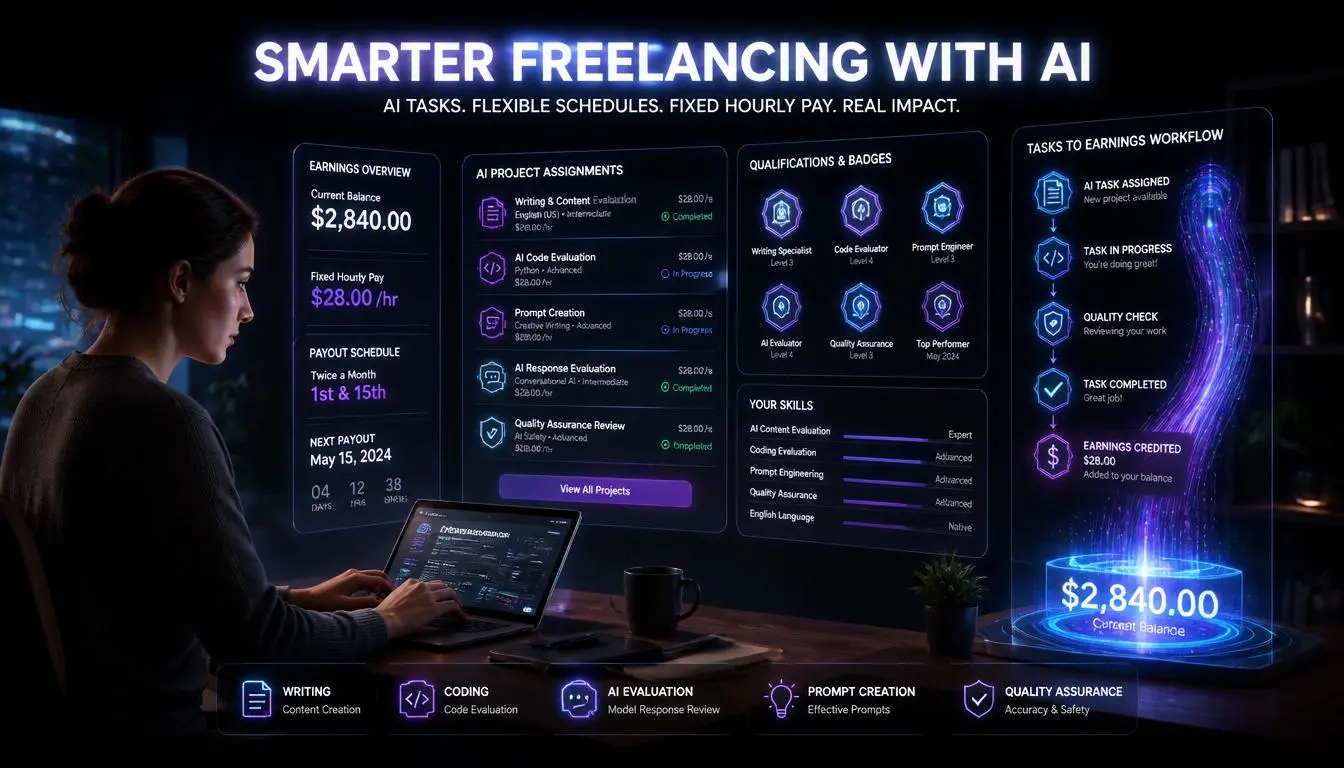
1. Fixed pay shown before you start
Every task displays its reward upfront, no scope creep, no chasing an invoice after the fact. Reward scales with project complexity and required expertise.
2. Domain expertise pays more without needing ML skills
You don't need a machine learning background. A physics PhD, a practicing attorney, or an experienced technical writer is exactly the profile Mindrift needs; your subject knowledge is the qualification.
3. Multiple engagements are explicitly allowed
Mindrift doesn't require exclusivity. Combining it with Appen, TELUS Digital, or OneForma to smooth out income across platforms is standard practice among contributors, not a workaround.
4. Structured onboarding reduces guesswork
Assessments confirm fit before you start paid work, and each project ships with clear instructions and examples, fewer wasted attempts, and faster ramp-up to your first approved task.
5. Predictable, twice-monthly payouts
Payment runs through Payoneer or Tipalti (PayPal) on a fixed schedule for approved work, a meaningfully different experience from platforms where payment timing depends on when a client gets around to it.
Read more about multiple PayPal accounts.
Keep payments separate from your main account. Issue a virtual card with CyberYozh in seconds, instant issuance, region-matched cards, and full control over limits.
Common Mistake: Treating the identity verification step as optional friction to skip past quickly. It's a one-time gate that protects your account long-term; rushing it or providing mismatched details is the most common reason applications stall.
Real use cases of Mindrift AI
Task Type | What It Involves |
Prompt & dialogue creation | Writing realistic prompts and multi-turn conversations a real user might send |
Response rewriting | Producing the "ideal" version of an AI draft, the benchmark the model is trained toward |
Domain expert review | Evaluating technical accuracy in specialized fields (law, medicine, code, finance) |
Quality/QA review | Checking other contributors' submitted work against project rubrics |
AI Artist projects | Visual art evaluation and generation tasks, priced per accepted piece |
Pros and cons of Mindrift AI
Cons:
Project availability isn't guaranteed and depends on client demand · Rates vary meaningfully by domain and region · Approval timelines vary during high-volume periods · Higher-paying specialist projects require qualification first
Pros:
No employment contract or fixed hours · Fixed rate visible before every task · No cost to join · Works alongside other freelance platforms · Structured onboarding with real support (QAs assigned to projects) · Strong country coverage relative to similar platforms
Pricing and earning structure in Mindrift AI
Role Type | Typical Pay |
Generalist creator (higher cost-of-living countries) | $15-30/hr |
Generalist creator (lower cost-of-living countries) | $5-15/hr |
Domain specialist | $30-60/hr |
Math/code specialist (US/UK) | $40-70/hr |
AI Artist | Priced per accepted piece |
Expert Insight: The gap between generalist and domain-specialist pay is the widest lever most contributors leave unused. If you have a professional credential, even one you're not using day-to-day, qualifying for a specialist project category is usually worth more than logging extra hours on generalist tasks.
The eligibility reality check
Every project listing carries a country-eligibility tag, and applicants complete a secure identity check before starting paid work, standard practice for a platform handling contractor payments across dozens of countries.
Worth being upfront about: this check exists specifically to confirm your application details match your real location, so a proxy or VPN has no legitimate role in that step.
Where a proxy does matter is everything that comes after you're verified, which is what the rest of this guide covers.
Setting up a proxy for the first time? Run a quick IP reputation check with CyberYozh's fraud-score checker before you rely on it for verified account work; it confirms the IP is clean before you attach it to anything that matters.
Trends shaping the AI training gig market
Demand for structured, human-reviewed training data keeps climbing as model developers compete on response quality, not just scale, a trend that favors platforms built around domain expertise over generic micro-tasks.
Remote-first contributor pools are also becoming the norm rather than the exception, and clients increasingly expect precise, rubric-matched output over volume.
Platforms like Mindrift, built around qualification and structured review rather than open bidding, are positioned to benefit from both shifts.
How CyberYozh proxies support remote Mindrift work
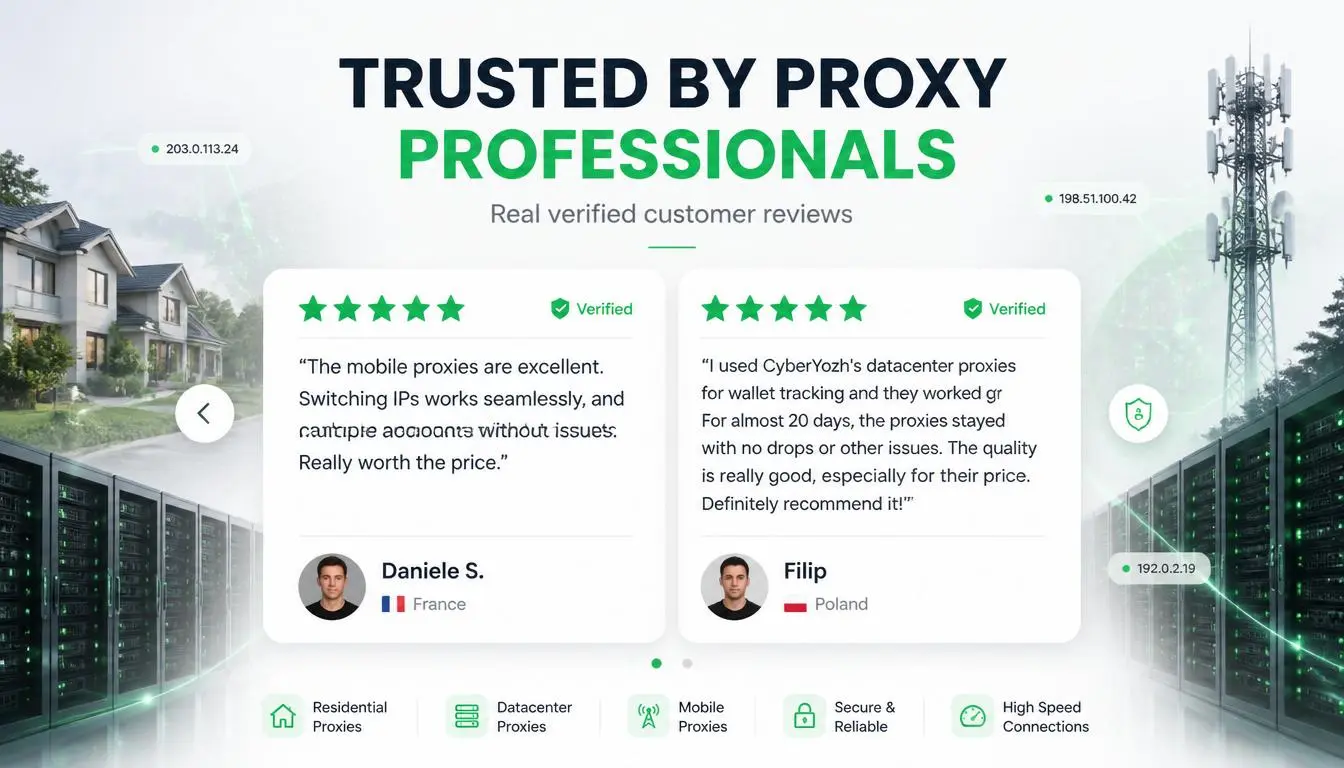
Contributors depend on stable, private access more than most gig work requires, for two reasons that have nothing to do with the platform itself: long task sessions where a dropped connection costs you mid-task, and NDA-covered project content that shouldn't be handled on open networks.
Stable sessions: A dedicated LTE/5G mobile or static ISP residential proxy holds a single IP for the duration of a work session, no mid-task resets from a rotating connection.
Secure access from any location. Contributors who travel, work from cafes, or share a house network get a private, consistent connection instead of relying on whatever open wifi happens to be available. CISA's guidance on public Wi-Fi is direct about the risk here: open networks aren't secure by default, which matters when the material on your screen is under contract.
Consistent location signal. One dedicated IP tied to your account avoids the erratic home-hotel-hotspot pattern that can read as suspicious activity on an already-verified account.
Simple setup. Configuration runs through a dashboard, not scripts, relevant given most Mindrift contributors are writers and domain experts, not developers.
CyberYozh's dedicated mobile proxies start at $1.70/day with unlimited traffic, and static ISP residential proxies start at $5.29/month, both built on real carrier and ISP IP ranges rather than datacenter blocks or consumer VPN exit nodes that platforms increasingly flag.
CyberYozh holds a 4.7 "Excellent" rating on Trustpilot, with reviewers frequently noting responsive support for first-time proxy setup, relevant if you're configuring one for the first time and aren't looking to become a networking expert to do it.
Warning: None of the above solves the eligibility-tag question from the section above. A proxy improves connection stability and privacy; it shouldn't be used to make your application appear to originate from a country you don't actually reside in.
Doing sensitive AI training work remotely? Check out CyberYozh proxy catalogue from $1.70/day for a stable, private connection, rated 4.7 "Excellent" on Trustpilot.