Price Discrimination: How Airlines and Hotels Hike Prices Based on Your IP Address (and How to Get Around It)

Roman

May 06, 2026

General

Price Discrimination: How Airlines and Hotels Hike Prices Based on Your IP Address (and How to Get Around It)
Internet
Security

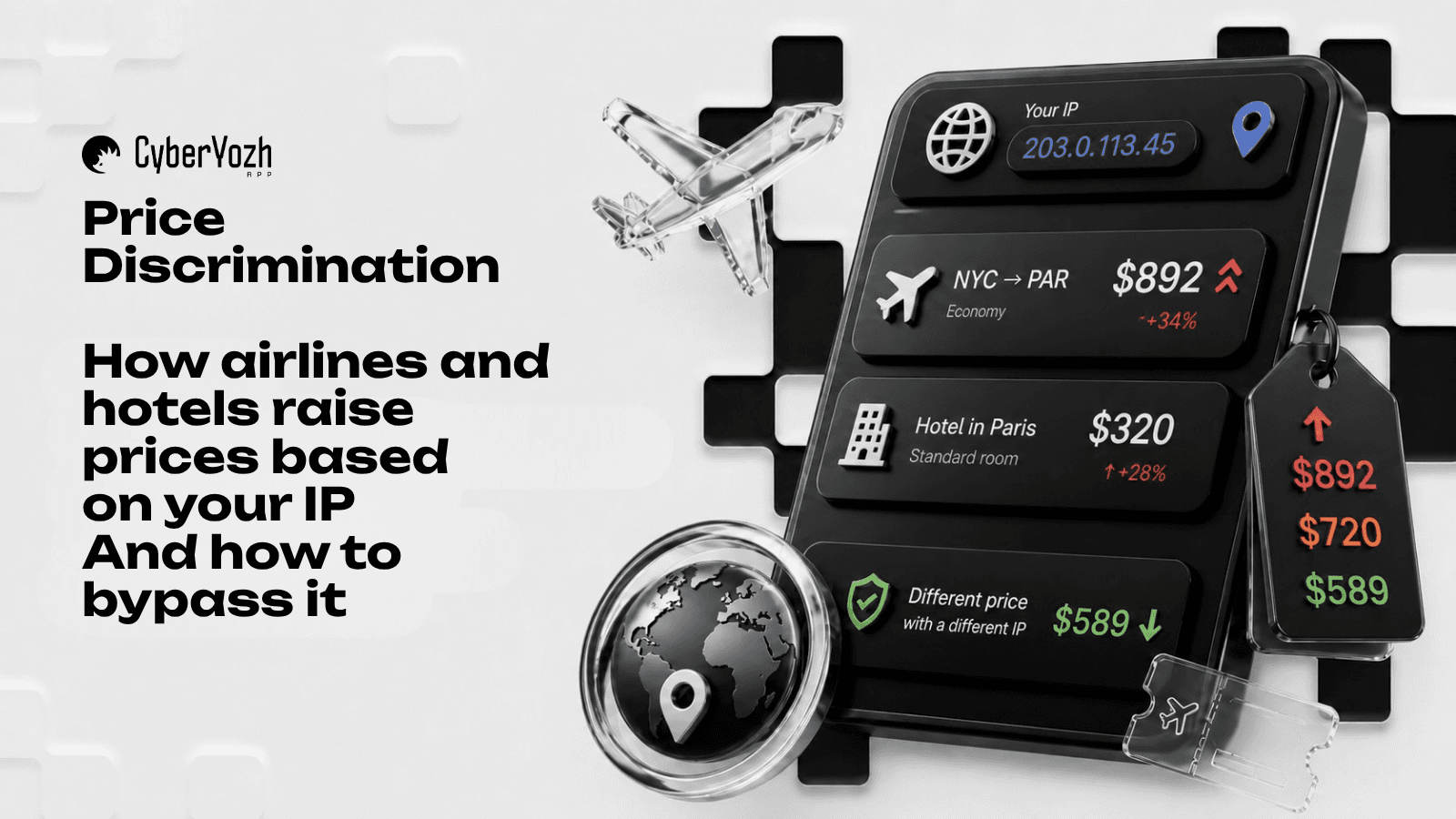
Imagine a familiar situation: you are planning a vacation, find the perfect flight or hotel room, but decide to think it over until evening. A couple of hours later, you return to the same site to make a booking and discover that the price has increased by 15%. Panicked, you buy the ticket, thinking that seats are running out.

In reality, the seats haven't gone anywhere. You have become a victim of algorithmic pricing — a system that analyzes your digital footprint and shows the price that, according to its calculations, you are willing to pay.

In this article, we will take a detailed look at how travel aggregators and airlines use your IP address, search history, and even your smartphone brand to inflate prices, and how modern privacy tools help restore fair rates.


How do price discrimination algorithms work?

Price discrimination in e-commerce is a legal marketing practice where the same product is sold to different buyers at different prices. In the travel industry (travel segment), this technology has been brought to perfection.

The algorithms of airlines and hotel chains collect your digital profile in milliseconds. Here are the three main factors that give you away to the system:

1. Your IP Address (Geographic Link)

An IP address is your digital home address. From it, a website instantly determines your country, city, and sometimes even your neighborhood.

  • How it affects the price: Standards of living and average incomes vary across regions. If the algorithm sees that you are booking a hotel in Southeast Asia while being in Western Europe or North America, the base price for you will be automatically multiplied. The system assumes: since you live in a country with a strong economy, you can afford to pay more.

  • Point of Sale: Prices for domestic flights are often lower for local residents. If you buy a ticket for a local airline in Latin America while on another continent, the fare for "foreigners" will be significantly higher.

2. Cookies and Search History

If you have searched for a ticket on the “Paris – Tokyo” route three times in the last two days, the aggregator stores this information in your browser's cookies.

  • How it affects the price: The algorithm understands that you are highly interested in this trip and are likely tied to specific dates. Artificial scarcity is created: the price increases to push you toward an impulsive purchase out of fear of further price hikes.

3. Device Fingerprinting

Websites see which device you are using to access them.

  • How it affects the price: Marketers have long noticed a correlation: owners of premium devices (for example, the latest iPhone or MacBook models) are statistically willing to spend more. In some cases, hotel search results for such users are sorted by default starting with more expensive options, and base rates are recalculated with a markup.


How to get a fair price: protection methods

To avoid overpaying and see the real market value of tickets, you need to "reset" your digital profile in the eyes of the aggregator.

Step 1. Browser Isolation

The standard “Incognito” mode is often insufficient, as it only hides local history, while your IP address and device fingerprint remain the same. Professionals use antidetect browsers, which allow you to create a completely clean virtual profile (a new identity for the internet).

Step 2. Spoofing Geolocation via Proxy

This is the most important stage. You need to make the website believe that you are in another country (for example, the destination country or a region with a lower income level). To do this, proxy servers are used, which pass your traffic through themselves, replacing your real IP address with their own.


Which proxies to choose for buying tickets?

It is important to understand that large airlines use advanced anti-fraud systems. If you try to use a free public server, the site will recognize the spoofing and may block access or issue an error during payment.

Within the CyberYozh App ecosystem, there are tools perfectly suited for analyzing regional prices and protecting against price discrimination:

  • Residential Proxies (SOCKS5 and HTTP)

    This is the gold standard for price monitoring. Residential proxies are IP addresses of real home internet service providers. If you choose a residential proxy in India or Argentina, the airline's website will see you as a regular local resident sitting at home with a laptop. This allows you to access the most favorable local rates.

    👉 You can read more about residential proxies here

  • Mobile Proxies (SOCKS5 / HTTP / VPN Access / VLESS / Xray)

    The most reliable class of IP addresses. These are addresses of real cellular operators. Mobile network technologies are designed so that thousands of real smartphone owners use one address simultaneously. Booking sites never block mobile IPs, ensuring you 100% trust from the system.

    👉 You can read more about mobile proxies here

  • Datacenter Proxies (HTTP)

    Available in static dedicated and Shared versions. They are cheaper and provide high speed, but we recommend using them more for basic surfing and working with less demanding platforms, as advanced aggregators can identify their belonging to data centers.


Conclusion

Algorithmic pricing is a harsh reality of the global market. Corporations invest millions of dollars in tracking technologies to maximize their profits at your expense.

However, the rules of the game can work both ways. Treat ticket purchases and hotel bookings like market research. Regularly clear your cookies, use high-quality residential or mobile proxies from CyberYozh App to check regional rates, and you will never again be a victim of unjustified markups.