
TikTok Shadowban: Why It Happens, How to Fix & How To Avoid It in 2026
You posted a video that should have popped off. Instead, it stalls at 127 views. Your next one: 89. Then 54. Meanwhile, your FYP traffic flatlines below 5%.
The platform applies suppression based on clear content, behavior, and technical signals. Most creators blame their content — but the real trigger is often unstable behavior or a broken setup.
Here’s what you need to know: over 40% of accounts that experience a sudden view drop are actually shadowbanned, not suffering from bad content. TikTok just stopped showing your videos to anyone who doesn’t already follow you.
In this guide, you’ll learn:
How to know if you are shadowbanned on TikTok (with a quick TikTok shadowban test)
The real TikTok shadowban causes behind sudden engagement drops
A step-by-step TikTok shadowban fix and recovery process that works
How to avoid TikTok shadowban using stable setups, proxies, and account handling.
TL;DR
A TikTok shadowban limits your reach by removing your content from the For You Page (FYP).
Most shadowbans are triggered by content violations, suspicious behavior, or technical signals like IP reputation and session inconsistency.
You can remove a TikTok shadowban by pausing activity, cleaning flagged content, and rebuilding trust with controlled posting.
Long-term prevention depends on stable account environments, including using a TikTok proxy, natural behavior patterns, and high-trust infrastructure.
What is a shadowban on TikTok?
A TikTok shadowban is a form of account suppression where TikTok limits your content’s visibility on the For You Page (FYP). It causes a sudden drop in views and engagement without notifying the user.
How to check shadowban on TikTok
TikTok doesn’t notify you about a shadowban. You detect it by how distribution behaves across multiple posts, not by a single drop in views.
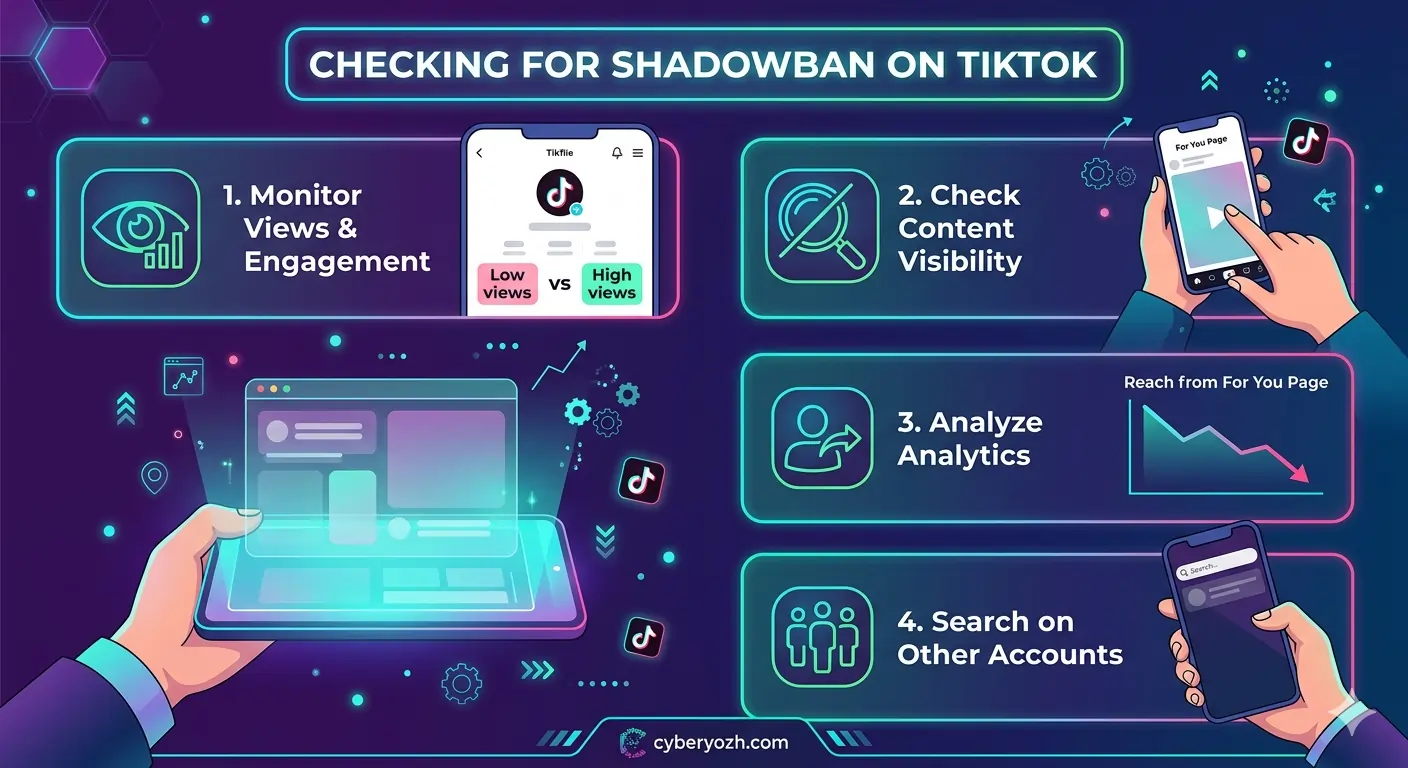
Every video on TikTok is pushed through test batches. If your account is flagged, distribution consistently fails at the same stage — even when content quality is fine.
Quick TikTok shadowban test
If you wonder “Why did my TikTok views drop suddenly?” run this once. It’s enough to confirm suppression:
Post a clean video (no risky topic, no spammy hashtags)
Wait for 30–90 minutes
Open analytics and check traffic sources.
What normal distribution looks like:
60–90% of views from For You Page
Views continue growing after initial push.
What shadowban looks like:
FYP traffic below ~5–10%
Views stall in the 50–200 range
No second distribution push.
👉 If this repeats across 2–3 posts, you’re not dealing with content quality. These are clear signs of suppressed distribution.
Core signals of a shadowban
After the TikTok shadowban check, watch out for these signals. They reflect where the distribution pipeline breaks:
Distribution stops after the first batch. TikTok typically tests content on ~50–200 users; shadowbanned accounts fail to move beyond this stage
FYP traffic collapses. Your videos stop reaching non-followers almost entirely, regardless of engagement
Hashtag indexing fails. Your video either doesn’t appear under hashtags or is buried beyond visibility
Reach becomes follower-only. All engagement comes from the existing audience, not new discovery.
Advanced TikTok shadowban signals (account-level suppression)
TikTok shadowbans are often account-level, not content-level. Look for:
Consistent caps across different videos. Different content reaches the same performance ceiling (e.g., ~100–300 views)
Delayed suppression. The first video performs well, next 1–2 get throttled. It signals the trust score drop, not content issue.
No recovery with “clean” posts. Even safe content fails to restore distribution.
Cross-account inconsistency. The same video performs normally on another account. This check confirms the account-level flag, not the content issue.
When it’s not a shadowban
Most drops are just weak distribution, not suppression. You can tell by how the system reacts next:
A bad video dies — the next one can still take off
Low retention kills reach, but doesn’t cap future posts
Missed timing reduces views, but distribution still happens.
The difference is simple. Normal behavior fluctuates. Shadowban behavior locks the distribution at the same level. If every post hits the same wall, regardless of content,
you’re dealing with restricted reach at the account level.
What causes a TikTok shadowban
TikTok doesn’t “shadowban” based on a single mistake. What you’re seeing as a shadowban is the result of distribution being restricted after the system loses trust in your account signals. That trust is calculated across three layers: content quality, behavioral consistency, and environment stability.
1. Content signals: where distribution starts breaking
Every video is evaluated on first exposure. If TikTok detects low-quality or risky patterns repeatedly, it reduces how aggressively your content is distributed. The most common triggers:
Borderline guideline violations — content that isn’t removed, but sits close to moderation thresholds (sensitive topics, flagged niches)
Low originality signals — reposted clips, stitched content without transformation, or formats saturated across the platform
Hashtag misuse — stacking trending tags that don’t match the content, or repeating hashtag sets across posts
Retention drops — videos that consistently lose viewers in the first seconds, signaling low value. According to TikTok moderation data, accounts flagged as "low quality" often never receive a formal strike but see all views from the For You Page set to zero.
Example: A creator posts a stitched video with trending music and repeated hashtags. The first batch gets 80 views, but after 30 minutes, the video stops receiving new impressions. FYP traffic falls below 10%, even though engagement from followers is normal. TikTok sees the content as low-originality, so it stops scaling further.
2. Behavioral signals: the biggest source of suppression
Most shadowbans are not content-driven. They come from how the account behaves over time. TikTok, just like other social media platforms, expects accounts to follow relatively stable usage patterns. High-risk behaviors include:
Posting bursts — uploading multiple videos within short timeframes after periods of inactivity. Publishing 10 clips per day or mass liking and commenting is interpreted by TikTok as bot engagement
Sudden scaling — going from low activity to aggressive posting within a day
Artificial engagement patterns — spikes in likes, follows, or comments that don’t match historical averages
Mass actions — rapid sequences of follows, likes, or interactions across many accounts.
These don’t trigger immediate bans. Instead, TikTok quietly reduces reach by limiting how far your content is distributed beyond the first audience batch.
Example: An account that normally posts once per day suddenly uploads 5 videos in 2 hours. Likes and comments spike artificially, with engagement rates tripling compared to previous posts. The system flags this as inconsistent behavior, and the next two videos reach only 50–120 FYP views instead of the usual 1,000+. Distribution is throttled until activity returns to normal.
3. Environment signals
This is critical if you’re running multiple accounts or doing any form of scaling. TikTok evaluates the origin and consistency of your connections, not just your content. Key risk factors:
Low-trust IP ranges — especially datacenter proxies that are flagged or reused
Multiple accounts from the same IP — creates clear linkage between accounts
Frequent IP switching — rotating locations between sessions without continuity
Geo inconsistency — when there’s no match between IP location, content targeting, and audience
Ignoring the warming – aggressive posting without a warming protocol is flagged as a high-risk entity, triggering restrictions as the activity pattern matches spam scripts.
From TikTok’s perspective, this looks like coordinated activity or account farming.
Example: Two accounts log in from the same datacenter IP range simultaneously. Each posts a video targeting the same trend. Both videos get less than 150 impressions in the first hour, whereas the same content on separate residential IPs gets over 1,000 views. TikTok links the accounts through the shared IP and reduces their reach.
4. Session and device consistency: silent trust killers
Beyond IPs, TikTok tracks how stable your sessions are over time. Accounts that maintain consistent device and session behavior build trust. Accounts that don’t lose distribution weight. Common issues:
Logging in from different devices frequently
Inconsistent device fingerprints between sessions
Using new environments for every login
Running multiple accounts without proper isolation.
These signals accumulate quietly. You won’t notice anything at first, until your reach starts getting capped across multiple posts.
TikTok controls reach by adjusting distribution, not visibility. Instead of banning you, it limits the size of your initial test audience and prevents distribution. This is what you experience as a shadowban. Until these signals are fixed, content quality has no impact on reach.
How long does a TikTok shadowban last?
A TikTok shadowban isn’t time-based. It lasts as long as the signals behind it stay unchanged. In practice, you’ll see it fall into one of these patterns:
24–72 hours (short-term). Usually triggered by a single issue like borderline content or hashtag spam. One or two posts stall around 50–150 views, FYP traffic drops below ~10%. The next clean upload restores normal reach.
7–14 days (behavioral). It’s caused by posting bursts or sudden engagement spikes. Multiple posts get capped around 100–300 views, with no second distribution push even when content is solid.
2–4+ weeks (persistent). This shadowban is driven by deeper trust issues such as low-quality IPs, shared infrastructure, or unstable sessions. Videos stall below 100–200 views, FYP traffic stays near zero, and recovery doesn’t happen until the setup is fixed.
The key point is that shadowbans don’t simply expire. If the same inputs remain (in content, behavior, or environment), TikTok keeps limiting distribution.
How to fix a shadowban on TikTok: A step-by-step guide
A TikTok shadowban is fixed by removing the signals that triggered it and restoring consistent, low-risk account behavior.
Stop all activity for 48–72 hours
TikTok evaluates accounts continuously. If your last posts were capped, continuing to post feeds the same negative signals back into the system. A short pause breaks that loop and resets evaluation.
Identify what changed before the drop
Shadowbans are almost always triggered by a shift: content, behavior, or setup. Look at the last 2–3 actions before the reach collapsed. New format, hashtag spam, posting bursts, or environment changes are oftentimes triggers.
Remove or stop repeating the trigger
If a specific video caused the drop, remove it or stop using that format. If it’s behavioral (posting bursts, spikes), correct the pattern. If it’s technical (IP, sessions), fix the setup. TikTok doesn’t need to remove content to reduce reach — it simply stops distributing it.
Return to stable, predictable behavior
TikTok tracks consistency more than volume. Go back to:
1–2 posts per day
Consistent timing
No sudden spikes in activity.
Accounts that behave predictably regain distribution faster.
Stabilize your environment before posting again
TikTok links accounts through IP, sessions, and device consistency. If these signals are unstable, recovery will fail regardless of content quality.
Use one stable IP per account. Avoid sharing IPs between accounts. Use high-quality IPs by CyberYozh to restore trust
No switching locations between sessions. Logging in from different countries breaks trust and looks like automated or risky activity
No shared environments across accounts. Running multiple accounts from the same setup leads to account linking and shadowbans. CyberYozh proxies have a built-in fingerprinting option for effective account management.
Reintroduce content gradually
The first posts after a pause are not meant to go viral. They are used to re-test your account and re-establish normal distribution.
Post clean, neutral content. Avoid risky topics or anything that could trigger moderation filters
Avoid heavy hashtag use. Large or aggressive hashtag sets can limit reach during recovery
Focus on normal watch behavior, not reach. The goal is stable engagement signals (watch time, completion), not maximum views right away.
Example: After a 48-hour pause, an account posts a simple video with no hashtags. It gets 300 views. The next post reaches 650, and the third crosses 1,200 with FYP traffic above 25%. Distribution is being restored step by step.
Watch distribution, not just views
Recovery is visible in how distribution changes, not just the total number of views.
First post → limited reach (200–400 views). This is normal after a pause and doesn’t mean recovery failed
Next posts → gradual scaling. Each upload should reach slightly more people if the account is recovering
FYP traffic increases with each upload. Growing For You Page share is the clearest sign that distribution is being restored.
What breaks recovery
Most failed recoveries come from adding more instability instead of removing it:
Posting more to “push through” suppression. Uploading 3–5 videos in a short window usually leads to all of them stalling in the 100–300 view range, reinforcing the same capped distribution pattern.
Switching IPs or devices. Logging in from different networks or devices within hours creates inconsistent session signals, which TikTok treats as risky and keeps FYP traffic below 5–10%.
Running multiple accounts in the same environment. Accounts sharing the same IP or setup often get linked, and once one is suppressed, others can drop to similar ceilings, for example 80–200 views per post.
Using low-trust or shared IPs. Datacenter or heavily reused IPs are often pre-flagged, which limits how far content is distributed from the start.
What recovery actually means
TikTok does not “lift” a shadowban. Distribution resumes only once the account stops triggering risk signals and behaves predictably again.
That happens when:
Behavior becomes consistent — steady posting of 1–2 times per day with no sudden spikes or gaps.
Environment becomes stable — same IP, device, and location across sessions over multiple days.
Content stops sending negative signals — no borderline topics, spammy hashtags, or repeated low-retention formats.
Recovery is visible as gradual scaling:
First post after a pause: 200–400 views.
Next posts: 400–800+ views.
FYP traffic grows from near zero to 20–40%+.
Until these signals align, distribution remains capped by design, regardless of how much content you post.
Advanced recovery (what actually works at scale)
Basic recovery works when the issue is recent. If your account is still capped after 10–14 days and 10+ posts, you’re not dealing with content anymore — you’re dealing with account-level suppression. Here’s what you can do.
Separate content from account signals
Take a piece of content that underperformed and publish it on a different account with a clean setup. If it reaches normal distribution there (for example 800–1,500+ views with 30–60% FYP traffic), your content is fine. It’s a distribution issue tied to the account.
Rebuild the account environment
If suppression persists, assume your environment is already flagged.
That means:
IP history is low-trust or shared
sessions are inconsistent
accounts are linked.
Run the account from a single, consistent IP, keep the same location across sessions, and eliminate shared infrastructure. If multiple accounts were used together, separate them completely. TikTok does not need strong evidence — weak correlation is enough to limit distribution.
Use controlled re-entry (force re-evaluation)
Once signals are stable, you need to trigger a clean re-evaluation cycle. Post simple content under controlled conditions, with no hashtags, no new formats, and no aggressive edits.
A typical recovery pattern looks like:
post 1: ~200–300 views, limited FYP
post 2: ~400–700 views, partial scaling
post 3–5: distribution opens (1,000+ views, growing FYP share).
After this, distribution should work normally.
Know when recovery has failed
This is where most people waste time. If after 10–15 controlled posts:
Views are still capped in the 100–300 range
FYP traffic stays below ~10%
No post breaks past the initial batch
These signals mean the system is not re-evaluating your account. Here’s what you can do at this point:
Audit the account environment
Check IP quality: move to a high-trust, dedicated IP (residential preferred).
Ensure device consistency: same device type and OS version across sessions.
Verify no cross-account linking: isolate the account from other accounts, logins, or shared infrastructure.
Reset suspicious sessions
Log out all devices, clear cookies and cache, reconnect from a single stable session.
Avoid sudden location changes — maintain one region/IP.
How to avoid TikTok shadowban (operator playbook)
Avoiding a shadowban is not about tricks. It’s about keeping your account within predictable, low-risk patterns so TikTok continues to trust its distribution.
Keep behavior consistent. Most suppression comes from sudden changes, not single actions. Posting 1–2 times per day consistently performs better than bursts followed by inactivity. Stability matters more than volume.
Don’t mix accounts or environments. Running multiple accounts from the same setup creates clear links between them. Once one account is flagged, others often follow. Separation is a requirement, not an optimization.
Use high-trust IPs and keep them stable. TikTok evaluates where your account connects from. Low-quality or shared IPs reduce trust before content is even evaluated. Consistent, high-quality IPs maintain stable distribution conditions.
Avoid aggressive scaling, (e.g., jumping from 1 to 5+ posts/day), which resets behavioral trust signals. Rapid growth patterns — more posts, more actions, more accounts — increase risk. Scaling works only when underlying signals remain stable.
Treat new formats carefully. Sudden shifts in content style, topic, or structure can affect distribution, especially on already unstable accounts. Test changes gradually instead of switching everything at once.
Monitor distribution, not just performance. Views alone don’t show risk. Watch how content is distributed — FYP share, scaling behavior, and consistency across posts. Early detection prevents long-term suppression.
Do proxies help avoid TikTok shadowbans?
Residential or mobile LTE/5G proxies reduce shadowban risk by stabilizing IP and session signals. TikTok evaluates IP reputation, session consistency, and account linkage. A high‑quality proxy (typically residential or mobile) can improve trust by giving each account a clean, consistent IP identity. This matters most in multi-account setups, where shared or low-quality IPs often lead to cross-account linking and reduced distribution.
Proxies help when they are used correctly:
One account per IP to avoid account linkage and silent shadowbans linkage; for example, running three accounts on one IP often leads all of them to cap around 100–300 views once one gets flagged.
Consistent location across sessions – if you run accounts for the US clients, use proxies from the same region to avoid mismatched location signals.
No aggressive rotation – use stable sessions that don’t switch your IP unexpectedly.
In practice, proxies are not a shortcut to more reach. They are an infrastructure layer that prevents avoidable trust issues, allowing TikTok to evaluate your content normally instead of limiting it at the account level.
Why most proxy setups fail on TikTok
Most proxy setups fail on TikTok because they focus on anonymity instead of consistency. TikTok does not reward hidden activity — it rewards predictable, low-risk patterns across IP, device, and session behavior.
Using rotating or shared IPs. When an account appears from a different IP or location every session, it breaks continuity and looks automated. This keeps For You Page distribution low, regardless of content quality.
Avoid account linkage. Running multiple accounts through the same proxy pool or environment creates relationships, leading to flags or a TikTok shadowban
Low-quality IPs make things worse. Datacenter IPs or reused residential IPs are often pre-flagged, so content gets limited from the start.
Effective setups don’t try to hide activity. They replicate normal usage: one account, one stable IP, consistent sessions, and no unnecessary changes.
What actually works
What works on TikTok is not “hiding” your activity but making your accounts look stable, isolated, and consistent over time. That requires infrastructure designed for account trust, not generic proxy usage. This is where CyberYozh fits: it combines high-trust IP types with controlled environments so each account operates independently, without cross-linking or unstable session signals.
Mobile proxies (unlimited bandwidth) — route traffic through real carrier networks, which TikTok treats as high-trust user traffic, reducing the chance of early distribution caps
Residential proxies — provide consistent ISP-based IPs tied to real locations, helping maintain stable session history and predictable account behavior
Fingerprint options — isolates device and browser signals so accounts don’t get linked through shared environments (most proxy providers don’t have this)
Anti-detect integration — support for tools like Dolphin Anty and OctoBrowser ensures each account runs with a separate device and browser identity
API-ready infrastructure — integrate directly with tools like Selenium, Playwright, Puppeteer, Scrapy, or custom scripts, allowing you to scale automation without breaking session consistency
All-in-one platform (not just proxies) — combine IP access, SMS activation, and fraud-risk checks (IP, phone, card) in one system, so you can validate inputs before running workflows.
Used correctly, this setup doesn’t boost reach artificially — it removes the constraints that prevent normal distribution.
Conclusion
TikTok shadowbans happen when accounts send unstable or risky signals, limiting distribution regardless of content quality. Recovery requires stabilizing your environment, correcting behavior, and gradually rebuilding trust through consistent posting. Using tools like CyberYozh ensures clean IPs, controlled sessions, and automation-ready infrastructure to prevent bans and maintain scalable, reliable account performance.