What Is Geo Targeting And How Proxies Help: The Complete 2026 Guide

Tania De Mel

March 20, 2026

Proxy

What Is Geo Targeting And How Proxies Help: The Complete 2026 Guide
Privacy
Internet
Proxy server

Quick answer: Geo-targeting is the practice of delivering different content, ads, or restrictions to users based on their geographic location, detected through IP addresses, GPS, Wi-Fi positioning, or carrier network data. Platforms use it for content licensing, regional pricing, fraud prevention, and legal compliance. Proxies help professionals bypass, simulate, or verify geo-targeting by routing traffic through IP addresses in specific countries or regions.

💡

TLDR

  • Geo targeting uses IP geolocation, GPS, carrier data, and Wi-Fi positioning to identify and segment users by location.

  • Platforms use it for content licensing, regional pricing, fraud detection, and legal compliance.

  • Proxies bypass or simulate geo-targeting by replacing your visible IP with one from a target region.

  • Key use cases: ad verification, SERP tracking, market research, regional content access, ticketing, and e-commerce testing

  • CyberYozh provides mobile LTE/5G, residential ISP, and datacenter proxies with fraud scoring and automation-ready API access, all from one platform.

  • Running pre-flight IP reputation checks before traffic prevents wasted spend and blocked workflows.

What is geo-targeting

Geo-targeting means showing different content to different users based on where they are. A streaming platform serves a different catalog in the UK than in Germany. A Google Ads campaign for a London restaurant shows ads only to users in London. A pricing page shows one price to users in the US and another to users in Brazil.

💡

Geo-targeted marketing relies on several detection methods working together, and understanding which one a platform uses determines what approach actually works when you need to test or verify it.

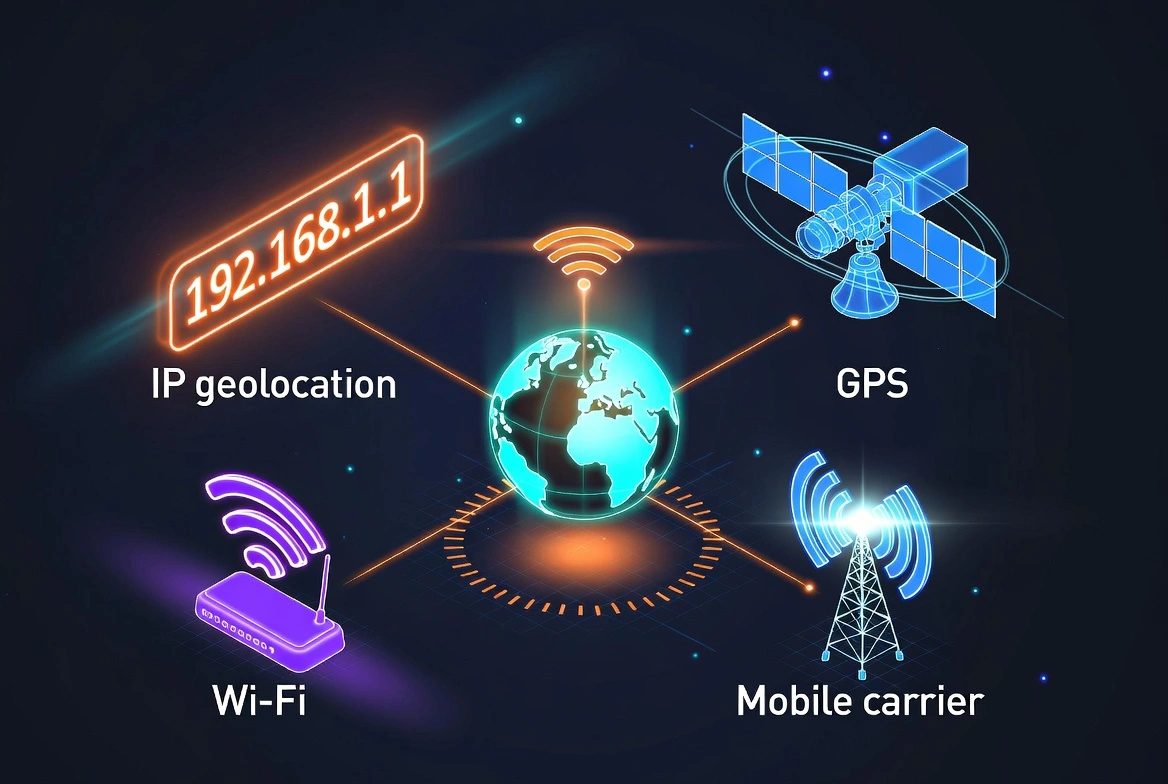
How geo-targeting technology actually works.

Geo-targeting technology is not complex; understanding each in depth will help you understand how each works.

how-geo-targeting-techology-work.webp

IP geolocation

The most widely used method. Every internet-connected device has a public IP address, and that IP is mapped to a location using commercial databases (MaxMind is the industry standard). These databases match IP ranges against ISP registration data, network routing paths, and observed traffic patterns.

  • Country-level accuracy: reliable. 

  • City-level: usually close. 

  • Neighborhood-level: often wrong by several kilometers. 

GPS and device location

When a mobile app asks "allow location access," it's requesting GPS coordinates. This is orders of magnitude more precise than IP, accurate to meters, not kilometers. But it requires explicit user permission and only works in apps that have been granted that access.

Web browsers can also request device location, but most users decline. So GPS is common in native apps, rare on the open web.

Wi-Fi positioning

Devices map nearby wireless networks to known physical locations using large databases of SSID-to-location pairings maintained by operating system vendors. A phone near a known access point can be positioned even with GPS off. This is why location features sometimes work indoors where GPS signals are weak.

Carrier network data

Mobile devices connecting through LTE or 5G expose the carrier's IP ranges, which are associated with specific geographic regions. A connection through a Vodafone UK tower carries different signals than a home broadband connection; the carrier, region, and network type are all visible.

💡

This is exactly why mobile proxies behave differently from residential or datacenter proxies when tested on geo-sensitive platforms. The signal isn't just "what country," it's "what kind of connection."

How platforms combine these signals

A mismatch between signals is a red flag. An IP address in Germany paired with GPS coordinates in New York looks like a VPN or proxy to fraud-detection systems. Sophisticated platforms cross-reference multiple layers, which is why matching just one signal isn't always enough.

💡

Location coordinates follow standardized formats; the GeoJSON specification (RFC 7946) defines how geographic data is structured across web services.

Why platforms use geo-targeting

Reason

What platforms do

Example

Content licensing

Block or serve content by territory

Netflix catalog differences by country

Regional pricing

Show location-appropriate price tiers

SaaS tools are priced differently in the market

Fraud prevention

Flag location mismatches as suspicious

Payment processor blocking VPN traffic

Legal compliance

Restrict access based on jurisdiction

Gambling sites are blocking certain countries

Ad delivery

Show ads only in relevant areas

Google Ads geo-targeted advertising

  • Geo-targeting advertising is the commercial backbone of this system. Google, Meta, X (Twitter), and programmatic platforms all allow advertisers to define geographic parameters, such as country, region, city, or a custom radius. 

  • Twitter geo targeting, for instance, lets advertisers target by country, DMA, metro area, or specific locations. This is fundamental to how geo-targeted ads work: the platform checks where the user is, then decides whether to show your ad at all.

💡

For advertisers, this means campaign delivery is only as accurate as the platform's location detection, which is why ad verification matters.

What is geo-targeting in advertising, and why does it break without verification

Geo-targeting in advertising: It's the configuration layer where advertisers tell platforms where to show their ads. But configuration and actual delivery are different things.

A campaign targeting Frankfurt may still serve impressions to users outside that region due to the platform's interpretation of "presence" vs. "interest" in a location. Competitors may be running campaigns in your geo that you cannot see from your own location. Localized creative may not render correctly in a specific market.

The only way to verify what actually happens in a specific region is to access that region from an IP that the platform treats as local. That's where geo-targeted advertising verification through proxies becomes a practical workflow rather than a theoretical one.

How proxies work with geo-targeting

geo-targeting-with-proxies.webp

A proxy routes your traffic through an intermediary server. The destination platform sees the proxy's IP, not yours. If the proxy IP is registered in Japan, you appear to be in Japan.

This is simple in concept, but the execution depends entirely on IP quality. Not all proxy IPs carry equal weight.

Proxy types and geo-targeting trust levels

Proxy type

Network source

Trust level

Best for

Mobile LTE/5G

Real carrier networks

Highest

Social platforms, ad verification, ticketing

Residential ISP (static)

Real household ISPs

High

SERP tracking, scraping, and long sessions

Residential rotating

Large ISP pool

Medium-high

Scalable data collection, price monitoring

Datacenter

Hosted server IPs

Lower

Speed-critical tasks, bulk operations

The trust gap between these types is real and measurable. A datacenter IP attempting to verify a Facebook geo-targeted ad may trigger a challenge because the IP doesn't match any residential network. Mobile proxies, by contrast, carry carrier network signals that social and ad platforms are built to trust.

What proxies cannot do:

  • Override GPS if an app has device location permission

  • Defeat multi-signal fraud systems that combine IP + browser fingerprint + behavioral data

  • Guarantee platform-level geo bypass if account-level controls are also in place

What proxies can do:

  • Route traffic through 100+ countries so you appear local to that region

  • Maintain consistent session identity for geo-specific scraping or testing

  • Rotate IPs to make high-volume requests from a region look like different users

Geo-targeting use cases that require proxies

Here are some of the most frequently used scenarios where geo-targeting requires a proxy:

geo-targeting-use-cases.webp

Ad verification

You cannot see what a user in Berlin actually sees in your campaign from a server in London. Residential or mobile proxies in the target region let you load the SERP or platform as a local user to check placement, creative rendering, competitor ads, and pricing accuracy. This is standard practice for media buyers managing geo-targeted ads across multiple markets.

SERP and SEO tracking

Geo-targeting website rankings means nothing if you're measuring from the wrong location. A keyword ranking differently in Tokyo vs. Toronto is common. Website geo-targeting for SEO requires measuring from within each target market, which means using seo proxies that platforms and search engines treat as local residential traffic.

Market research and competitive pricing

E-commerce platforms price by region. To collect accurate regional pricing data at scale, you need IPs that the platform treats as genuine users in those locations. Static residential proxies with long session support handle this reliably.

Streaming and content access verification

Media companies and compliance teams need to verify which content is accessible or blocked in specific territories. Testing this with a real residential IP in the target market gives accurate results. IP database claims alone are not sufficient.

Ticketing and high-demand retail

Regional availability, local pricing, and inventory differences across markets are real. Mobile proxies, through carrier networks, carry the trust level these platforms require during high-traffic events.

How CyberYozh helps with geo-targeting 

Most geo-targeting problems trace back to the same root causes: the wrong proxy type, unknown IP reputation, or fragmented tools that don't integrate cleanly. Here's how the infrastructure maps to specific scenarios.

Mobile LTE/5G proxies: for trust-sensitive platforms

When to use: Verifying geo-targeted ads on social platforms, testing ad placements on Meta or X, and high-demand retail and ticketing workflows.

  • CyberYozh mobile proxies run through real carrier networks, not simulated mobile traffic. 

  • Each connection has a dedicated channel, manual and API-based IP change, OS fingerprint switching, UDP protocol support, and VPN/VLESS configuration.

  • These carry the highest platform trust because they replicate actual device behavior on real carrier infrastructure.

  •  From $1.7/day, unlimited traffic.

Residential ISP proxies (static): for stable regional identity

When to use: SERP tracking by country, long-session scraping, QA workflows requiring consistent regional identity.

  • One dedicated static IP from a real ISP. 

  • High connection speed, SOCKS protocol support, unlimited traffic, 99.9% uptime.

  • When you need the same regional IP to persist across a session rather than rotate, this is the right tool. 

  • From $5.29/month.[learn more about residential proxies]

Residential rotating proxies: for scalable data collection

When to use: Price monitoring across regions, large-scale competitive research, and collecting localized search data across multiple markets simultaneously.

  • Over 50 million residential rotating IPs across 100+ countries,

  • Speeds up to 10 Mbps, free geo-targeting included, 

  • HTTP and SOCKS5 support, 

  • Session-based connections for controlled reuse when needed. 

  • From $0.9/GB.

Datacenter proxies: for speed-critical geo tasks

When to use: Infrastructure testing, bulk operations where platform trust sensitivity is lower, and cost-efficient large-volume workflows.

  • Dedicated IPv4/IPv6, no sharing, high-speed connections, 99.9% uptime, unlimited traffic. 

  • Not the right tool for social or ad platform verification, exactly the right tool for speed and scale, where trust sensitivity isn't the constraint. 

  • From $1.9/month.

Fraud score and IP reputation checks: before you run anything

  • Running geo-targeting traffic through an IP with a poor reputation wastes budget and triggers blocks. 

  • CyberYozh's pre-flight IP reputation checks let you evaluate fraud indicators, complaint history, and block status before routing traffic through any IP. 

  • This is a decision-support step; it catches problems before they become operational failures.

Automation-ready API

  • CyberYozh is API-ready by design. 

  • Puppeteer, Playwright, Selenium, Scrapy, Postman, and custom scripts can all integrate directly. 

  • You don't change your existing automation stack; you plug the proxy and session control into it.

One platform

  • Mobile proxies, residential proxies (static and rotating), and datacenter proxies.

  • SMS activation, and fraud score checks for IPs, phone numbers, and cards.

  • Device fingerprinting.

  • All within one system. 

  • One integration layer instead of three separate vendors with their own APIs, billing, and support queues.

Conclusion

Geo-targeting is infrastructure built into every major platform, ad network, and content system running today. It controls what gets shown, what gets priced, and what gets blocked based on the origin of a connection.

For professionals running campaigns, collecting regional data, or verifying ad delivery, that creates a practical problem: you cannot see what local users see from a location you're not in. Proxies solve that. But only if the IP type matches the platform's trust expectations, the session behavior is clean, and the IP itself isn't already flagged before you start.

That's the difference between guessing and knowing. Check the IP before you run. Match the proxy type to the task. Keep the toolchain in one place.

💡

Explore proxy options by country or run an IP reputation check before your next campaign at cyberyozh.

Frequently asked questions about geo-targeting ads