
What Is a Residential Proxy: The Complete 2026 Guide

A residential proxy is an IP address assigned by a real Internet Service Provider (ISP) to a home device, such as a laptop or smartphone, that acts as a middleman between you and the websites you visit. Because the IP belongs to a genuine household, websites treat your traffic as if it comes from a real person, not a server or bot. Residential proxies are the gold standard for any online task where being detected or blocked is not an option.
TL;DR
A residential proxy uses a real home IP address (issued by an ISP) to hide your identity online.
Websites trust residential IPs far more than data center IPs, making them harder to detect or block.
Static residential proxies keep the same IP across sessions; rotating proxies change it per request.
Best uses: web scraping, ad verification, fraud prevention, SEO monitoring, and account management.
They are legal when used ethically, but free residential proxies are almost always unsafe.
Mobile proxies are harder to block but slower and more expensive than residential proxies.
What is a Residential proxy
A residential proxy routes your internet traffic through a real home device. The IP address you present to websites is one that an ISP, such as Comcast, Verizon, or British Telecom, assigns to someone's actual home connection.
Think of it like asking a friend to receive a package on your behalf. The store sees your friend's home address, not yours. They have no idea you were ever involved. A residential proxy works the same way: websites see a real home IP address, not yours.
This matters because every website you visit makes a trust judgment about your traffic. Data center IPs (used by most VPNs and cheap proxies) are well known to anti-bot systems and are constantly flagged or blocked. Residential IPs are not, because they look exactly like normal broadband users browsing from home.
What makes a residential proxy different:
A real ISP issues the IP to a real household
Your traffic appears to come from a human user, not a server
Your actual IP address and location stay completely hidden
Detection rates are dramatically lower than with data center proxies
Expert observation: Blocking a residential IP address is risky for websites; it can prevent a real customer from accessing the site. This is why even sophisticated anti-bot platforms like Cloudflare and Akamai treat residential IPs with far more leniency. That asymmetry is the core reason businesses pay a premium for them.
How do Residential proxies work
The technical process is straightforward. Here is exactly what happens when you use a residential proxy.
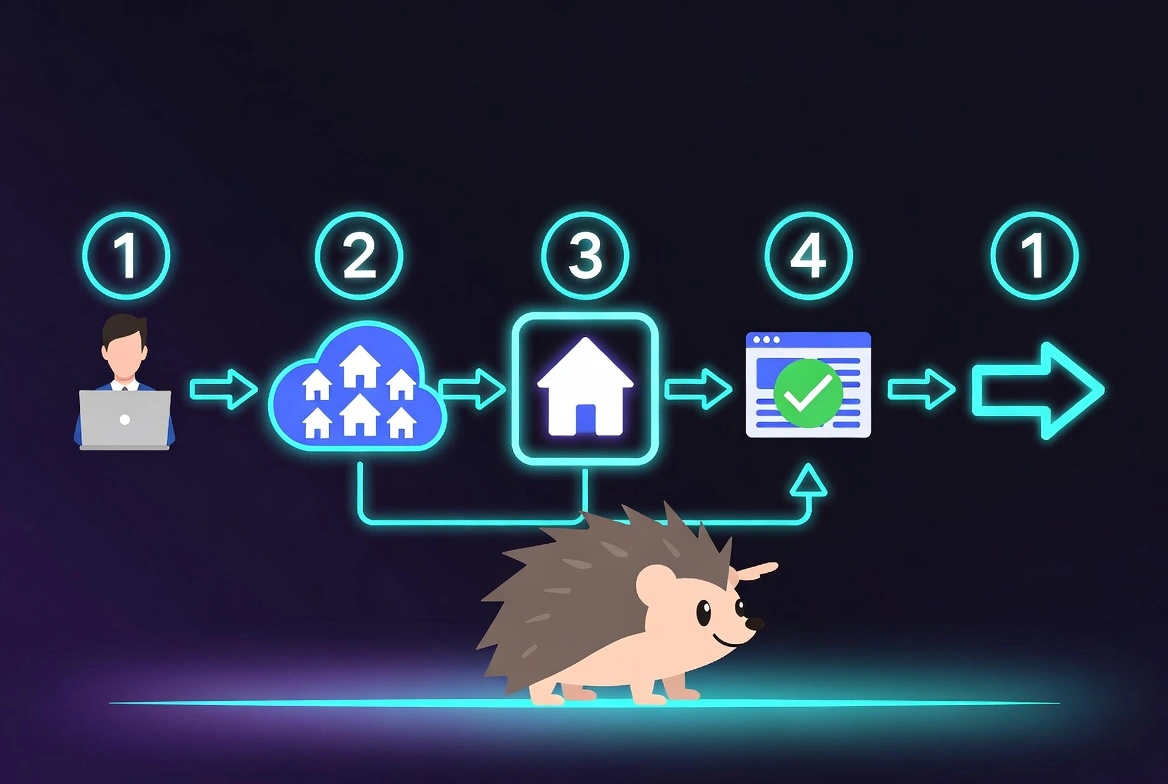
Step-by-step:
You send a request: visiting a website, running a scraper, or checking an ad placement.
The request goes to a proxy pool: the provider's network holds millions of real residential IPs from real devices.
A residential IP is selected: either a fixed one (static) or a new one on request (rotating), depending on your settings.
The target website receives your request: it sees a real ISP name, a real city, and normal-looking residential traffic.
The response returns to you: your actual IP and identity remain fully hidden throughout.
Two session types you need to know:
Session Type | How It Works | Best For |
IP changes every request or at set intervals | Bulk scraping, price monitoring | |
Sticky / Static | Same IP held for minutes, hours, or permanently | Account logins, session-based tasks |
Expert observation: The biggest mistake people make with residential proxies is not choosing the right IP; they use the wrong behavior with a good IP. Sending 500 requests per minute from a "residential" address is still bot-like behavior. Realistic request pacing and human-like session patterns matter just as much as IP quality.
What is a Static Residential proxy
A static residential proxy, also called an ISP proxy, gives you a fixed residential IP address that does not change between sessions. Unlike rotating proxies that constantly swap IPs, a static residential proxy keeps the same address for days, weeks, or even months.
Critically, the IP still belongs to a real ISP. You get the trust level of a residential proxy combined with the stability of a dedicated connection.
When a static residential proxy is the right choice:
Managing social media or e-commerce accounts over time
Staying logged into platforms without triggering re-authentication
Brand monitoring from a consistent geographic location
Any workflow where the same IP identity needs to persist
Static vs. Rotating Residential proxies: Quick comparison:

Feature | Static Residential Proxy | Rotating Residential Proxy |
IP address | Fixed, same every session | Changes per request or on a timer |
Best for | Account management, long sessions | Scraping, bulk data tasks |
Session continuity | Excellent | Limited |
Detection risk | Very low (stable, ISP-trusted) | Low (always a fresh IP) |
Pricing model | Per IP / monthly | Per GB of traffic |
If you need to maintain an online identity consistently, not just visit a page anonymously, a static residential proxy is the tool you need.
Residential proxy vs Mobile proxy
Both proxy types use IPs assigned by ISPs, but they come from very different sources and serve different purposes.
Feature | Residential Proxy | Mobile Proxy |
IP source | Home broadband devices | 4G/5G mobile carrier networks |
Trust level | High | Extremely high |
Detection risk | Very low | Near zero |
Speed | Moderate | Variable (carrier-dependent) |
IP sharing | Often shared in pools | Naturally shared via carrier NAT |
Best for | Scraping, SEO, ad verification, and account management | Social media, mobile app testing, and ad fraud detection |
Cost | Moderate | Higher |
Which one should you use
Choose residential proxies for most web scraping, price monitoring, SEO tracking, and account management tasks. They handle the vast majority of use cases effectively.
Choose mobile proxies when interacting with platforms that are heavily mobile-native (like TikTok or Instagram's mobile app), or when a target site specifically targets and blocks residential IP ranges. Mobile carrier IPs are shared by millions of real users, making them extraordinarily difficult to block without collateral damage.
Are residential proxies better than mobile proxies? Not always, it depends entirely on the task. For web scraping and data collection, residential proxies offer better value. For mobile-first platform automation, mobile proxies often outperform. [Read about the best mobile proxy providers]
When should you use Residential proxies
Use residential proxies whenever detection, blocking, or rate-limiting would break your workflow. Here are the clearest real-world scenarios where they deliver results.
Web scraping and data collection
Websites protect their data with CAPTCHAs, IP bans, and rate limits. Residential proxies let you collect pricing data, product listings, and market intelligence at scale, without triggering blocks. Success rates for complex scraping tasks with residential proxies consistently exceed 90%. [hiQ labs vs LinkedIn]
SEO monitoring and SERP tracking
Search results are personalized by location. Running SEO campaigns for clients in multiple cities? Residential proxies let you check rankings as a local user would, without being skewed by your office's IP or location. [Read more about the best seo proxies for monitoring]
Ad verification
Ad fraud is a multi-billion-dollar problem. Residential proxies allow marketing teams to verify that ads appear in the correct geo-locations, in the right formats, to real audiences, not just in analytics reports that can be manipulated.
Fraud prevention and security testing
Security and compliance teams use residential proxies to test how fraud detection systems respond to traffic from different locations. Simulating real user behavior from various regions validates that transaction screening, login monitoring, and bot detection are working as intended.
Residential proxy for fraud prevention has become one of the fastest-growing enterprise use cases in 2026, particularly in fintech, e-commerce, and ad tech.
Competitor price monitoring
E-commerce prices change constantly and often vary by location. Residential proxies let you monitor competitor pricing quietly, without triggering bot detection, so that you can respond to market shifts in real time.
Social media account management
Platforms like Instagram, LinkedIn, and TikTok flag multiple accounts that operate from the same IP address. Assigning each account its own residential IP makes each one appear to originate from a different household, significantly reducing bans and security flags.
Cybersecurity research
Security researchers need to visit malicious domains, phishing infrastructure, and adversarial content to analyze active threats. Residential proxies allow this safely, without exposing organizational IPs or creating attribution risks.
Application and website testing
Developers use residential proxies to simulate users from different cities and countries. This surfaces geo-specific bugs in payment flows, content localization, and page load performance, before real users encounter them.
Are Residential proxies safe and legal
Yes, in most countries, using a residential proxy is entirely legal. [Computer Fraud and Abuse Act]. The legality depends on what you do with it, not the tool itself.
Collecting publicly available data, managing your own accounts, running ad verification, and testing your own systems are all legitimate activities.
Using proxies to commit fraud, access unauthorized systems, or violate a platform's Terms of Service exposes you to legal risk.
Safety depends almost entirely on the provider you choose. Here is how to evaluate that:
Factor | Safe Practice | Risk Signal |
IP sourcing | IPs obtained with device owner consent | IPs from malware-infected devices (botnets) |
Provider transparency | Clear Terms of Service, legal entity, abuse contacts | No company information, anonymous operation |
Data logging | Minimal or no-log policy, clearly stated | Logging policy absent or vague |
Pricing | Paid service with transparent pricing | Free proxy lists or suspiciously cheap offers |
Support | Responsive customer support | No contact channels |
Free residential proxies are rarely safe. They are frequently sourced from compromised devices without the owner's knowledge. Using them exposes your traffic to third parties and creates legal risk.
Bottom line: Reputable, paid providers that source IPs ethically are safe to use for legitimate purposes. The IP itself is not risky; the provider and your use case are what determine safety.
When Residential proxies do not work well
Residential proxies are powerful, but they are not the right solution for everything. Here is an honest assessment of their limitations.

Situations where residential proxies underperform:
Speed-critical bulk tasks
If you need maximum throughput for thousands of lightweight requests and stealth is secondary, data center proxies are faster and cheaper.
Real home connection speeds constrain residential IPs.
Complete anonymity guarantees
No proxy provides 100% anonymity. Browser fingerprinting, WebRTC leaks, canvas fingerprints, and timezone/language mismatches can still expose you if your broader setup is not properly configured.
A residential IP alone is not a complete anonymity solution.
Sites that block all proxy traffic
Some high-security platforms (government portals, certain banking sites) block all non-direct ISP traffic, regardless of IP type.
A residential proxy will not bypass systems that verify device certificates or require biometric authentication.
Real-time financial applications
Latency introduced by routing traffic through a real home device makes residential proxies unsuitable for millisecond-sensitive use cases like algorithmic trading or live auction bidding.
Overused shared IP pools
In shared proxy pools, a previous user's abusive behavior may have already flagged that IP.
Always verify IP reputation before use. Dedicated or fresh IPs avoid this "noisy neighbor" problem entirely.
Why CyberYozh has the best Residential proxies in the market
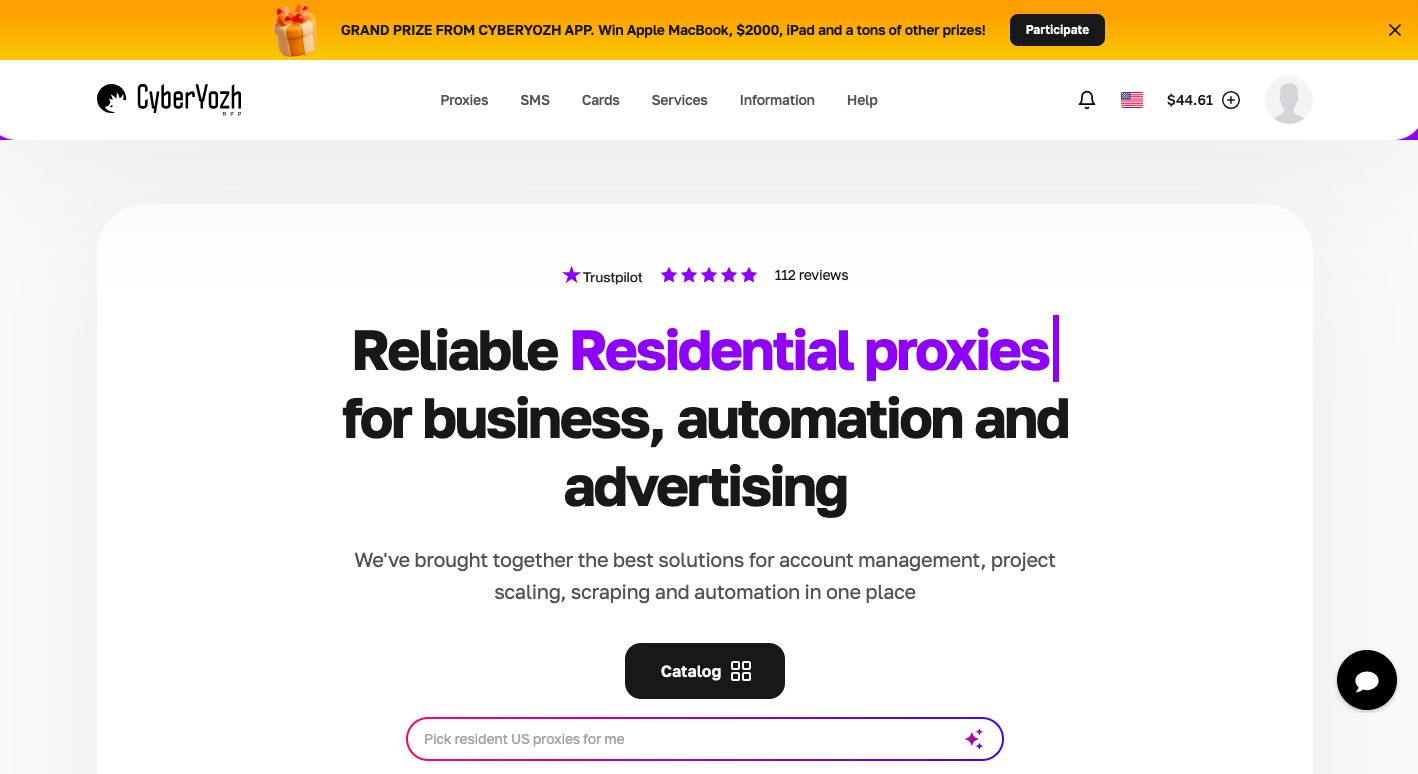
CyberYozh provides rotating residential proxies, static residential (ISP) proxies, datacenter proxies, and 4G/5G mobile proxies, all on a single platform built for real-world operational use.
Platform highlights:
100M+ IPs across 100+ countries, with city-level targeting
99.8% task completion rate, across protected and high-security targets
Compatibility with Selenium, Puppeteer, Playwright, and Postman, no custom integration required
Seamless integration with any antidetect browser, Dolphin Any, Multilogin, and many more.
Built-in fingerprinting to keep accounts separate.
SOCKS, HTTP, and UDP protocol support.
Built-in IP Reputation Checker, verify any IP's history before deploying it.
SMS Activation Services, for multi-account workflows requiring phone verification
Most affordable in the proxy industry, unlimited traffic for mobile proxies starting from $1.7/day and residential proxies at $5.29/month.
CyberYozh is not positioned as a workaround tool. It is an infrastructure platform trusted by security teams, marketing agencies, data scientists, and developers who need reliable, ethical proxy access at scale, without enterprise-only pricing.