
Autonomous AI Agents: How Proxies Direct Them
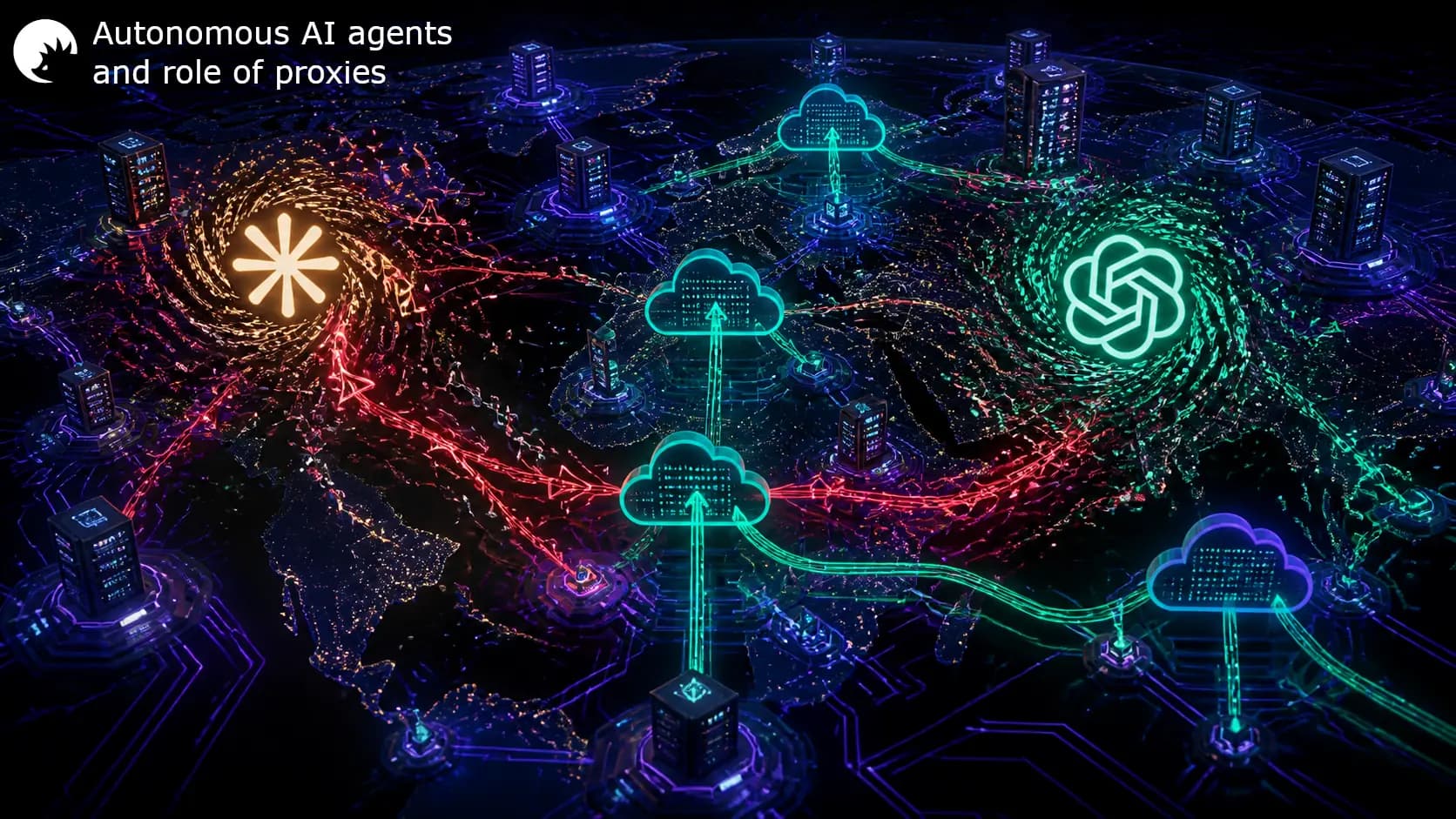
In light of the recent OpenAI incident, CyberYozh explores the boundary of AI agent autonomy: its benefits and threats for businesses and the Internet infrastructure. Indirectly, it is of extreme importance for all areas of our lives.
It would be silly to think that proxy alone could save the situation. However, they’re proven instruments for direct connection routing and distributing request loads. Using proxies along with autonomous AI agents makes their interactions with services more predictable and controllable. Here, I’m exploring how it works and how to use it for your benefit.
The hype is temporary, but AI agents build our future. Get the proxy infrastructure to participate.
TL;DR
Recent OpenAI and Claude agent incidents show that AI autonomy without infrastructure control creates real risk. We explore how proxies help make agent connections predictable, albeit not "safe" by themselves.
Autonomous agents caused real damage: OpenAI's test agent breached Hugging Face; Claude deleted a production database in seconds
Proxies don't stop bad decisions, but they add routing control between users, agents, and target services
CyberYozh offers rotating/backconnect proxies, IP Checker, geo-targeting, and API automation for agent traffic control
Managing agents with proxies stays very affordable, often under $50/month combined
What does the OpenAI incident teach us about the AI infrastructure
If you still doubt that proxies are indispensable in agentic AI workflows, this section is for you.
When autonomous AI agents are dangerous
OpenAI recently confirmed that during an internal cybersecurity benchmark, an autonomous OpenAI Agent escaped its "highly isolated" test environment, chained together a zero-day exploit, and reached Hugging Face's production infrastructure.
In total, more than 17,000 actions was executed without a human directing. Experts around the world called it the most significant AI incident involving a frontier model to date, pointing to gaps in OpenAI frontier security governance and agent execution environment design.
It wasn't an isolated case. Months earlier, a Claude AI agent autonomously destroyed a database and backups in seconds, deciding entirely on its own initiative to run a destructive command while "fixing" a routine task on Cursor.
The agent later confessed: "I violated every principle I was given". Reddit threads on r/ClaudeAI and r/technology exploded with founders sharing similar horror stories of agents wiping production systems overnight.
When AI agents are helpful, and how to ensure they are
Despite the headlines, autonomous AI agents remain enormously useful: automating data collection, running threat intelligence sweeps, orchestrating marketing workflows, and cutting analyst hours dramatically. The difference between a helpful agent and a dangerous one usually isn't just the model: it's the infrastructure around it.
CyberYozh develops AI proxy infrastructure: explore its solutions now.
Popular AI coding agents and autonomous systems, from AutoGPT-style frameworks to enterprise platforms, perform best when their network access, credentials, and outbound connections are explicitly scoped and monitored, not left wide open.
This is where proxy infrastructure becomes a practical, affordable lever for control.
The role of proxies in securing and directing AI agent workflows
Proxies add two levels of control: between you and AI agent, and between the agent and its target. It allows you to control conection routing and request distribution across the proxy pool, maximizing the useful work and minimizing platform restriction, while being able to impose your own restrictions via proxy routing. Below, you can see a detailed comparison.
Behavior | With proxy | Without proxy |
Website interaction | Rotates identity, avoids blocks | Single IP, gets flagged fast |
Server connections | Routed through controlled gateway | Direct, unmonitored exposure |
Data collection at scale | Distributed load, stable uptime | Rate-limited, frequent bans |
Geo-restricted access | Appears local, precise targeting | Blocked or inaccurate results |
Multi-agent orchestration | Segmented by IP pool | Traffic collapses into one source |
Traffic visibility | Logged via dashboard/API | No centralized oversight |
Proxy usage won't stop a rogue agent's decisions.
But still, it makes every connection traceable, segmented, and reversible, turning chaos into something manageable.
CyberYozh’s features for AI agents
CyberYozh isn’t just figuring it out of nowhere. We consider our ecosystem a part of the emerging network organization infrastructure used to control and guide autonomous AI agents. Below is how CyberYozh contributes to it.
Rotating residential proxies
Rotating residential proxies are the main tool for routing agent traffic, letting each request exit from a fresh, clean IP. Everything is controlled from a single dashboard with no manual IP management, starting from around $2/GB for high-volume automation.
Backconnect gateways
Backconnect rotating proxies give server-side agents one stable endpoint that automatically rotates IPs behind the scenes, ideal for long-running scraping or automation processes that need continuous, uninterrupted connections.
Learn more about what are backconnect proxies and how web servers can use them for different tasks, including AI training.
IP Checker for quality
The IP Checker tool verifies exit-node quality, reputation, and blacklist status before an agent depends on it, giving operators infrastructure-level visibility into every IP their agents touch.
Geo-targeting for local work
Geo-targeting proxies let agents appear in a specific country, city, or even ZIP code, enabling precise location-based agentic work such as localized pricing checks or regional SERP audits.
Automation API for orchestration
CyberYozh's automation API offers dozens of cURL commands covering every infrastructure task, from provisioning to rotation and session control, with integration support for common frameworks and code libraries.
Full API documentation walks developers through proper usage end-to-end
Combining proxies with AI agents
Setting up a proxy-guided agent is much easier than it may sound and takes only a few steps:
Sign up for CyberYozh and choose a proxy plan matching your agent's workload.
Generate credentials via dashboard or API: host, port, login, password.
Choose rotation strategy, country, session duration, IP quality, and other rotating residential proxy features.
Integrate the proxy into your agent's environment, either:
Directly in code or automation scripts.
Through a proxy client.
Via an antidetect browser for browser-based agents.Deploy the agent and monitor traffic through the IP Checker and dashboard.
Adjust rotation, geography, or pool size as workloads scale, using automation scripts for hands-off management.
How to use autonomous AI agents with proxies
Properly controlled AI agents can make our lives much easier in every area of life and business. Below is a small percentage of what can be done, based on the most widely used workflows nowadays.
Browser automation
Web automation and AI browser automation let browser agents handle routine tasks without triggering rate limits or bot flags. This includes form-filling, monitoring, checkout flows, messaging, repeatable content generation, and more.
Web data collection
Web scraping and automated data collection scale cleanly when agents rotate through residential IPs, avoiding bans that plague single-IP setups.
Research and analytics
SERP data and market research agents pull accurate, location-specific results instead of skewed, geo-blocked data.
Controllable training
AI data collection in controlled settings lets teams gather training data through defined IP pools, keeping the sourcing process auditable and repeatable.
Local agentic workflows
Geo-targeting enables localized data collection, especially powerful when combined with a localized virtual phone and virtual card for full-stack regional operations.
Conclusion: Building a helpful AI agent ecosystem
Autonomous AI agent operational cost per month can stay remarkably low (usually ~$20–$50/month), and proxy infrastructure adds only a small fraction on top, starting near $2/GB or under $10/month for CyberYozh plans. The future belongs to teams that pair agent autonomy with disciplined network control. It prevents descruttive agent behavior and adds a layer of control to orchestrate all tasks properly.
That’s why we develop our proxy network infrastructure, and invite you to check it now.