
10 Best Sneaker Proxies in 2026: Ranked for Nike, Adidas & Shopify Drops
TL;DR:
Most drop failures in 2026 are not your bot's fault; they're your proxy's.
Specifically, they're your IP's reputation.
This guide ranks 10 sneaker proxy providers tested across Nike SNKRS, Adidas Confirmed, and Shopify drops, starting with the one provider that solves the problem everyone else glosses over.
If you've missed drops despite doing everything right, the answer is in section three.
5 reasons your sneaker proxy is failing before the drop even opens
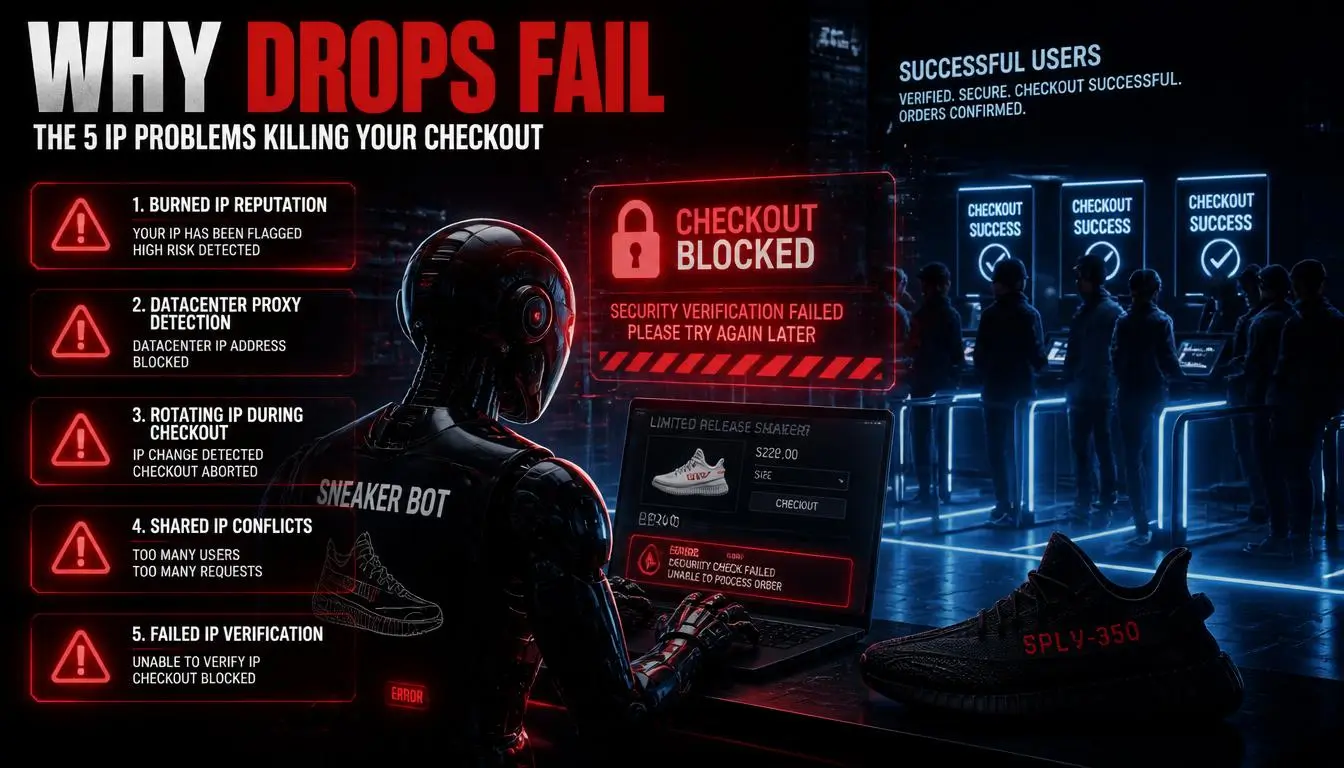
Most people reach for this guide after they've already lost a drop. So before we get to the provider rankings, here's what's actually killing your sessions, and why most sneaker bots never figure it out.
Your IP is already flagged. A recycled IP address with a history of abuse fails Nike's reputation check the moment it connects, before your bot even loads the product page.
You're using datacenter proxies on Nike SNKRS. Nike has blocked known datacenter IP ranges for years. This was true in 2022, it was true in 2024, and it's more reliable in 2026, not less. Do not use them on SNKRS.
Your IP is rotating mid-checkout. Rotation is great for monitoring. During an active cart session, it reads as a session discontinuity and drops your cart.
You're sharing IPs across multiple tasks. One flagged account takes down every task on the same IP. One proxy per task is the minimum.
You skipped the reputation check. Five minutes of IP verification before a drop removes the single most common cause of silent task failure.
Fix these five things, and a mid-tier proxy setup will outperform an expensive one used carelessly. That's not an opinion; it's the architecture of how sneaker platforms work.
The real reason you keep missing drops: your sneaker bot isn't the problem
You did everything right. You joined the right cook group, configured your tasks the night before, and set your entry time to the millisecond. The drop opened. You hit start. Access denied. The queue number is in the thousands. Or just nothing.
Here's what's happening underneath:
Nike uses a variety of tools to identify and remove bots from the SNKRS platform, including advanced analytics and machine learning to verify user and entry authenticity.
Depending on the popularity of a launch, bot attacks can make up about 10–50% of all entries.
Every month, Nike stops as many as 12 billion bot calls attempting to game SNKRS launches globally.
That's an industrial-scale detection system that evaluates IP reputation as its first filter, before your session even reaches the checkout queue.
The proxy is not a formality you sort out after choosing your bot.
It is the infrastructure that decides whether your bot gets a fair shot.
"The wrong proxy doesn't slow you down. It ends your session before it starts."
And the thing no one tells you clearly enough: it's not just the proxy type that matters. It's IP reputation. A residential IP that's been hammered by previous botters carries all of that history into your session. A clean mobile IP from a smaller provider will outperform a burnt residential IP from the most expensive pool on the market.
We analysed and ranked each provider type across Nike SNKRS, Adidas Confirmed, Footlocker, and Shopify drops, evaluating IP cleanliness, session stability, checkout success rate, geo-targeting accuracy, and cost per successful cop. Here's what we found.
What a sneaker proxy does: the short version
A sneaker proxy server is a middleman that gives your bot a different IP address for each task. Instead of Nike seeing 50 checkout attempts from a single IP, it sees 50 from 50 different locations, each appearing to be a separate real user.
That distinction makes it possible to run multiple simultaneous tasks without triggering the rate limits, subnet bans, or CAPTCHA floods that kill single-IP setups. But the IP has to be clean. That's the part this guide focuses on.
The 4 types of sneaker proxies for drops
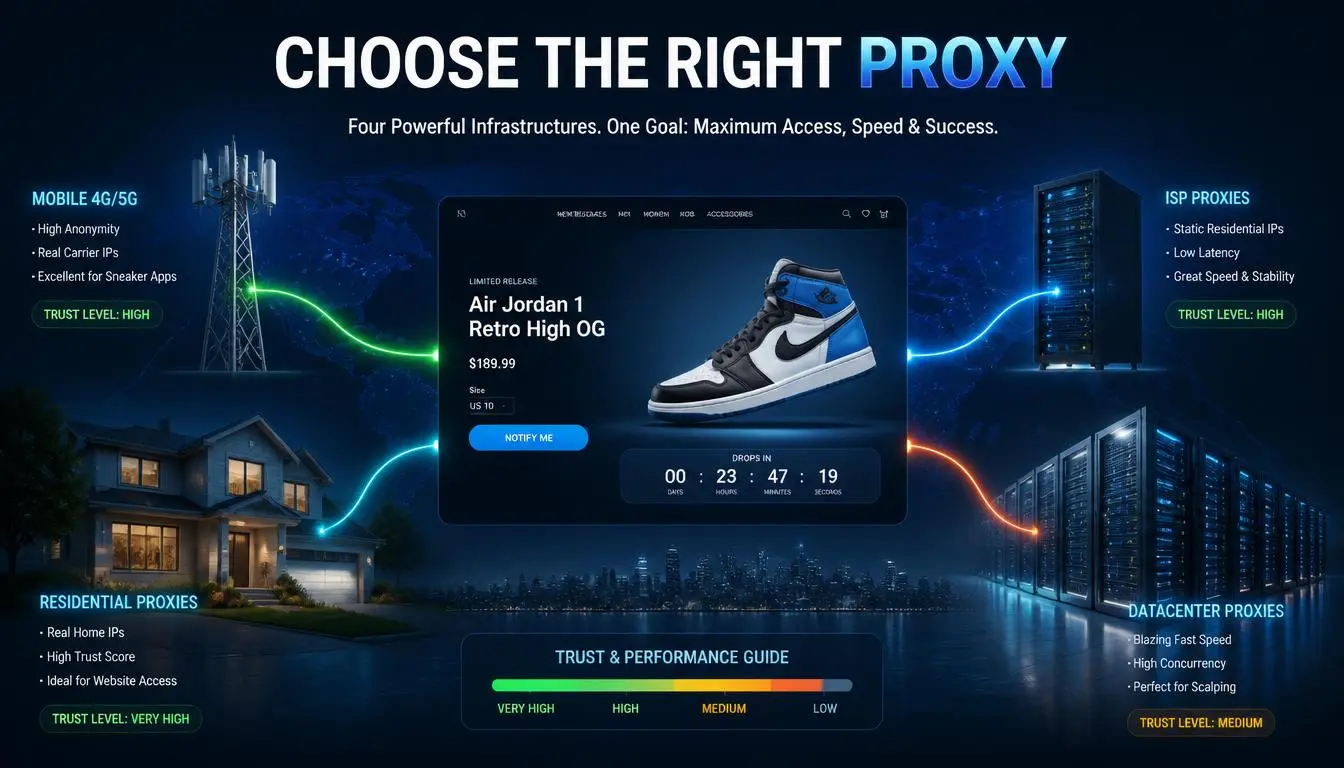
Mobile LTE/5G proxies: highest trust, highest cost
LTE/5G mobile proxies route traffic through real 4G and 5G carrier networks.
On Nike SNKRS and Adidas Confirmed, a mobile IP address looks identical to that of someone browsing on their phone because, technically, it is.
The carrier infrastructure is shared by millions of real users, which means companies creating limited-run products often run into grey marketers who reserve these products in shopping carts as soon as they're available, and the platforms that protect against this use sneaker bot detection systems that treat mobile carrier IPs with the same trust level as genuine consumer traffic.
The trade-off is cost; mobile proxies are sold per day, not per GB.
For a hyped drop where one successful cop returns multiples of the proxy cost, the economics work. For bulk monitoring tasks, they don't.
Best for: Nike SNKRS draws, Adidas Confirmed, Supreme, and premium Shopify boutiques.
ISP proxies (static residential)
ISP proxies hold a sweet spot that's become the dominant choice among experienced botters in 2026.
They carry real ISP-registered IP addresses, so detection systems read them as genuine home users, but they're hosted on datacenter hardware, which means they're fast.
Same IP throughout your session. No mid-checkout rotation. No broken cart states.
For Shopify drops and Footsites where both speed and session continuity matter simultaneously, ISP proxies are the cleaner choice.
Best for: Shopify drops, Footlocker, ChampSports, any speed-critical checkout flow.
Residential rotating proxies
Residential rotating proxies cycle through large pools of real home internet connections.
Each request comes from a different IP, which makes them ideal for tasks requiring many distinct identities at once, restock monitoring, account creation, and price checking.
The key rule: use rotation for the monitoring phase. Switch to sticky sessions (same IP held for a defined window) the moment checkout begins. Rotation mid-cart is one of the most common self-inflicted drop failures.
Best for: Restock monitoring, account generation, price tracking, raffle entries at scale.
Datacenter proxies
A datacenter proxy is fast, inexpensive, and identifiable.
Sneaker sites can recognise data centre IPs as non-residential traffic and act on it.
Nike SNKRS does this aggressively and reliably. Where datacenter proxies remain useful: bot testing, CAPTCHA harvesting, monitoring on lower-security targets, and configuration testing before a live drop.
Best for: Bot testing, config checks, monitoring on non-SNKRS targets.
10 best sneaker proxies in 2026 ranked and honestly reviewed
The best sneaker proxy providers in 2026 are reviewed with honesty
1. CyberYozh
CyberYozh is the only provider on this list that combines proxies, built-in IP fraud checking, and SMS verification on a single platform, which matters in practice because no single factor causes most drop failures. A combination of dirty IP causes them, the wrong proxy type, and a failed SMS check at checkout. CyberYozh addresses all three without requiring you to manage three separate tools.
"The fraud check being built in is genuinely different. You verify before you run, not after something breaks."
Why it works specifically for sneaker drops:
The IP fraud score checker is native to the platform.
You clean your list before committing it to bot tasks, the single most impactful habit change available to any botter, and CyberYozh makes it automatic rather than manual.
The mobile proxy network runs on real LTE/5G carrier connections with dedicated channels per user.
Your IP history is not mixed with other users' activity.
OS fingerprint switching is supported, adding a device-level trust signal alongside the network-level one, meaningful on platforms that fingerprint at both layers simultaneously.
The full API means that proxy management, rotation, and session control can be written directly into automation scripts—no dashboard management during a live drop.
CyberYozh features:
Mobile LTE/5G proxies: Real carrier IPs, dedicated per-user channels, OS fingerprint switching, VLESS support, unlimited traffic. From $1.7/day
Residential rotating proxies: 100M+ IP pool, 100+ countries, free geo-targeting, sticky sessions, rotation on demand. From $0.9/GB
ISP proxies (static residential): Fixed real-ISP IP, 99.9% uptime, unlimited traffic. From $5.29/month
Datacenter proxies: Dedicated IP, unlimited traffic. From $1.9/month
IP fraud score checker: Check any IP's reputation, complaint history, and risk signals before loading it into your bot. Included in the platform
SMS activation: Real carrier numbers (not VOIP) for account verification at checkout. Stops the SMS failure loop that kills otherwise good setups
Full API access: Compatible with Selenium, Playwright, Puppeteer, Scrapy, and Postman
Compatibility with any major anti-detector browser
Most budget-friendly in the proxy market, starting with $0.9/GB
Payment: Visa, Mastercard, AMEX, crypto (BTC, ETH, USDT, and others). No long-term commitment required.
What makes it different from every other provider here is that the fraud check is built in. You don't pay for proxies and separately pay for a third-party reputation tool. You check, clean your list, and run. That single workflow change prevents the failure category that causes most missed drops.
Check your IP reputation before your next drop. Run any proxy through CyberYozh's built-in fraud score checker, then buy only what your setup actually needs. → Start with CyberYozh
2. Bright Data
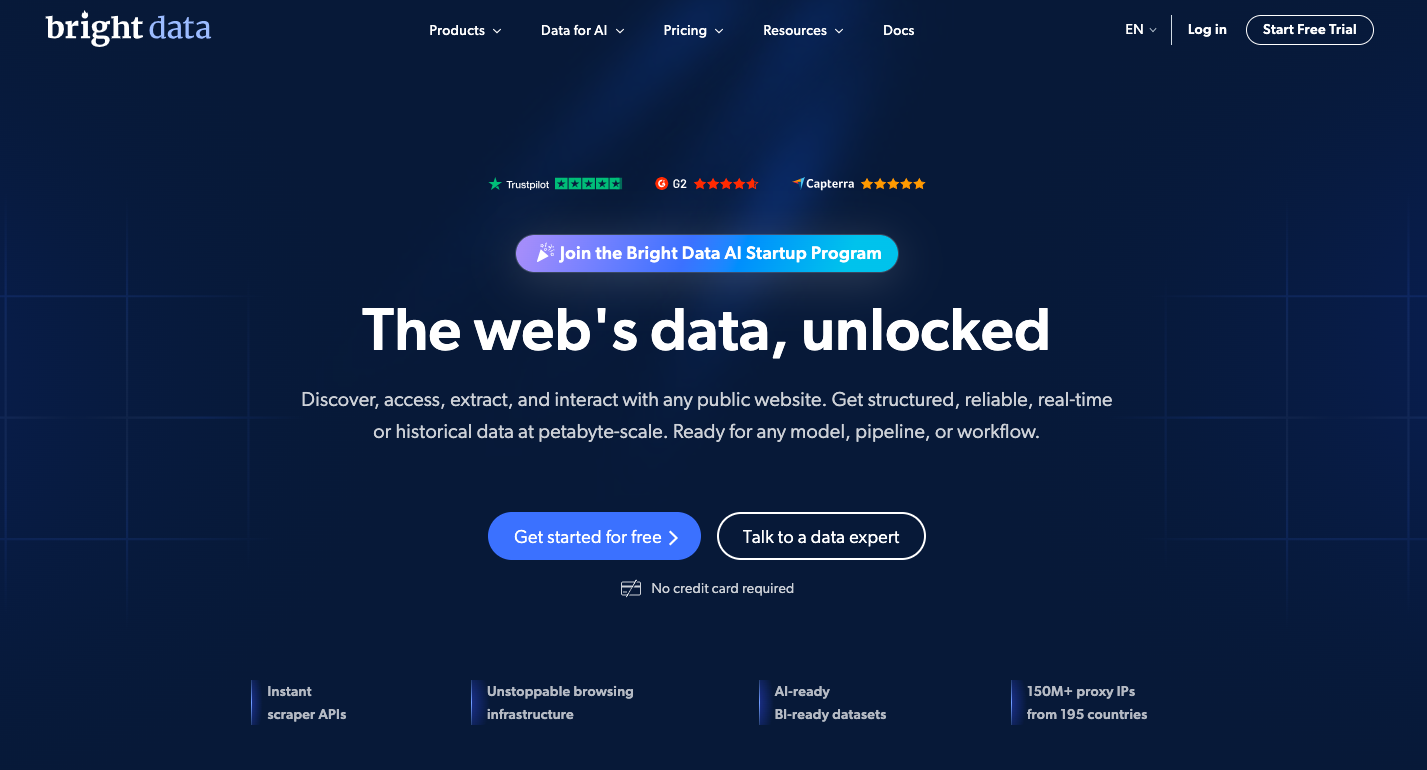
Bright Data provides a proxy network by IP count, with 72 million+ residential IPs and a product stack built for organisations running hundreds of simultaneous tasks across multiple platforms.
Key features:
72M+ residential IPs, global coverage
Web Unlocker and Scraper APIs for managed scraping
Dedicated account management for enterprise contracts
SOC 2 Type II and ISO 27001 certified
Pricing: Residential sneaker proxies from $8.40/GB (PAYG). Enterprise plans are negotiated separately.
Honest assessment:
Bright Data is good for large-scale data operations.
Specifically for sneaker copping, the pricing is structured for enterprise data teams.
At $8.40/GB PAYG, you're paying roughly 2.5× what comparable providers charge for the same residential performance on drop tasks.
New accounts require ID verification, which adds friction most botters don't want.
For high-volume operations where compliance and scale are priorities, the trade-off is reasonable.
For individual or small-team sneaker setups where cost efficiency matters, you're paying for infrastructure you won't fully use.
3. Decodo
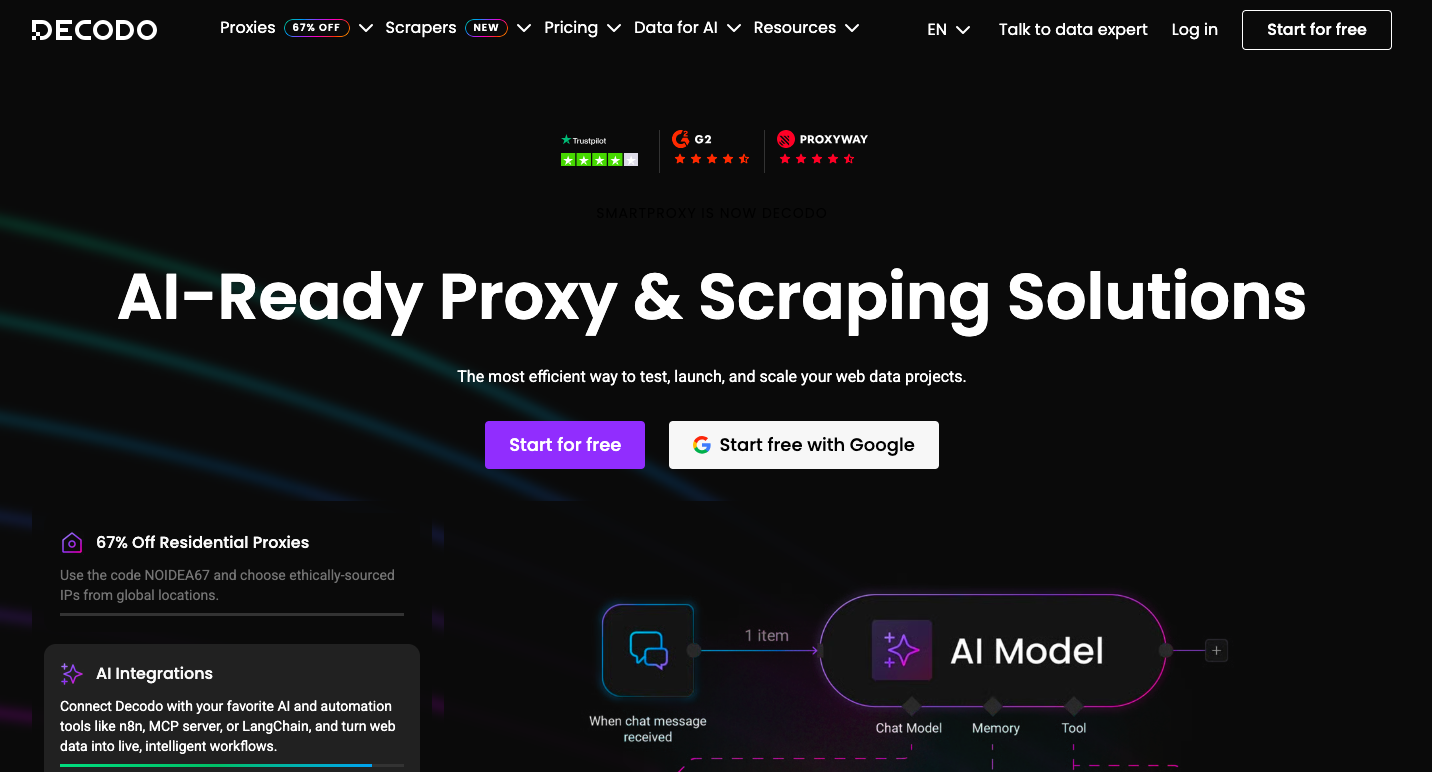
Decodo now operates one of the most accessible platforms available. Card, no sales call, live under two minutes. The residential pool spans 125M+ IPs across 195+ countries and benchmarks consistently well in independent testing.
Key features:
125M+ residential IPs, 195+ countries
99.95% success rate, 0.54s average response time
14-day money-back guarantee
No KYC requirements for standard plans
SERP API included
Pricing: Residential sneaker proxies from $3.75/GB (3GB plan). PAYG at $4/GB. ISP proxies before IP.
Honest assessment:
Decodo performs reliably for Shopify drops and Footsites.
The pool quality is mid-tier, clean enough for most standard drops, but you will encounter burned IPs in the residential pool on hyped drops that require manual filtering before use.
No built-in fraud check means you need a third-party verification tool before critical sessions.
At this price point, that's manageable, but it's an extra step in your workflow that CyberYozh eliminates natively.
4. Oxylabs
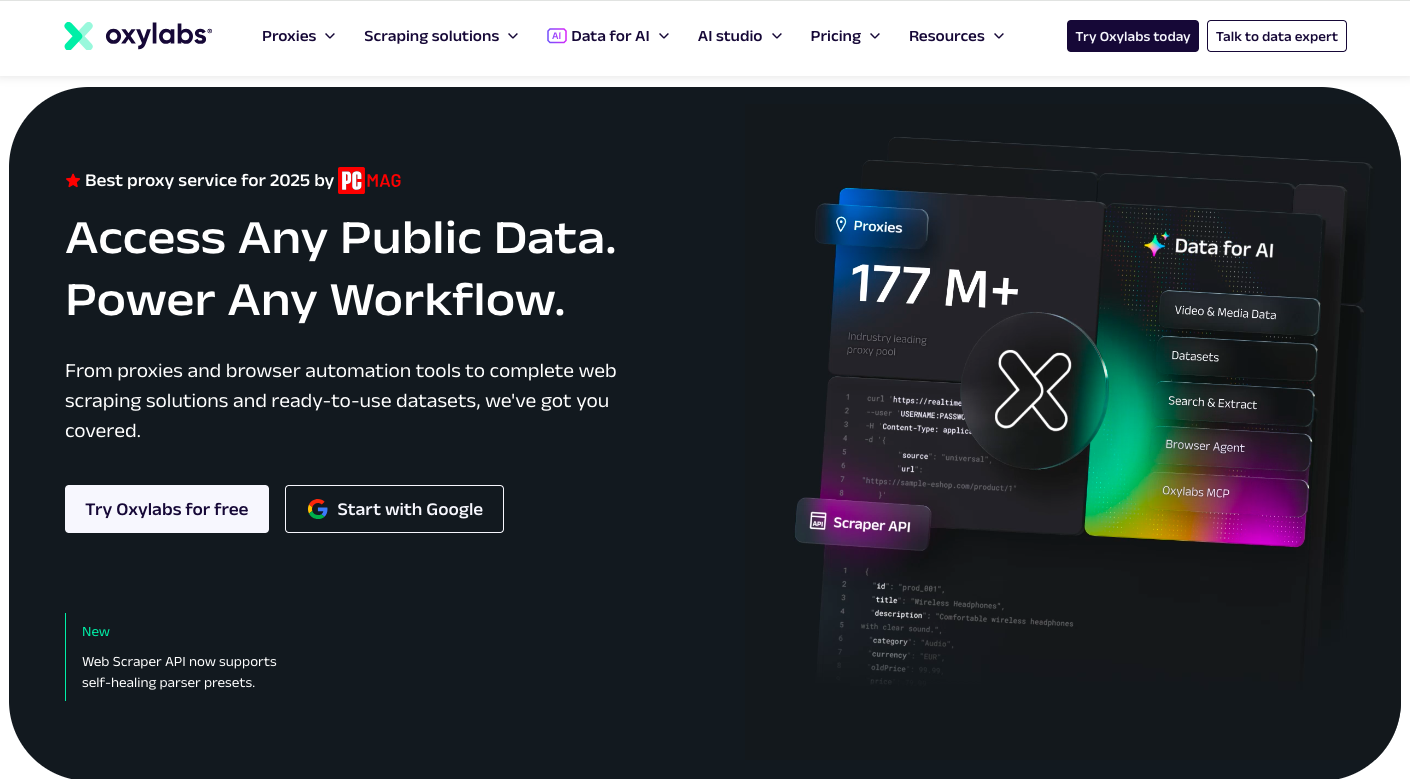
Oxylabs operates 175M+ IPs across 195 countries and holds ISO 27001 and ISO 27701 certifications. Built for enterprise procurement teams who need documented compliance alongside proxy performance.
Key features:
175M+ residential IPs
Dedicated ISP proxies, unlimited traffic, 14 countries
ISO 27001 / ISO 27701 certified
Sub-0.6s response times, 99.95% success rate
Pricing: Residential sneaker proxies from $8/GB (PAYG). ISP proxies per-IP, unlimited bandwidth.
Honest assessment:
Excellent infrastructure for enterprise data teams.
For sneaker copping, the pricing structure and mandatory KYC process create friction that most individual botters won't want.
Per-GB residential cost at PAYG is among the highest on this list.
For larger operations that run proxies across multiple use cases and need compliance documentation, Oxylabs makes clear sense.
For anyone buying proxies specifically to run drops, you're paying for things you won't use.
5. NodeMaven
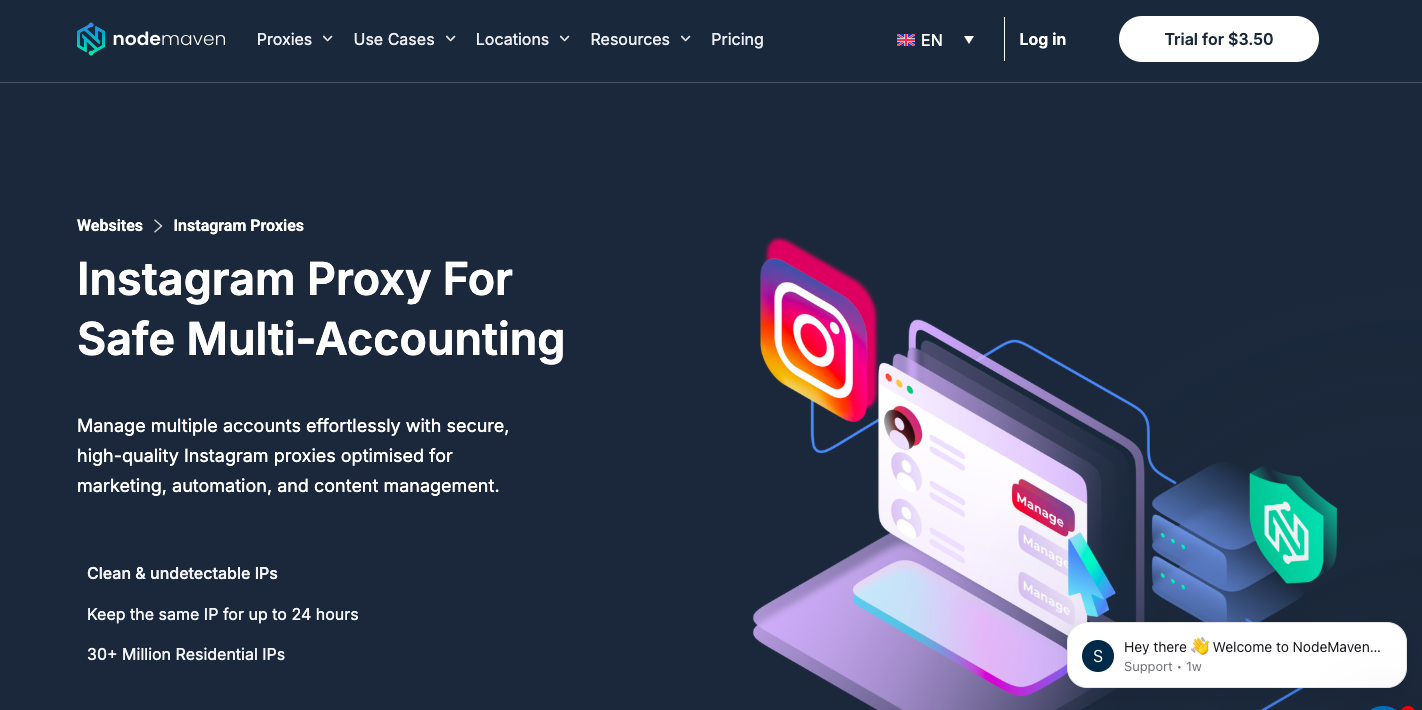
NodeMaven operates on a filter-first principle, actively screening its residential pool to remove flagged and burned IPs before they reach users. The result is a smaller pool (30M+ IPs). The 24-hour sticky session duration is the longest on the market, which is significant for account-warming workflows.
Key features:
30M+ filtered residential IPs, 95% clean-record rate
24-hour sticky sessions, longest available
ZIP-level geo-targeting
$3.50 trial before committing
Quality guarantee across residential, ISP, and mobile types
Pricing: Residential from $3.50/GB. Best ISP proxies from $2.99/IP.
Honest assessment:
NodeMaven is genuinely strong on IP cleanliness and session stability, two things that matter most for trust-sensitive platforms.
The smaller pool is a real constraint if you're running dozens of simultaneous tasks and need a wide IP surface.
For operations where IP quality and session predictability matter more than raw volume, NodeMaven is a solid choice.
Scaling to large task counts will surface pool-size limitations.
6. SOAX
SOAX operates 155M+ IPs with city-, state-, ASN-, and carrier-level targeting, the strongest location-precision option when your drop requires matching a specific storefront region exactly.
Key features:
155M+ residential and mobile IPs, 195+ countries
City, ASN, and carrier-level targeting
Mandatory IP wallowing on all plans
Rotating and sticky sessions
Pricing: Residential from approximately $3.60/GB at 25GB. Mobile from $99/month for 15GB.
Honest assessment:
SOAX's targeting precision is genuinely best-in-class when location accuracy is the deciding variable.
The mandatory IP allowlisting is an inconvenient friction point; you have to register your connection IP before the proxies work, which can be disruptive when you're configuring mid-drop.
Infrastructure performance has shown some inconsistency in recent third-party benchmarks.
For standard drops where city-level precision isn't critical, simpler providers on this list deliver similar results with less setup overhead.
7. IPRoyal
IPRoyal offers the lowest entry cost for residential proxies on this list at $1.75/GB, with non-expiring traffic on select plans and no monthly pressure to consume bandwidth.
Key features:
32M+ residential IPs, 190+ countries
Non-expiring residential traffic
Best ISP proxies in 30+ countries
No long-term commitment
Pricing: Residential from $1.75/GB. Datacenter from $1.39/IP. ISP from $2/proxy/day.
Honest assessment:
IPRoyal's pricing is real, but the residential pool quality reflects it.
IP freshness is inconsistent; some addresses have a history of fraud that surfaces in Shopify's bot detection layer.
Sticky sessions are shorter than those of premium providers.
For Nike SNKRS and high-security Adidas drops, a burned IP means a wasted session regardless of how cheap the proxy was.
For lower-security Footsite drops, CAPTCHA harvesting, or bot testing where the consequences of a flagged IP are low, IPRoyal's pricing makes it a sensible entry point.
The key caveat: pair it with an IP fraud checker before any high-stakes drop.
8. Rayobyte
Rayobyte positions itself on ethical sourcing and direct infrastructure ownership. The 40M+ IP pool covers 100+ locations with unlimited threads and volume-based pricing that drops significantly at scale.
Key features:
40M+ IPs, 100+ locations
Volume pricing drops to ~$0.90/GB at multi-TB scale
Unlimited threads, bandwidth-based billing
Transparent ethical sourcing policy
Pricing: Residential from approximately $3.50/GB. Significant discounts from ~$0.90/GB at TB volume.
Honest assessment:
Rayobyte's bulk pricing economics are strong for high-volume operations where TB-scale monthly consumption is the norm.
For individual or small-team sneaker setups that measure usage in GBs per drop, the entry pricing isn't significantly more competitive than that of other providers.
The 40M+ IP pool is smaller than mid-market competitors, and city-level targeting options are more limited.
For operations prioritising ethical sourcing and bulk-tier economics, Rayobyte delivers.
For the average botter running 50–200 tasks per drop, the differentiation doesn't justify a switch.
9. NetNut
NetNut's focus is on direct ISP partnerships; its static residential network connects via ISP peering rather than end-user device networks, delivering faster, more stable connections than traditional residential pools.
Key features:
ISP-peered static residential proxies
1M+ static IPs, tens of millions rotating
City and state targeting
HTTP/HTTPS/SOCKS5 support
Pricing: Entry plans from approximately $99/month. Per-GB pricing varies by plan tier.
Honest assessment:
NetNut's ISP-peered infrastructure delivers stable, fast connections that perform well for checkout-phase tasks.
The entry pricing of $99/month for a fixed plan is structured around business data operations rather than the flexible, session-based purchasing model that most botters use.
There's no meaningful pay-per-drop option.
For teams running consistent, high-volume operations where monthly commitment pricing makes economic sense, NetNut's stability is a genuine asset.
For casual or semi-regular sneaker operations, the pricing structure is a poor fit.
10. MarsProxies
MarsProxies markets itself explicitly to the sneaker copping community, with dedicated proxies and 5-minute rotation cycles calibrated to sneaker-site behaviour patterns.
Key features:
Purpose-built for sneaker copping
Dedicated proxies and 5-minute rotation cycles
Primarily residential and ISP proxy types
Support team with sneaker bot experience
Pricing: Primarily subscription-based with sneaker-focused tiers. No universal PAYG.
Honest assessment:
MarsProxies solves the "does this provider understand what I'm doing?" problem.
Community alignment and sneaker-fluent support are genuinely valuable for botters early in their setup learning curve.
The trade-off: purpose-built sneaker providers typically operate smaller networks than general-purpose residential providers, which means less IP diversity and more potential overlap with other users' bot activity on the same subnets.
For someone who values familiar, context-aware support over maximum IP surface, MarsProxies is a reasonable choice. For larger operations, pool depth will surface as a limitation.
How to set up sneaker proxies correctly
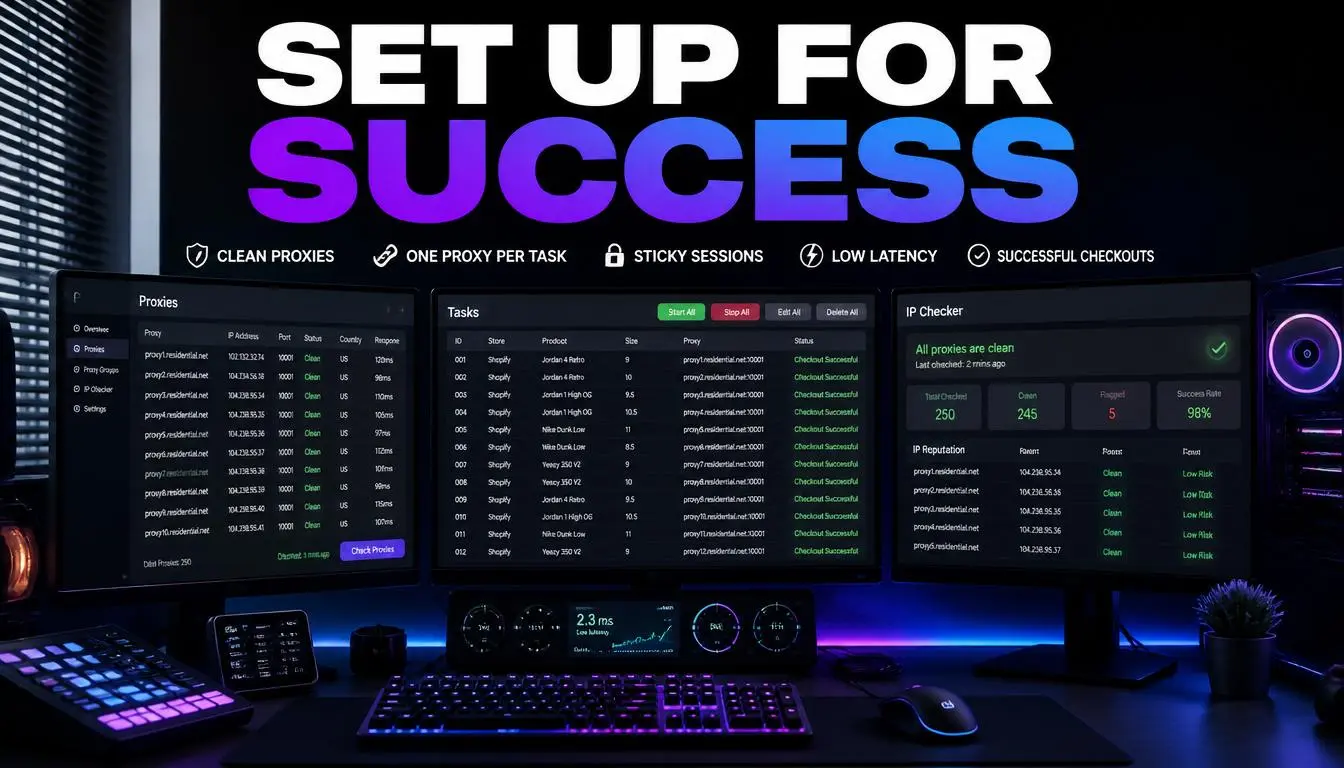
Step 1: Verify IP reputation first. Run your proxies through a fraud-scoring tool before they reach your bot. Remove anything with a medium or high risk score.
Step 2: Format correctly. Most bots accept ip:port:username:password or username:password@ip:port. SOCKS5 is preferred when your bot supports it.
Step 3: One proxy per task. One unique IP per bot task is the baseline rule. Never share IPs across tasks on the same drop.
Step 4: Match session type to drop phase. Rotating sessions for monitoring. Sticky sessions the moment checkout begins. Do not rotate mid-cart.
Step 5: Test before the drop. Confirm latency under 100ms for your target region, verify geo-targeting accuracy, and run a stability test on sticky sessions before go-live.
Common sneaker proxy mistakes and the fix
Using shared proxies on Nike or Adidas. Other users' behaviour travels with shared IPs. On high-security drops, shared traffic gets flagged more aggressively than dedicated.
Rotating IPs during checkout. Breaks session continuity. Use sticky sessions from the cart onwards.
Skipping the reputation check—the most expensive mistake on this list. Five minutes before a drop is all it takes.
Using datacenter proxies on SNKRS. Nike uses advanced analytics and machine learning to verify that users and entries are authentic, and datacenter IP ranges are blocked reliably at the first filter. They fail before your tasks queue.
Assigning the same subnet to multiple tasks. Even technically distinct IPs on the same subnet appear to detection systems as the same source. Spread tasks across diverse subnets.
Not matching proxy location to drop region. If you're entering a US drop from a UK IP, detection systems flag the geographic mismatch at the account level. Match your proxy country to your account's shipping region.
Tested across Nike SNKRS, Adidas Confirmed, Footlocker, and Shopify drop formats. Pricing current as of June 2026.
Ready to stop missing drops? CyberYozh combines mobile proxies from $1.70/day, residential from $0.9/GB, built-in IP fraud checking, and SMS verification in one platform, no juggling three tools during a live drop.