
Buy Aged Amazon Accounts in 2026: What They're Worth and How Ownership Actually Transfers
Most people who buy aged Amazon accounts lose their investment within 30 days, not because the account was bad, but because they logged in incorrectly. This guide covers what aged accounts actually cost, how to verify one before paying, and the exact infrastructure you need before your first login.
Quick Answer: An aged Amazon account has a documented purchase or sales history spanning months to years. Aged buyer accounts typically sell for $50–$500 in resale; aged seller accounts with clean metrics and category approvals can be worth $5,000–$10,000+ as part of a business sale.
Amazon's position is that seller accounts are "generally not transferable", except through a documented entity or asset sale that Amazon itself reviews and approves. Buying a bare account from an anonymous seller falls outside that process entirely, and Amazon updated its Business Solutions Agreement in 2026 to close that gap explicitly.
TLDR
Buyer accounts and seller accounts are different products with different value drivers — most listings blur this on purpose.
Account age alone means nothing to Amazon's systems; consistent activity history is what it actually measures.
Amazon allows ownership to change hands exactly one way: through its own documented business-sale process. Everything outside that is unsanctioned.
As of August 24, 2026, Amazon's updated Business Solutions Agreement explicitly prohibits transferring rights under a seller's agreement outside that process.
CyberYozh doesn't sell or help transfer accounts. Its relevance here is IP consistency and fraud-score checks for legitimate multi-account operations—a different use case, covered below.
What an aged Amazon account actually is (buyer vs seller: They're not the same)
This distinction alone will save you from overpaying.
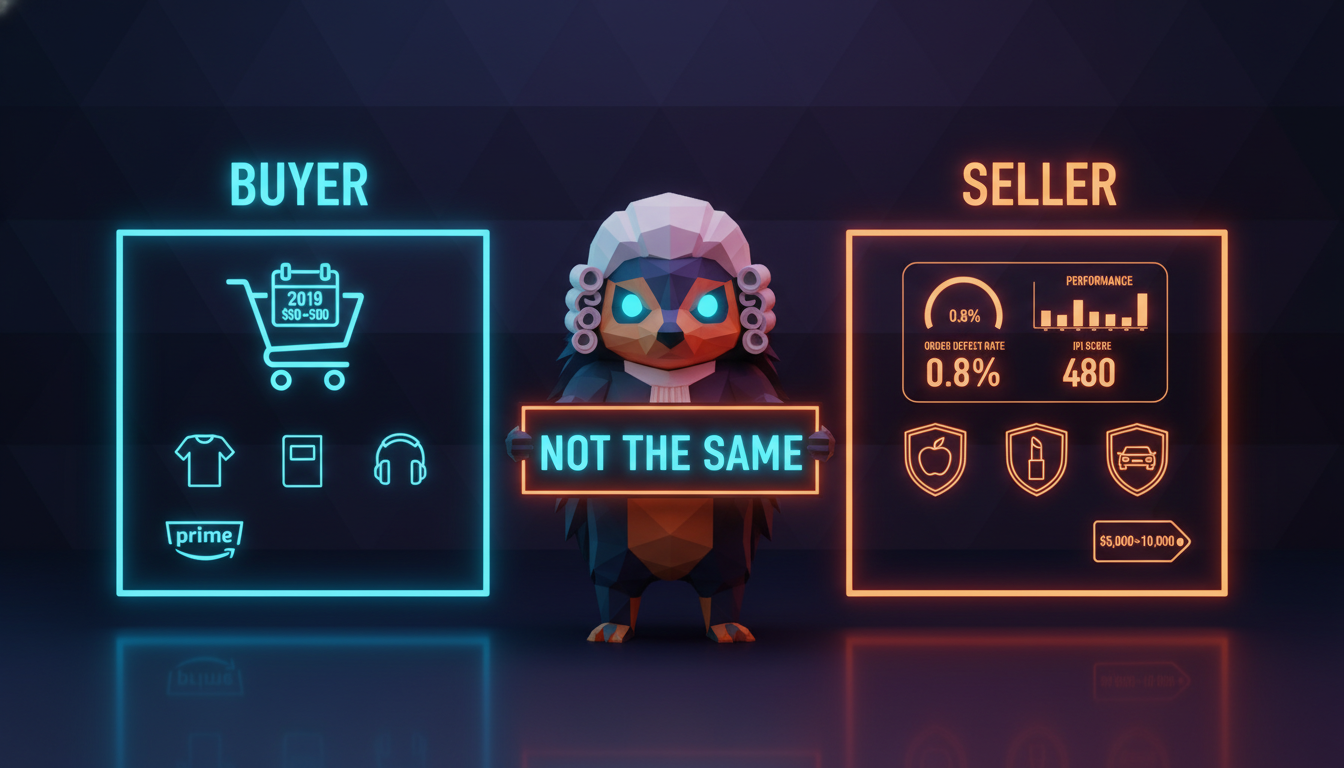
Aged Amazon buyer accounts have consumer purchase history, orders stretching back years, sometimes with a Prime membership, and verified payment methods. They cost $50–$500. Their value is limited: a trust signal for certain third-party programs, or a starting point for sellers who want to avoid the new-account scrutiny period.
Aged Amazon seller accounts are a different product entirely. These carry:
Seller Central access with established performance metrics
Pre-approved access to gated categories (grocery, beauty, jewelry, automotive) is the most valuable feature
Buy Box eligibility history
Higher FBA inventory limits from a strong Inventory Performance Index (IPI)
Reduced payment hold periods compared to new accounts
A seller account that's 3 years old, has a sub-1% Order Defect Rate, and is already ungated in grocery and beauty can legitimately be worth $5,000–$10,000. The same account with poor recent metrics might be worthless or a liability.
The thing sellers miss: Amazon doesn't just look at creation date. It weighs recency and consistency of activity. An account created in 2018 with no orders between 2020 and 2024 is not a 6-year-old account in any way that matters to Amazon's algorithm. Check the oldest order date, not the account settings page.
Why sellers pay up to $10,000 for aged Amazon accounts
Buy Box exclusion for the first 90 days minimum. On competitive listings, the Buy Box drives over 80% of sales. Without it, your ad spend yields almost nothing, and your listings sit below those of established sellers.
Category gating blocks new accounts from grocery, beauty, jewelry, and collectibles entirely. Getting ungated requires supplier invoices, documentation, and weeks of review. An account already approved skips all of that.
FBA storage limits start low for new accounts, sometimes as few as 200 units. Accounts with strong IPI scores have significantly higher limits, which matters operationally when stocking for Q4.
Payment hold periods are longer for new accounts. Faster disbursement cycles improve working capital on every sale.
These advantages are real. That's also why Amazon built detection systems to catch transferred accounts before they can use those advantages.[Read about aged Facebook accounts here]
Feature | New Account | Aged Account (Well-Maintained) |
Buy Box eligibility | Restricted 90+ days | Immediate if metrics are clean |
Gated category access | Approval required | Carries existing approvals |
FBA storage limits | Low (risk reserve) | Higher with strong IPI |
Payment hold period | Up to 14 days | Reduced based on history |
Platform scrutiny | High | Lower, with a clean history |
Transfer detection risk | None | Real, see below |
These advantages only transfer with the account if the transfer itself is legitimate. That's a narrower path than most listings imply, here's what it actually looks like.
How CyberYozh protects your aged Amazon account investment
Amazon's detection cross-references at least four signals on every new session:
IP geolocation
Payment method origin
Behavioral pattern.
If two or more shifts are simultaneously active, which is exactly what happens when you log in from your home connection after buying an account, the account enters review. If three change at once, suspension follows within days.
This failure mode wipes out most purchases. Someone buys a legitimate US seller account, logs in from their home IP in Germany, and the account is suspended before they've changed a single listing. The IP shift alone was enough.
Running a legitimately acquired account: what actually matters post-transfer
A documented transfer solves the ownership question, it doesn't solve day-to-day account operations. Two things trip up new owners even on accounts acquired the right way:
IP consistency for ongoing management. New owners are often based somewhere different from where the business originally operated, or manage the account alongside other client or brand accounts. Consistent, clean IP infrastructure matters for the same reason it does on any account: unstable or flagged connections create account-health friction unrelated to the ownership change itself.
This is also the standard setup for agencies and consultants managing multiple seller accounts on behalf of different clients, a legitimate, common arrangement under Amazon's own multi-account policy, which requires a valid business reason and keeps each account's activity clearly separated. CyberYozh's residential proxies support exactly this: a dedicated, clean IP per account, so one client's or brand's operations never overlap with another's.
CyberYozh's IP fraud-score checker flags blocklisted or previously abused IPs before you connect any new infrastructure to a live account, useful hygiene whether the account is newly acquired or long-held.
Static residential proxies start at $5.29/month; mobile proxies from $1.70/day.
None of this changes whether a transfer is sanctioned; that depends on whether it went through Amazon's process, not on network setup. It addresses the operational side that comes after.
How Amazon seller account ownership changes hands
Amazon's stated position: seller accounts "generally are not transferable." In practice, there are exactly two sanctioned routes to a seller account with real history behind it.
Build it yourself: A self-aged account created and operated on clean, consistent infrastructure has no transfer-detection risk because there's nothing to detect; it's your account the whole time. The tradeoff is time: 6–12 months before the account's history matters for gated categories or Buy Box eligibility.
Acquire it through a documented business sale: When a seller's business changes hands—an entity sale or a full asset sale- Amazon has a process for it: updated legal entity documentation, a retaken tax interview, verification of the new owner, and a review period that typically runs 2–4 weeks. This is how brokers like Empire Flippers and Flippa operate; the account is one asset inside a real business transaction with due diligence behind it, not a standalone item changing hands between strangers.
Important: In May 2026, Amazon updated its Business Solutions Agreement, effective August 24, 2026, to explicitly prohibit transferring rights or obligations under a seller's agreement outside Amazon's own process, and to prohibit pledging future disbursements as collateral. Anonymous account purchases were already outside Amazon's terms; this update removes any ambiguity.
Anything outside these two paths- a bare account bought from an anonymous seller with no business behind it- carries the risks the rest of this article covers, with no path to Amazon treating it as legitimate if the origin is ever questioned.
How to evaluate an account during acquisition due diligence
Do not pay until you have completed this checklist in 2026:
Step 1: Verify real account age
Navigate to Account > Returns & Orders > filter oldest.
The date of the first order is the real account age. Not the account settings page, the order history.
Step 2: Check activity consistency
200 orders in a 3-month burst, then nothing for 2 years, is not a well-aged account.
Look for regular monthly activity across the account's timeline.
MaxMind's research on IP behavioral scoring confirms that platforms like Amazon weigh recency and consistency above raw history length.
Step 3: Review seller performance metrics (seller accounts only)
Order Defect Rate: below 1% (top-performing accounts run under 0.3%)
Late Shipment Rate: below 4%
Cancellation Rate: below 2.5%
Inventory Performance Index: above 400 (corrected, the current restriction threshold; 550+ is a solid working target, not 450)
Account Health Rating: "Healthy" with zero active violations
Step 4: Confirm the transfer is going through Amazon's documented process
Ask directly whether the seller has notified Amazon of the change in business ownership and where they are in that review.
If they haven't started that process, or can't describe it, you're not looking at a legitimate acquisition; you're looking at an account that will be flagged the moment activity resumes under new ownership.
Step 5: Check for policy violations
In Seller Central: Performance > Account Health.
Any active warnings carry forward. You're buying the liabilities too.
Build or acquire: which makes sense for you
Build if: you have 6–12 months, don't need gated-category access immediately, and are running a single storefront. Zero transfer risk, and the only cost is time.
Acquire through a documented business sale if: you need established metrics and category access sooner, and you're prepared for the due diligence, timeline, and cost of a real acquisition, not a bare account bought anonymously. Brokers who handle full FBA business sales exist specifically because this path requires real verification on both sides.
What doesn't hold up: buying a bare account from an anonymous seller with no business behind it. No version of Amazon's process treats that as legitimate, and the August 2026 BSA update removed the ambiguity that some of this market has operated in.