
Protocol Evolution: Why SOCKS5 Is No Longer Enough and How VLESS, Xray, and XTLS-Reality Work
The web has officially become an algorithmic battleground. Deep Packet Inspection (DPI) is now standard practice for tier-1 ISPs. They aren't just filtering traffic anymore—they're identifying its exact nature with 95% to 100% accuracy. Under these conditions, legacy privacy tools built decades ago have essentially become “transparent walls.” Instead of protecting you, they just wave a red flag at network filters.
TL;DR: Core takeaways
SOCKS5 in restricted networks: This protocol completely lacks encryption, making it an easy target for DPI systems. Use it only on the unrestricted web.
The invisibility standard: VLESS and Xray (powered by XTLS-Reality) camouflage your traffic as regular HTTPS browsing. Blocking it is technically impossible without shutting down legitimate major websites.
The self-hosting hurdle: Setting up your own server demands solid sysadmin skills, sourcing clean IPs, and picking the right fallback domains. One mistake means an instant ban.
The CyberYozh App solution: VLESS/Xray technologies come baked directly into our premium mobile proxies. You get a high-trust IP from a real carrier and out-of-the-box DPI protection without messing with code.
Why SOCKS5 no longer cuts it for security
The SOCKS5 (Sockets Secure) protocol was once the go-to workhorse for overcoming standard network limits. Operating at layer 5 (session) of the OSI model, it routes packets without applying any baseline encryption. Today, relying on it introduces severe security flaws:
Zero cryptographic protection: Because SOCKS5 provides no inherent encryption, your data is only safe if the destination app uses HTTPS on its own.
Fingerprinting vulnerability: The protocol has a distinct handshake pattern. DPI systems spot it in milliseconds.
Active probing: Strict network firewalls actively scan suspicious servers. If your server responds with a standard SOCKS5 handshake, the IP is blacklisted instantly.
Within the CyberYozh App ecosystem, SOCKS5 remains available for mobile and residential proxies. It's the ideal choice when raw speed and high throughput matter more than navigating strict network filters - perfect for scraping, SEO analytics, or multi-accounting on e-commerce platforms.
Xray architecture: VLESS as the gold standard of invisibility
When network inspectors began filtering on legacy VPN protocols (like OpenVPN and WireGuard) due to their predictable traffic signatures, the industry pivoted to the Xray core and the VLESS protocol.
VLESS (Very Lightweight Encryption Security Stream) - is a stripped-down protocol that ditches native encryption to run seamlessly inside a standard TLS tunnel.
Minimal overhead: Older protocols tack on hundreds of bytes of metadata. A VLESS header drops that footprint down to a mere 25–50 bytes.
HTTPS camouflage: VLESS wraps traffic in TLS 1.3. To a network observer, it looks identical to someone browsing any secure, mainstream website.
Analysis resistance: The XTLS-Vision tech built into the Xray core dynamically pads packet sizes. This stops firewalls from identifying a VPN through statistical data flow analysis.
XTLS-Reality and Hysteria 2: The technological cutting edge
Right now, the absolute pinnacle of stealth technology is XTLS-Reality. Its defining feature? It literally borrows authentic TLS certificates from trusted, heavy-traffic web platforms like google.com or yahoo.com.
Active probing defense: If an automated inspection bot probes your server without authorization, Reality triggers an automatic fallback redirect to the actual donor site. The inspector sees nothing but legitimate content and valid certificates.
Hysteria 2: Built for maximum performance when connections are unstable or actively throttled (shaped) by an ISP. Powered by UDP (via QUIC), it aggressively claims bandwidth to ensure smooth video streaming where traditional protocols choke.
CyberYozh App: Ready-made vs. DIY setup
The biggest perk of the CyberYozh App ecosystem is that VLESS/Xray support is natively integrated into our premium mobile proxies. Forget digging through code or manual server configuration—it works straight out of the box, ensuring elite trust scores and restoring stable connection pathways.
That said, if you decide to take the Self-Hosting (DIY) route, expect a steep learning curve and a handful of technical hurdles:
Hurdle 1: Infrastructure choice and geolocation gaps
The risk: If you use an offshore VPS located in Amsterdam but disguise it via XTLS-Reality using a US-hosted fallback domain, it creates a massive red flag. Smart DPI tools easily match the server's IP against the domain's physical location.
The fix: You must carefully select a donor domain with network architecture matching your server's exact location. In the CyberYozh App, this mapping is fully automated under the hood.
Hurdle 2: Deployment complexity
The friction: You'll need comfort with SSH, terminal commands, and command-line text editors like nano. You have to manually deploy control panels like 3X-UI on an Ubuntu machine, configure ports (like 443 for TLS), and generate keys (Short IDs, plus Private and Public keys).
Here is a basic inbound configuration example for running VLESS with XTLS-Reality. Keep in mind that all security parameters (client UUIDs, privateKey, shortIds, and the donor domain) are entirely randomized and included strictly to showcase the structure:
"inbounds": [
    {
      "listen": "127.0.0.1",
      "port": 54321,
      "protocol": "tunnel",
      "settings": {
        "address": "127.0.0.1"
      },
      "sniffing": null,
      "streamSettings": null,
      "tag": "api"
    },
    {
      "listen": "0.0.0.0",
      "port": 443,
      "protocol": "vless",
      "settings": {
        "clients": [
          {
            "email": "user1",
            "flow": "xtls-rprx-vision",
            "id": "123e4567-e89b-12d3-a456-426614174000"
          },
          {
            "email": "user2",
            "flow": "xtls-rprx-vision",
            "id": "987fcdeb-51a2-43d7-9012-3ab456789012"
          },
          {
            "email": "user3",
            "flow": "xtls-rprx-vision",
            "id": "550e8400-e29b-41d4-a716-446655440000"
          }
        ],
        "decryption": "none",
        "encryption": "none",
        "testseed": [
          112,
          456,
          890,
          234
        ]
      },
      "sniffing": {
        "destOverride": [
          "http",
          "tls",
          "quic",
          "fakedns"
        ],
        "enabled": true,
        "metadataOnly": false,
        "routeOnly": false
      },
      "streamSettings": {
        "network": "tcp",
        "realitySettings": {
          "maxClientVer": "",
          "maxTimediff": 0,
          "minClientVer": "",
          "mldsa65Seed": "",
          "privateKey": "aB3dE5fG7hI9jK1lM3nO5pQ7rS9tU1vW3xY5zA7bC9d",
          "serverNames": [
            "yahoo.com"
          ],
          "shortIds": [
            "1a2b3c4d5e",
            "f6g7h8i9j0",
            "1234",
            "abcd"
          ],
          "show": false,
          "target": "yahoo.com:443",
          "xver": 0
        },
        "security": "reality",
        "sockopt": {
          "V6Only": false,
          "acceptProxyProtocol": false,
          "dialerProxy": "",
          "domainStrategy": "AsIs",
          "interface": "",
          "mark": null,
          "penetrate": false,
          "tcpFastOpen": false,
          "tcpKeepAliveIdle": 60,
          "tcpKeepAliveInterval": 12,
          "tcpMaxSeg": 1360,
          "tcpMptcp": false,
          "tcpUserTimeout": 15000,
          "tcpWindowClamp": null,
          "tcpcongestion": "bbr",
          "tproxy": "off"
        },
        "tcpSettings": {
          "acceptProxyProtocol": false,
          "header": {
            "type": "none"
          }
        }
      },
      "tag": "inbound-443"
    }
  ]
Human error risk: Misconfiguring the SNI or Dest parameters breaks the camouflage instantly, getting your server blacklisted within 24 hours.
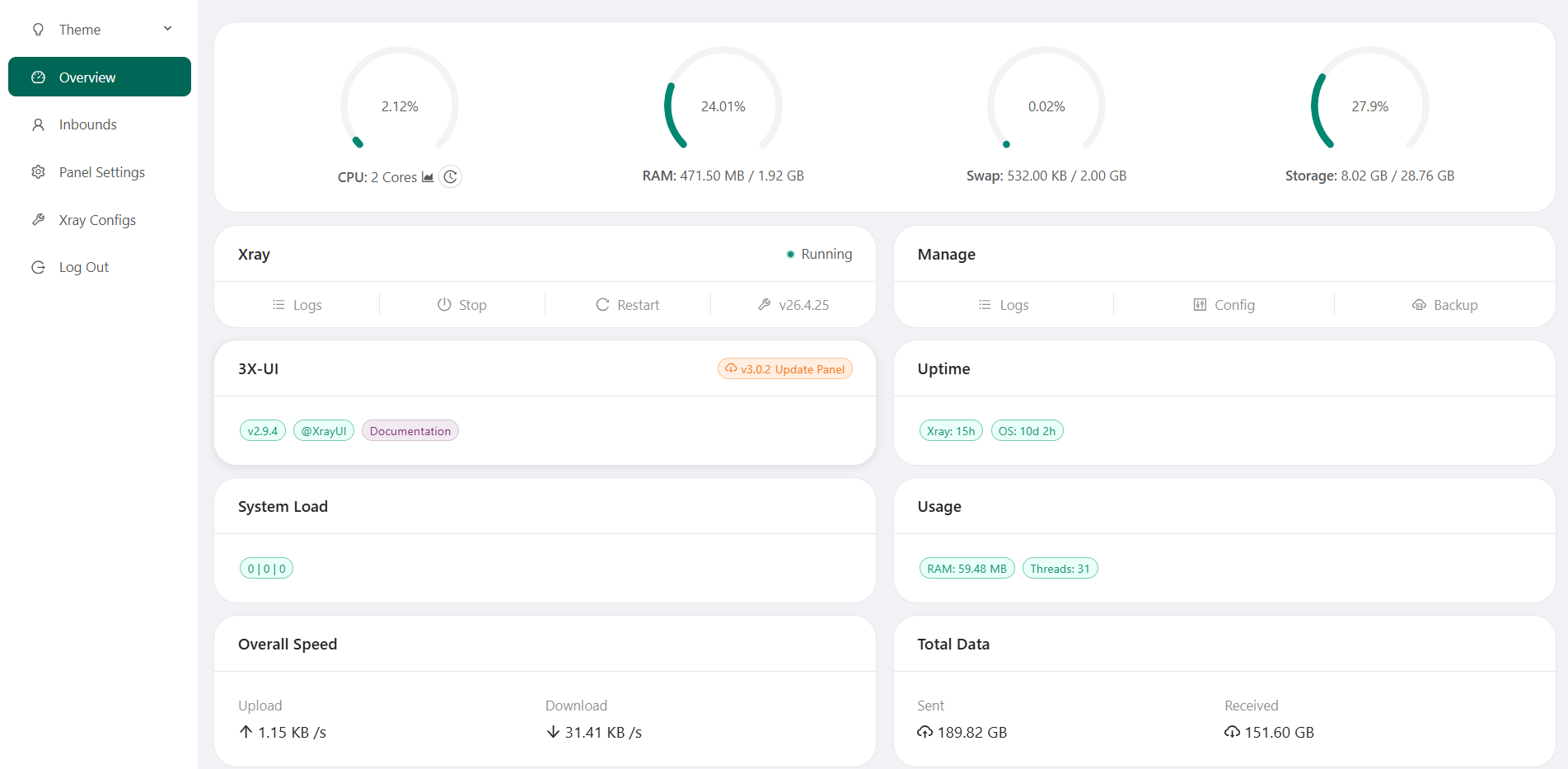
3X-UI main dashboard
Hurdle 3: IP reputation and fraud scores
The risk: When buying a VPS manually, you usually get a generic Data Center IP. Major websites and ad networks (like Google Ads and Facebook) flag these ranges immediately, spamming you with CAPTCHAs or suspending accounts on sight.
The fix: CyberYozh App grants access to residential ISP proxies and mobile IPs with authentic OS fingerprints. This ensures your traffic patterns look completely organic.
All-in-one protection
True modern digital footprint protection demands more than just a cutting-edge protocol—every trace of peripheral data must be immaculate. The CyberYozh App ecosystem provides a comprehensive tool suite to cover your bases:
Private registration: Leverage one-time or residential numbers (Real ISP) to receive SMS verification across 700+ global platforms.
Secure payments: Spin up virtual payment cards to fund international services and ad accounts without tying them to your personal banking records.
Anti-fraud monitoring: Audit your digital fingerprint using our built-in Fraud Score tracker, which cross-checks your IP against blacklists and predicts suspension risks.
Choosing between building it yourself and leaning on a turnkey ecosystem comes down to your priorities. For professionals who value their time and demand a flawless trust score, CyberYozh App delivers a production-ready VLESS/Xray tech stack in an incredibly streamlined package.