
Unlimited mobile proxy for social media: Twitter, Facebook, TikTok
Quick answer: An unlimited mobile proxy routes social media traffic through a real carrier IP under flat-rate billing instead of per-GB charges. That matters for account management, localization testing, and ad verification across Twitter/X, Facebook, Instagram, TikTok, Reddit, and LinkedIn, but it doesn't override any platform's own automation or multiple-account rules, and no legitimate provider will claim otherwise.
TL;DR
Social media workflows are often the first place people hit real bandwidth volume, which is where an unlimited mobile proxy for social media actually pays for itself over metered per-GB pricing
Whether you're searching for an unlimited mobile proxy, mobile proxy unlimited bandwidth, or just mobile proxy unlimited, the underlying question is the same: does the plan cap data by the gigabyte, or not
A mobile IP proxy sits differently in a platform's trust signals than a datacenter IP, though it is not a guarantee against enforcement
Dedicated mobile IPs suit consistent account management; an unlimited rotating mobile proxy setup suits distributed research and monitoring across many accounts or regions
CyberYozh is one practical option once you know exactly which of these problems you're solving
What is an unlimited mobile proxy
A mobile proxy server routes your connection through a real mobile carrier IP, the kind a phone gets from Vodafone, Verizon, or T-Mobile, rather than a datacenter or home broadband address.
"Unlimited" describes the billing model: a flat daily, weekly, or monthly rate instead of metered per-gigabyte charges, within whatever fair-use terms the provider actually publishes.
Unlimited mobile proxies aren't a special IP category; they're a pricing structure applied to standard mobile proxy infrastructure.
Why mobile proxies help social media workflows
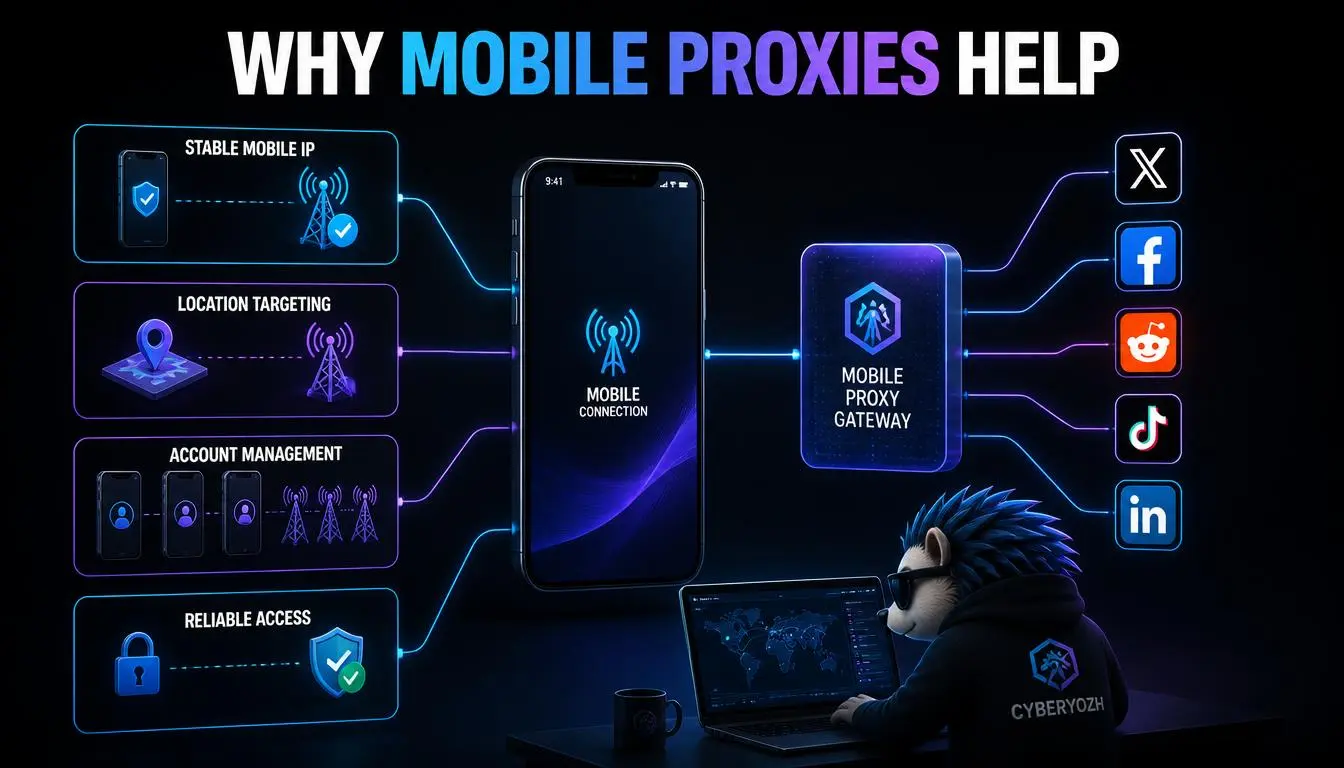
Social media traffic is heavier than most people expect.
Profile images, video previews, ad creative, infinite-scroll feeds, and repeated page loads for monitoring or research all add up fast; a single research session across a handful of accounts can burn through gigabytes without anyone touching an actual video.
That's the specific pressure point where GB-based pricing gets expensive and unpredictable, and where a social media proxy running on flat-rate, unlimited billing starts to make financial sense instead of being a nice-to-have.
The other reason mobile IPs specifically come up in social media conversations is network representation:
A datacenter IP looks nothing like a real user's connection. A residential IP is closer, but still isn't the same network path a phone uses.
A mobile IP proxy runs through the same carrier infrastructure a real mobile user would be on, which matters for legitimate mobile-network testing, not because it changes how a platform evaluates trust and safety signals more broadly.
What unlimited traffic means
"Unlimited" gets used loosely, and it covers four genuinely different things worth separating before you buy:
Term | What it means | What it does not mean |
Unlimited bandwidth | No per-GB traffic charge, within the provider's fair-use policy | Unlimited without any conditions attached |
Unlimited rotation | IPs can be changed as often as the mechanism allows | Unlimited bandwidth, rotation and traffic volume are often billed separately |
Unlimited connections | Multiple simultaneous sessions or threads are permitted | Unlimited data transferred across those connections |
Unlimited sessions | Long or persistent sessions are supported | That the IP stays fixed forever without provider-side resets |
Unlimited bandwidth doesn't automatically mean unlimited rotation, and unlimited rotation doesn't automatically mean unlimited bandwidth; check which of the four a specific plan is actually promising.
Mobile vs residential vs datacenter proxies
Feature | Datacenter | Residential | Mobile |
IP source | Cloud hosting provider | Real home ISP connection | Real mobile carrier network |
Network type | Server infrastructure | Fixed broadband | Cellular (4G LTE / 5G) |
Typical reputation | Lowest trust signal | Higher trust than datacenter | Often the highest, but not guaranteed |
Geographic targeting | Precise, server-level | Good, ISP-dependent | Carrier and region dependent |
Mobile-network representation | None | None | Accurate |
Best use cases | High-speed bulk tasks, low trust requirements | General browsing-style workflows | Mobile-specific testing, carrier-realistic conditions |
IP type is only one input in how a platform evaluates an account; behavior patterns, device fingerprints, and account history also factor in. A mobile IP is not a substitute for following a platform's actual rules.
Unlimited mobile proxy use cases for social media
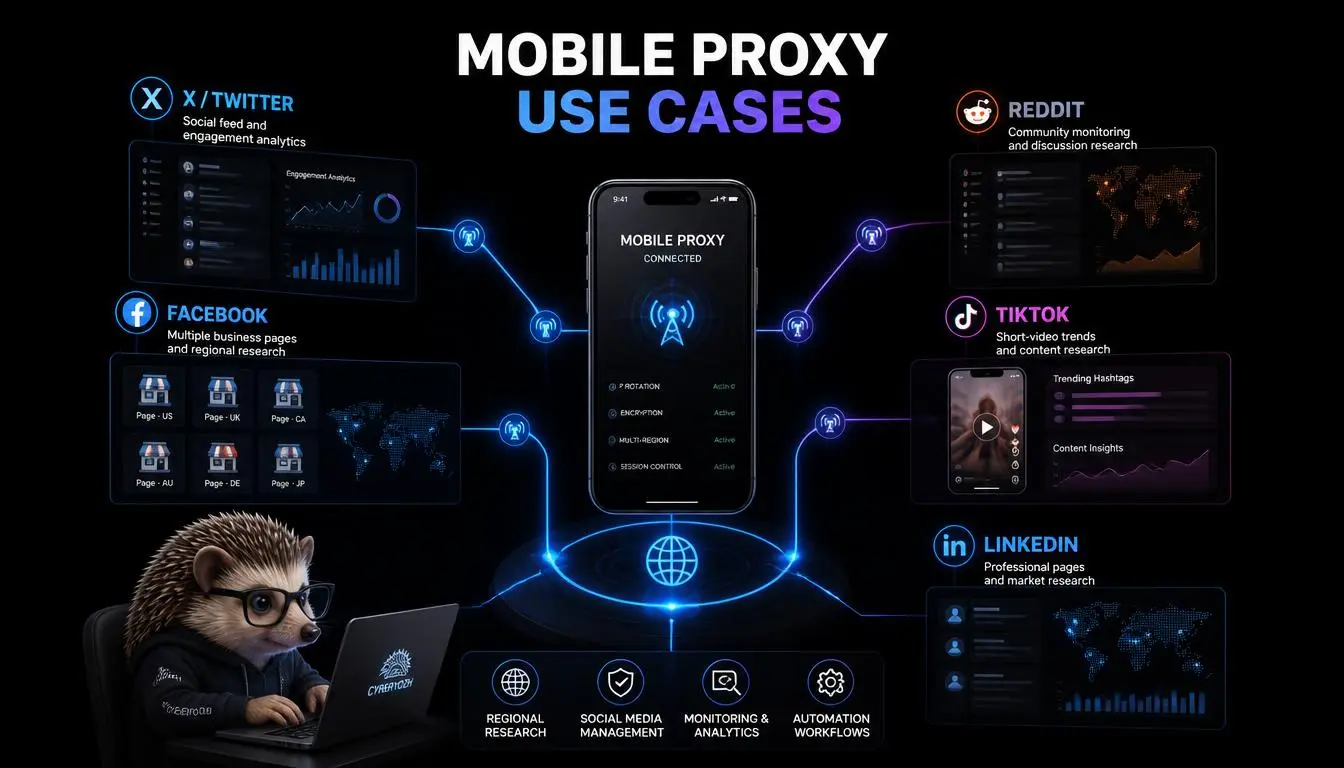
Social media platforms where a mobile proxy is essential to the workflow:
Twitter and X
A Twitter proxy, or an X proxy under the platform's current name, is most useful for regional content testing, location-based research, monitoring public conversations, and QA on how content renders for users in different markets.
X's own automation rules govern what automated activity is permitted regardless of network setup, and following them matters more than any proxy configuration.
A 4G LTE proxy connection is the broadly available, consistent default here; reach for 5G only if your workflow specifically needs the higher throughput.
A Facebook proxy fits regional testing, Page management from a stable network environment, ad verification across markets, and social media research.
A dedicated or sticky mobile IP tends to suit Page and account management better than constant rotation, since logging in from a wildly different network every session is itself an inconsistency signal, not because rotation is inherently risky.
An Instagram proxy is commonly used for account management from a consistent environment, regional content testing, ad verification, and localization checks.
IP consistency matters here for the same reason it matters on Facebook: a stable, predictable network pattern fits how real accounts actually behave.
TikTok
This is where unlimited bandwidth math becomes obvious fastest.
TikTok is video-first, and repeated feed loads for regional content research or campaign testing quickly consume real data volume.
A TikTok proxy on a 5G mobile proxy connection may help create a more geographically relevant testing environment for localized feeds; it doesn't guarantee a specific feed version, and any claim that it does deserves skepticism.
A Reddit proxy supports subreddit research, regional content testing, and monitoring; much of it is read-heavy and login-optional, which keeps bandwidth needs lower than TikTok or Instagram but still benefits from a stable IP for account-based research.
Read about the top 10 Reddit proxy providers ranked
A LinkedIn proxy is typically used for regional market research, localization testing, and account management tied to social media operations.
LinkedIn's professional-network context makes account consistency especially important; this is more often a dedicated-IP use case than a rotating one.
Rotating vs dedicated mobile proxies for social media
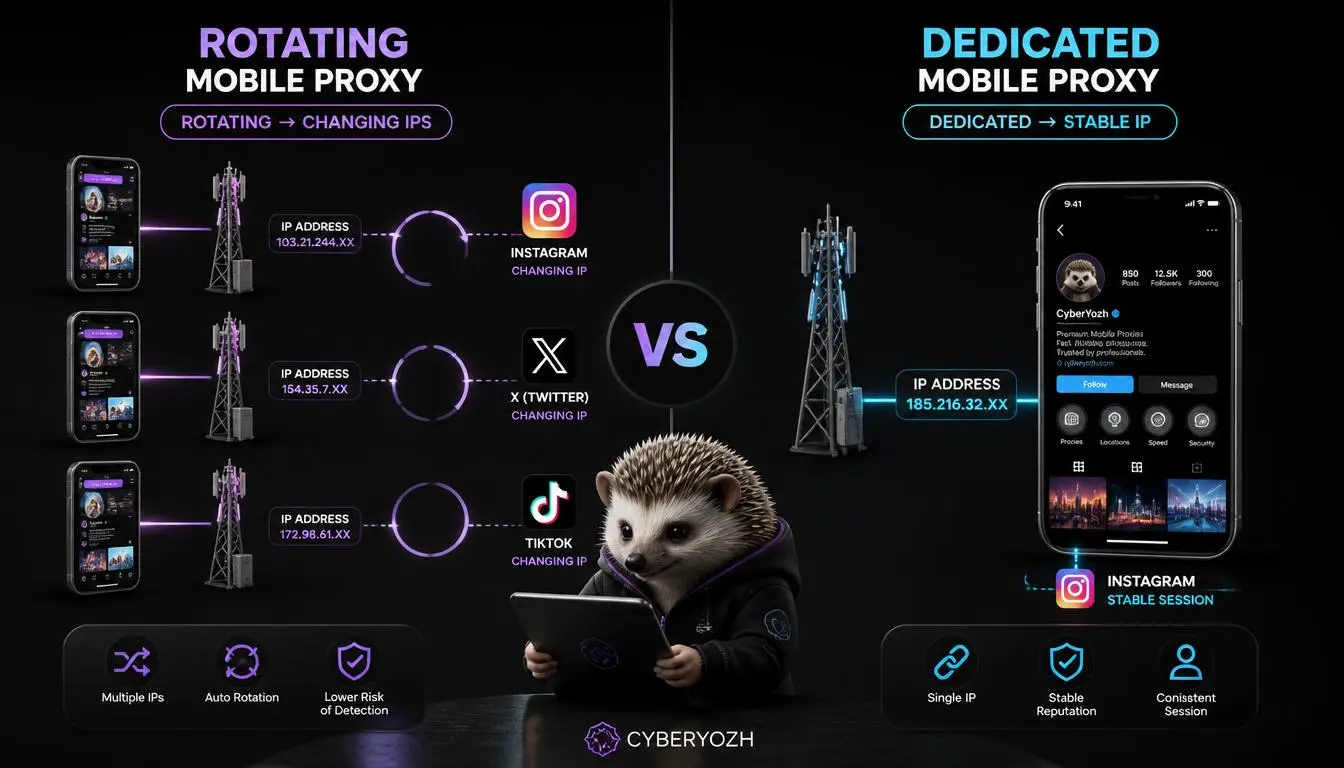
Dedicated or sticky mobile proxies suit situations where session consistency matters: the same IP is preferred, account workflows need to look stable over time, and repeated logins should come from a consistent network environment.
Rotating mobile proxies suit situations where IP changes are genuinely required: distributed research across many accounts, location testing across multiple regions, or high-volume monitoring where a single IP would otherwise take on an unusual traffic pattern.
An unlimited rotating mobile proxy with flat-rate billing and automatic IP cycling is the right combination when both traffic volume and IP diversity matter in the same workflow, though not every provider bundles both into one plan.
Neither approach is universally better. Excessive rotation on an account-management workflow can create the exact inconsistency you were trying to avoid; a single fixed IP on a distributed research workflow just recreates the datacenter problem with better optics.
4G vs 5G mobile proxies
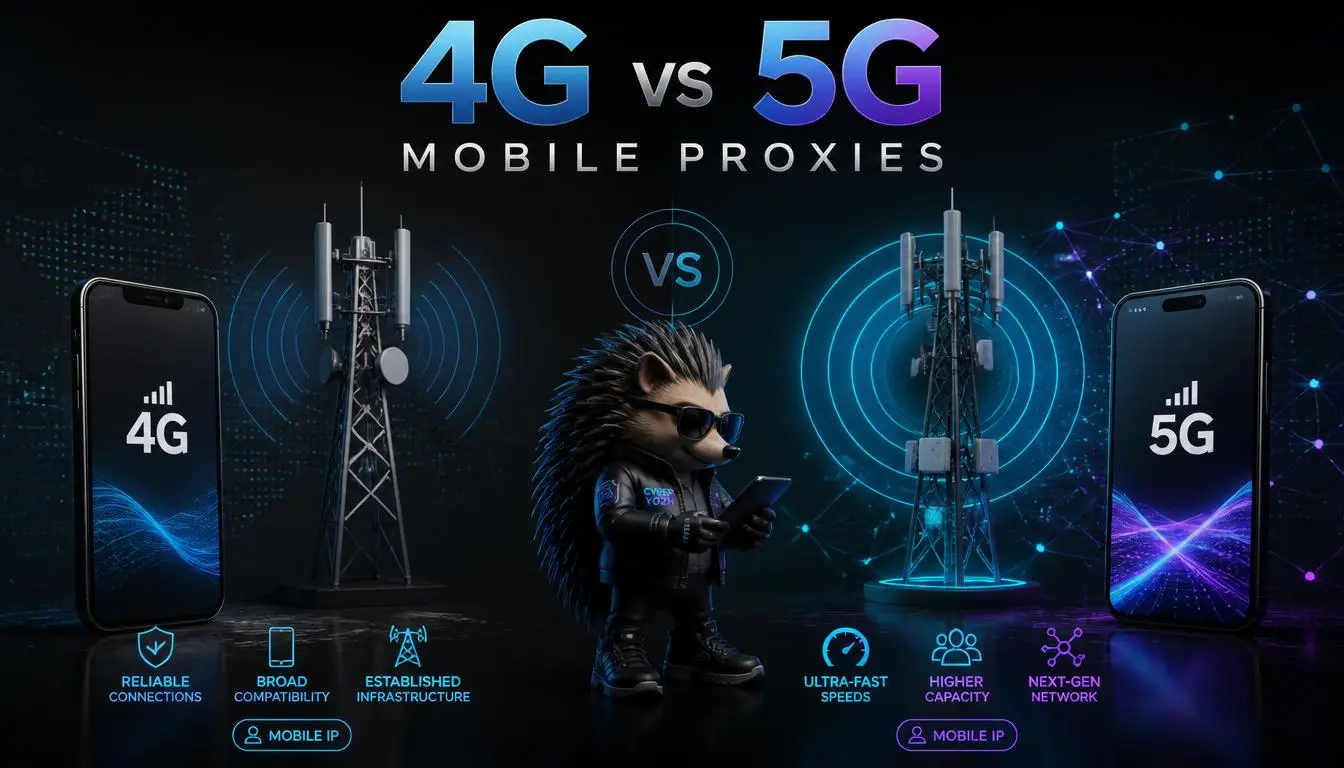
Feature | 4G LTE mobile proxy | 5G mobile proxy |
Network generation | Mature, broadly deployed | Newer, expanding coverage |
Typical performance | Solid, consistent | Higher peak speeds where fully rolled out |
Availability | Broad, most carriers, most regions | Uneven outside major cities |
Stability | Very mature and predictable | Varies more by carrier and location |
Best social use cases | General account management, most testing | Bandwidth-heavy media testing, TikTok/Instagram video |
Important considerations | The safer default for broad coverage | Confirm real 5G availability before assuming a speed advantage |
A 5G proxy isn't automatically better than 4G across the board; actual performance depends on the carrier, local congestion, infrastructure, device, and how the provider implements the connection, not just the network generation on the label.
For most account-management and research workflows, 4G rotating proxies or a dedicated 4G proxy cover the need well; 5G mobile proxies earn their keep for media-heavy, bandwidth-intensive testing.
When do you need unlimited bandwidth
Unlimited bandwidth makes sense when traffic volume is genuinely substantial: media-heavy workflows across TikTok or Instagram, repeated requests across many accounts, or continuous monitoring that would otherwise generate an unpredictable GB bill. It makes less sense for occasional browsing, low-volume research, or one-off testing, where a normal residential proxy, or even a small metered mobile plan, is cheaper than a flat-rate commitment you won't fully use.
Common mistake: Assuming "unlimited" always means the best deal. If your actual traffic volume is low, a flat-rate plan can cost more than metered billing would. Match the pricing model to your real usage, not the other way around.
The FTC has treated "unlimited" claims as a real regulatory issue, not just a marketing word; the agency fined TracFone $40 million in 2015 specifically for advertising unlimited mobile data while quietly throttling heavy users. Read the fair-use terms behind any unlimited mobile proxy plan before committing to one.
If bandwidth-heavy social workflows are the actual bottleneck, CyberYozh's proxy plans are worth checking against your real traffic volume before you commit to a flat rate.
How to choose a mobile proxy for social media
Confirm the fair-use policy behind any "unlimited" claim
Check real carrier quality rather than resold low-tier connections
Verify actual 4G or 5G availability in your target markets
Check whether rotation is manual or automatic and how sticky sessions are configured
Match dedicated versus shared access to whether your workflow needs persistence or diversity
Test speed and reliability at small scale before committing to volume, and confirm authentication method and API support fit your existing tools.
Need mobile IPs without conventional GB-based traffic limits for testing across these platforms? Explore CyberYozh's current 5G mobile proxy options and check whether the plan fits your workload.
CyberYozh as a practical unlimited mobile proxy solution
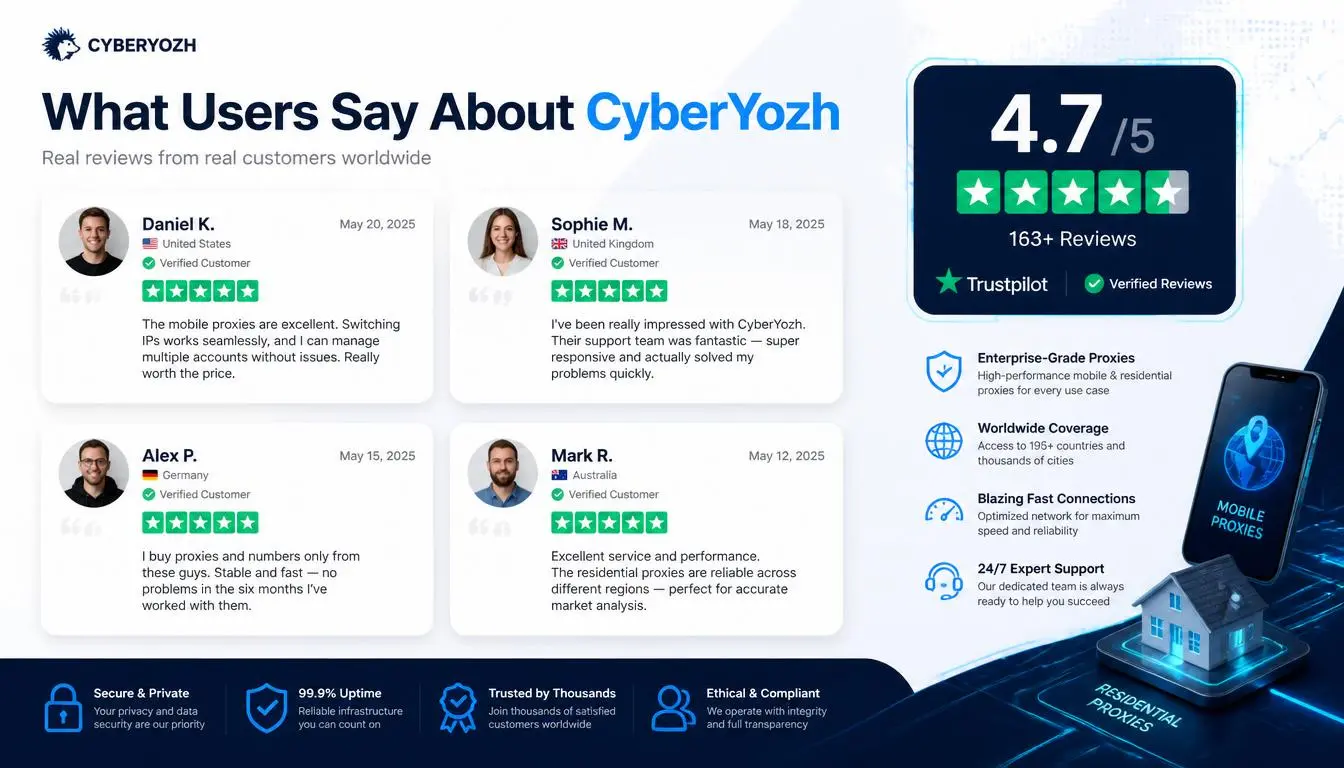
CyberYozh's dedicated 4G/LTE/5G mobile proxies start at $1.70/day, billed at a flat rate with no data-volume cap, across 20+ dedicated mobile locations including the US, UK, Germany, Israel, and Portugal, plus a shared-port option from around $0.70/day for lighter workloads.
High traffic from media-heavy platforms. Conventional GB limits get expensive fast on video-first workflows. CyberYozh's flat daily rate with no data cap keeps high-volume TikTok or Instagram testing cost-predictable, no matter how much media the workflow loads.
Need for a real mobile network environment. Datacenter and even residential IPs don't represent an actual carrier connection. CyberYozh's 4G and 5G mobile proxy infrastructure gives testing workflows a genuinely mobile-network-based environment.
Need for IP control that matches the workflow. Constant random rotation doesn't fit every social account workflow. CyberYozh's connection generator supports manual or automatic IP rotation and sticky sessions up to 30 minutes, so both account-management-style use and distributed, rotation-heavy research can run on the same infrastructure.
CyberYozh isn't the only option here, and it isn't necessary for light, occasional use, but for the specific combination of mobile-network realism, flat-rate unlimited billing, and configurable rotation this article covers, it's worth evaluating against your actual requirements.
Read about the top 10 mobile proxy providers ranked
Common mistakes to avoid
Assuming unlimited bandwidth also means unlimited rotation, connections, or session length, when it usually covers only one.
Ignoring the fair-use policy behind an unlimited claim and being surprised by throttling under real load.
Choosing 5G by default because it sounds faster, without checking whether it's actually available where you're testing.
Using constant IP rotation on an account-management workflow where a stable, dedicated IP would look more consistent.
Assuming any proxy type prevents platform enforcement action is wrong, and no legitimate provider should claim otherwise.
Final verdict
An unlimited mobile proxy for social media earns its cost specifically when traffic volume is real: video-heavy testing on TikTok or Instagram, sustained monitoring across several accounts, or research workflows that would otherwise generate an unpredictable GB bill.
For occasional, low-volume use, the flat-rate premium isn't worth it. Once you've identified the specific problem- bandwidth, rotation, or a genuinely mobile-network environment- CyberYozh's dedicated 4G/5G mobile proxy plans are a practical option to evaluate against those requirements.