
Best Residential Proxies With Unlimited Bandwidth In 2026

Many proxy providers charge for residential traffic based on how many gigabytes you use. This model works for short tasks, but it quickly becomes restrictive when workflows run for long periods or generate large amounts of data. Scraping, monitoring, automation, and regional testing can consume bandwidth continuously, making it difficult to control costs or keep operations running without interruption.
This is where residential proxies unlimited bandwidth become valuable. Instead of limiting traffic or billing every request, unlimited bandwidth allows tasks to run as long as needed. Teams can focus on completing workflows rather than constantly monitoring data usage or adjusting scripts to stay within a traffic limit.
Another important factor is session stability. Many operations require the same IP address to remain consistent during the entire session. Static residential proxies unlimited bandwidth provide this stability by using real ISP-based IPs that do not change during use. This makes them suitable for long scraping sessions, regional website testing, SEO monitoring, and other workflows that rely on consistent connections.
What are residential proxies with unlimited bandwidth
Residential proxies route your connection through IP addresses assigned by real internet service providers. When a request goes through a residential IP, websites see it as traffic from a normal household connection rather than a server. This makes residential proxies useful for tasks that require stable access, regional testing, data collection, and long-running sessions. When these proxies come with unlimited bandwidth, the provider does not charge based on how much data passes through the connection.
Most residential proxy services charge per GB, which means every request increases the total cost. With residential proxies unlimited bandwidth or static residential proxies unlimited bandwidth, traffic limits are removed. This allows scraping jobs, monitoring tools, and testing workflows to run for longer periods without stopping because of bandwidth restrictions.
Key points to understand:
Residential proxies use real ISP IP addresses instead of datacenter networks
Unlimited bandwidth means traffic is not billed per GB
Static residential proxies unlimited bandwidth allow long sessions with the same IP
This model is better suited for scraping, testing, and monitoring tasks that generate large volumes of data
Stable residential IPs reduce disruptions caused by frequent IP changes
Learn more about what a residential proxy is!
Why stable long sessions are important
Some online workflows depend on keeping the same IP address active for a long time. When a connection changes too often, websites may reset sessions, request additional verification, or interrupt access. This is why stable connections are important for tasks that run continuously, especially when automation, monitoring, or data collection tools are involved.
Using static residential proxies unlimited bandwidth helps maintain a consistent IP while allowing the session to run without traffic limits. This combination supports longer operations and reduces interruptions that can slow down scraping jobs, testing workflows, or regional monitoring tasks.
Stable long sessions are important because they help:
Keep the same IP address active during long tasks
Reduce repeated logins, verification checks, or session resets
Support automation scripts that run for hours or days
Maintain consistent regional access when testing websites or collecting data
Allow workflows to run without stopping due to bandwidth limits with residential proxies unlimited bandwidth
Key features to look for in residential proxies with unlimited bandwidth
Not all residential proxy services provide the same level of infrastructure quality. When evaluating residential proxies unlimited bandwidth, it is important to look beyond the traffic model and review the technical features that affect reliability and usability.
Important features include:
Real ISP-sourced IPs: IP addresses should come from genuine internet service providers rather than datacenter networks.
Stable long-session support: The proxy should allow connections to remain active without frequent interruptions.
High connection speed: Faster connections help scraping tools, automation scripts, and monitoring systems run more efficiently.
Clean and managed IP quality: Providers should actively monitor IP reputation to reduce conflicts and blocks.
Country and regional targeting: The ability to select specific locations is important for market research, SEO checks, and regional testing.
SOCKS5 and HTTP/HTTPS support: Multiple protocols make it easier to integrate proxies with different tools and environments.
API access for automation: Developers and data teams often need programmatic control over proxy sessions.
Transparent pricing: Clear pricing helps teams estimate costs without hidden limitations.
Reliable support: When issues appear during long workflows, responsive support can prevent downtime and task interruption.
Why is CyberYozh a strong choice for residential proxies with unlimited bandwidth
CyberYozh is one of the best residential proxies with unlimited bandwidth for teams that need stable long sessions and predictable costs. The platform focuses on infrastructure and practical features rather than marketing claims. Each proxy includes 1 dedicated residential IP, unlimited bandwidth, real ISP connections, 24-hour availability, low ping, speeds up to 150 Mbps, and SOCKS5 with UDP support. Pricing is also transparent, starting from $5.39 per month for 1 IP, which makes it easier to plan scraping jobs, testing sessions, regional checks, and other workflows that depend on a stable connection.
CyberYozh also offers strong global coverage. The platform provides access to over 100 million residential IPs across 100+ countries, allowing users to choose between static residential proxies for stable long sessions or rotating proxies for wider request distribution. Developers and automation teams can also integrate proxies easily using API access, HTTP, and SOCKS5 protocols, which work well with scraping tools, monitoring systems, and testing frameworks.
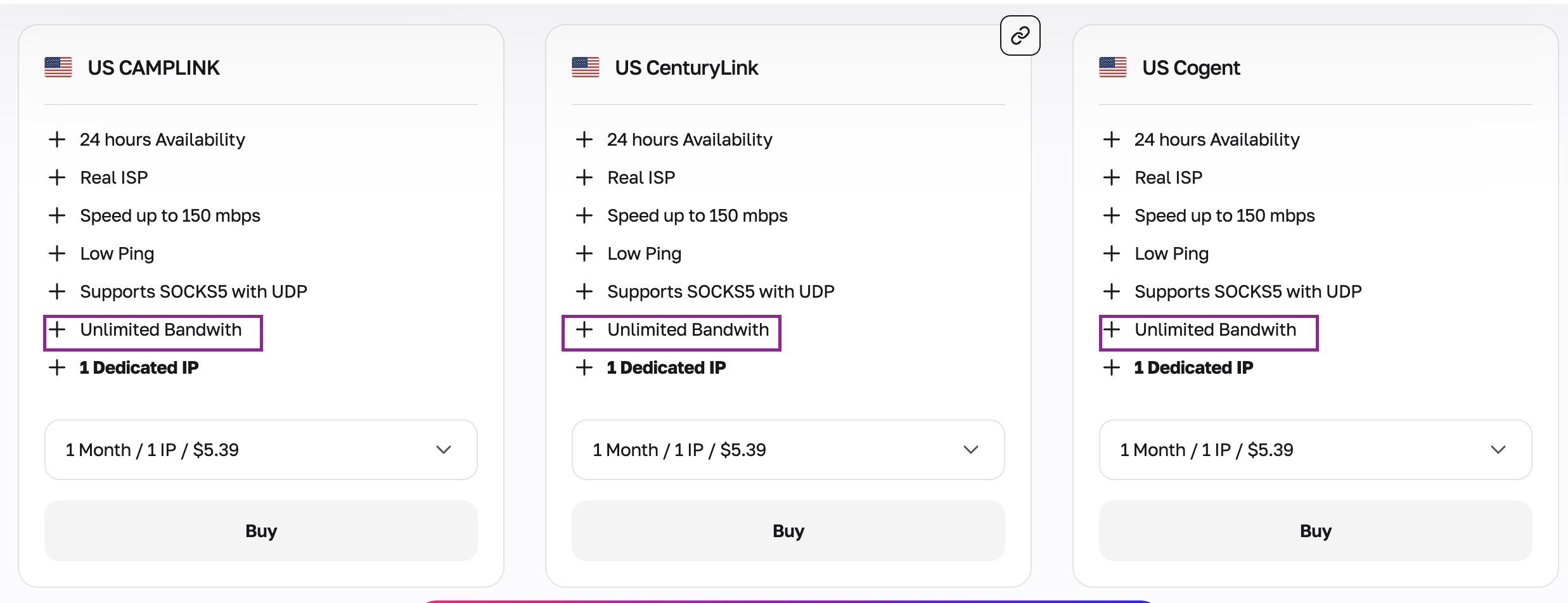
Another advantage is that CyberYozh provides more than just residential proxies. Inside the same platform, users can access the best mobile proxies, datacenter proxies, SMS activation, and reputation checks, reducing the need to manage several infrastructure providers.
Start using CyberYozh residential proxies with unlimited bandwidth today and run long workflows without traffic limits.
Why do these features help in practice
Unlimited bandwidth helps long-running tasks continue without traffic limits
1 dedicated IP supports stable sessions and consistent identity
Real ISP residential IPs make traffic look more natural to websites
Speed up to 150 Mbps helps with data-heavy tasks and faster response times
Low ping supports workflows that need steady performance
SOCKS5 with UDP support gives more flexibility for tools and integrations
24-hour availability supports ongoing tasks without frequent interruptions
100 million residential IPs in 100+ countries gives broad location coverage for scaling
Additional proxy options for different workflows
CyberYozh also provides other proxy types for tasks that require different network behavior. Users can access mobile proxies, rotating residential proxies, and datacenter proxies inside the same platform without switching providers.
Mobile proxies (LTE/5G) – from $1.7 per day, with unlimited traffic. Suitable for trust-sensitive platforms, social networks, and account-based workflows.
Residential rotating proxies – from $0.9 per GB, designed for large-scale scraping, crawling, and data aggregation tasks.
Datacenter proxies – from $1.9 per month with unlimited traffic, useful for speed-critical operations and cost-efficient large request volumes.
Having these options in one platform allows teams to match the proxy type to the task without managing multiple vendors.
When unlimited bandwidth is better than pay-per-GB pricing
Many proxy providers charge for residential traffic by the amount of data used. This model works for short tasks, but it becomes restrictive when workflows run for long periods or generate large volumes of requests. In those situations, residential proxies unlimited bandwidth offer a more practical setup because traffic limits no longer control how long a task can run.
Unlimited bandwidth is usually the better option when:
Long-running tasks with predictable uptime needs: Scraping jobs, monitoring systems, or testing environments may run for hours or days. With unlimited bandwidth, the session can continue without worrying about reaching a traffic cap.
Frequent requests over time: Tools that send repeated requests, such as price monitoring or SERP tracking systems, steadily generate traffic. Unlimited bandwidth allows these systems to run consistently without adjusting request rates.
Teams that want simpler cost planning: Metered proxy plans make it difficult to estimate monthly costs because usage can vary. Unlimited bandwidth removes this uncertainty and makes budgeting easier.
Cases where metered pricing becomes expensive or hard to predict: Large scraping jobs or data aggregation tasks can quickly consume gigabytes of traffic. With usage-based pricing, costs may rise unexpectedly as data collection grows.
Static vs rotating residential proxies
Residential proxies generally fall into two categories: static residential proxies and rotating residential proxies. Both use real ISP IP addresses, but they behave differently during a session. Choosing the right type depends on how stable the connection needs to be and how widely traffic should be distributed.
Static residential proxies
Static residential proxies provide one dedicated IP address that remains the same during the session or rental period. This stability makes them useful for tasks that rely on a consistent connection environment.
Static proxies are commonly used for:
Long sessions where the same IP must remain active
Web scraping projects that run continuously
QA testing and behavioral checks on websites
Repeated access from the same region
Static IPs work well when persistence matters. Because the connection stays consistent, websites are less likely to interrupt the session with verification prompts or resets.
Rotating residential proxies
Rotating residential proxies automatically switch between different IP addresses from a large pool. Each request or session may use a different residential IP.
This model works well for:
Large-scale crawling across many pages
Data aggregation from multiple regions
High-volume request distribution
Tasks that require frequent identity changes
However, rotating proxies are not always the best option for session-heavy workflows. When the IP changes too often, websites may reset sessions or interrupt tasks that depend on a stable connection.
Which one fits your workflow
Choosing between static and rotating residential proxies depends on how the task operates. Some workflows benefit from stable sessions, while others require broad IP distribution.
Consider these factors when selecting a proxy type:
Match proxy type to task – scraping sessions often prefer stability, while large crawlers benefit from rotation
Stability vs rotation – static IPs maintain consistency, rotating IPs spread traffic across networks
Persistence vs distribution – long sessions favor persistence, large-scale collection favors distribution
Who needs residential proxies with unlimited bandwidth
Not every workflow requires unlimited proxy traffic, but some operations generate continuous requests and long-running sessions. When tasks run for hours, collect large amounts of data, or need stable connections, bandwidth limits quickly become a constraint. Residential proxies unlimited bandwidth are often used by teams that depend on consistent access, predictable costs, and uninterrupted operations.
Web scraping teams running long jobs
Data collection often runs for hours or even days. Scraping product pages, search results, or public listings generates large volumes of requests. When traffic is billed per GB, costs rise quickly and scripts may need to slow down. With residential proxies unlimited bandwidth, scraping tools can collect data continuously without stopping to manage bandwidth usage.
QA and testing teams checking region-based experiences
Many companies test how their websites behave in different locations. QA teams may need to keep the same IP active while checking checkout flows, login behavior, or localized content. Static residential proxies unlimited bandwidth make these tests easier because the session stays stable and traffic limits do not interrupt the process.
E-commerce operators monitoring stores and listings
Online sellers often track competitor prices, product availability, and marketplace listings. These checks run repeatedly throughout the day and can generate a lot of traffic. Using residential proxies with unlimited bandwidth allows monitoring systems to collect updates regularly without worrying about bandwidth limits.
SEO teams doing local SERP checks
Search results change depending on location. SEO teams use residential proxies to see what users in different regions actually see in search engines. When these checks run across multiple keywords and locations, bandwidth usage grows quickly. Unlimited traffic allows ranking checks and SERP monitoring tools to run consistently.
Agencies managing client environments
Marketing and automation agencies often manage multiple accounts, campaigns, and platforms for different clients. Each environment may require a separate IP and long session stability. Residential proxies with unlimited bandwidth make it easier to maintain these environments without constantly tracking traffic usage.
Businesses running repetitive, always-on workflows
Some operations never really stop. Monitoring systems, automation scripts, and data collection tools may run around the clock. In these situations, metered proxy plans become difficult to manage. Residential proxies unlimited bandwidth allow these workflows to run continuously while keeping costs predictable.
Common mistakes when choosing residential proxies
Many users focus on surface-level features when selecting a proxy provider and overlook the factors that actually affect stability and long-term usability. Residential proxies can look similar on paper, but small differences in infrastructure, bandwidth policies, and session behavior can significantly impact how well a workflow performs.
Common mistakes include:
Choosing rotating proxies when the task needs persistence: Some workflows require the same IP for long sessions. Frequent rotation can trigger verification checks or session resets.
Focusing only on IP pool size: A large pool does not guarantee quality. Overused IPs can lead to unstable connections and more blocks.
Ignoring protocol support: Tools may require SOCKS5 or HTTP. Without proper protocol support, integration becomes difficult.
Buying based on price alone: Cheap proxies often come with unstable IPs, slower speeds, or heavy address reuse.
Not checking whether bandwidth is truly unlimited: Some providers advertise unlimited traffic but apply hidden limits or fair-use policies.
Overlooking support and infrastructure control: When problems appear during long workflows, reliable support can prevent downtime and broken tasks.
Residential proxies with unlimited bandwidth vs other proxy types
Residential proxies are only one option within the proxy ecosystem. Mobile proxies and datacenter proxies also serve specific purposes. Understanding the differences helps ensure the chosen proxy type fits the task.
Residential ISP proxies vs mobile proxies
Mobile proxies operate through real mobile carrier networks. Because these networks frequently rotate IPs among mobile devices, they often receive higher trust from some online platforms.
Key differences include:
Mobile proxies for trust-sensitive environments: Platforms that closely monitor traffic patterns may respond better to mobile carrier IPs.
Residential ISP proxies for long sessions and stable identity: Static residential IPs provide a consistent connection that can remain active for extended periods.
When deciding between them, consider whether the workflow requires high trust signals or stable session persistence.
Residential ISP proxies vs datacenter proxies
Datacenter proxies come from cloud hosting providers and corporate server networks. They are often faster and cheaper than residential proxies but are easier for websites to identify as non-residential traffic.
Important distinctions include:
Datacenter proxies for speed and cost efficiency: These proxies work well for infrastructure tasks and operations that require high request speeds.
Residential proxies for realism and regional stability: Because they originate from real ISP networks, residential IPs are better suited for workflows that need realistic browsing environments.
The most effective choice always depends on the task. Instead of searching for a universal “best” proxy type, it is better to match the proxy network to the operational requirement.
Final thoughts
Residential proxies with unlimited bandwidth are the best choice for workflows that run continuously or generate large amounts of traffic. Unlike pay-per-GB models, they allow scraping, monitoring, testing, and automation tasks to run without worrying about traffic limits or unpredictable costs.
For long-running operations, static residential proxies unlimited bandwidth are especially useful because they keep the same ISP-based IP active during the session. This stability reduces session resets, repeated verification checks, and interruptions.
When choosing the best residential proxies with unlimited bandwidth, focus on real ISP IPs, stable connections, transparent pricing, and reliable infrastructure. Providers such as CyberYozh combine these elements with 1 dedicated IP, unlimited bandwidth, speeds up to 150 Mbps, SOCKS5 support, and pricing starting from $5.39 per month, along with access to 100 million residential IPs in 100+ countries.
For teams running scraping jobs, SEO monitoring, QA testing, or automation systems, residential proxies unlimited bandwidth provide the stability, scale, and cost predictability needed for long-term workflows.
FAQs about static residential proxies unlimited bandwidth
What does unlimited bandwidth mean for residential proxies?
Unlimited bandwidth means the proxy provider does not charge based on how much data passes through the connection. Instead of paying per GB, users can send requests and transfer data without worrying about traffic limits. This allows scraping, monitoring, testing, and automation tasks to run continuously.
Are unlimited bandwidth residential proxies faster?
Unlimited bandwidth itself does not increase speed. Proxy performance depends on network quality, infrastructure, and routing. However, unlimited traffic allows tasks to run without slowing down due to bandwidth caps or usage restrictions.
When should you use residential proxies with unlimited bandwidth?
Residential proxies with unlimited bandwidth are useful when workflows generate large volumes of traffic or run for long periods. Common use cases include web scraping, SEO monitoring, price tracking, regional website testing, and automation systems that send frequent requests.
What is the difference between static residential proxies and rotating residential proxies?
Static residential proxies keep the same IP address during the entire session or rental period. Rotating residential proxies automatically switch between multiple IP addresses from a larger pool. Static proxies work better for stable long sessions, while rotating proxies help distribute requests across many IPs.
Are residential proxies better than datacenter proxies?
Residential proxies use IP addresses assigned by real internet service providers, which makes them appear like normal user traffic. Datacenter proxies come from cloud servers and are usually faster and cheaper, but they are easier for websites to detect.
Can residential proxies be used for web scraping?
Yes. Residential proxies are commonly used for web scraping because they help requests appear like normal user traffic. When combined with unlimited bandwidth, they allow scraping tools to collect large amounts of data without worrying about traffic limits.
Can you choose locations with residential proxies?
Most residential proxy providers allow users to select locations such as countries or regions. This helps with regional testing, SEO monitoring, market research, and collecting data from specific geographic locations.
Are residential proxies safe to use?
Residential proxies are safe when used through reputable providers that operate legitimate proxy networks and maintain proper infrastructure management. Reliable providers also monitor IP quality and maintain stable network performance.