Best SEO Proxies for 2026: 10 Top Picks for Rank Tracking & SERP Data

You're three hours into a keyword crawl. Rankings are flowing in. Client deliverable is looking sharp. Then it stops! CAPTCHA wall. IP flagged. Session dead. And now you've got to explain to your client why a third of their keyword data is missing.
SEO proxies exist to solve exactly this problem by making your automated requests appear to come from real people in real locations rather than from a single bot hammering the same endpoint. But choosing the right one in 2026 is genuinely complicated.
The market is crowded, the pricing is confusing, and half the "best of" lists out there were written by people who've never actually run a serious rank tracking operation.
“We tried over 30 providers. Along with their best features ,we looked at pricing structures that don't require a contract negotiation to understand. And we found something most guides aren't willing to say out loud: many SEOs are paying for the wrong tools and still getting blocked, because they're missing a layer.”
Who needs SEO proxies
Before we get into the providers, let's be clear about who this is actually for. Because "SEO proxy" gets thrown around a lot, and the use cases are genuinely different.
Rank tracking professionals: If you're checking where a site ranks for hundreds or thousands of keywords across multiple locations, you're sending a volume of requests that no search engine will tolerate from a single IP. Proxies are non-negotiable.
Digital marketing agencies managing multiple clients need geographic diversity in their data. A client in Manchester needs ranking data that reflects what someone in Manchester actually sees, not what Google serves to your office IP in London or Chicago.
In-house SEO teams at larger brands face the same volume-related problems. Enterprise-level keyword portfolios require enterprise-level infrastructure to monitor accurately.
Competitor intelligence analysts scraping SERP features, ad placements, and organic rankings for strategy work will hit blocks fast without rotating IPs.
Content marketers and bloggers running their own rank tracking on smaller budgets still benefit; even lighter keyword sets get blocked when you're checking them daily from the same IP.
Web scraping developers building SEO tools, price monitoring systems, or content aggregators rely on proxy infrastructure as the backbone of their entire operation.
Multi-account SEO operators. People running link building outreach at scale, managing multiple client Google Business Profiles, or operating several Search Console accounts simultaneously. For them, it's not just about IPs, it's about complete identity isolation. That's a distinction we'll come back to.
Why your SEO tools keep getting blocked
Search engines are no longer just counting requests per IP. That approach worked ten years ago. Today, it's a much more sophisticated operation.
Google's detection systems look at request cadence; if searches are arriving at perfectly timed intervals, that's a bot signature. They look at session behavior: do visitors scroll, pause, or occasionally go back, or does every session follow the same path? They analyze geographic consistency. Checking the timezone in your browser headers matches the city your IP is supposedly coming from?
And browser fingerprinting, which is where most modern anti-bot systems land the actual killing blow. Your browser leaks information constantly: screen resolution, installed fonts, canvas rendering output, WebGL configuration, audio stack characteristics, hardware concurrency, and device memory estimates.
This is why swapping your IP using a proxy that works seamlessly with anti-detector browsers is important. You change your address, but your fingerprint stays the same. The platform correlates them and knows it's you.
What makes a great SEO proxy

Five things separate genuinely useful SEO proxies from those that look good on a spec sheet but fail in production.
IP pool size — A larger pool means each IP gets used less often, making patterns harder to detect. When one provider has 50M IPs, and another has 5M, the difference in block frequency is immediately felt in real-world crawls.
Location targeting precision — Country-level targeting is the bare minimum. For local SEO work, you need city-level at minimum, ideally down to ZIP code or specific ISP. "US proxies" is not useful if your client needs to know what ranks in Denver specifically.
Success rate — the percentage of requests that return clean, usable data. Anything below 99% starts compounding into real data gaps at scale. A 2% failure rate across 100,000 requests is 2,000 holes in your report.
Response speed — Sub-second response times keep your crawls efficient and, crucially, keep your request timing looking more natural. Slow proxies don't just cost you time; they change your request pattern in ways that trigger detection.
Ethical IP sourcing — IPs sourced through opt-in networks where users knowingly consent to sharing bandwidth, maintain cleaner histories. Providers using botnet-harvested IPs deliver pools where addresses are already flagged across thousands of blocklists before you've sent a single request.
Rotating vs. Dedicated SEO proxies: Which one do you need
The right answer depends on what you're actually doing, but most SEO operations eventually need both.
Rotating proxies assign a fresh IP with each request or on a timed rotation schedule. Every search appears to originate from a different person in a different location. This is the right choice for large-scale keyword tracking, SERP scraping across thousands of queries, and any bulk data collection where IP diversity is the primary defense against detection.
Dedicated SEO proxies maintain the same IP address for an extended period, assigned exclusively to you, not shared with other customers. This is what you need when you're logged into Google Search Console, maintaining consistent monitoring sessions, or doing any account-based work where session continuity matters. The consistency of a dedicated IP also builds an implicit "trust history" with platforms that track returning visitors.
“The practical guidance for most agencies and professionals: use rotating proxies for data collection and dedicated SEO proxies for session-based and account-related tasks. Running both simultaneously through a single management layer is the professional standard, and it's one of the things that makes all-in-one tools worth looking at seriously.”
The 10 best SEO proxy providers for 2026
We tested these across real-world rank-tracking workloads, paid attention to actual block rates rather than marketing claims, and looked closely at pricing structures that make sense for professional budgets. Here's what we found.
1. CyberYozh
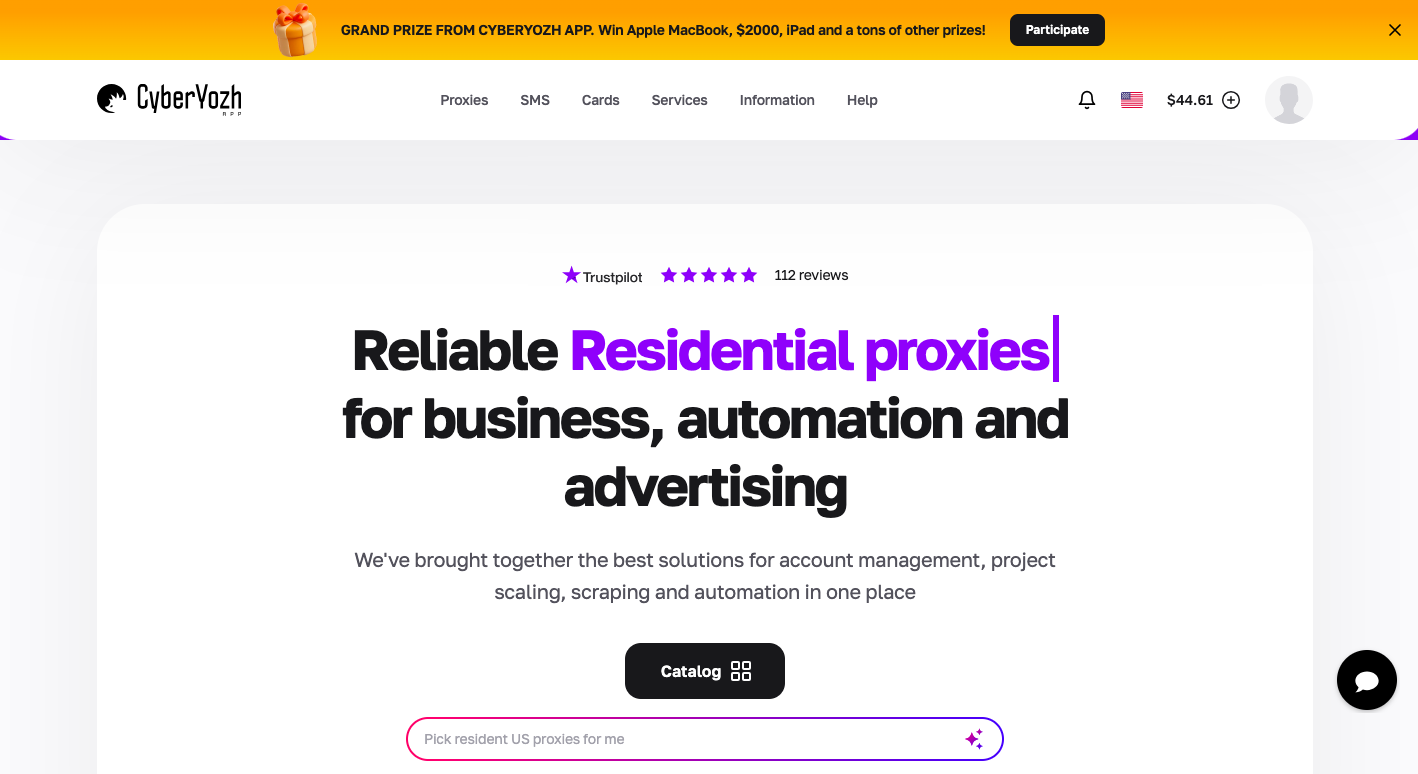
CyberYozh takes a different approach. The big idea behind CyberYozh is simple: getting blocked isn't just an IP problem, it's a trust problem. So instead of just selling IPs, they built a platform that handles every layer of that trust, from the IP's history to the connection type to the verification tools your workflow actually needs.
What really sets it apart from day one is that every single IP gets checked against 50+ security databases before you ever use it. Their built-in Fraud Score tool catches blocked or flagged addresses upfront, not after they've already broken your crawl. That's not something most proxy providers bother doing, and in real SEO work, it makes a noticeable difference to your data quality.
The mobile proxy network is another genuine standout. CyberYozh runs on real 4G/5G carrier networks with actual SIM cards, not emulated connections. Mobile IPs are among the hardest for search engines to flag, and at $1.70/day with unlimited traffic (no bandwidth caps, ever), this is priced far more accessibly than comparable mobile proxy services.
Features:
Fraud Score tool — every IP is screened against 50+ security databases before use
50 million residential IPs across 100+ countries with city and country targeting
Real 4G/5G mobile proxies on actual carrier networks with unlimited traffic.
Built-in SMS and phone number verification, no third-party service needed
99.9% uptime with automatic IP failover so sessions don't break mid-crawl
Residential, mobile, and datacenter proxies, all in one dashboard
SOCKS5, HTTP, HTTPS, and UDP protocol support for any tool in your stack
Works natively with Multilogin, AdsPower, and Dolphin Anty
Full automation and scraping support — plug straight into your existing workflows
24/7 customer support in 7 languages
The pricing is where CyberYozh quietly outsmarts most of the competition. Static residential from $5.29/month. Mobile from $1.70/day with no traffic limits.
Best for: Affiliate marketers, agencies managing multiple accounts, ad verification, competitor intelligence, rank tracking professionals, and anyone running large-scale scraping who needs clean, pre-vetted IPs without enterprise-level pricing.
“Compare that to the typical SEO stack, a proxy subscription here, an anti-detect browser there, a separate SMS verification service on top, and you're often looking at $150–300+/month for a setup that still has gaps. CyberYozh replaces most of that in a single, affordable platform.”
2. Webshare
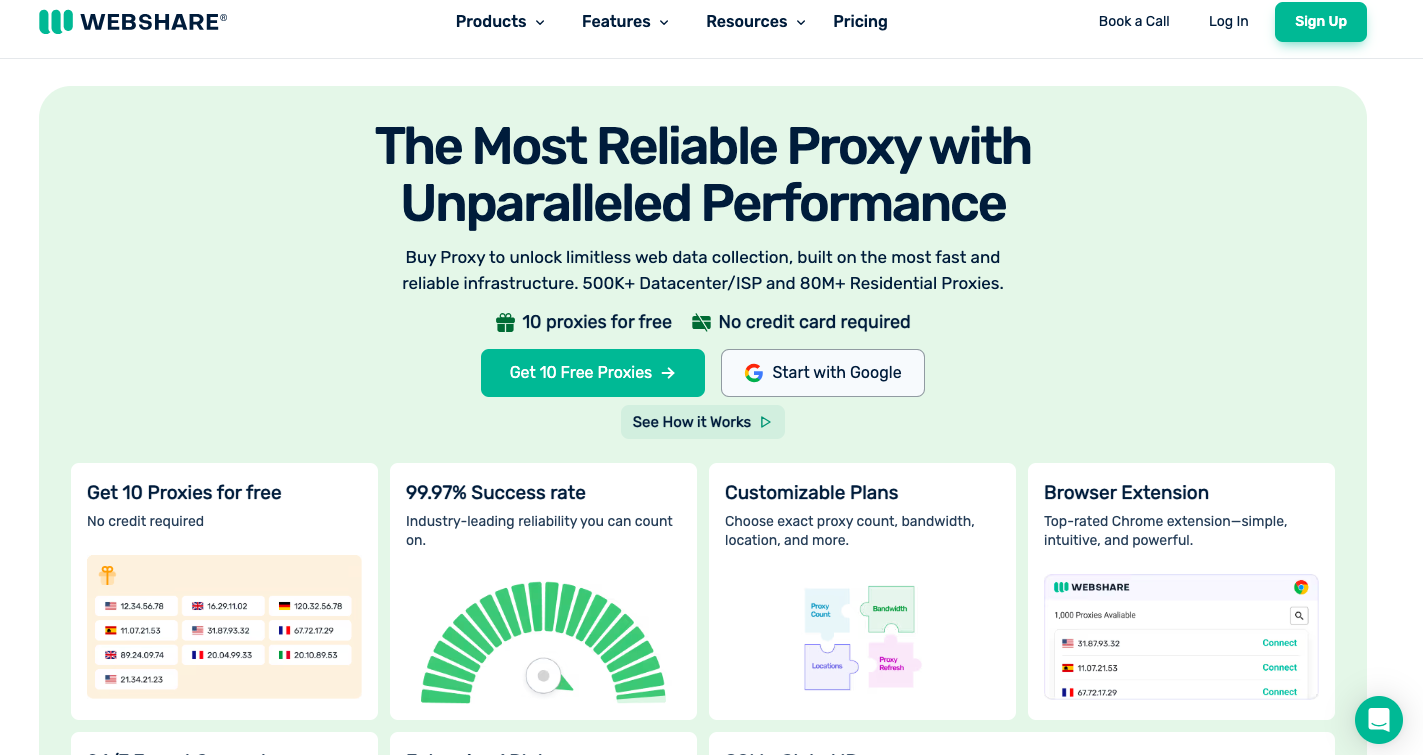
Webshare's free tier is the most legitimately useful free option in the proxy market: ten proxies, 1GB of bandwidth, no credit card required. For someone testing whether proxies solve their specific problem before committing to a paid plan, this is the honest starting point.
30M+ IPs on paid plans, with pricing that scales gradually, means you can grow your usage without a sudden pricing cliff. The documentation is written in plain English, setup takes under ten minutes, and their browser extensions make day-to-day proxy switching accessible to non-technical users.
Features:
Offer Residential Proxies and (ISP) Proxies
30+ million residential IPs
Proxy servers in 50+ countries
Residential proxies in 195 locations
99.7% uptime for residential proxies
Dedicated Gigabit internet lines for proxy servers
Chrome Extension: Browser extension for easy proxy management
Customizable Options: Configure locations, bandwidth limits, thread count, and speed
Starting Price: Free (10 proxies, 1GB/month)
Paid from ~$2.99/month
3. NetNut
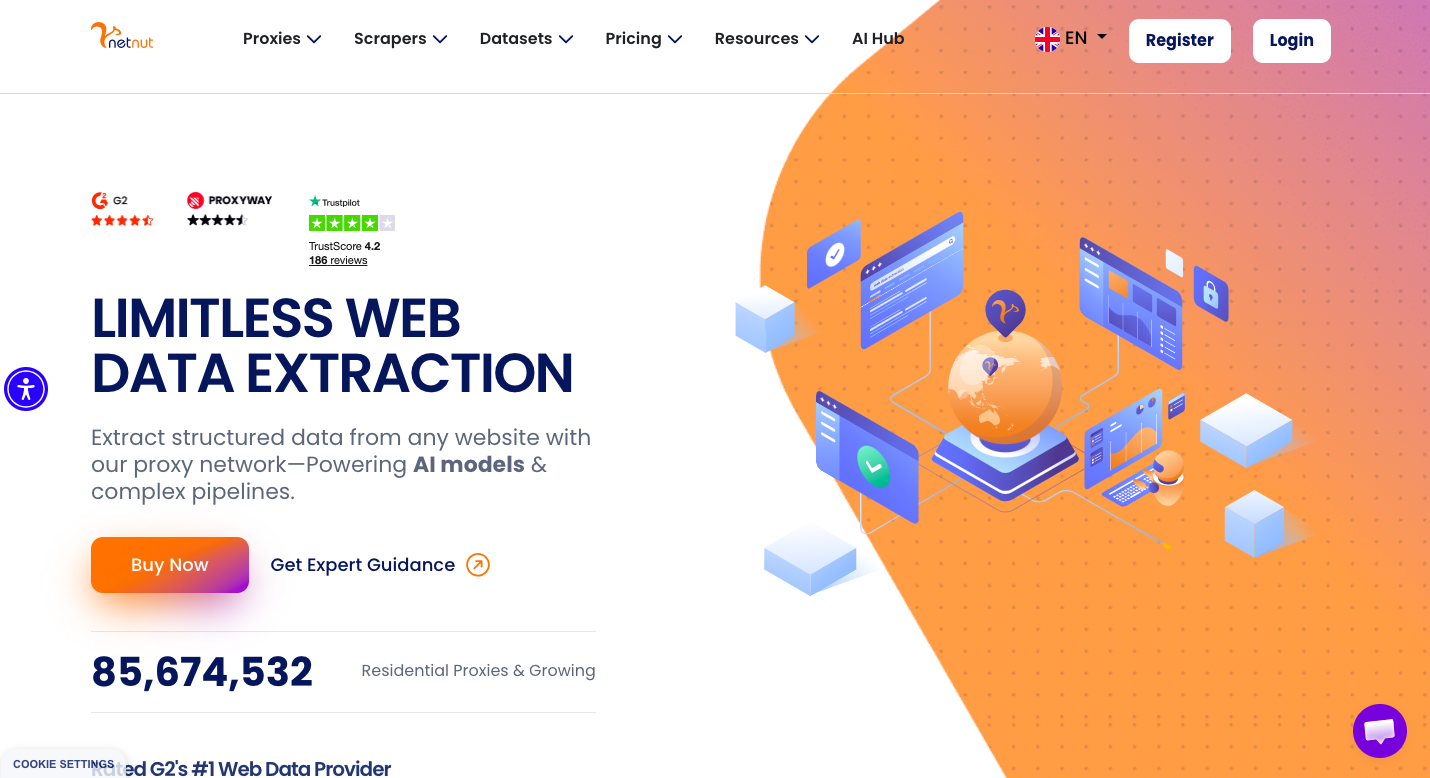
Net operates at the ISP level; their IPs are effectively permanent residential addresses that don't change, giving them the legitimacy of residential IPs with the stability and consistency of dedicated infrastructure. They have 85M+ IPs, with particularly strong coverage in Europe.
For long-term monitoring projects where you need the same IP to return repeatedly without triggering re-verification, NetNut's static residential approach is the cleanest solution on the market.
Features:
ISP-sourced residential IPs
Low latency and high speeds
Static and rotating IP options
Strong infrastructure reliability
Diverse Proxy Types
High Success Rate 99.99% connection reliability.
Starting Price: Custom quote (typically starts ~$300/month)
4. NodeMaven
NodeMaven's standout feature is real-time IP health filtering and active monitoring, which claims a 95% clean rate across its 30M+ IP pool. In practice, this means the IPs you pull are much less likely to be flagged on major blocklists before you've even sent a request.
Features:
30M+ IPs across residential and mobile networks
IP Quality Filter blocks flagged addresses (95% clean rate)
Sticky sessions up to 24 hours
Custom rotation rules (per request or timed intervals)
Supports HTTP(S) and SOCKS5
Geo-targeting by country, city, region, or ASN
Starting Price: From ~$75/month
5. Oxylabs
Oxylabs is good for enterprise proxy infrastructure with 100M+ IPs across 195+ countries, a 99.7% success rate backed by actual SLAs, and a SERP scraping API that returns structured, clean data rather than raw HTML you have to parse yourself. The pricing, though, is genuinely enterprise.
Features:
100M IPs link up, covering nearly every corner of 195 regions worldwide.
The choice of proxies depends on the work they need to be done. Different tasks call for different setups, location - countries first, then states, down to single cities. Precision isn’t built overnight. It grows from wide views to street-level stops.
Supports SOCKS5 connections
When a system reboots, sticky sessions still keep a user on their original server.
Adjustable IP rotation options
Custom quote (typically $300+/month for residential) |
6. Bright Data
Formerly Luminati, now rebranded but running the same network. 72M+ residential IPs with targeting options that go down to the ASN level, meaning you can target a specific internet service provider in a specific city, which matters for hyper-local SERP accuracy.
The interface has a learning curve, and the pricing model requires attention. Different proxy types are priced differently, and the dashboard options can overwhelm new users.
Features:
Has 70+ million residential IPs worldwide
Geo-targeting.
API-driven management system
Enterprise-level scaling infrastructure
Complicated dashboard and configuration controls
Starting Price: ~$8.40/GB (pay-as-you-go residential)
7. Decodo
Decodo has 65M+ IPs, a dashboard your whole team can use without a dedicated technical resource managing it, and a SERP scraping API that removes significant manual work from your data pipeline.
Their pay-as-you-go model means you're not locked into a volume commitment that made sense in month one and hurts in month six when a major client churns. The pricing is transparent; you know what you're paying before you sign up.
Features:
55M+ residential IPs across 195+ locations
Sub-0.5 second response times
Chrome extension for one-click proxy switching
Sticky sessions up to 24 hours
Rotating and static proxy options
Supports HTTP(S) and SOCKS5
Residential from $8.50/GB, mobile from $50/GB
3-day money-back guarantee
Starting Price: $6/GB (residential, pay-as-you-go)
8. SOAX
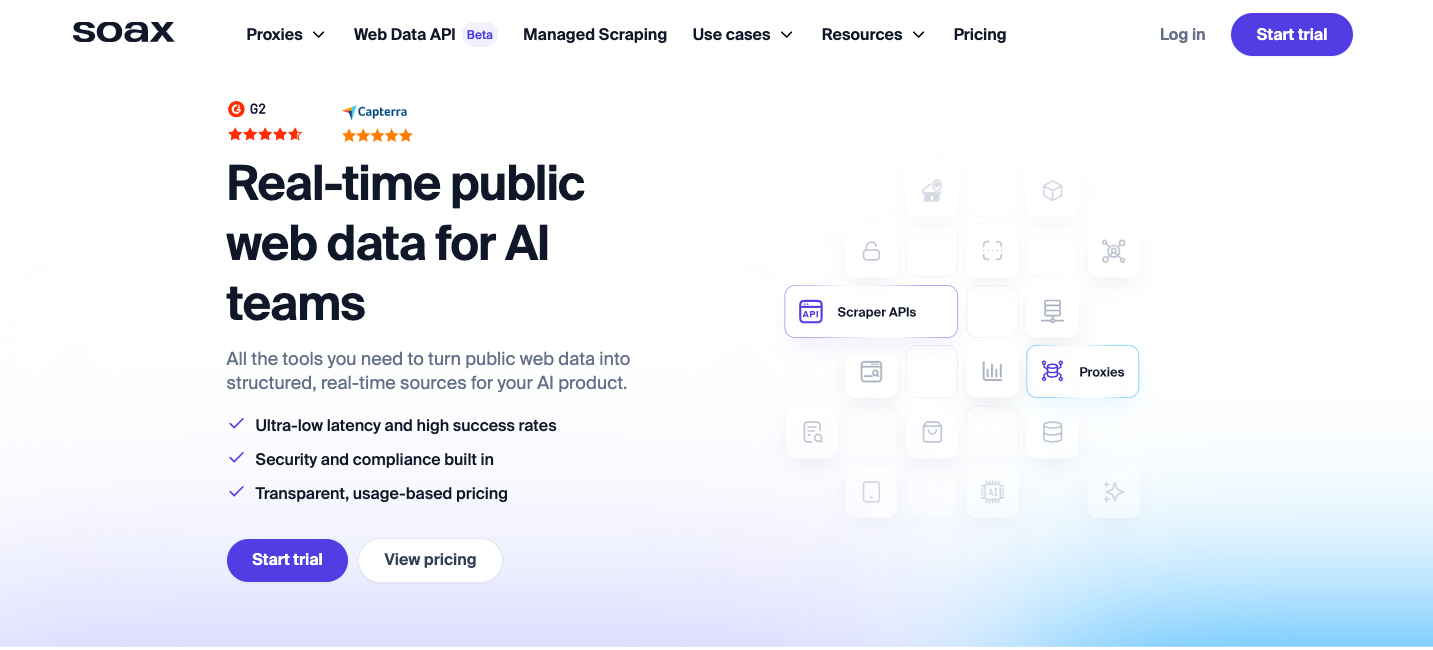
SOAX claims 190M+ IPs with active filtering that removes non-working addresses before they make it into your request queue, which in practice translates to fewer retries, fewer errors, and better crawl performance when you're hitting SERPs that run aggressive bot detection.
Features:
190+ million IPs, spread out over 195+ spots around the world.
Has residential, mobile, internet service provider, and datacenter proxies
Responses arrive quickly, most of the time within under a second.
Advanced geo-targeting for country-level and regional access
The tool includes useful features, including a proxy tester.
Starting Price: $99/month (starter plan, approximately 15GB)
9. IPRoyal
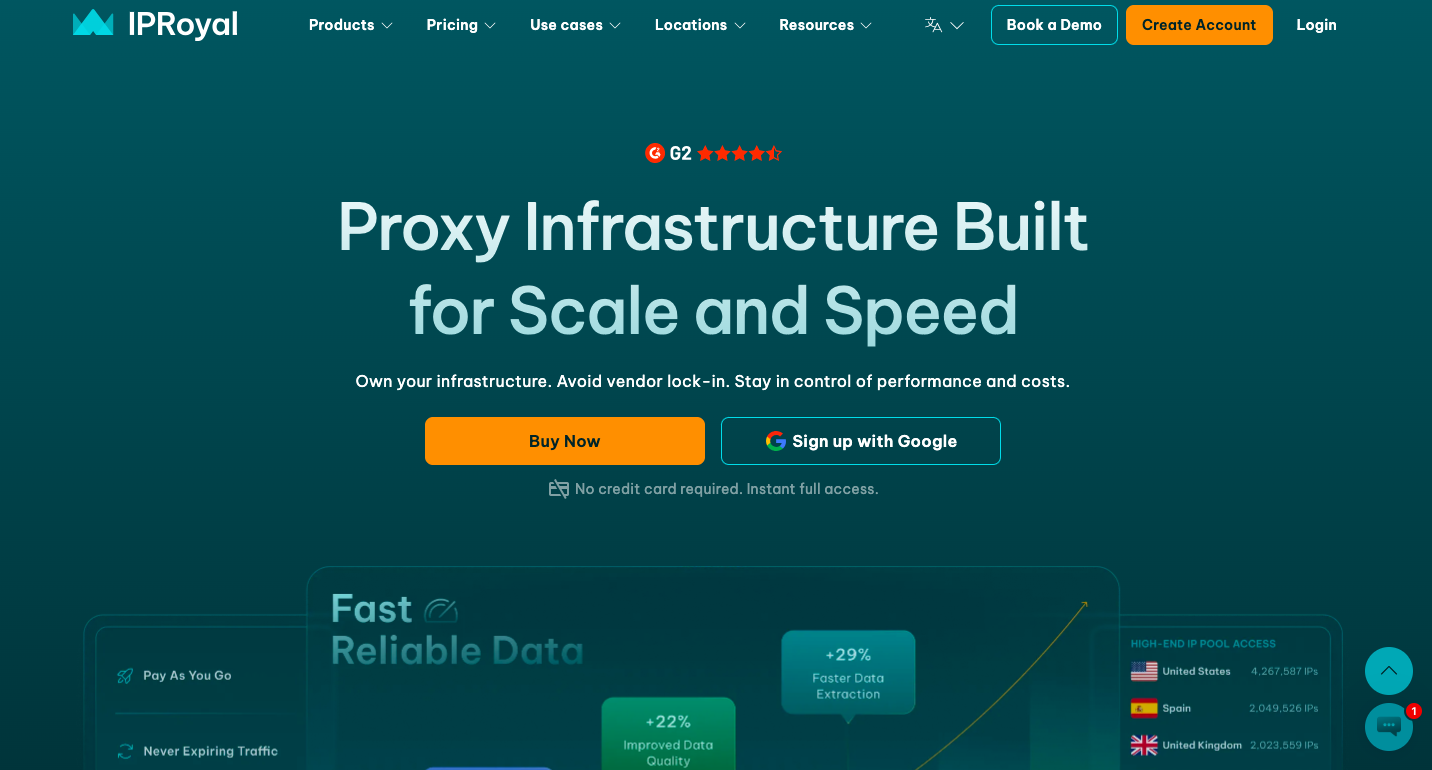
IPRoyal has 34M+ IPs, transparent per-GB pricing, browser extensions for easy setup, and responsive support that doesn't require enterprise-tier contracts. They don't chase the feature list that Bright Data or Oxylabs publish.
What they deliver is a reliable, fairly-priced proxy service that works predictably for standard SEO tasks. Their ISP proxy option is worth noting for users who need the legitimacy of residential addresses with more consistent performance.
Features:
Residential and mobile proxies
Pay-as-you-go pricing structure
Quick setup process
Global IP coverage
Traffic that does not expire
IP retention up to 7 days
Starting Price: ~$1.75/GB (residential)
10. ProxyEmpire
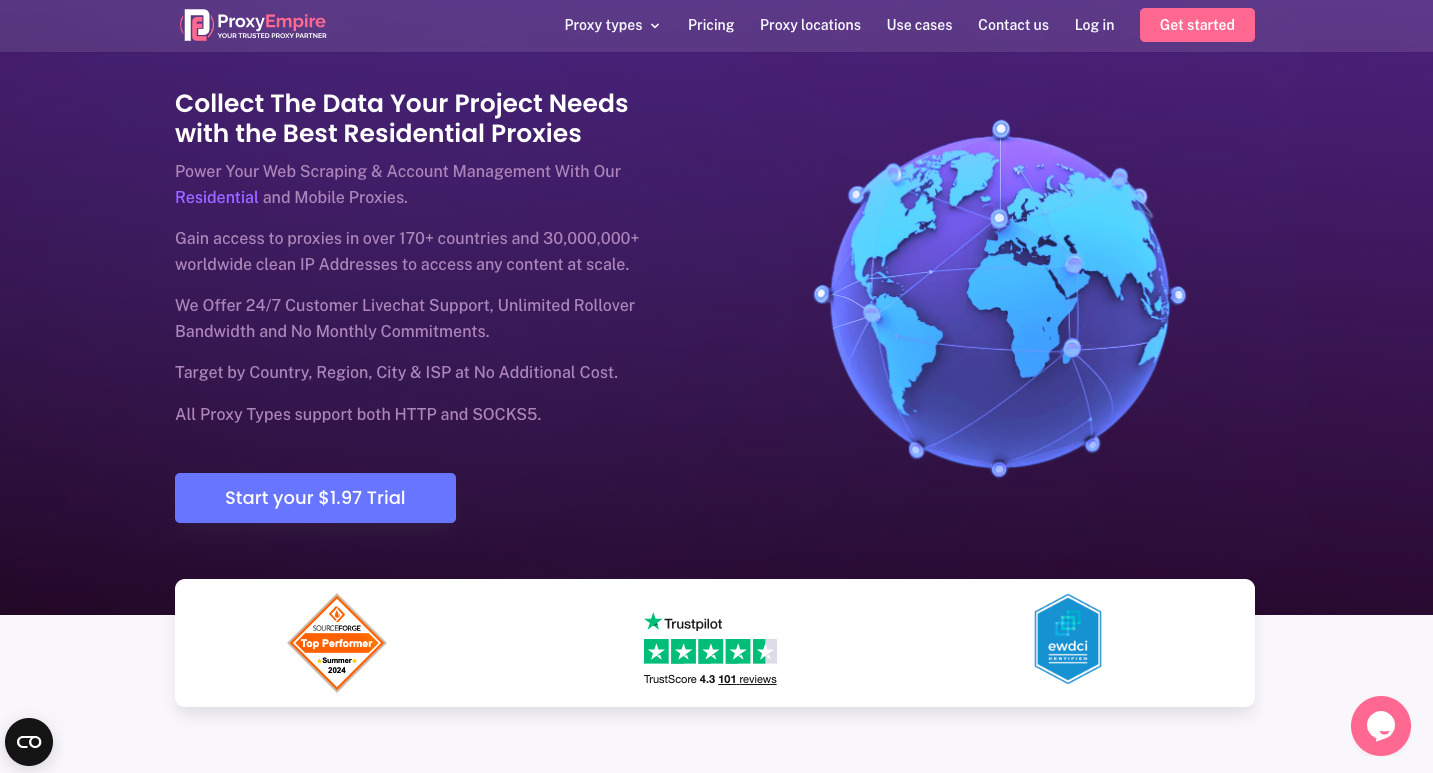
9.5M residential IPs across 170+ countries with a 99.9% claimed uptime, and average response times we clocked around 0.6 seconds in testing. ProxyEmpire's pool is smaller than enterprise providers, but the quality-to-price ratio for residential IPs is strong. The low-cost trial is a genuine test opportunity, not a limited demo.
Features:
API access for automation
Supports different IP addresses. Some stay put, while others constantly shift locations.
mobile or datacenter proxies, depending on your needs.
Reach specific locations down to cities or internet providers. One moment it’s a region, next it’s a neighborhood - precision shifts on its own.
Running nonstop with barely any delays. Most of the time, it works without a hitch.
Starting Price: $1.97 trial, then from ~$45/month
Quick comparison table
Provider | IP Pool | Starting Price | Proxy Type |
CyberYozh | 50M+ | $5.29/month and $1.70/day mobile unlimited traffic. | Residential, mobile, ISP, and datacenter proxies |
Oxylabs | 100M+ | Custom (~$300+/month) | Rotating/Static |
Bright Data | 72M+ | ~$8.40/GB | Rotating/Static |
Decodo | 65M+ | $6/GB | Rotating |
SOAX | 190M+ | $99/month | Rotating |
Webshare | 40M+ | Free / ~$2.99/month | Mixed |
IPRoyal | 34M+ | ~$1.75/GB | Mixed |
ProxyEmpire | 9.5M+ | $1.97 trial | Residential |
NetNut | 85M+ | Custom (~$300+/month) | ISP/Static |
NodeMaven | 30M+ | ~$75/month | Mixed |
Why most SEOs are running a broken stack
"Our proxy costs went up again. And we're still getting blocked on Google. And the rank tracker keeps throwing errors."
The reason this keeps happening comes down to a fundamental misconception about how modern detection works. Most SEO professionals think about their proxy as "the security layer." Get a better proxy, solve the detection problem. So they upgrade their proxy. The block rate drops for a while. Then it creeps back up. So they upgrade again.
The proxy addresses only one of the signals that detection systems track. The IP address. One signal out of dozens. The other signals, like your browser fingerprint, your request behavior, your time zone alignment, your font inventory, and your WebGL signature, don't change when you change your IP.
The SEOs who are running clean, block-free operations in 2026 are doing two things: using quality proxies and managing their browser fingerprint. Those still fighting CAPTCHA walls are usually doing so without the other.
“Providers like CyberYozh integrate seamlessly with anti-detector browsers of all kinds, saving time and money by eliminating the need to juggle multiple proxy providers and anti-detector browsers.”
Who actually uses CyberYozh for SEO proxies in 2026 and why
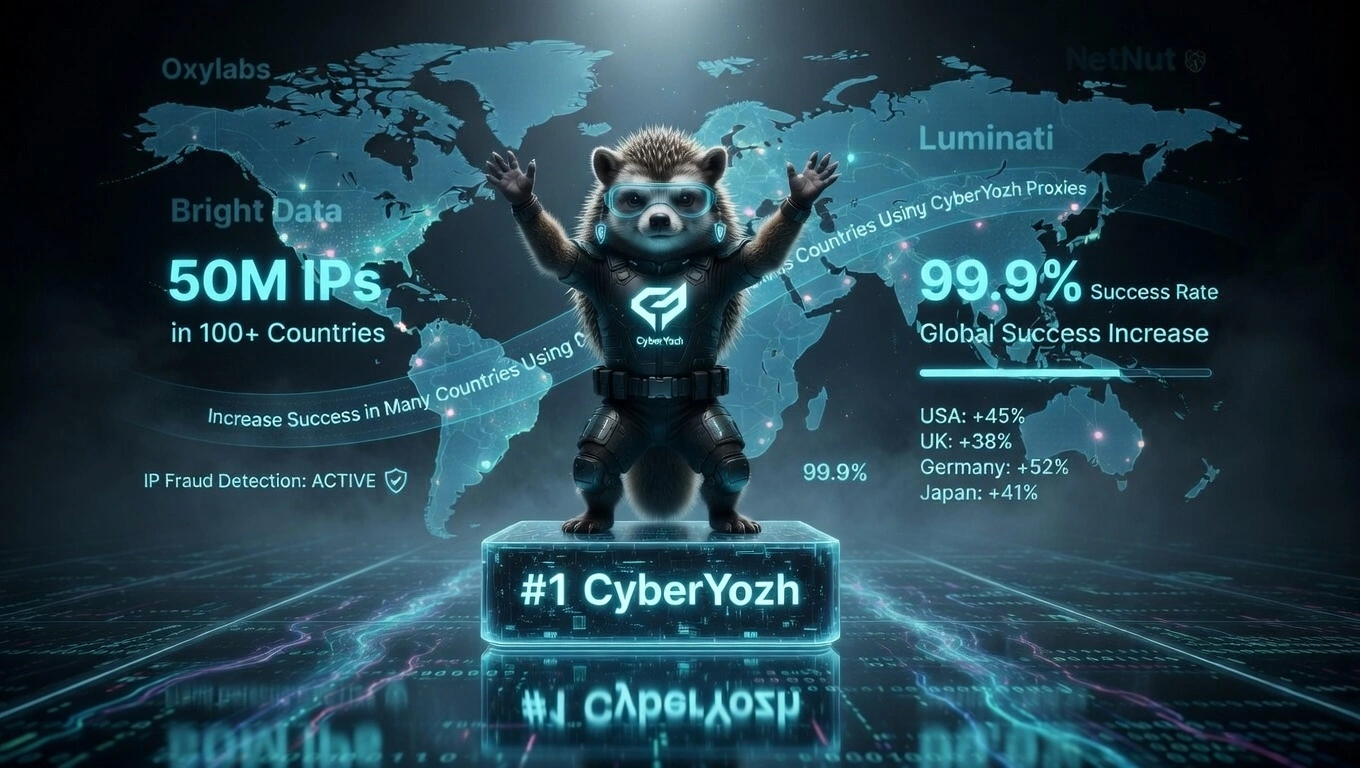
The tools you choose reveal a lot about how seriously you take your SEO operations. Here's who's using CyberYozh and what problem they were trying to solve when they found it.
Agency owners managing 10+ clients switched to CyberYozh because maintaining separate proxy accounts with no integration with anti-detect browsers for each client's project was both expensive and operationally messy. CyberYozh provides one dashboard, complete profile isolation per client, and integrated proxy management. The operational cleanup alone was worth it for many of them before they'd even looked at the pricing comparison.
In-house SEO leads at medium-sized brands use CyberYozh for accurate local rank tracking without the technical overhead of enterprise proxy infrastructure. They needed city-level SERP accuracy without a six-figure vendor contract.
Affiliate marketers and niche site operators managing multiple projects that can't be associated with each other rely on CyberYozh's profile isolation. Complete session separation means no cross-contamination between projects, something that a simple proxy rotation tool can't provide.
Link-building specialists running outreach at scale need to appear as different people to different targets. CyberYozh profiles give them isolated digital identities for each outreach campaign without the operational complexity of managing multiple physical machines or VMs.
Freelance SEO consultants are consolidating previously fragmented tooling, with one tool replacing proxy subscriptions, anti-detect browser subscriptions, and IP detection workarounds. The pricing consolidation alone often represents $80–150/month in savings.
Developers building SEO tools use CyberYozh's Selenium and Playwright compatibility to run automated rank tracking through browser sessions, achieving detection rates far higher than traditional headless browser approaches.
“What connects all of them is a common realization: the fragmented approach of separate proxy + seamless antidetection browser integration + separate IP reputation, SMS verification tools was costing them more in money, time, and data quality than switching to an integrated solution.”
Final Verdict: Which SEO Proxy Is Right for You
There's no universally correct answer, and you should be skeptical of any guide that pretends there is. But there are honest recommendations based on where you actually are.
And if you're doing any serious professional SEO work, agency, in-house, or independent, and you're currently managing a proxy subscription separately from your browser environment, CyberYozh is the most efficient path to solving both problems at once.
The proxy solves your IP. The seamless integration with an anti-detect browser solves your fingerprint. CyberYozh combines both, calibrated specifically for SEO work, at pricing that undercuts the cost of buying either solution from a specialist vendor.
For the vast majority of SEO professionals, the best Google SEO proxies setup in 2026 isn't about finding the one perfect proxy provider. It's about closing the fingerprint gap that most proxy-only setups leave open, without doubling your tooling budget. That's exactly what CyberYozh was built for.
Frequently asked questions about SEO proxies
What are SEO proxies, exactly?
An SEO proxy is a server that routes your connection through a different IP address so that search engines don't recognize and block you when you're pulling rank data, scraping SERPs, or monitoring competitor positions at scale. Instead of Google seeing thousands of requests from your office IP, it sees requests from thousands of different residential addresses, each appearing to be a normal individual user searching from home.
Can't I just use a VPN for SEO tracking?
VPNs are privacy tools, not performance tools. They route all your traffic through a single shared IP (or a small pool of IPs), which means those IPs accumulate block history quickly across thousands of users. VPNs also offer no request management features, no rotation, no session control, and no geographic precision beyond the country level. Most VPN IPs are well-known to search engines and get flagged immediately for high-volume requests. SEO proxies are purpose-built for scale; VPNs simply aren't.
How many SEO proxies do I need for keyword tracking?
For 100–500 keywords tracked daily from a single location, 5–10 rotating IPs can work with careful pacing. For multi-location tracking across the same keyword set, multiply by the number of target locations. For thousands of keywords or high-frequency tracking (multiple checks per day), you need a rotating pool large enough to ensure that no single IP handles more than a handful of requests per hour. The math gets complex fast, which is one reason managed solutions like CyberYozh, where rotation is handled automatically, significantly reduce operational overhead.
What's the difference between residential and dedicated SEO proxies?
Residential IPs are registered to real home internet connections, making them appear to search engines like genuine users. They're harder to detect and block, but more expensive and sometimes slower. Dedicated SEO proxies are IPs assigned exclusively to you, not shared with other customers, and can be either residential or datacenter-grade. Dedicated proxies offer predictable performance and consistent session behavior; residential proxies offer maximum detection resistance. Professional SEO operations typically need both.
Will Google SEO proxies help me avoid CAPTCHA completely?
Quality proxies dramatically reduce CAPTCHA frequency, but not to zero on their own. Google SEO proxies with clean IP histories and proper rotation significantly improve your pass rate. Where CAPTCHA challenges typically slip through is when your browser fingerprint is inconsistent with your proxy's apparent location.
Can I use free proxies for SEO monitoring?
Not for anything that matters. Free proxies are almost universally pre-blacklisted on Google and major search platforms before you send your first request. They're overcrowded, unreliable, often slower than your regular connection, and in documented cases have been used to intercept unencrypted traffic.