
Best virtual cards for Telegram ads in 2026

Search for a virtual card to pay for Telegram ads and you will find roundups listing the same fintechs that appear in every other card article. Almost none of them mention the thing that decides whether any of it works.
The official Telegram Ads platform does not take cards. It bills in TON, Telegram's own cryptocurrency, and the ad platform itself says so plainly. On Meta or TikTok the card is the account, so its BIN, region and history all matter because the platform inspects them directly. On Telegram Ads the platform holds a TON balance and never sees your card at all.
That does not mean the platform is closed to you, and it does not make a virtual card useless. The self-serve TON route is genuinely accessible, with a reported minimum deposit around 20 TON and a minimum CPM of 0.1 TON per thousand impressions. The million-euro figures you will see quoted apply to direct EUR accounts through agencies. The card simply belongs one step earlier in the chain than people expect.
💡 TL;DR
Official Telegram Ads is paid in TON. No card attaches to it directly, so any guide that skips this has copied a Meta article and swapped the platform name.
A card does work on four routes: Mini App ad networks that accept cards, reseller agencies billing in EUR or USD, buying TON through an exchange or on-ramp, and the tooling around the campaign.
Mini App networks are the practical entry point, with deposits typically around $100 to $150 and card payment accepted.
CyberYozh is the pick when Telegram advertising sits inside a wider account operation. PST.NET and Pay2.House are faster if you only need a card today. Wallester wins at issuance scale.
Issue one card per campaign or client rather than running everything through one, and check the card and the IP before the first transaction.
For the broader question rather than the Telegram-specific one, seven virtual cards compared for social media ads covers Meta, TikTok and Google, and there is a dedicated breakdown of virtual cards for Facebook ads. This article stays on Telegram.
⭐ About to fund a new route? Check the card, the IP or the number first so a decline is something you catch rather than something you discover mid-campaign.
The four routes where a virtual card actually works
In rough order of how many advertisers use them. All four sit inside the same social campaign workflow, which is why the card decision is rarely separable from the account and network decisions around it.
1. Mini App ad networks. Third party networks selling placements inside Telegram Mini Apps rather than in channels. Ordinary billing, typically accepting cards alongside wire and crypto. Deposits sit around $100 to $150, and reported cost per subscriber on the better networks lands between $0.10 and $0.90. This is where a card behaves as it does on any other advertising workflow, and where a social media proxy keeps the account side consistent while the campaign runs.
2. Reseller agencies. Official resellers place Sponsored Messages for you and bill in EUR or USD, absorbing the TON layer. Deposits run into the low thousands with service fees on top, and direct EUR accounts without an agency carry minimums in the millions. Checking how the finished placement renders in the market you bought is a separate job, and one an ad verification endpoint handles better than a colleague's phone.
3. Buying TON directly., Telegram's official marketplace, describes buying TON on an exchange such as OKX or ByBit, or with a bank card, then transferring it to a wallet. Identity verification is part of it, exchange access often depends on a stable connection from a supported region, and card issuers vary widely on whether they permit crypto purchases at all.
4. Everything around the campaign. The least glamorous route and the one most teams actually spend on. Creative and scheduling tools, analytics, bot hosting, channel management, and the proxy and verification infrastructure underneath multiple account management at any scale. Note that the CyberYozh advertising card excludes hosting and domain payments, so a bot's server bill needs the general-purchase card instead.
Before the card matters: what Telegram Ads requires of your destination
Most people who cannot run Telegram ads are not blocked by payment. They are blocked by the destination, and no card fixes that. Worth checking before you fund anything.
Sponsored Messages only appear in public channels with 1,000 or more subscribers. That is the placement inventory, and it is also the growth threshold your own channel needs to cross before it qualifies for placement and revenue share.
The ad is 160 characters and one button. The button must open a Telegram destination: a bot, a public channel, or a public channel post. Not a website, not a group. If your funnel ends on a landing page, you need a bot or channel in between.
Destination quality is judged, not just counted. Rejections citing destination quality are common on channels that technically exist but look abandoned: a handful of posts, no avatar, no description, no recent activity. Operators who have been through it recommend 15 to 20 real posts, a proper avatar and description, and visible regular activity before submitting. A short warm-up period on the channel is cheaper than a rejection and a resubmission.
Prohibited categories are broad. Gambling, political content, weapons, unverified medical claims, harmful financial products, drugs and hate speech. Crypto advertising is permitted, but claims have to be factual, which rules out guaranteed returns and earnings promises. That matters because crypto and airdrop projects are among the heaviest advertisers on the platform and among the most frequently rejected.
Formatting gets ads rejected on its own. All caps, clickbait, spaced-out letters, emoji-stuffed channel names and aggressive imperatives all fail moderation. So does a mismatch between the ad copy and what the destination is actually about.
Review usually takes about a business day. Finance and crypto categories run longer, commonly three to five days, and repeated rejections for the same policy can tighten review on the whole account. Fix properly before resubmitting rather than tweaking and retrying.
Best virtual cards for Telegram ads
Seven providers, ranked for the routes above rather than for a platform that does not take cards.
Provider | Card issuance | Funding | Watch out for |
CyberYozh | Instant, per-BIN series with shared balance and per-card limits | Card or crypto | Advertising card excludes hosting and domains |
PST.NET | Instant, 20+ private BINs from US banks, first card without KYC | Crypto or wire | Recurring Trustpilot complaints about held funds |
Pay2.House | Instant Visa, unlimited cards, no KYC on standard cards | USDT (TRC20), Capitalist | Lighter controls than a banking product |
Wallester | Mass issuance via dashboard or API | Bank transfer | Full business verification, setup measured in days |
Capitalist | CardsPro, instant, from a low minimum budget | Internal, crypto or bank | Issuance eligibility and 3DS vary by BIN |
Wise Business | Instant virtual cards for team members | Bank transfer, multi-currency | No mass issuance, no merchant locks |
Payoneer | Cards drawn on an existing Payoneer balance | Payoneer balance | Can flag on arbitrage-heavy patterns |
1. CyberYozh
Best for teams whose Telegram work involves more than paying an invoice.
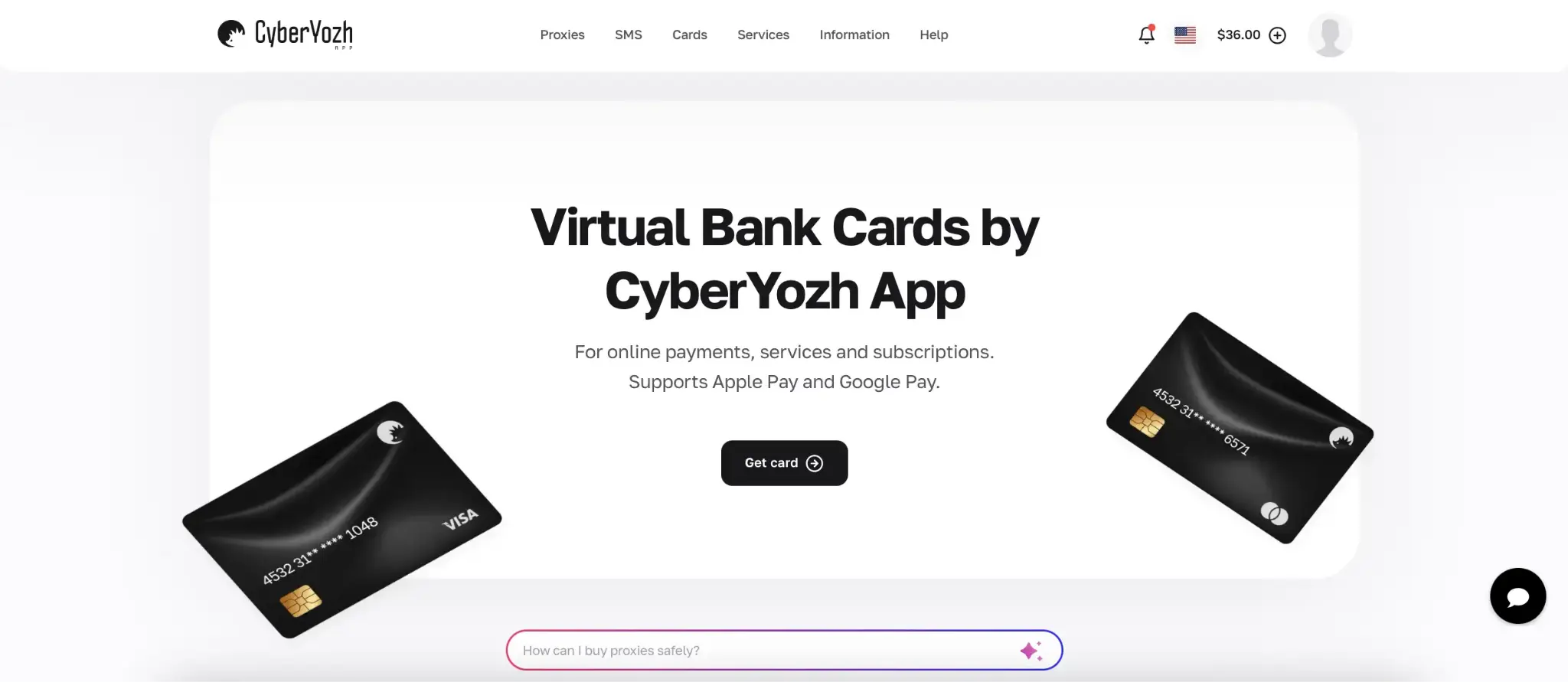
CyberYozh sells virtual cards as one product inside a wider operational platform rather than as a standalone fintech service, and that framing explains most of what is good and bad about it. Cards are issued and killed instantly from the app, with per-card limits and a region setting so payments clear correctly on international services.
The structure worth understanding before you use it is the BIN: it acts as a wallet for a whole series of cards sharing one balance, with the issuance fee drawn from your main CyberYozh balance and the bank fee from the BIN balance. Spending on any card in that series draws down the shared pool, which maps unusually cleanly onto client-level budgeting.
There are two card categories and the difference matters here. One is built for advertising and SaaS spend but excludes hosting and domain payments, which catches people out when they try to pay a bot's server bill with it. The other handles general purchases and supports Google Pay and Apple Pay, with region settings chosen per card.
What makes the whole thing worth a look for Telegram specifically is what sits next to the card: a Telegram advertising operation needs an account, which needs a number to verify it and a network route that stays consistent. All three come from the same balance, and all three can be checked for a bad history before you use them, which is the difference between finding out now and finding out from a declined deposit. Reputation on an address is scored, not guessed, and an IP quality score is what that score is called.
Full feature list:
Instant virtual card issuance and instant deactivation from the app
BIN acts as a wallet for a card series, with one shared balance across every card issued from it
Issuance fee charged to the main balance, bank fee charged to the BIN balance
Per-card spending limits, set and changed in a few clicks
Region settings selected per card so payments clear correctly on international services
Two card categories: an advertising and SaaS card excluding hosting and domains, and a general-purchase card supporting Google Pay and Apple Pay
Separate cards per advertising account, parser, project or client, so one block never cascades
Custom BIN available through the partner programme
Fraud Score checks for card, IP, phone number and email on the same balance
SMS activation and number rental for the Telegram account itself
Mobile, static ISP, rotating residential and datacenter proxies on the same balance
Full API access across products
Top up by card (Visa, Mastercard, AMEX, Discover, MIR, SBP) or crypto (BTC, USDT, ETH, TRX and others)
Verdict. The card on its own is competitive rather than exceptional. What makes it the pick for Telegram work is that the operation is never just a payment, and running the card, the number and the network route across three vendors means three support queues on the day something breaks.
Good: instant issuance and deactivation, per-card limits, a BIN balance structure that suits client budgeting, and cards sitting alongside numbers, proxies and risk checks in one account. Less good: the advertising card's merchant restrictions need checking against your route, and this is infrastructure tooling rather than business banking, so it will not replace an accounting stack.
2. PST.NET
PST.NET issues virtual cards on exclusive BINs from US banks, and BIN quality is genuinely the product rather than the marketing. For advertisers whose cards keep declining on ad platforms, it is the most cited fix in the media buying community, and the reason is that it monitors BIN transaction success and rotates supply rather than selling you whatever a single issuer will approve. Registration takes minutes, the first card comes without documents, and 3D Secure codes surface inside the account rather than going to a phone you may not control.
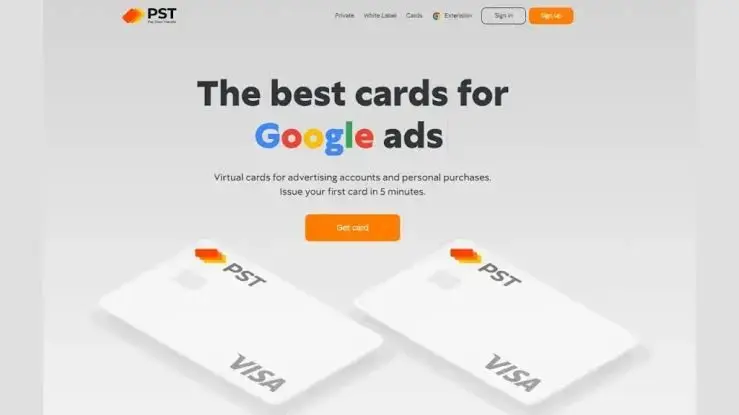
The commercial structure is unusual and worth understanding. Rather than charging per transaction, it advertises zero fees on approved payments, declined payments, refunds and withdrawals, taking its margin on top-up instead. The premium tier layers on up to 100 free cards a month and 3% cashback on advertising spend, which at real volume is a rebate rather than a token. Funding is crypto or wire, so there is no card-to-card route in.
Full feature list:
20+ private BINs from US banks, issued in USD and EUR
Instant issuance, with the first card available without KYC
3D Secure, with confirmation codes surfaced inside the account
Crypto funding (USDT, BTC) and wire transfer
Team accounts with member limits, spend controls and reporting
Proprietary BIN checker and in-browser cardholder view
Premium tier advertising up to 100 free cards monthly and 3% cashback on ad spend
Advertised 0% on approved and declined transactions, refunds and withdrawals
API access on the premium tier
Good: clean US BINs, genuine 3DS, the most generous cashback here, no interview to get started.
Less good: the Trustpilot picture is mixed in a way that matters. Recurring reports describe funds held in processing for extended periods, non-functional cards with unrefunded issuance fees, and at least one account deleted with a balance inside. Fee transparency is a repeated complaint even from satisfied users. Fund it in small amounts before trusting it with a campaign budget.
3. Pay2.House
Pay2.House is a payment service built for media buyers and arbitrage teams, and it optimises almost entirely for speed. Standard cards are issued without identity verification, there is no cap on how many you create, and funding arrives through USDT on TRC20 or from a Capitalist balance. For a team that needs a working card this afternoon because a campaign is already booked, that combination is hard to beat.
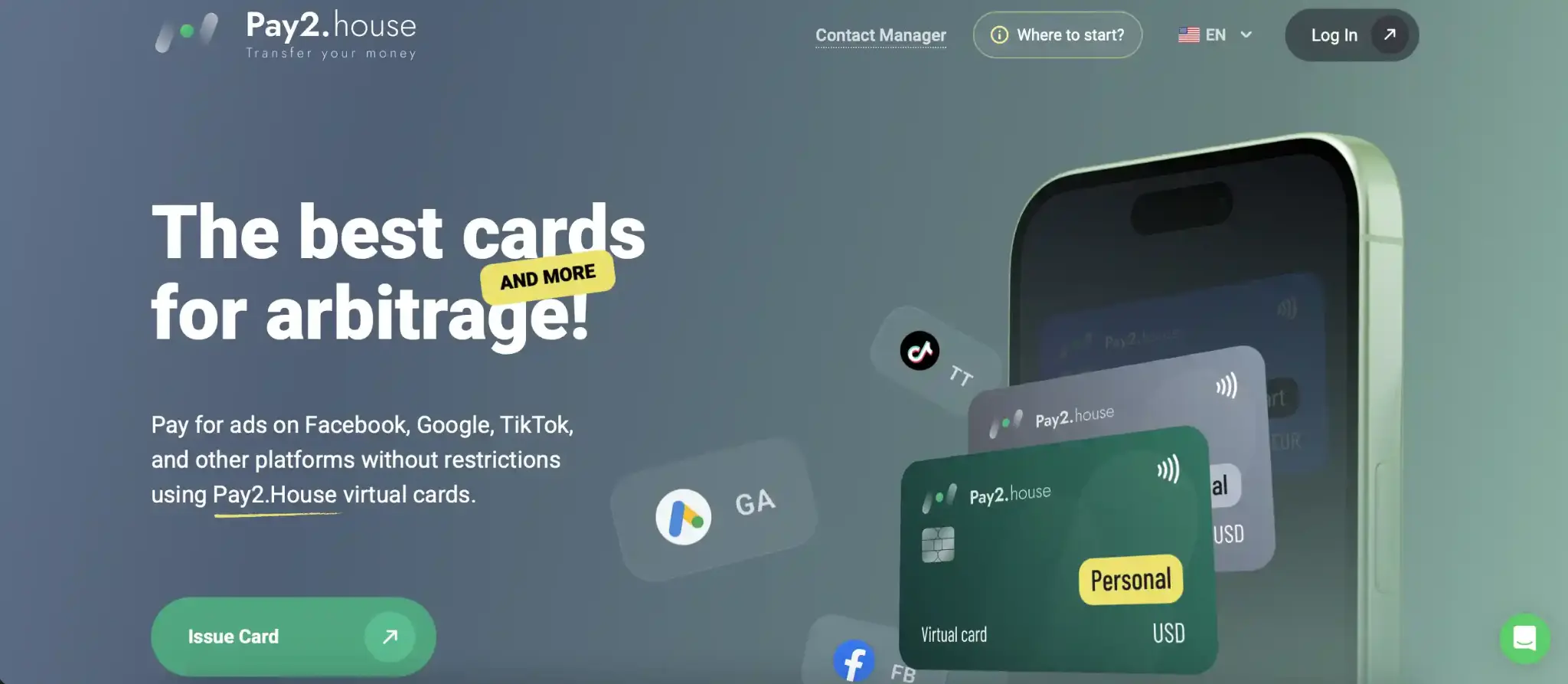
Underneath the issuance layer it behaves more like a payment account than a card product. Balances are held in USD, EUR and USDT, internal transfers between accounts are free, and there is an API for automating issuance and reconciliation alongside reporting tools for tracking flows across campaigns. What you do not get is the control surface a business banking product would give you, which is the trade for the speed.
Full feature list:
Instant Visa issuance with no limit on the number of cards
Standard cards issued without identity verification
3D Secure where the destination requires it
Accounts in USD, EUR and USDT on TRC20
Funding through USDT or Capitalist
Free internal transfers between accounts
API for automating issuance and reconciliation
Reporting tools for tracking flows across campaigns
Good: fast, flexible funding, no onboarding delay, widely used by media buying teams.
Less good: lighter on spending controls and reporting than a banking product, and no risk-checking layer.
4. Wallester
Wallester is a European card issuer rather than an affiliate-industry service, and it is the only option here built for issuing cards at genuine industrial scale. Thousands of cards through a dashboard or an API, real-time limits set per card, per day or per month, 3D Secure, and merchant category controls that restrict where a card can be spent at all. If your problem is governance rather than access, nothing else in this list is close.
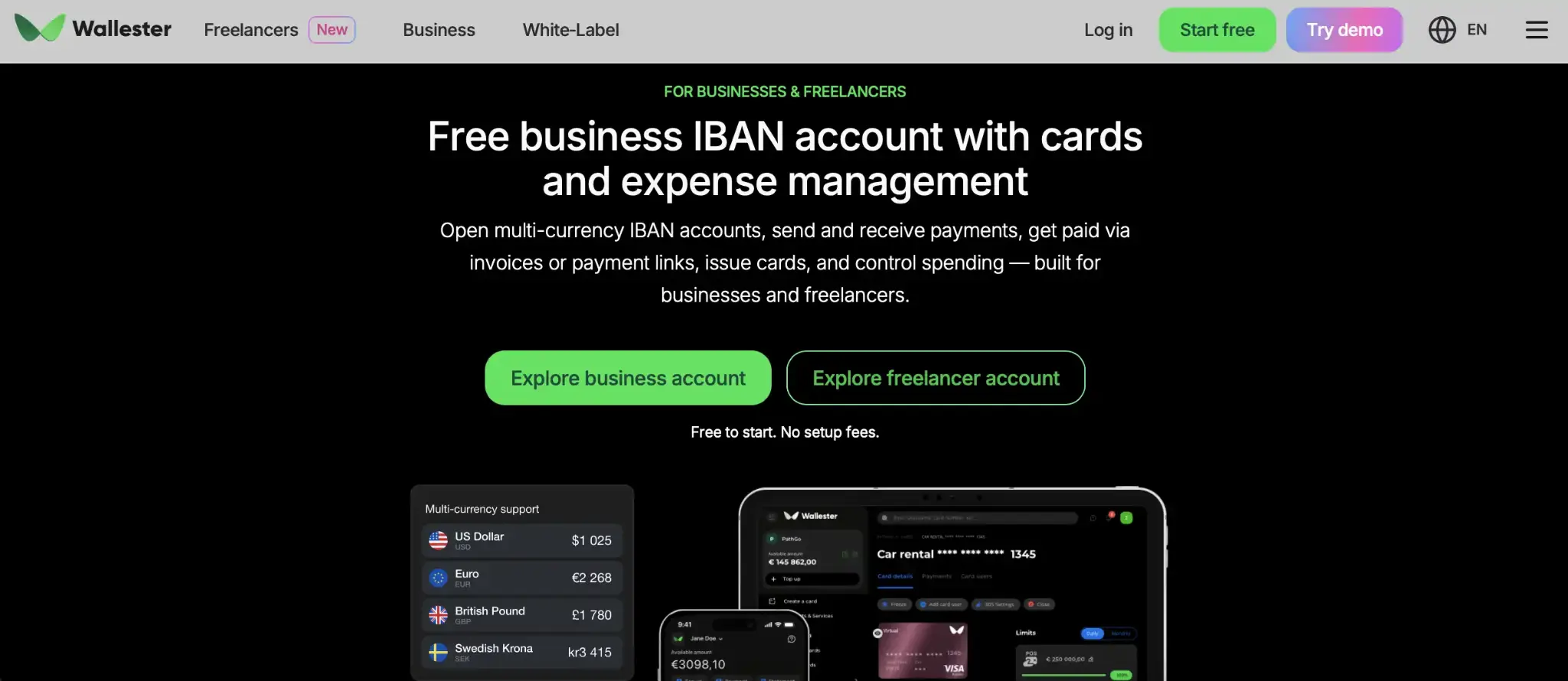
The cost of that is onboarding. Full business verification is required and setup is measured in days rather than minutes, which removes it from consideration for a campaign starting this week. It is also not tuned for advertising workflows specifically, so some of the media-buying conveniences the other services build in are simply not there. The starter tier advertises the first 300 virtual cards free, which makes a pilot cheap once you are through the door.
Full feature list:
Mass card creation through dashboard or API, into the thousands
European issuer with a proper regulatory posture
Real-time per-card, per-day and per-month spending limits
3D Secure plus merchant category controls restricting where a card can be used
Real-time transaction notifications
Exportable expense reports at campaign level
Starter tier advertising the first 300 virtual cards free
Works across the major ad platforms
Good: genuine scale, the most granular controls in this list, credible compliance for teams that need it.
Less good: full business verification is required and setup takes days, which rules it out for a campaign starting this week. It is also not built specifically for advertising workflows.
5. Capitalist
Capitalist is a payments network first and a card issuer second, which is exactly why it appears in this list. A large slice of the affiliate and media buying economy already settles through it, so if your partners pay you there, issuing cards from the same balance removes a withdrawal step and its fee. Its CardsPro service is built around team budgets, with instant issuance from a low minimum and a multi-currency wallet behind it.
The caveat is that Capitalist is not one card product but several, and they differ in ways that matter. Issuance eligibility, BIN region, 3D Secure availability and wallet support all vary by card type, and some cards have historically shipped without 3DS at all. That is survivable for ad platform spend and a genuine problem on any destination that requires it, so confirm the specific product against your route rather than the service as a whole.
Full feature list:
CardsPro virtual card service built around team budgets
Instant issuance from a low minimum budget
Multi-currency wallet
Free transfers inside the system
Apple Pay and Samsung Pay support on supported BINs
Crypto and bank funding alongside internal transfers
Established affiliate payments network attached to the same account
Good: low entry cost, long track record in affiliate payments, useful if partners already settle through it.
Less good: issuance eligibility, 3DS availability and BIN region vary by card type, and some cards historically shipped without 3DS at all. Confirm the specific product before committing, particularly if a destination requires it.
6. Wise Business
Wise is the outlier here and belongs in the list for one specific route: paying a reseller agency that invoices in EUR when your money sits in USD. It holds balances in a wide range of currencies, converts at low and transparent rates, and gives you local account details for receiving payments. For a funded brand campaign going through an official Sponsored Messages reseller, it is the cheapest way to move the money and the least likely to raise a question from anyone's finance team.
For anything resembling media buying at scale it is the wrong tool and does not pretend otherwise. There is no mass issuance, no merchant category locking, no per-campaign card structure, and no tolerance for the transaction patterns that arbitrage work produces. Instant virtual cards for team members are the extent of it. Treat it as a treasury layer rather than a campaign tool.
Full feature list:
Multi-currency balances across a wide currency range
Conversion at low, transparent rates
Instant virtual card issuance for team members
Local account details in several currencies for receiving payments
Standard business accounting integrations
Full regulatory footing and business verification
Good: the cheapest way to pay a EUR-denominated reseller invoice from a USD balance, and the most boring option here in the best sense.
Less good: no mass issuance, no merchant category locks, and not designed for advertising workflows.
7. Payoneer
Payoneer earns its place through inertia rather than features. If client payments already land in a Payoneer balance, issuing a virtual card against it removes an entire withdrawal cycle, and for a freelancer running one or two Telegram campaigns that convenience outweighs anything on a feature list. Acceptance is wide, receiving accounts are available in several currencies, and the marketplace payout integrations are mature.
Beyond that use case the fit drops off quickly. There is no per-campaign card structure, support is not specialised in advertising workflows, and accounts can be flagged on the high-volume patterns that arbitrage work generates. It is a business payments account that happens to issue cards, not a media buying tool, and stretching it into that role tends to end with a frozen balance at the worst moment.
Full feature list:
Virtual cards drawing on an existing Payoneer balance
Wide international acceptance
Receiving accounts in several currencies
Established marketplace and platform payout integrations
Business verification with a clear compliance posture
Good: no new account to set up if client payments already land here, which makes it the path of least resistance for a freelancer running one or two campaigns.
Less good: support is not specialised in advertising workflows, there is no per-campaign card structure, and accounts can be flagged on high-volume arbitrage patterns.
What Telegram advertising costs on each route
Route | Typical entry cost | Payment method |
Official Telegram Ads, self-serve | Reported minimum deposit around 20 TON | TON |
Official EUR account via reseller | Low thousands through an agency, millions direct | EUR or USD invoice |
Mini App ad networks | Around $100 to $150 minimum deposit | Card, wire, crypto |
Buying TON for a self-serve account | Cost of the TON plus fees | Card to exchange or on-ramp |
What a decline actually tells you
Card declines, ad rejections and account problems look similar from the dashboard and are fixed completely differently. This is where most wasted hours go.
What you see | Usually means | What to do |
Card declined at an exchange while buying TON | The merchant category is crypto, which many card products restrict | Check the card's permitted categories rather than the card itself, or fund from an account that allows it |
Card declined at a Mini App network | 3DS not supported, or the network's acquirer rejects the BIN region | Confirm 3DS support and try a card issued in a region the network serves |
Payment goes through but the balance does not appear | Deposit is still confirming, common on crypto rails | Wait for confirmations before retrying, since a second deposit is how people double-fund |
Ad rejected, payment fine | Editorial or destination problem, not payment | Read the section above and fix the destination before resubmitting |
Everything worked yesterday, nothing works today | Account-level flag rather than a card fault | Stop retrying. Repeated failed attempts make this worse |
The pattern worth internalising: if the money moved, it is not a card problem. If the money did not move, the card never reached Telegram anyway, because on every route here you are paying an intermediary. Checking the card, the IP and the number against a reputation score before the first transaction turns most of this table into something you never see.
Getting started with CyberYozh for Telegram advertising
The payment step is usually the last thing to break and the first thing people blame, so the sequence matters.
Decide the route first. Mini App network, reseller, TON purchase or tooling spend. There is no point issuing a card before you know which rail you are on.
Create an account and top up. Card or crypto, instant, one balance for cards, numbers, proxies and checks.
Set up the Telegram account properly if it is new, following the registration and SMS sequence and weighing the free and paid number options, then give it a Telegram proxy that stays put between sessions.
Issue the card against the right BIN. One BIN per client, one card per campaign, limit set at the deposit amount rather than left open.
Make a small first deposit on any new route before scaling, then keep the pairing stable. Same card, same account, same route.
⭐ Building the account side before the campaign side? Match a proxy to the country your Telegram operation runs from and keep the route consistent from registration onward.