
CyberYozh vs Proxy-Cheap 2026: Which Proxy Service Fits Your Workflow
TL;DR
CyberYozh wins for account management, multi-accounting, and any workflow where a ban costs real money, dedicated IPs, bundled SMS verification, and fraud-score checking
Proxy-Cheap wins on raw entry price for high-volume, low-stakes scraping and SEO rank tracking, where occasional blocks are just a cost of doing business
Biggest difference: CyberYozh's IPs are dedicated to you; Proxy-Cheap's residential and mobile pools are shared, which introduces real "bad neighbor" risk
Quick recommendation: choose CyberYozh if an account ban would hurt your business; choose Proxy-Cheap if you're scraping data at volume and can tolerate the occasional block
Quick Answer:
CyberYozh is the better choice for account management, ad campaigns, and multi-accounting, since it offers dedicated IPs, bundled SMS verification, and fraud score checking starting at $2/GB.
Proxy-Cheap is the better choice for high-volume, low-stakes scraping and SEO tracking, offering shared residential proxies at roughly $1.99/GB and no account-safety tooling.
What is CyberYozh
CyberYozh is built around the idea that a proxy is one piece of an operations stack, not a standalone product. Alongside mobile, residential, and datacenter proxies (100M+ IPs across 195+ countries), it bundles SMS activation and virtual numbers from 140+ countries, IP/phone/card fraud-score checking, and full API access with antidetect browser integrations (AdsPower, GoLogin, Multilogin, Dolphin Anty, Octo Browser). The target user is less "I need an IP" and more "I need my accounts to stay alive."
CyberYozh App
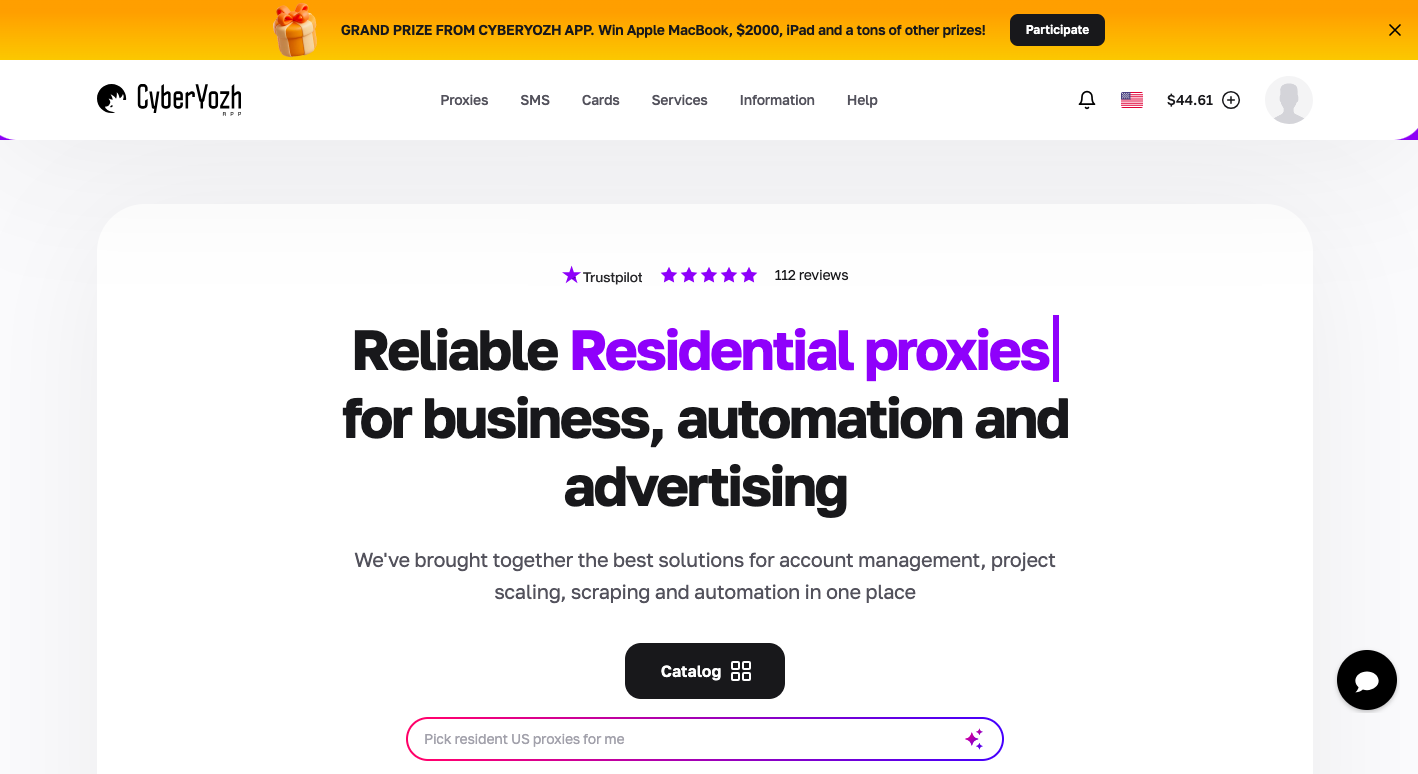
Key features:
Rotating residential proxies from $2/GB, no monthly minimum, with 24-hour sticky sessions.
Dedicated LTE mobile (4G/5G) proxies from $1.70/day, unlimited traffic
Static ISP residential from $5.29/month
Datacenter proxies from $1.90/month
High-quality 100M+ IPs in 195+ different countries
Offer SMS activation and virtual numbers from 140+ countries
Provide IP reputation checks, phone and card risk checks to spot fraudulent activity
User-friendly dashboard with 7 language support.
Full API access, seamless integration with Selenium, Puppeteer, Scrapy, Playwright, Postman and custom scripts.
Provides a built-in fingerprinting option and is compatible with any major anti-detect browser, such as Adspower, Octobrowser, Multilogin, DolphinAnty, etc.
Support for HTTP, HTTPS, SOCKS5, and UDP protocols.
Most budget-friendly option
Not sure which proxy type is best for your project? Browse CyberYozh's full proxy catalogue, mobile, residential, ISP, and datacenter, side by side, with unlimited-traffic plans from $1.70/day.
What is Proxy-Cheap
Proxy-Cheap has operated since 2018 and positions itself squarely at the budget end of the market, claiming 45,000+ clients. It bundles rotating and static residential, ISP, data center (IPv4/IPv6), and mobile proxies into a single dashboard, genuinely broad coverage for the price.
Its total IP pool is around 7 million, including 1M+ ISP proxies from 35 ISPs, and it offers mobile coverage in 127+ countries. It's rated 4.4/5 on Trustpilot from 662 reviews.
One honest limitation independent reviewers flag: Proxy-Cheap doesn't publicly disclose its residential pool size or its registered company entity on-site; the terms cite Delaware law as governing, which is a jurisdiction, not a headquarters.
Proxy-Cheap
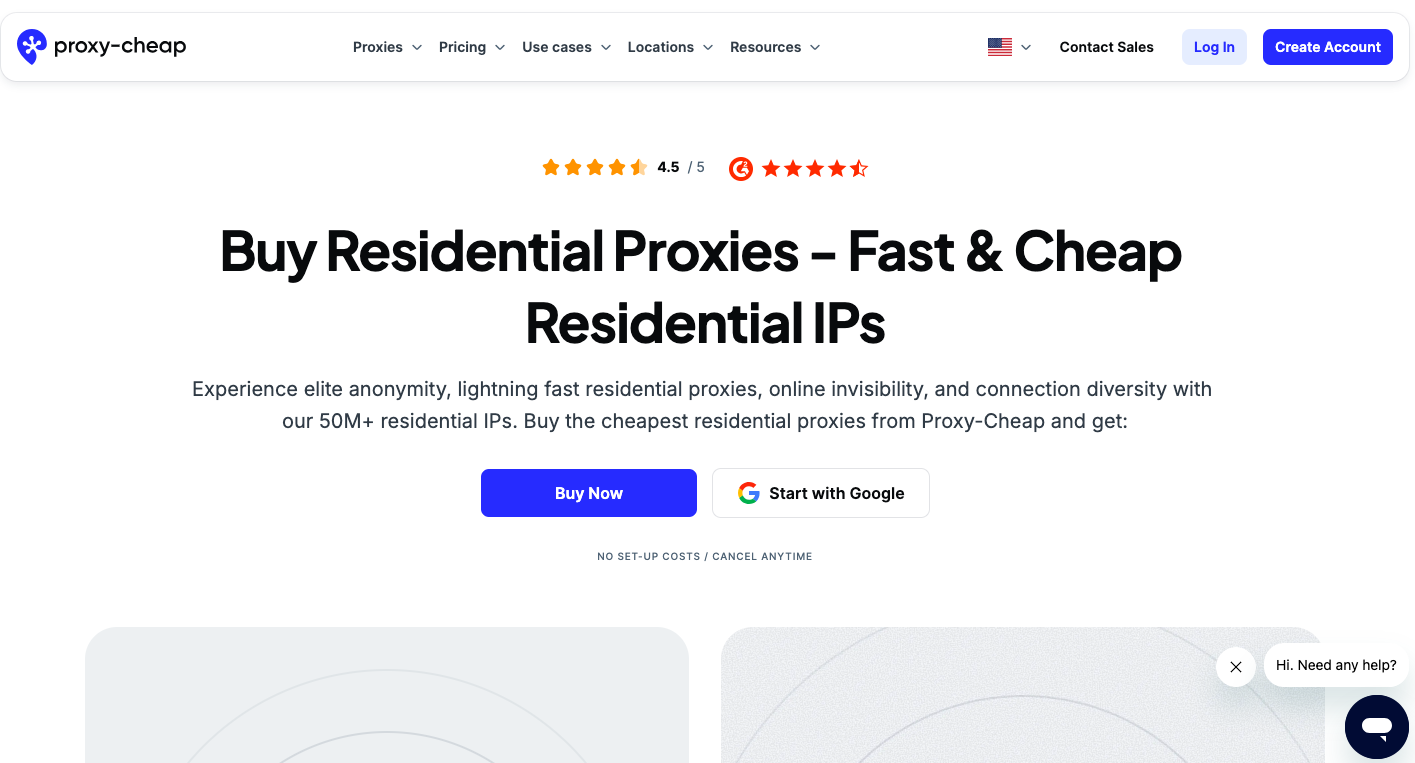
Proxy-Cheap provides access to numerous IP addresses and offers multiple payment methods. Its primary strengths are simplicity and scalability, making it ideal for technical tasks such as price monitoring and SEO rank tracking.
Key features:
50M IPs across 125+ locations.
The service is easy to use, with a straightforward dashboard.
The pay-as-you-go model
Built for Technical Tasks
Residential, datacenter, and mobile proxy options available
City, state-specific targeting.
Chrome browser extension for quick location switching without system settings
No subscription lock-in
HTTP and HTTPS protocol support
CyberYozh vs Proxy-Cheap: Quick comparison
Feature | CyberYozh | Proxy-Cheap |
Residential proxies | Dedicated, static ISP + rotating | Shared, rotating + static |
Mobile proxies | Real SIM cards, dedicated or shared | Partially emulated, limited coverage |
Datacenter proxies | Dedicated IPv4, 99.9% uptime | IPv4 + IPv6, budget-tier |
Countries | 195+ | 127+ (mobile), pool size undisclosed overall |
Rotation | Manual or API-scheduled | Automatic, interval-based |
Sticky sessions | Yes, static IPs available | Limited on rotating plans |
API | Full REST API | Basic API access |
Browser support | AdsPower, GoLogin, Multilogin, Dolphin Anty, Octo Browser, Kameleo | Chrome extension only |
SMS verification | Yes, 140+ countries, 700+ services | Not available |
Fraud score checker | Yes (IP, phone, card) | Not available |
IP reputation tools | Yes | Not available |
Automation support | Selenium, Puppeteer, Playwright, Postman | Basic Python/JS scripts |
Pricing | From $2/GB | From ~$1.99/GB |
Customer support | 24/7, dedicated | Standard ticket support |
Key Takeaway: The table isn't close on tooling; Proxy-Cheap is proxies only. The real decision is whether your workflow needs the account-safety layer CyberYozh bundles in, or whether raw IP volume is all you need.
Proxy types: What you're actually getting
CyberYozh App:
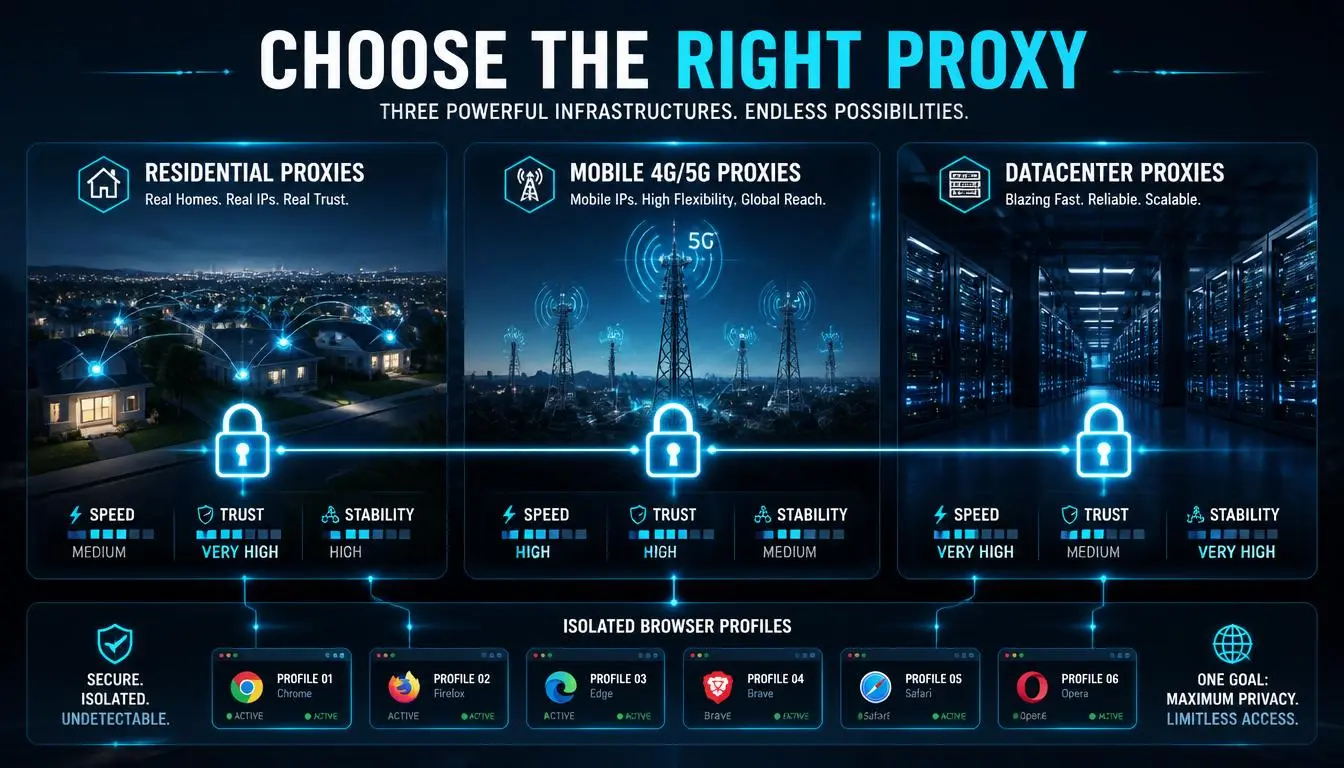
LTE/5G mobile proxies come from real SIM cards on carrier networks such as AT&T, T-Mobile, and Vodafone; when you access Instagram through one, you appear to be an ordinary phone user.
Residential ISP proxies and rotating residential proxies are static, clean IPs, with 99.9% uptime and 24-hour sticky sessions (rotating), suited to long-term account management on Facebook Ads, Google Ads, or Amazon Seller Central.
Datacenter proxies run 99.9% uptime for tasks where reliability matters more than looking residential.
Need to verify an account's identity or a phone number before you commit budget to it? CyberYozh's SMS verification covers 700+ services in 140+ countries, starting at $0.02 per code.
Proxy-Cheap:
Mobile proxies have more limited geographic coverage and are partially emulated rather than sourced from live carrier connections, making them suitable for basic tasks but increasingly detectable by stricter platforms over time.
Its residential IPs are genuinely cheap and fine for general browsing or market research; its datacenter proxies are fast and inexpensive, built for high-volume parsing rather than account safety.
IP sharing: The factor most buyers skip
This is where the two providers diverge most. CyberYozh's IPs are dedicated, non-recycled, and their reputation depends entirely on your own activity. Proxy-Cheap's residential and mobile pools are shared among multiple users, which introduces genuine "bad neighbor" risk: reputation damage from other users on a shared IP or subnet is a well-documented cause of blocks and restrictions, independent of anything you've done yourself.
If you're running a Facebook ad account on a shared IP and another user on that same address gets flagged for aggressive automation, your account can take collateral damage with zero control over the cause.
Not sure if an IP is already flagged before you deploy it? Run it through the fraud-score checker, the same category of anti-fraud check major platforms use internally.
Common Mistake: Choosing a proxy solely based on price per GB without checking whether it's shared or dedicated. A cheaper shared IP that gets your account flagged costs far more than the few cents saved per gigabyte.
Why businesses choose CyberYozh in 2026
Startups and solo operators get enterprise-grade IP quality without committing to enterprise pricing
Agencies can assign a dedicated IP per client account, avoiding cross-contamination between campaigns
Affiliate marketers get real mobile IPs that keep ad accounts trusted at scale
Developers and scraping teams get full REST API access plus native Selenium, Playwright, Puppeteer, and Postman support
Enterprise users get everything: proxies, SMS verification, fraud checking, under one login instead of stitching together three vendors
Pricing: mobile from $1.70/day (unlimited traffic), Residential ISP from $5.29/month (unlimited), Rotating Residential from $2/GB, datacenter from $1.90/month.
Pro Tip: If you manage more than one client account, price a dedicated IP per client rather than pooling them on a single connection; the cost difference is usually small, and it isolates each account's risk from the rest.
What users say
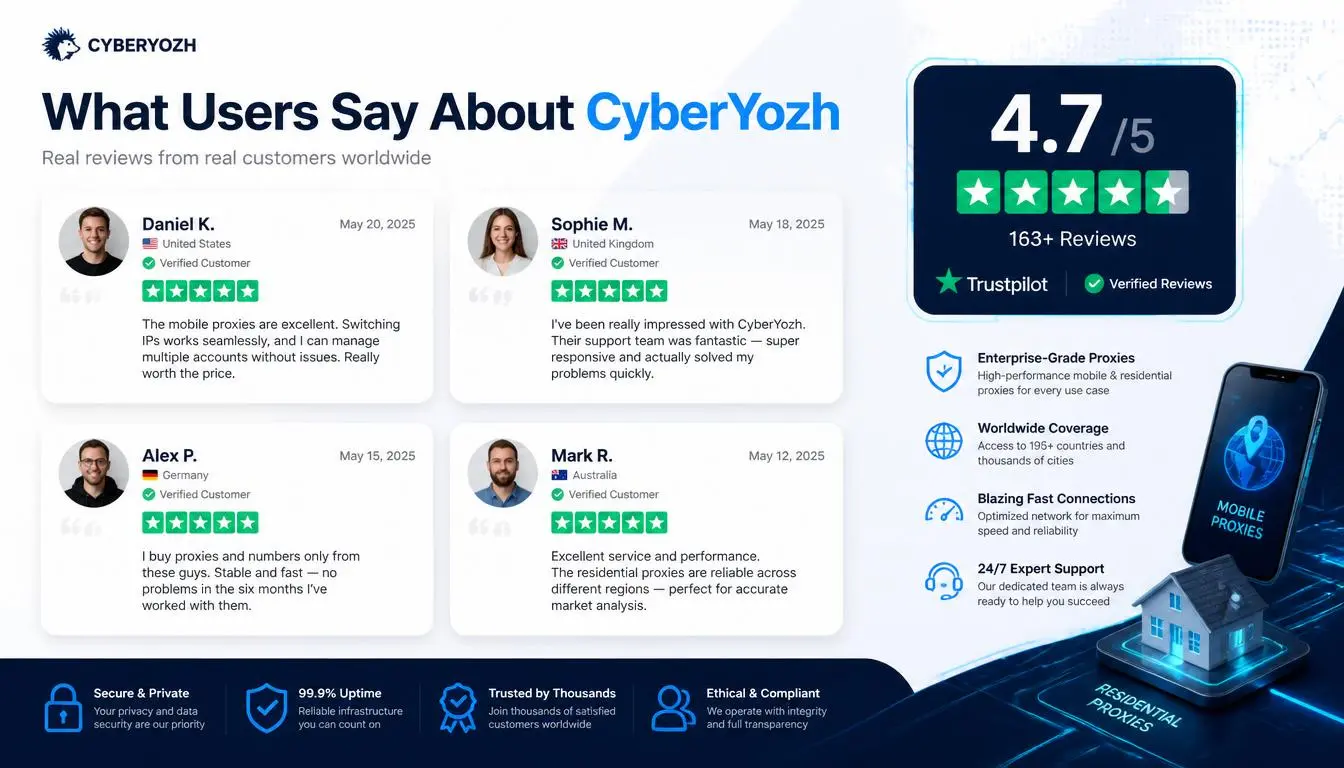
CyberYozh sits in the 4.7-4.8 range on Trustpilot and G2 across several hundred reviews. Recurring themes: fast support response (several reviewers specifically mention resolution within minutes over Telegram), stable connections during long automation sessions, and the fraud-checker catching risky transactions before they became chargebacks for at least one small business user.
On the more critical side, a few reviewers note that the documentation could go into more detail for first-time setup, and that the refund window is fixed at 24 hours rather than an extended trial. It's worth testing against your actual target platform early rather than a generic speed check.
For context on the wider market, AIMultiple's 2026 proxy pricing analysis puts typical residential proxy rates at $3-$15/GB across the industry, which is useful for judging whether either provider's rate here is actually competitive.