
12 Best Residential Rotating Proxies with Unlimited Bandwidth in 2026
TL;DR:
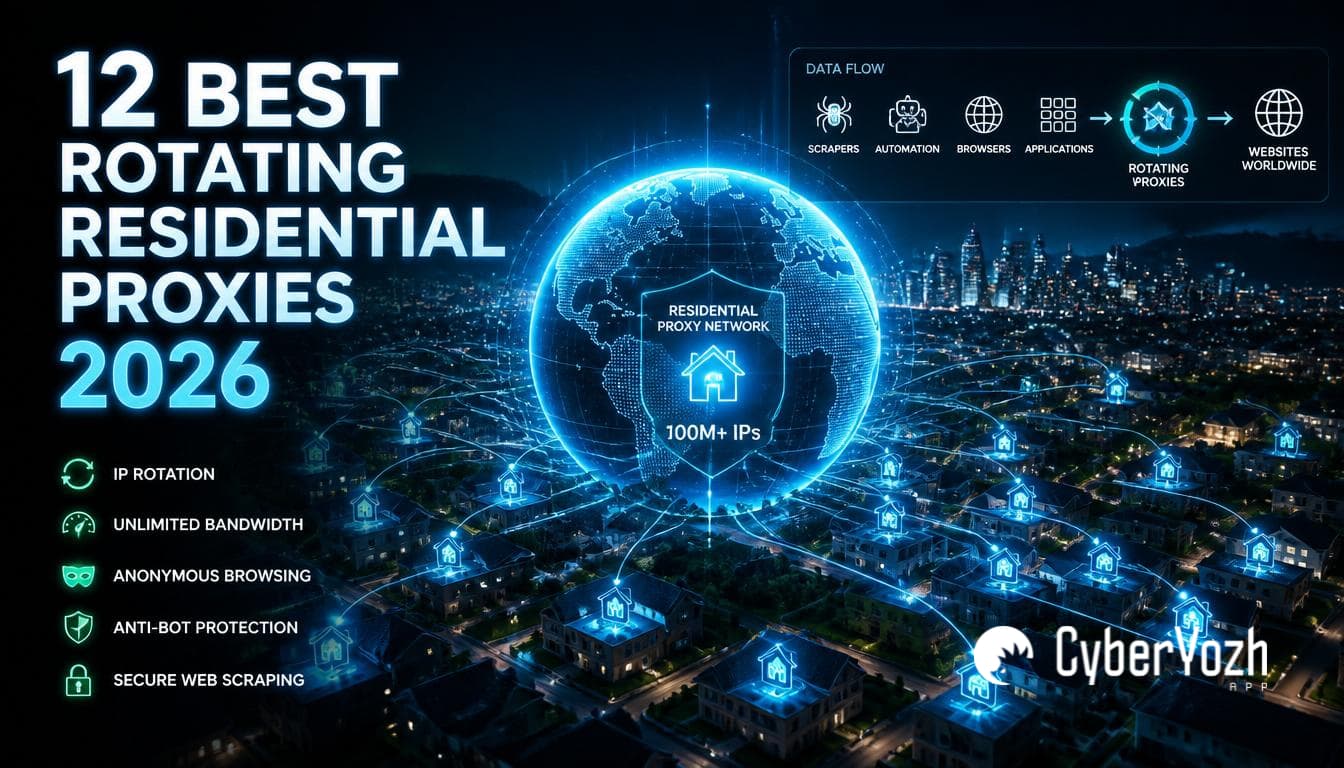
Rotating residential proxies solve the two problems that kill most scraping and automation projects, IP blocks and account flags, by cycling through real ISP-assigned IP addresses instead of easily flagged datacenter ranges.
Below are the 12 best rotating residential proxies of 2026, including which ones actually deliver unlimited bandwidth-style flexibility rather than a hard per-GB ceiling.
Why do your proxies keep getting blocked
You set up a scraper. It works great for a week. Then the success rate starts sliding, 90%, then 70%, then you're staring at a wall of 403s wondering what changed.
The target site just got better at spotting you. Datacenter IPs come from known hosting ranges that no real person browses from, so once a site sees enough traffic from those ranges, it blocks the whole block, not just your IP. Rotating residential proxies fix this by routing traffic through real addresses assigned to actual homes by internet service providers. Hence, a scraper appears to be a person rather than a server farm.
According to Proxyway's independent 2026 proxy benchmarks, success rates across the category vary far more than most marketing pages admit, which is exactly why this guide leads with verified pricing and pool data instead of headline claims. Below, the 12 best rotating residential proxies on the market this year, including which ones genuinely offer unlimited bandwidth-style flexibility rather than a capped plan dressed up in generous language.
What are rotating residential proxies
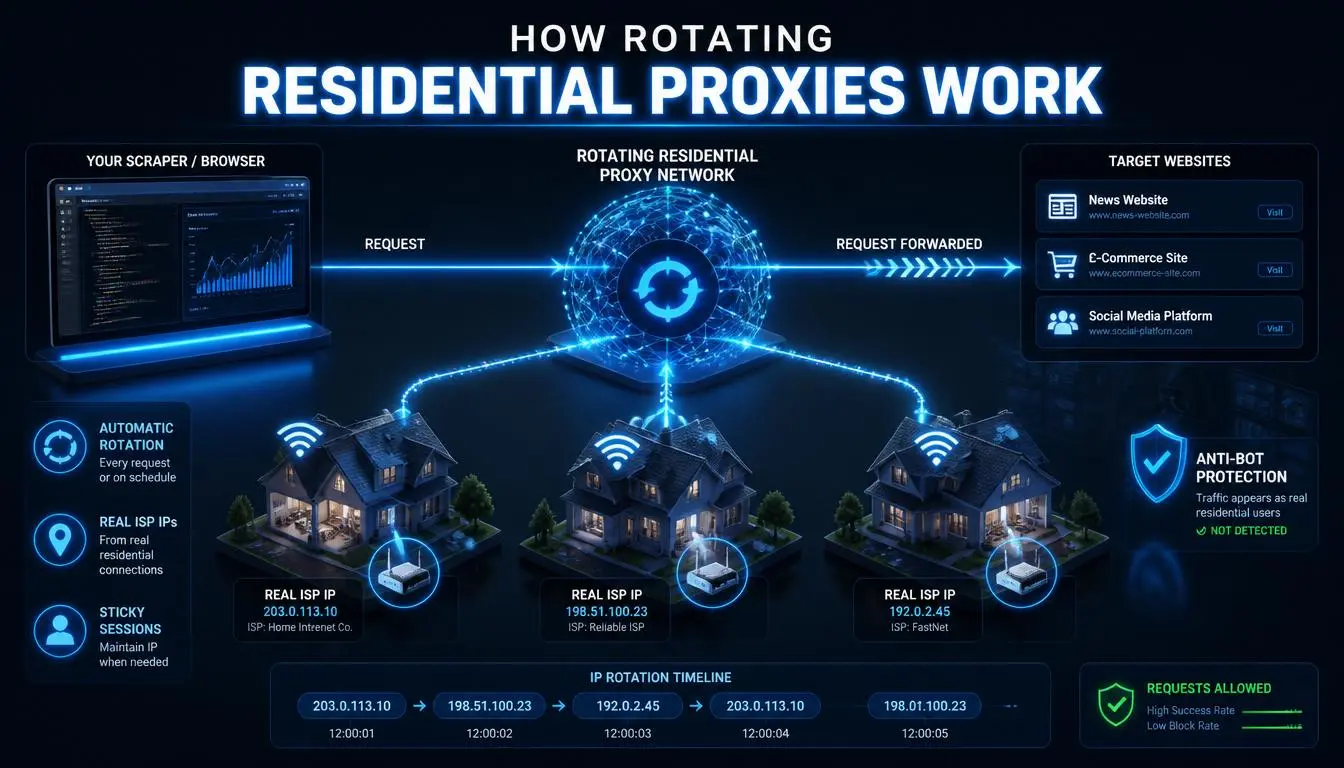
A rotating residential proxy assigns a different IP from a real-device pool on a schedule you control, every request, every few minutes, or every few hours. That's different from a static residential rotating proxies setup in one important way: rotation is what keeps any single address from accumulating enough volume to get flagged, while the "residential" part is what gets you past IP-reputation checks in the first place. Get both right, and you have a pool that's hard to detect and hard to exhaust.
Five problems rotating residential proxies solve
1. The slow bleed from 90% success to 60%. This is the classic sign of a burning pool, one small or reused enough that the target site has started fingerprinting it. Pool size and pool hygiene matter more here than brand recognition.
2. Sticky sessions breaking mid-task. Rotating the IP address mid-task on a multi-step form or during a logged-in session can make it appear that the request came from a different device. Sticky sessions solve this by holding a single IP for a set period before rotating.
3. Account platforms reading rotation as a takeover signal. Rotating IPs are the wrong tool for managing logged-in social accounts; Instagram and LinkedIn both read a mid-session IP change as a security risk. Static ISP proxies are the correct tool for that job.
4. Paying enterprise prices for hobbyist volume. A rotating residential proxy plan with genuinely flexible, non-expiring bandwidth is usually smarter than chasing the lowest headline rate, since usage caps and expiring credits are where budgets quietly blow up.
5. Configuration failures that look like proxy failures. A surprising share of "the proxy doesn't work" tickets are protocol mismatches or expired auth, not the pool itself.
If you're evaluating rotating residential proxies for the first time, the fastest way to shortcut this list is to match your use case to the right provider below, starting with the one built specifically for SMB budgets and real workflows.
The 12 Best Rotating Residential Proxies in 2026
Every provider below was evaluated on the same criteria: pool size and quality, rotation flexibility, sticky-session support, and, where it applies, genuine unlimited bandwidth flexibility rather than marketing language. AIMultiple's 2026 proxy pricing analysis was used to cross-check per-GB rates where providers' own pages were ambiguous.
CyberYozh
CyberYozh is a rotating residential proxy provider built for small businesses, agencies, and automation teams that need real ISP IP addresses without enterprise pricing or KYC delays.
CyberYozh rotating residential proxies start at $0.90/GB, among the most aggressive entry pricing in this entire comparison. That low floor is backed by a full ecosystem rather than a bare-bones proxy endpoint: SMS verification, an IP fraud score checker, virtual cards, and antidetect browser integrations (Dolphin{anty}, Adspower) all live under the same account.
It's also one of the few providers on this list with a genuinely strong, verifiable reputation to back the pricing, a consistent 4.6–4.8★ rating across independent Trustpilot listings and 100+ public reviews, with users specifically calling out speed, uptime, and support responsiveness.
Features:
100M+ real ISP IPs across 100+ countries
Speeds up to 10 Mbps
Sticky sessions up to 6 hours
Protocol support: SOCKS, HTTP, HTTPS, UDP
Full API access with a mass credentials generator, integration with Selenium, Puppeteer, Postman, Playwright, Scrapy, and custom scripts.
Native antidetect browser and fraud-score-checker integration
Pricing: Rotating residential proxies start from $0.90/GB, with better rates at volume; confirm current tier breakpoints on the live pricing page.
Pros:
Lowest verified entry price of any provider in this comparison
Full API access at every tier, not gated behind enterprise plans
Combined proxy + SMS + fraud-check + antidetect ecosystem reduces vendor sprawl
Strong, independently verifiable Trustpilot reputation (4.6–4.8★, 100+ reviews)
Get Started with CyberYozh Rotating Residential Proxies →
Bright Data
Bright Data operates a publicly disclosed rotating residential proxies network, built for enterprise-scale data collection against the hardest anti-bot targets on the web. Pricing is usage-based, with pay-as-you-go rates dropping substantially at committed volume, and the raw network comes bundled with a Web Unlocker that automates CAPTCHA handling and retries, at a price point most SMB budgets will find hard to justify.
Features:
400M+ IP network across 195 countries
Country/city/ZIP/ASN/carrier-level targeting
Web Unlocker for automated CAPTCHA and block handling
SOC 2 and compliance documentation
Proxy Manager desktop app for SOCKS5 configuration
Pricing: ~$8.40/GB pay-as-you-go, dropping toward $2–3.50/GB on committed enterprise tiers
Cons:
Mandatory KYC review gates full network access, adding days before you can actually run traffic
Nearly 10x CyberYozh's entry price per GB, with billing complexity on top
Pros:
Unmatched pool size and targeting granularity
Strong compliance documentation for regulated buyers
Oxylabs
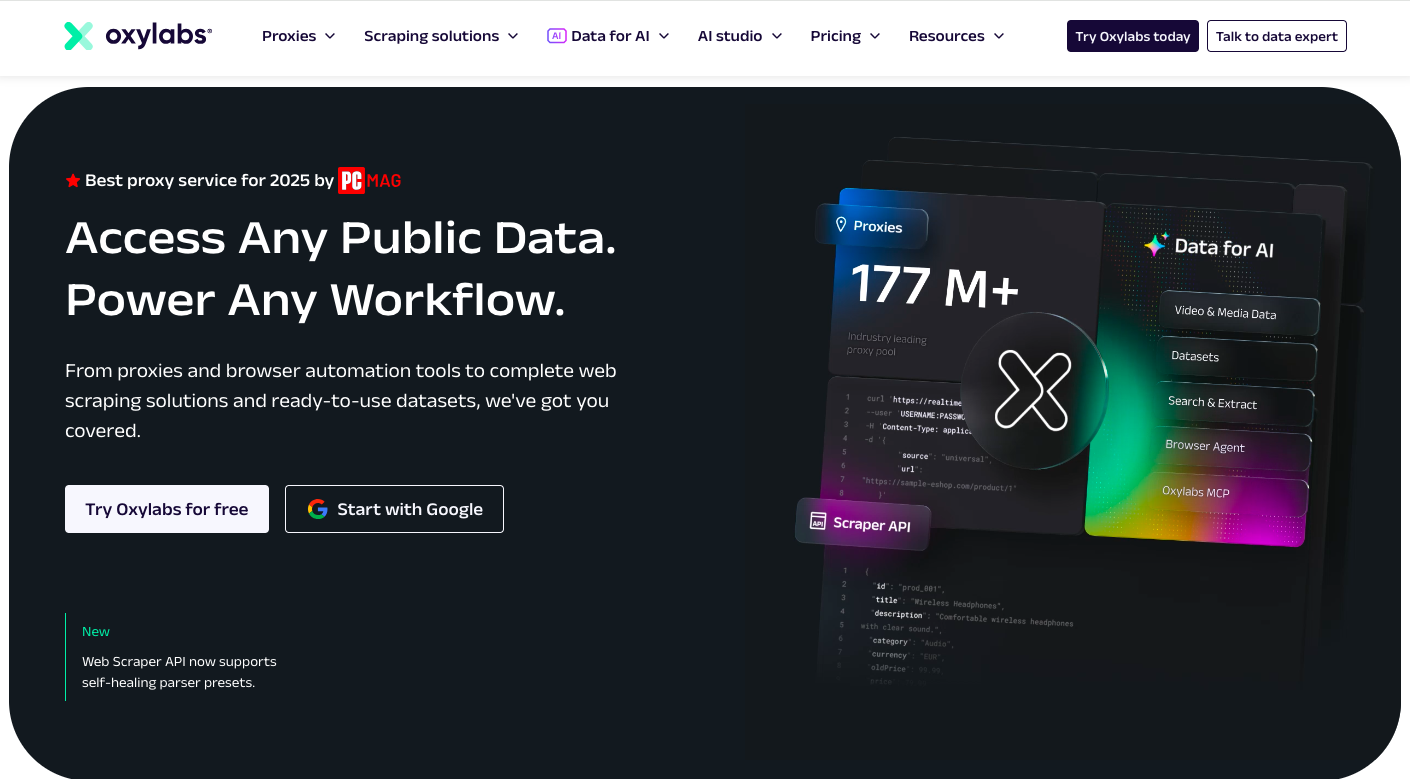
Oxylabs positions itself for teams seeking enterprise-grade success rates alongside developer tooling, including an AI code assistant that generates scraping scripts on demand. Independent benchmarks consistently place its pool quality and response times near the top of the category. However, onboarding for advanced filters still requires a KYC process that smaller teams may find creates unnecessary friction at their volume.
Features:
175M+ residential IPs, 195+ locations
Sub-second average response times
City, state, and ZIP-level geo-targeting
OxyCopilot AI scraping assistant
Web Scraper API for SERP, e-commerce, and real-estate data
Pricing: $6–8/GB entry, down to ~$2.50/GB at 1TB+ (Corporate tier)
Cons:
KYC friction on advanced filters and residential trials
Unused monthly bandwidth doesn't roll over, unlike pay-as-you-go alternatives
Pros:
Strong independent benchmark performance
Broad self-service product range beyond raw proxies
Decodo
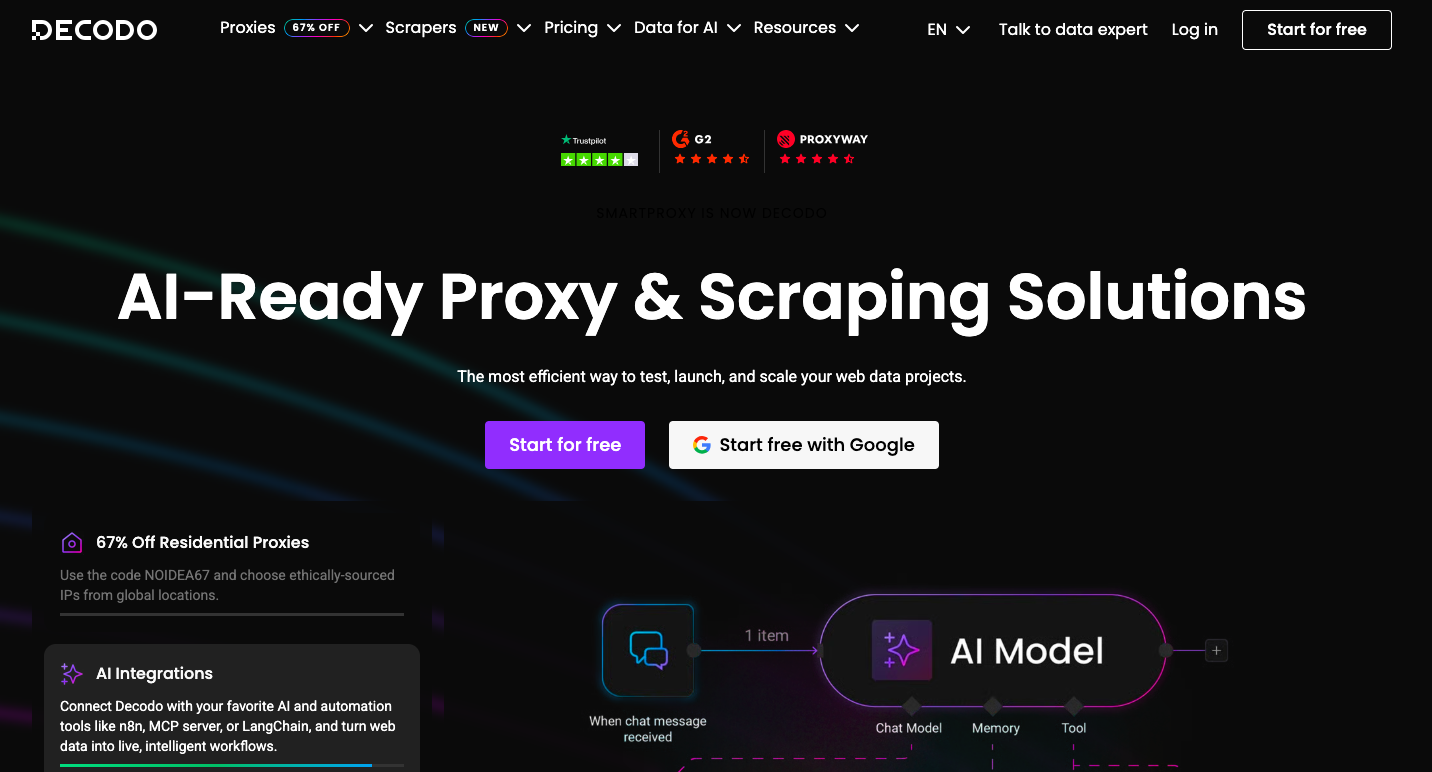
Decodo runs a residential rotating proxies network built around self-serve accessibility, no sales call, no KYC gate, just a credit card and a working proxy. Rebranded from Smartproxy in 2025, the underlying infrastructure carries over unchanged, and its linear pricing ladder consistently benchmarks as a moderately cost-efficient option in the mid-market tier. However, it still starts well above CyberYozh's entry rate.
Features:
125M+ residential IPs across 195+ countries
State, city, and ASN-level targeting
Sticky sessions up to 30 minutes
Site Unblocker and SERP/eCommerce scraping APIs
Pricing: $3.75–4/GB pay-as-you-go, down to ~$2/GB at 1TB
Cons:
No SOC 2/ISO attestation yet, which can block regulated-industry procurement
Higher ban rates on the toughest Cloudflare/Akamai targets than top-tier plans
Pros:
True self-serve onboarding, no sales gate
Consistently strong cost-efficiency in independent benchmarks
SOAX
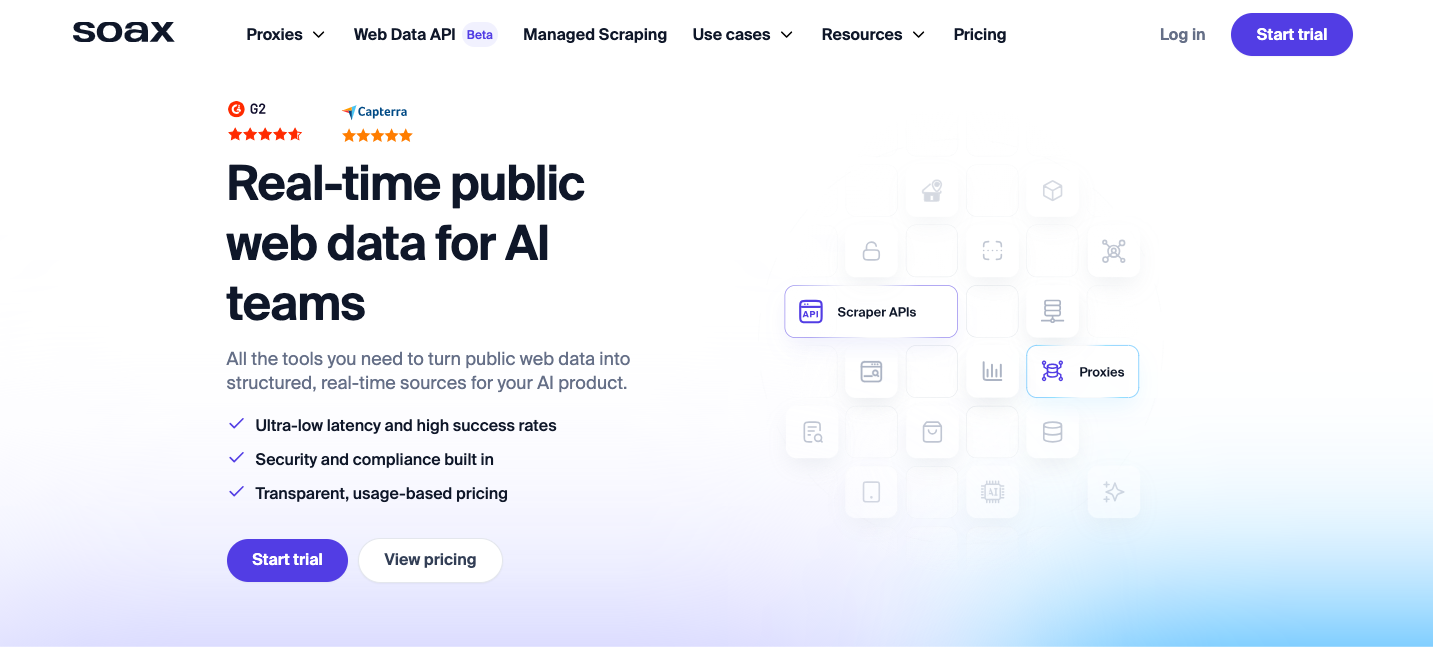
SOAX built its reputation on precision rather than raw pool size, actively removing flagged IPs to maintain what it calls a clean pool, a meaningful differentiator for anyone whose rotating residential proxy traffic keeps getting caught by aggressive anti-bot systems. Its targeting accuracy at the city and ASN level tests well against both mid-market and enterprise competitors, though pricing sits solidly in the mid-tier rather than budget territory.
Features:
155M+ residential IPs
Aggressive pool-cleaning policy
City and ASN-level targeting accuracy
SOCKS5, HTTP, and HTTP(S) protocol support
AI-driven session routing
Pricing: From ~$3.60/GB; monthly plans from $90 for 25GB
Cons:
Geo-filtering can behave unpredictably outside documented parameters
Mid-tier pricing, not a budget option
Pros:
Actively maintained clean-pool policy
Strong independent benchmark reliability
NetNut
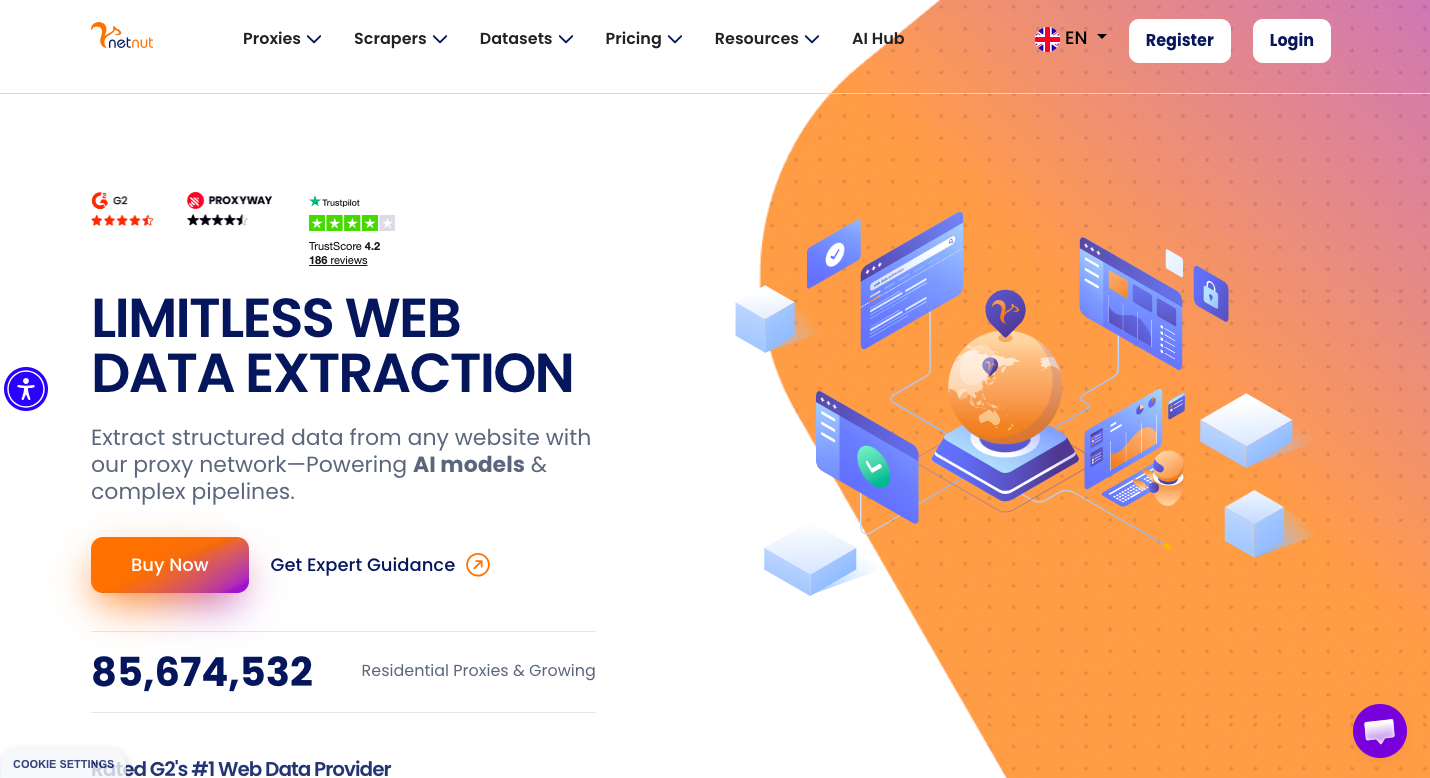
NetNut takes a different architectural approach from most rotating residential proxy providers, sourcing IPs directly through ISP partnerships rather than relying on peer devices being online. That trade-off delivers datacenter-like speed with residential-grade legitimacy, making it a fit for long-session, stability-first workflows. However, it also carries the highest entry price of any mid-market provider on this list.
Features:
85M+ IPs across 195+ countries
Direct ISP-partnership sourcing
City, state, and ASN filtering (not combinable)
Ultra-stable long-duration sessions
Free residential trial available
Pricing: ~$3.53/GB, entry plans from $99
Cons:
Highest entry price point among mid-market providers
Independent benchmarks place success rates behind most competitors on this list
Pros:
Direct ISP sourcing reduces dependence on end-user device availability
Strong for static-style, long-session use
Still comparing options? The providers above cover the enterprise and mid-market tiers; CyberYozh remains the strongest fit if you want that same real-ISP infrastructure without enterprise-scale pricing. [See CyberYozh's proxy plans →]
DataImpulse
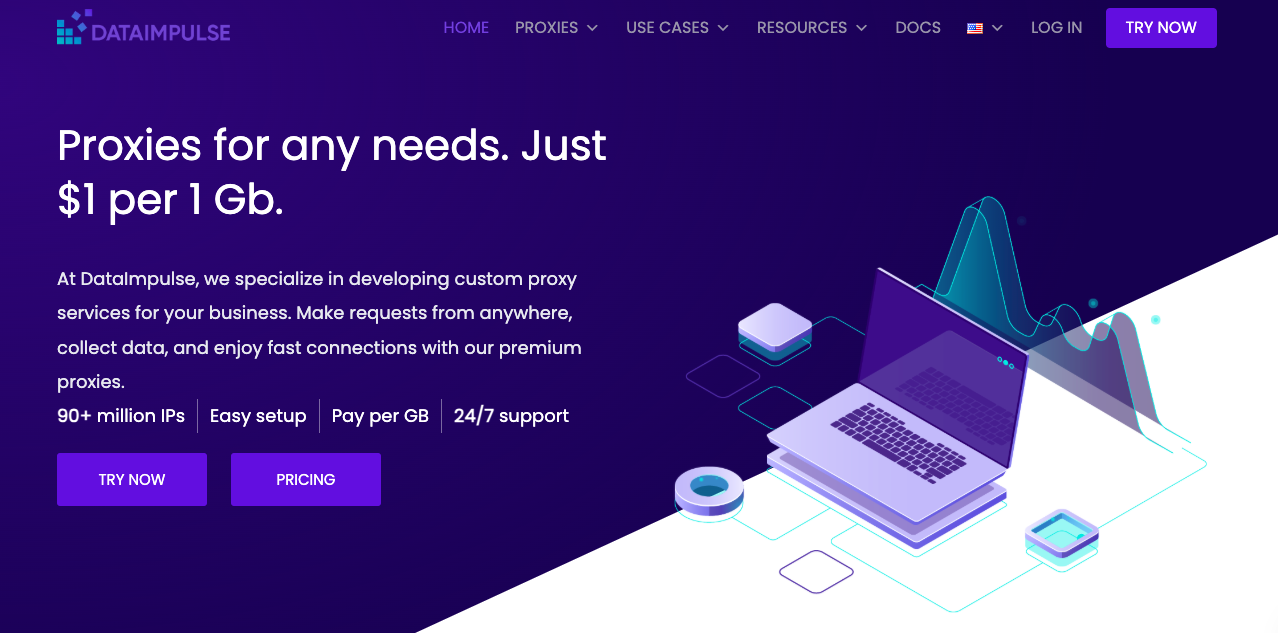
DataImpulse's pay-as-you-go model with traffic that never expires comes closer than most to a genuine unlimited-bandwidth feel; you're never racing a monthly reset clock. At $1/GB. That said, the country-only free targeting means that any serious geo-targeting work quickly adds cost, and its managed API tooling is thin compared to providers built around automation from day one.
Features:
90M+ ethically sourced IPs across 195 countries
Non-expiring pay-as-you-go traffic
Country-level targeting included free
HTTP, HTTPS, and SOCKS5 support
ISO 27001-certified infrastructure
Pricing: $1/GB pay-as-you-go, no monthly minimum
Cons:
City/ASN-level targeting costs extra on top of the base rate
Thin managed-API ecosystem, no SMS, fraud-check, or antidetect tooling bundled in
No sticky-session support beyond basic rotation controls
Pros:
Low, straightforward per-GB rate
Traffic never expires
IPRoyal
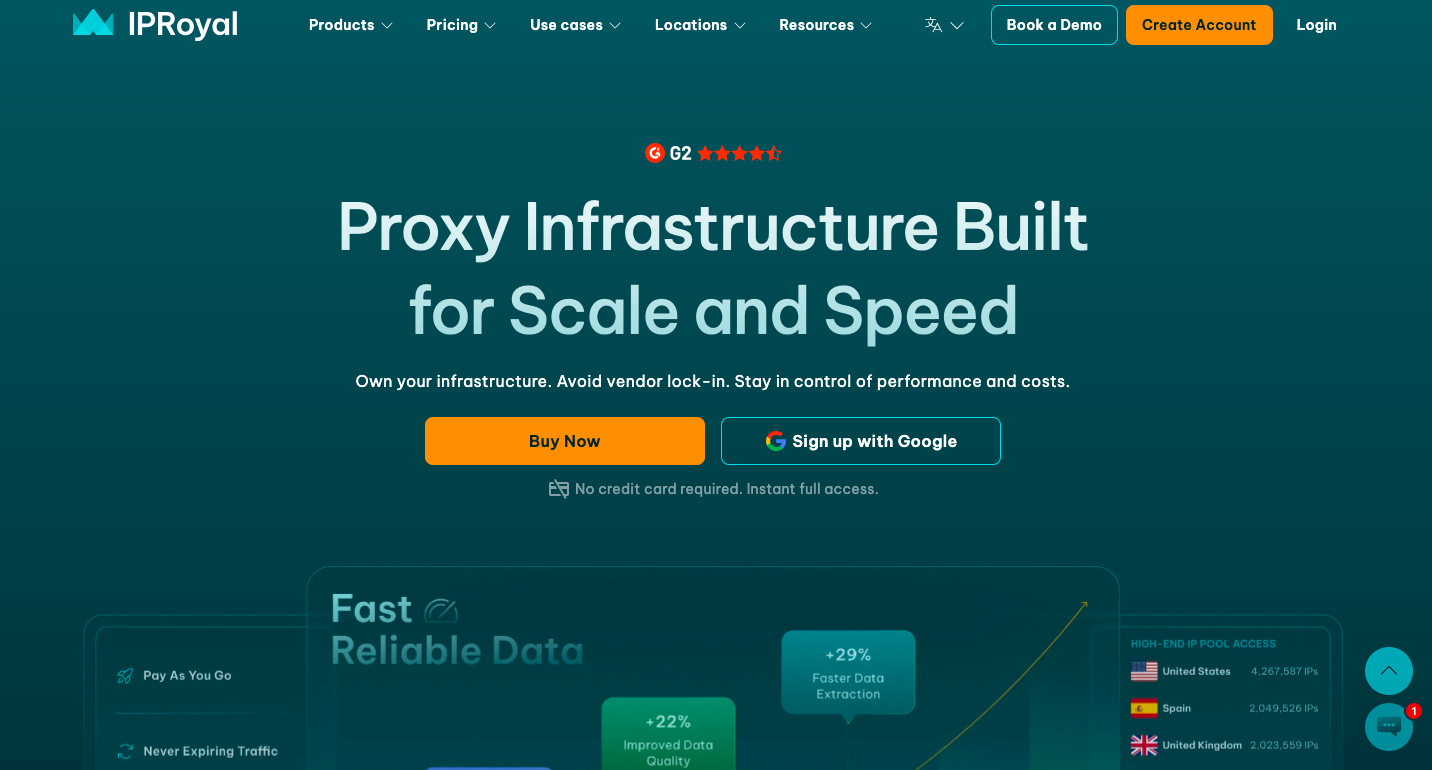
IPRoyal's bandwidth rolls forward rather than resetting each month, helping teams with bursty, uneven usage patterns avoid wasting prepaid GB. Pricing improves substantially at volume, and 7-day sticky sessions add flexibility. Still, the entry-tier rate is actually higher than several competitors on this list, and recent independent benchmarks show its connection stability has slipped.
Features:
32M+ IPs across 195 countries
Country, state, and city geo-targeting
Sticky sessions up to 7 days
No contract required
Unlimited concurrent sessions
Pricing: ~$7/GB pay-as-you-go entry, down to ~$1.75/GB at 500GB+ commitment
Cons:
Independent 2026 benchmarks show a real regression in connection stability
Smallest pool among the mid-market providers, and the highest PAYG entry price on this list before volume discounts
Pros:
Unused bandwidth rolls forward indefinitely
No contract required
Webshare
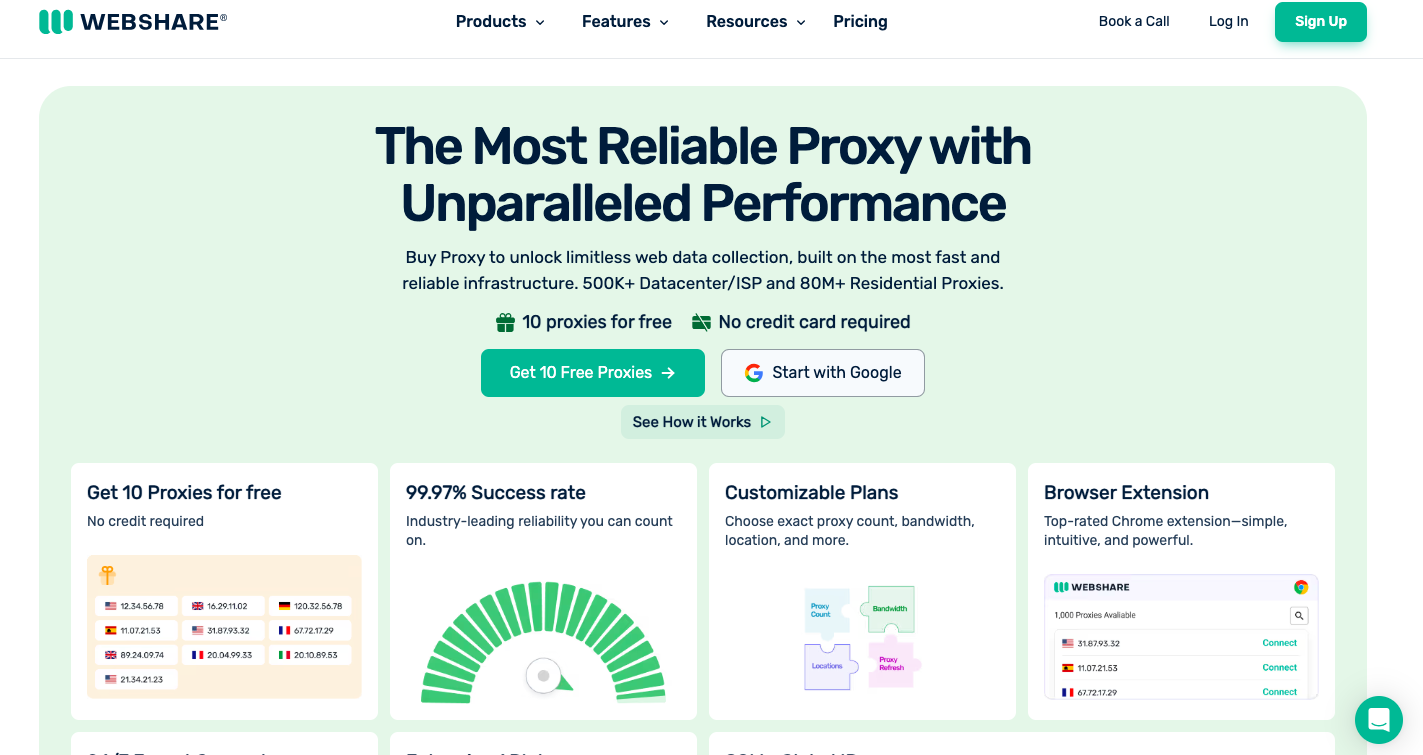
Webshare's biggest draw is a genuinely usable free tier, making it an easy entry point for testing a workflow before committing a budget. Past the free tier, though, bandwidth resets monthly rather than rolling over, and independent benchmarks consistently rank it behind the mid-market and budget leaders on hardened anti-bot targets, meaning the "cheap" plan can end up costing more in retries and failed requests than a slightly pricier, cleaner pool.
Features:
Tier A residential IP quality
Genuinely usable free tier
HTTP(S) and SOCKS5 support
Real-time usage dashboard
IP authorization and allowlisting
Pricing: Free tier available; residential plans from ~$3.50/month
Cons:
Bandwidth resets monthly rather than rolling over
Weaker performance against hardened anti-bot targets than most of this list, per independent benchmarks
Pros:
Lowest-friction signup in the category
Free tier is actually usable, not just a trial
Rayobyte
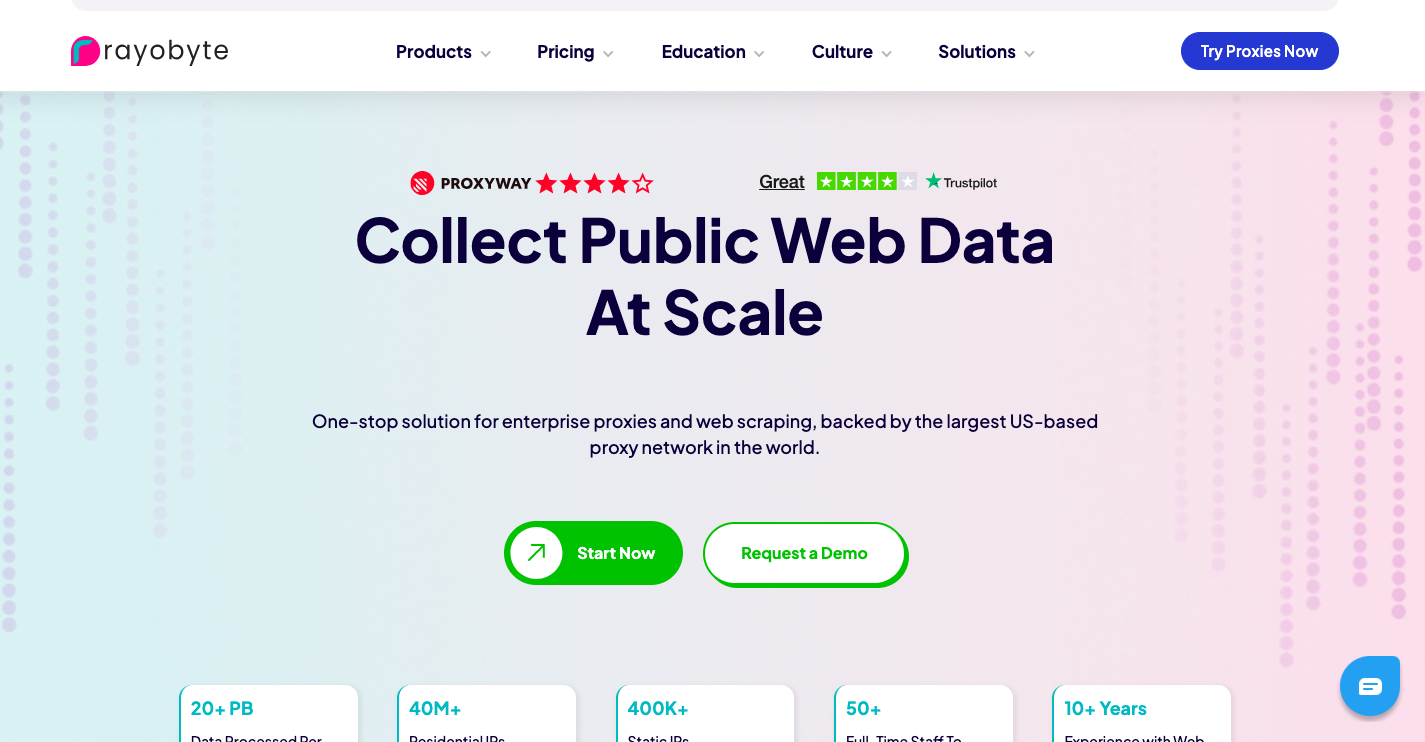
Rayobyte earns a spot on this list for teams that specifically want a US-based vendor relationship; it's headquartered in Lincoln, Nebraska, with no KYC gate on pay-as-you-go residential access. Its residential pool is sourced through a proxyware app. While the exact pool size isn't disclosed (a transparency gap worth noting), its pricing and non-expiring credits stay competitive with the mid-market tier.
Features:
Residential coverage across 150+ countries
Non-expiring credits with a 5% recurring discount
Sticky sessions from 1–120 minutes
Self-hosted Chromium browser option
Free 5,000-scrape Web Scraping API tier
Pricing: From ~$3–3.50/GB
Cons:
Undisclosed exact pool size, no way to verify scale claims independently
Dashboard UX lags noticeably behind more polished self-serve competitors
Pros:
No KYC gate on pay-as-you-go residential
Generous free-tier scraping API
Infatica
Infatica runs the smallest disclosed pool in this comparison and is pivoting toward broader data-provider territory rather than doubling down on proxy infrastructure. Pricing has varied significantly across sources, anywhere from $4 to $12/GB, which on its own is a signal to get a direct quote before committing any budget.
Features:
~10–15M residential IPs
City and ASN-level targeting
HTTP/SOCKS protocol support
Rotation from 90–600 seconds
Expanding data-provider product suite
Pricing: Entry pricing quoted between $4–12/GB depending on plan and commitment
Cons:
Smallest pool on this list by a wide margin
Independent benchmarks place success rate behind every other provider here
Inconsistent public pricing makes budgeting difficult upfront
Pros:
Growing product breadth beyond proxies alone
ProxyWing
ProxyWing is a rotating residential proxy option built around unusually long sticky sessions at a low price point, making it a reasonable fit for long-running, low-complexity tasks rather than high-volume scraping against hardened targets. Broad country coverage helps it compete with pricier mid-market names in terms of reach, though it lacks the independent benchmark track record of more established providers.
Features:
70M+ IPs across 190+ countries
Sticky sessions configurable up to 7 days
Dedicated ISP and datacenter IP options
Speeds up to 1 Gbps
Straightforward flat per-GB pricing
Pricing: ~$2.50/GB
Cons:
Little independent benchmark coverage to verify performance claims
Nearly 3x CyberYozh's entry price for a comparable use case
Pros:
Unusually long maximum sticky-session window for the price
Broad country coverage
Feature comparison table
Provider | IP Pool | Starting Price | Best For |
CyberYozh | 100M+ | $0.90/GB | Small business & growing teams |
Bright Data | 400M+ | ~$8.40/GB | Enterprise scale |
Oxylabs | 175M+ | ~$6–8/GB | Premium performance |
Decodo | 125M+ | ~$3.75/GB | Mid-market value |
SOAX | 155M+ | ~$3.60/GB | Precision geo-targeting |
NetNut | 85M+ | ~$3.53/GB | Session stability |
DataImpulse | 90M+ | $1/GB | Budget scraping, no bundled tools |
IPRoyal | 32M+ | ~$1.75–7/GB | Rollover bandwidth |
Webshare | Not disclosed | Free tier / ~$3.50/mo | Testing & low-volume |
Rayobyte | Not disclosed | ~$3–3.50/GB | US-based support |
Infatica | ~10–15M | ~$4–12/GB | Multi-product bundling |
ProxyWing | 70M+ | ~$2.50/GB | Long sticky sessions |
How to choose the right rotating residential proxy
Web scraping: prioritize a large, clean pool with per-request rotation
Account management: skip rotation entirely, use static ISP proxies with a fixed IP
SEO and rank tracking: city/ZIP/ASN-level targeting matters more than raw pool size
Budget-conscious projects: look for a rotating residential proxy plan with non-expiring traffic and a low verified entry rate; CyberYozh's $0.90/GB is currently the lowest verified starting price in this comparison
All-in-one workflows: if you also need SMS verification, fraud-score checking, or antidetect browser support, bundling with CyberYozh removes the need for separate vendors entirely
Not sure which tier fits your volume? [Compare CyberYozh residential proxy plans →] before committing to a pricier enterprise contract you may not need yet.
The bottom line
Whether you need the best rotating residential proxies for enterprise-scale scraping or a budget-friendly rotating residential proxy setup for a small project, the right choice comes down to matching pool size, session flexibility, and pricing to your actual workload, not the biggest name you've heard of.
For most small businesses and growing teams, CyberYozh is the strongest fit on this list: the lowest verified entry price ($0.90/GB), a real 4.6–4.8★ Trustpilot track record across 100+ reviews, sticky sessions long enough for real workflows, and a full ecosystem- proxies, SMS verification, fraud-score checking, and antidetect browser support- under one account. That combination is hard to match without paying enterprise rates or clearing a KYC queue first.