
Use Free Cloud Phone for Different Tasks Without Drawbacks
Cloud phone usage has surged in recent years due to the growth of remote work, but also the need for optimization. When I interviewed a social media manager of an e-commerce agency, she told me that using ordinary physical phones for most of their TikTok and Instagram activities is nonsense nowadays. Platforms ban accounts when detection algorithms link multiple profiles via shared device fingerprints, resulting in losses. Based on the information I got from her, let’s explore the usage of cloud phones here, focusing on the free cloud phone apps. What are the actual free cloud phone offers, which free apps are trustworthy, which commercial tools offer good free tiers, and what are potential drawbacks? All these questions will be covered. Let’s start!
TL;DR
Free cloud phones are real, but their value depends entirely on your use case. Casual users and developers can benefit, while professional teams always need paid plans.
Fully free options (BlueStacks X, MyAndroid) cover gaming and app testing but lack anti-detection features and proxy support
Freemium platforms (UgPhone, Funpass) offer limited trial credits — enough to test, not enough for uninterrupted professional workflows
Commercial free tiers (MoreLogin, GeeLark, BitCloudPhone) are more trustworthy and support proxy integration, making them viable for personal account management
Data security is the top risk: always check the privacy policy and use a verified proxy like CyberYozh to protect your session and identity
Match the tool to the task: UgPhone/VSPhone for gaming, MyAndroid/GeeLark for testing, MoreLogin for accounts — no single free option does it all
What are cloud phones
Cloud phones are virtualized mobile environments accessible via the internet, allowing users to test apps, manage accounts, and automate tasks without physical hardware. Before exploring everything further, we should focus on their specific features and how it’s possible to access them for free.
Features of cloud phone emulators
That’s how cloud phones work, and what they allow SMMs and account managers to do:
Run a full Android OS instance: a complete, isolated Android cloud phone environment running remotely, with no traces left on the local device
Select among device model profiles, such as Samsung S23 Ultra, Google Pixel 7 Pro, Xiaomi Poco X4 Pro, Oppo Reno 6, etc., to simulate real hardware fingerprints
Enjoy root access by default, allowing deep system customization, which is usually impossible on a standard Android device
Keep sessions even when the user closes their browser or app, allowing uninterrupted business process automation
Learn more about digital fingerprints, what they are, and why they matter a lot.
As a result, cloud phone usage emulates real Android phones, which can be heavily customized and used for running multiple accounts without cross-linking. It works when one virtual device runs one account, each with its unique proxy selection to have a separate IP.
Basically, a cloud phone is a device without a device. Each of them is recognized by platforms as a separate Android platform, but we don’t need to buy 100 smartphones for 100 accounts. All we need is 100 cloud phone instances, each with unique characteristics, and voila: no bans, no cross-linkings, only a clear strategy!
Cloud mobile phones for free
But how can we get all these features for free? Short answer: Free options are limited, and all professional SMM teams use professional paid services.
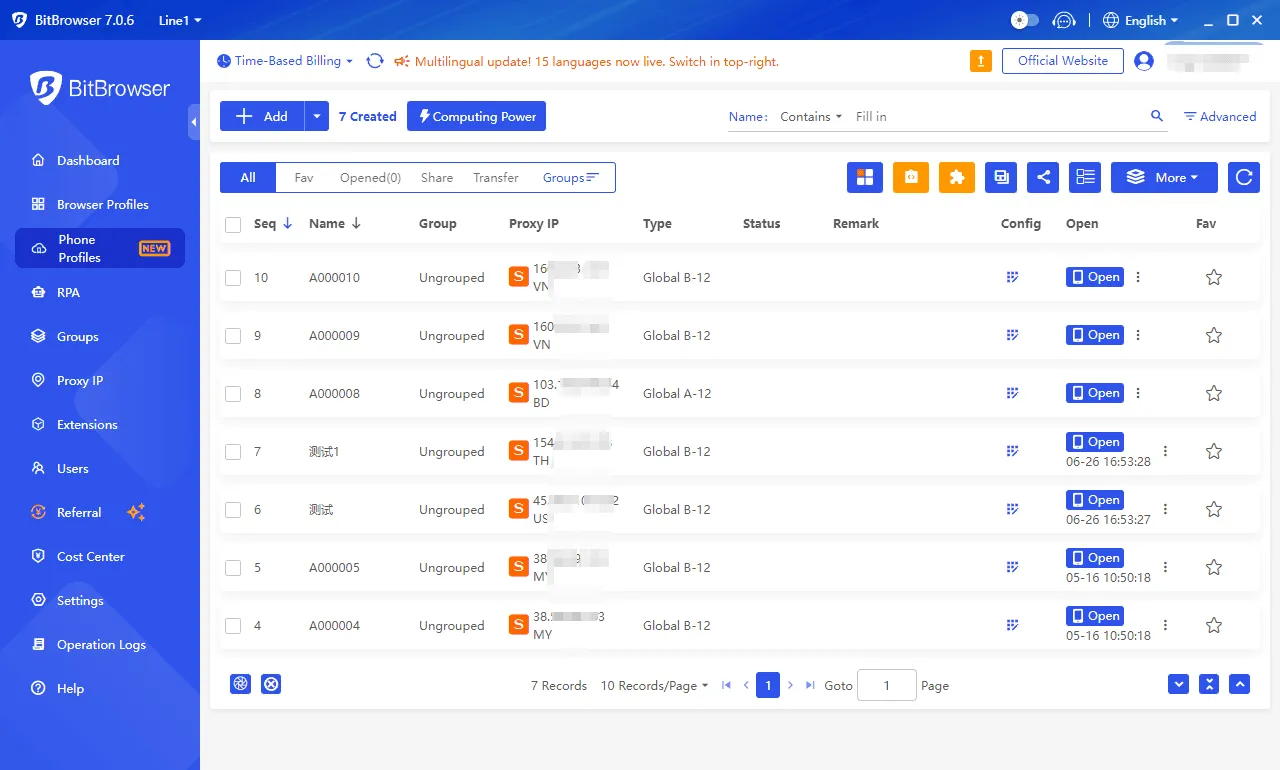
Long answer: For many real-world problems and, especially, personal use, free options are more than viable. For example, there are free services with session limits. Other services offer very low prices, such as $0.03/day per cloud phone instance from BitCloudPhone, making them effectively free for small-scale use. Some services are freemium, meaning their basic functionality is free. Explore the best Android cloud phones on CyberYozh for more information.
No, we don’t use free cloud phones, but you can do that! For personal use, there are many either fully free options or viable free-tier offers. They aren’t suitable if you need more than one or two devices and a high, uninterrupted connection speed, but they are good for testing your personal applications or playing your favorite games without restrictions.
Using free cloud phones: Examples
Let’s explore specific examples of cloud mobile phones available for free (or almost for free). Don’t forget to pair them with mobile proxies to ensure a safe virtual environment that helps avoid many drawbacks.
Free cloud phone apps
These four providers are either fully free or operate under a freemium model with additional paid features.
BlueStacks X is available directly in the browser on Windows, Mac, and other platforms, with no subscription or credit card required. It offloads some computation to the local endpoint, reducing server costs enough to eliminate fees in exchange for watching short pre-session ads. It is gaming-only and not suited for multi-account management or social media automation.
UgPhone is a freemium cloud phone with group-control synchronization, making it popular for multi-account mobile gaming (including Roblox and other titles). New users receive 250 free diamonds upon registration, which can be exchanged for approximately 4 hours of trial usage, with additional time purchasable with gem-based credits.
Funpass is a cloud phone and cloud gaming service built on native Android with ultra-low latency and 24/7 multi-instance support, targeting e-commerce marketers and TikTok Live operators. It is not technically free, but it runs a heavily discounted, freemium-adjacent model: at baseline, it costs under $3 for 7 days, with further discounts during regular 50% anniversary promotions.
MyAndroid is a free cloud phone emulator that runs directly in a browser and is mostly used for app testing. It’s fully free, has a good privacy policy, and can be used by individual developers and testers, but its feature set is, of course, very limited.
Free cloud phones are usually designed for gaming, allowing Android gamers to farm in-game resources for better results, which is called AFK farming. However, they can also be used for app testing and personal account management, if a user doesn’t want to reveal their own mobile phone.
Also, explore why gamers need a proxy in CyberYozh’s article.
Cloud phone free trials
These services are full-scale commercial cloud phone services, which offer various paid-tier subscription plans, but they also have free plans, usually to let users evaluate the provider before committing to a paid plan. However, those who need a single cloud phone line, especially those with infrequent usage, can be fully satisfied with these plans.
MoreLogin is an antidetect browser platform with a built-in cloud phone module, combining browser fingerprinting and Android device simulation in one product. Its free plan includes 2 browser profiles and 2 cloud phone profiles with no functional limitations or time expiration, making it genuinely usable long-term for solo operators.
VSPhone is an Android cloud phone primarily used for 24/7 AFK gaming and app automation, accessible via a mobile or desktop client. Its free tier grants 6 hours of trial time per account with no persistent storage: a recurring loophole that lets users exploit temp emails to recycle trials. Paid plans are required for any serious, continuous usage.
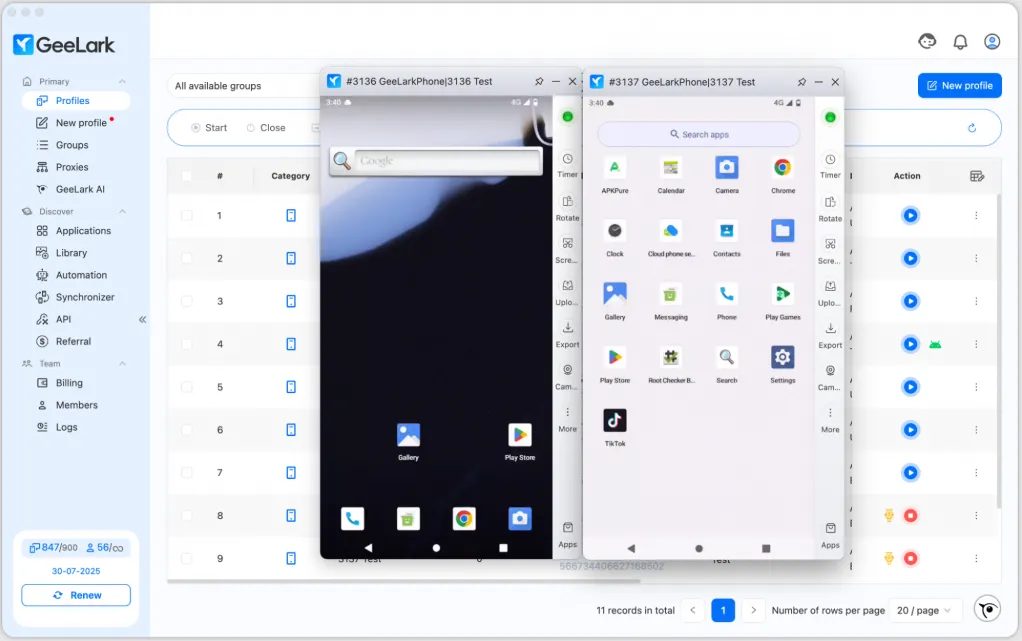
GeeLark is a professional cloud phone platform built on real ARM hardware fingerprints, which also offers additional content-generation features. Its free plan grants 2 profiles and 60 minutes of cloud phone runtime with no credit card required. After that, usage costs $0.007/minute with a hard daily cap of $1.20 per phone.
BitCloudPhone isn’t truly free, but its minimum price is $0.03/day per cloud phone, which is very affordable. For personal operations requiring one to two cloud phone instances, it’s basically free and offers robust proxy integration and security features.
Being free versions of high-quality commercial tools, cloud phone free trial apps are usually more trustworthy than fully free (or rather, freemium) cloud phone apps.
Problems with free cloud phones
Here is an essential question: Is a “free” cloud phone actually a warning sign, rather than an opportunity? Let’s explore it.
Data security issues
This concern is the most serious one. As I was told, it outweighs all other concerns because it effectively undermines the whole idea of using cloud phones for privacy and security. Some cloud phones even try to monetize users' personal information and behavioral data, selling it to third parties for advertising or even shadier purposes. Make sure to use a clean, high-quality proxy paired with a free cloud phone instance, and verify IP quality with CyberYozh's IP Checker. Platforms like GeeLark that offer a free trial are usually more reliable in that.
Always pay attention to the user agreement and privacy policies, especially those parts where personal data is mentioned. If the agreement doesn’t explicitly mention something like “We won't disclose personal information to third parties without explicit user consent, except in law-obliging cases,” it’s a large red flag. If it explicitly mentions that your personal information can be shared with third parties, just never, NEVER use it.
Privacy concerns
This problem is connected to the previous one and to a lack of security measures, which can be the case with free cloud mobile phones, as they must limit their expenses to stay viable. As a result, your activities may be less protected when you use a free cloud phone instance, and your fingerprints may be flagged as fake and restricted by platforms. The usage of high-quality proxies, such as the CyberYozh service, may avert these issues.
Performance issues
It’s better to remember that cloud phones are infrastructure tools that require computational infrastructure to process user requests. Such projects cannot be deployed for free; therefore, they need monetization in any case, so it's no wonder that any trustworthy “free” cloud phone service is actually freemium.
Increased dependencies
Last but not least, using free cloud phone apps or free tiers is usually associated with additional restrictions, such as potential data deletion and limited access to services. Such services often have higher latency and lower speeds than commercial paid tools, which is the price of using them for free. The reason is, again, to cut costs and ensure the project’s viability.
Choose the best free cloud phone
Let’s summarize which free cloud mobile phones should be used for which task, and why.
For gaming: use UgPhone and VSPhone for AFK farming, while BlueStacks X is an easy-to-install casual option.
For app testing, use a fully free MyAndroid service, while GeeLark and BitCloudPhone offer more professional services.
For personal account management, MoreLogin offers a fully free small-scale option with full features.
Everything starts from a purpose. Don’t try to use a free service for professional activities at all: I can tell you for sure. For personal use, there are many options. For example, BlueStacks X is good for gaming, if you’re ready to watch some ads, and MyAndroid can allow you to test your applications, but you never want to use them for SMM: you’ll be instantly banned.
Summary: Can you have a cloud mobile phone for free?
Free cloud phones genuinely exist but come with real trade-offs. Fully free options like MyAndroid and BlueStacks X suit app testing and casual gaming, but lack built-in proxy integration, device fingerprinting, and persistent sessions needed for serious work. Freemium tiers from MoreLogin and GeeLark are more trustworthy for personal account management. For any professional multi-account or social media automation workflow, paid commercial plans remain the only viable path. Don’t forget to sign up for CyberYozh and integrate a proxy with a cloud phone, either directly or indirectly, to stay protected.