
If you run multi-account operations, scrape web data, or operate in regions with aggressive internet filtering, you know the drill. Traditional privacy tools fail regularly. Your exit IP address might be perfectly clean, but Deep Packet Inspection (DPI) filters run by major service providers flag the specific connection handshake. Once they spot it, you are blocked.
Stable operational workflows require network tools that do not just encrypt data but hide it completely from censorship filters. This is exactly why the VLESS protocol was built. It has quickly become the modern, infrastructure-grade standard for hiding automated proxy traffic.
What is the VLESS protocol
VLESS (Very Lightweight Encryption Security Stream) is a lightweight network protocol designed to operate without a native encryption layer. Instead, it runs entirely inside a secure TLS tunnel.
Legacy VPN solutions append hundreds of bytes of overhead data to each packet. VLESS minimizes this payload, using a tiny header that takes up only 25 to 50 bytes. By packaging this data inside the TLS 1.3 standard, it makes your automated scripts look like organic browser activity. To any external firewall, the stream is identical to someone visiting an ordinary HTTPS website.
How VLESS works in professional infrastructure
Deploying custom VLESS servers from scratch is a highly demanding task. It requires deep Linux system administration expertise, managing clean donor domains, and tuning delicate configuration inputs like SNI, Short IDs, and destination properties. Making a single mistake with these values breaks your stealth layer. Your server gets blacklisted almost instantly.
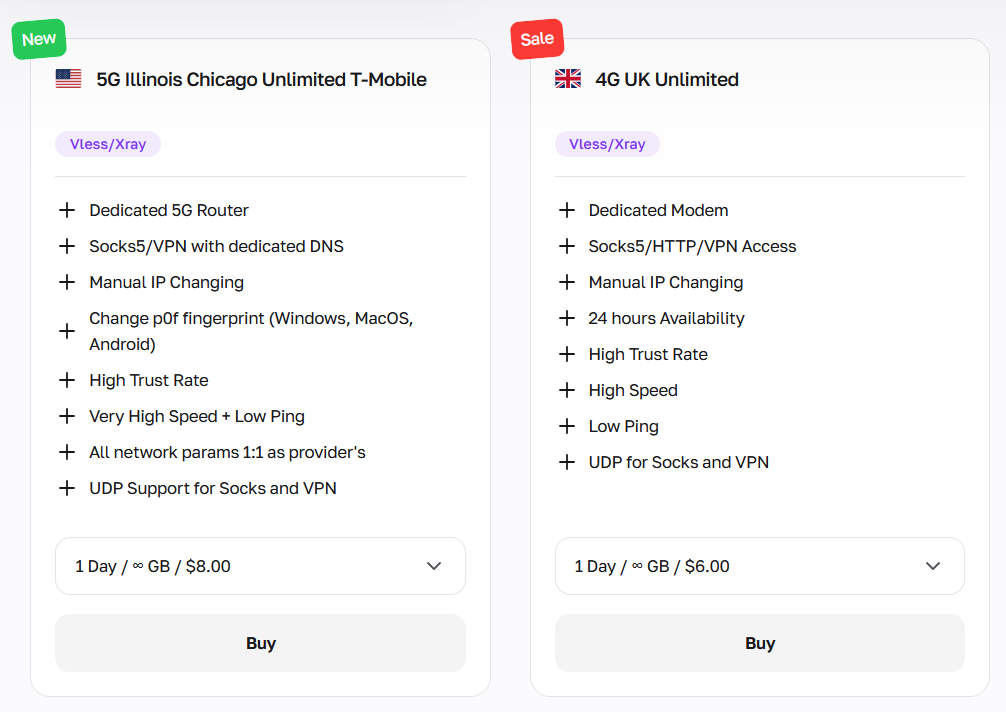
The CyberYozh App ecosystem resolves this operational risk by providing a pre-configured, enterprise-grade proxy stack designed for serious automation.
Feature: Built-in VLESS protocol support running on the Xray core inside our premium mobile LTE, 4G, and 5G proxies. It utilizes XTLS-Vision parameters to dynamically adjust packet sizes, stopping security systems from identifying proxy nodes through traffic pattern analytics, and the XTLS-Reality protocol disguises the proxy server as a legitimate popular website, completely protecting the infrastructure from active probing.
Technical Overview: Understanding XTLS-Vision and XTLS-Reality
XTLS-Vision is a stealth mechanism within the VLESS/Xray architecture designed specifically to neutralize Deep Packet Inspection (DPI). Instead of altering cryptographic algorithms, it directly controls the physical structure of the data stream. It dynamically resizes packets and eliminates the distinct network fingerprints that security systems use to flag proxy connections. For automation frameworks, integrating XTLS-Vision is a major upgrade; it slashes detection risks and ensures rock-solid session stability when managing multiple accounts.
XTLS-Reality takes a completely different route with certificate-less proxy obfuscation. It eliminates the need to buy custom domains or generate TLS certificates, both of which are easily flagged by modern firewalls. Instead, a REALITY server "borrows" the public data and TLS handshake of a massive, trusted platform like Apple, Microsoft, or Google.
How it handles active probing: If an anti-fraud or DPI system tries to directly verify the connection, the proxy simply forwards the genuine response of the spoofed website. This makes filtering technically impossible without blocking the legitimate service itself.
Workflow: You copy the ready-made configuration credentials from your CyberYozh App dashboard and paste them into your anti-detect browser or any compatible connection client like v2rayNG or Shadowrocket. This removes the need for custom coding or manual server deployment.
Outcome: Your automation infrastructure secures stable sessions and a high trust rate. Automated anti-fraud systems see an ordinary mobile consumer browsing pages over standard, encrypted HTTPS. This lowers network-level block rates significantly.
Why professionals choose VLESS
The classic SOCKS5 protocol has been a reliable choice for years. However, it lacks native encryption and relies on an easily identifiable handshake signature that modern DPI firewalls block automatically. Standard VPN protocols like OpenVPN or WireGuard focus entirely on cryptographic security rather than obfuscation. Because they produce clear cryptographic signatures, automated firewalls flag and throttle them quickly.
VLESS operates as a stateless, highly efficient stream. By delegating all encryption overhead directly to the TLS 1.3 layer, it hides your proxy traffic while keeping device CPU usage minimal. Your software runs faster because it avoids the processing penalties of double encryption setups (tunnels inside tunnels). Under aggressive network filtering, VLESS over TCP delivers the highest predictability and connection stability.
Realistic risk management
We keep things simple and honest: no network protocol can promise a 100% ban-proof solution. VLESS handles your network transport layer perfectly, ensuring that ISPs and analytical tools cannot detect your proxy connection.
However, if you route a VLESS connection through flagged, low-quality datacenter IPs or public proxy pools, platforms like Google Ads and Facebook will still restrict your accounts due to a poor trust score at the endpoint. To ensure complete security and workflow consistency, the CyberYozh App infrastructure blends advanced VLESS obfuscation with the immaculate reputation of real cellular carrier networks.
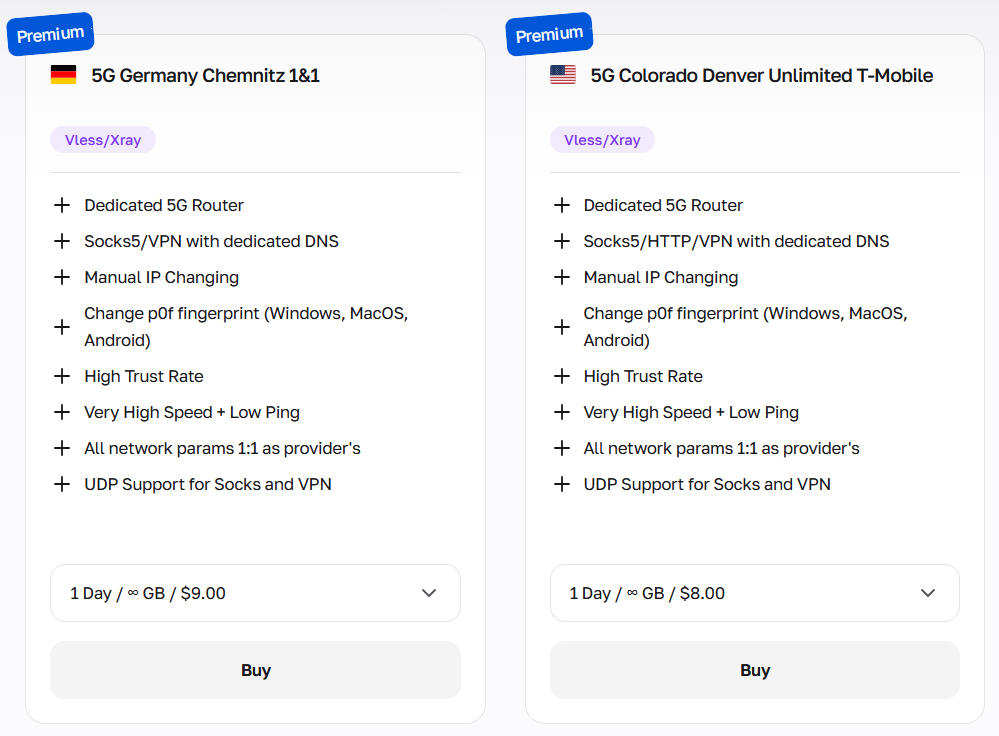
Ready to scale your operational workflows?
Stop relying on fragile, unintegrated workarounds. Build your multi-accounting campaigns on a stable foundation designed specifically for automation teams, SMM agencies, and professional operators.
👉 Start with $1.70 Now - get instant access to premium mobile proxies powered by pre-configured VLESS/Xray infrastructure.
👉 Check IP Fraud Score - evaluate your digital footprint before launching your next automation run.