
Buy Aged Instagram Accounts: The Complete Safe Buyer's Guide (2026)

You've probably already googled "buy aged Instagram account" and found a mix of marketplace listings, vague safety tips, and a few articles that either oversell how easy it is or scare you into thinking it's riskier than it actually is. Neither extreme is useful.
The reality sits somewhere more nuanced:
Aged Instagram accounts are genuine digital assets.
They're bought and sold every day, by brands trying to skip the painful early algorithm phase, by content creators entering new niches, by performance marketers who understand audience acquisition the same way a real estate investor understands property acquisition.
Buy the right account, transfer it correctly, and you have a meaningful head start.
Buy the wrong one, or mishandle the transition, and you can lose both the account and your money.
This guide is built around the mistakes that actually cost buyers. Not the theoretical risks, but the specific, repeatable errors that recur in this market. By the end, you'll know how to evaluate an account, verify its followers, structure the purchase, secure the transfer, and protect what you've bought.
TL;DR:
Buying an aged Instagram account is legal in most countries but violates Meta's Terms of Service, which means the account can be suspended if the transfer is handled carelessly.
The safest purchases involve aged accounts with verified organic followers, a clean violation history, and niche consistency.
Always audit engagement data before paying, use escrow for payment protection, update credentials in the correct sequence after transfer, and warm up the account gradually over two to four weeks.
Avoid any seller unwilling to provide analytics access, and never log in from a data center IP address immediately after purchase.
What does aged Instagram account actually mean
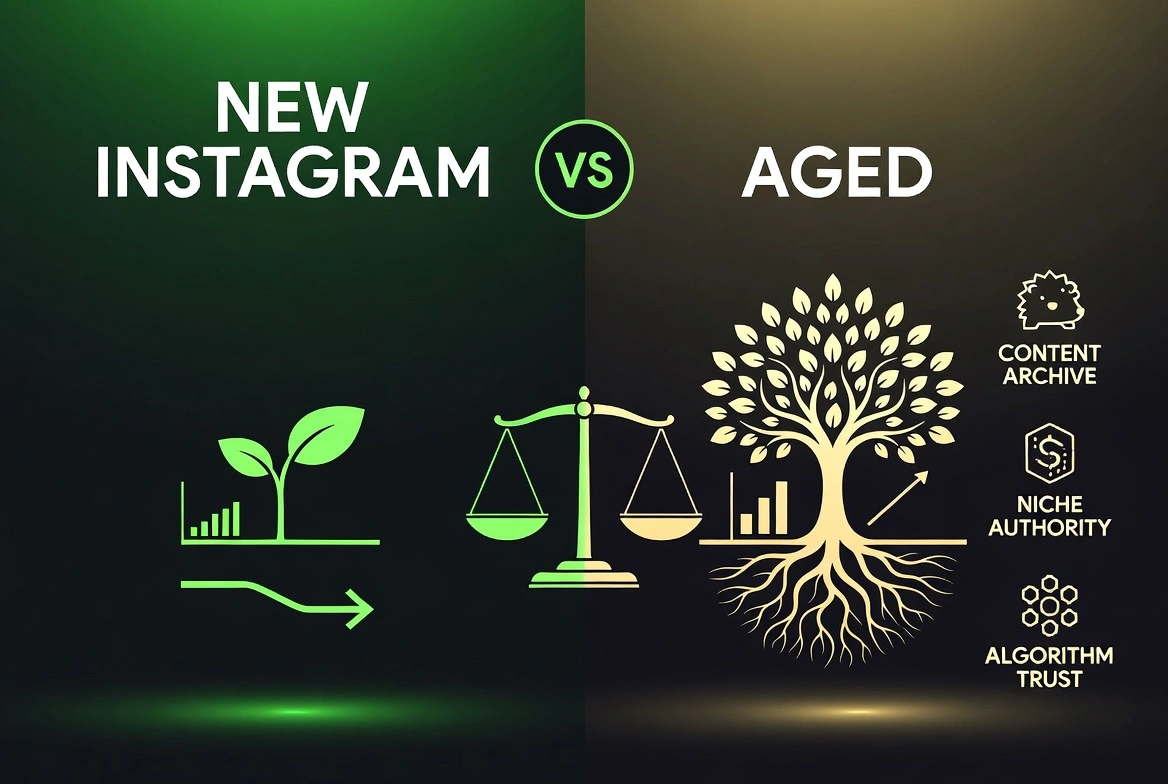
Direct answer: Purchasing aged Instagram accounts means acquiring full ownership of the login credentials, associated authentication methods (email and phone number), and the complete digital identity of that profile, its followers, content archive, niche authority, and engagement history.
It's not just a username change. You're acquiring years of algorithm trust, content infrastructure, audience relationships, and, if the account is well-monetized, existing revenue streams.
Think of it the way a seasoned entrepreneur thinks about buying a small business versus starting one from scratch. The startup path is cheaper upfront, but you're paying in time, effort, and the likelihood that most new ventures won't gain traction. Acquisition costs more initially, but you're buying a running engine rather than building one from parts.
That framing matters because it changes how you evaluate a purchase. You're not buying followers. You're buying attention infrastructure.
Is it legal to buy aged Instagram accounts
Direct answer: Buying or selling aged Instagram accounts isn't a criminal act under the laws of the United States, the United Kingdom, the European Union, or most other jurisdictions. However, it violates Meta's Terms of Service (specifically Section 4.1), which prohibits account transfers without Meta's explicit permission.
This is the section most buyers either ignore entirely or misunderstand:
Violating Instagram's ToS doesn't expose you to legal liability.
You won't be fined or prosecuted. But it does give Meta the right to suspend or permanently delete accounts it identifies as transferred without authorization.
Here's the practical reality:
Meta processes billions of daily interactions but lacks the infrastructure to hunt for account transfers proactively.
What it does have are automated systems that flag anomalous behavior, sudden geographic login shifts, rapid credential changes, engagement pattern discontinuities, and device fingerprint mismatches.
These trigger account reviews, not the transfer itself.
The accounts that get suspended after purchase are almost universally ones where the new owner made obvious, avoidable mistakes during onboarding.
Change every piece of account data within 24 hours of purchase, log in from a suspicious IP, immediately shift the content style 180 degrees, and yes, you're sending every red flag Instagram's systems watch for simultaneously.
Handle the transition thoughtfully, and we'll cover exactly how to do that, and your risk profile drops considerably.
Why people buy aged Instagram accounts in 2026
The market has matured significantly. In 2020, most buyers were individuals. In 2026, a growing share of the market is brands, agencies, and professional investors who treat aged Instagram account acquisition the way venture capital treats early-stage company acquisition: find undervalued assets, apply expertise, and extract compounding returns.
Here's what's actually driving demand:
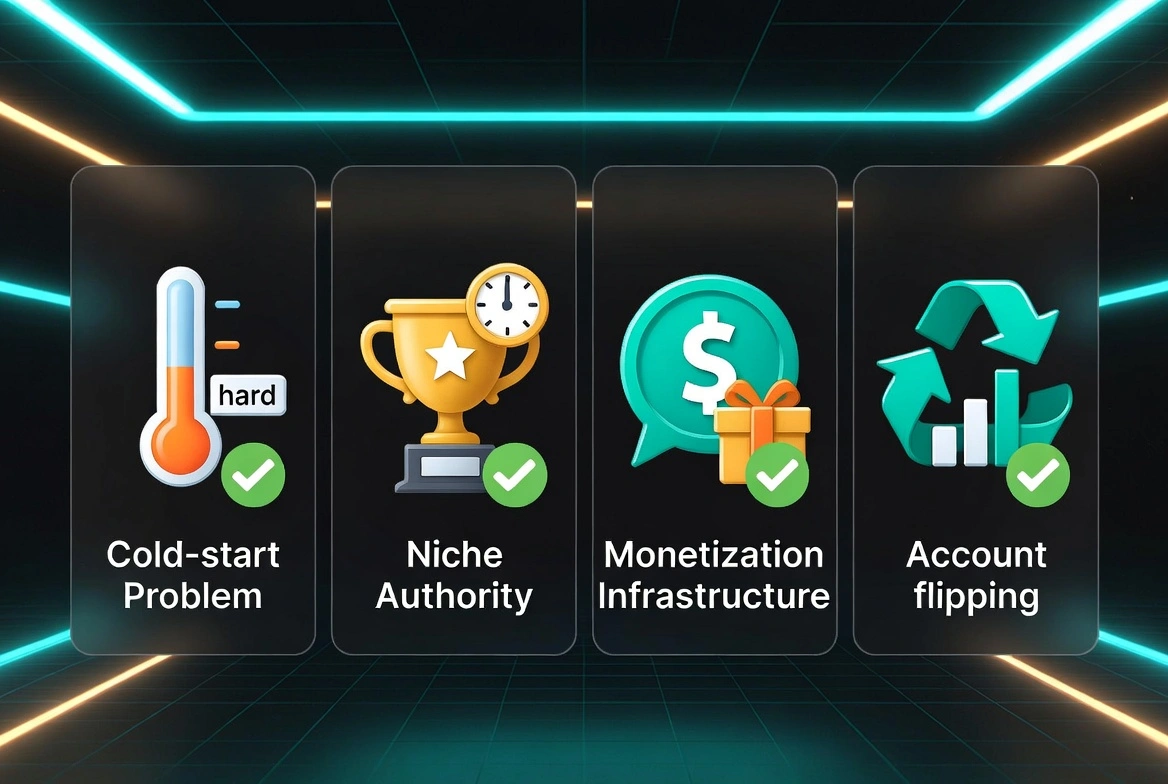
The cold-start problem is getting worse:
Instagram's algorithm increasingly suppresses new accounts.
A profile created today faces a harder distribution ceiling than one created four years ago.
For brands on a launch timeline, organic growth from zero isn't compatible with a go-to-market strategy.
Niche authority is expensive to rebuild:
An account that's been consistently posting about sustainable fashion, personal finance, or professional cooking for three years has earned something genuinely difficult to replicate: topical trust signals that take years to accumulate.
The Creator Economy monetization infrastructure matters:
Instagram in 2026 has robust monetization tools: Subscriptions, Gifts, Badges, Brand Collabs Manager, and Shopping integrations, most of which require account history and minimum follower thresholds to unlock.
Buying an established account means buying access to infrastructure that's already been unlocked.
Account flipping as a business model:
Experienced operators buy undermonetized accounts in growing niches, apply content strategy, audience development, and brand-deal outreach, then sell them at a 3–5x multiple.
It's a real business with real practitioners, not a fringe strategy.
Instagram's 2026 enforcement landscape:
Meta has increased enforcement against AI-generated content farms and inauthentic engagement networks over the past 18 months.
This has actually improved the overall market quality for buyers, as lower-quality account factories have faced greater pressure.
Legitimate aged accounts have become proportionally more valuable.
Where to buy aged Instagram accounts: A practical marketplace guide
Direct answer: The most established platforms for buying and selling aged Instagram accounts in 2026 include Fameswap, Social Tradia, Trustiu, and PlayerUp. Each serves different buyer profiles, price ranges, and due diligence standards.
Here's what the table they never show you looks like:
Platform | Escrow Service | Seller Vetting | Price Range | Best Suited For | Key Limitation |
Fameswap | Yes | Basic (self-reported) | $50–$80,000+ | General buyers, wide selection | Verification is minimal |
Social Tradia | Yes | Moderate | $200–$150,000+ | Mid-to-high value, niche accounts | Higher fees |
Trustiu | Yes | Stronger than average | $100–$30,000 | Mid-tier, first-time buyers | Smaller inventory |
PlayerUp | Yes | Moderate | $30–$15,000 | Budget buyers, testing the market | Inconsistent seller quality |
Private Brokers | Negotiated | High (relationship-based) | $5,000–$500,000+ | Premium accounts, experienced buyers | Higher commission (10–15%) |
What the platforms won't tell you:
Verification on virtually every marketplace is largely self-reported by sellers.
The escrow system protects your money during the transaction, but it doesn't protect you from fake followers, shadowbans, undisclosed policy strikes, or engagement pods that collapse after the transfer.
Due diligence is not the platform's job. It's yours.
For accounts priced above $5,000, seriously consider private brokers.
A good broker has direct seller relationships, full visibility into account history, and skin in the game; their reputation depends on every deal they close.
The 10–15% commission is often justified solely based on avoided mistakes.
Private Discord communities and Telegram groups also facilitate account sales, particularly in niche verticals like gaming, crypto, fitness, and beauty. These carry a higher risk and zero buyer protection, but occasionally surface deals not available on public marketplaces. Approach with proportionally higher scrutiny.
What “buying aged Instagram accounts with active followers" actually means
Active followers are real human accounts that engage consistently with content: watching Stories to completion, saving posts, leaving genuine comments, clicking links, responding to polls. They're not just people who once followed and forgot. They're an audience that actually shows up.
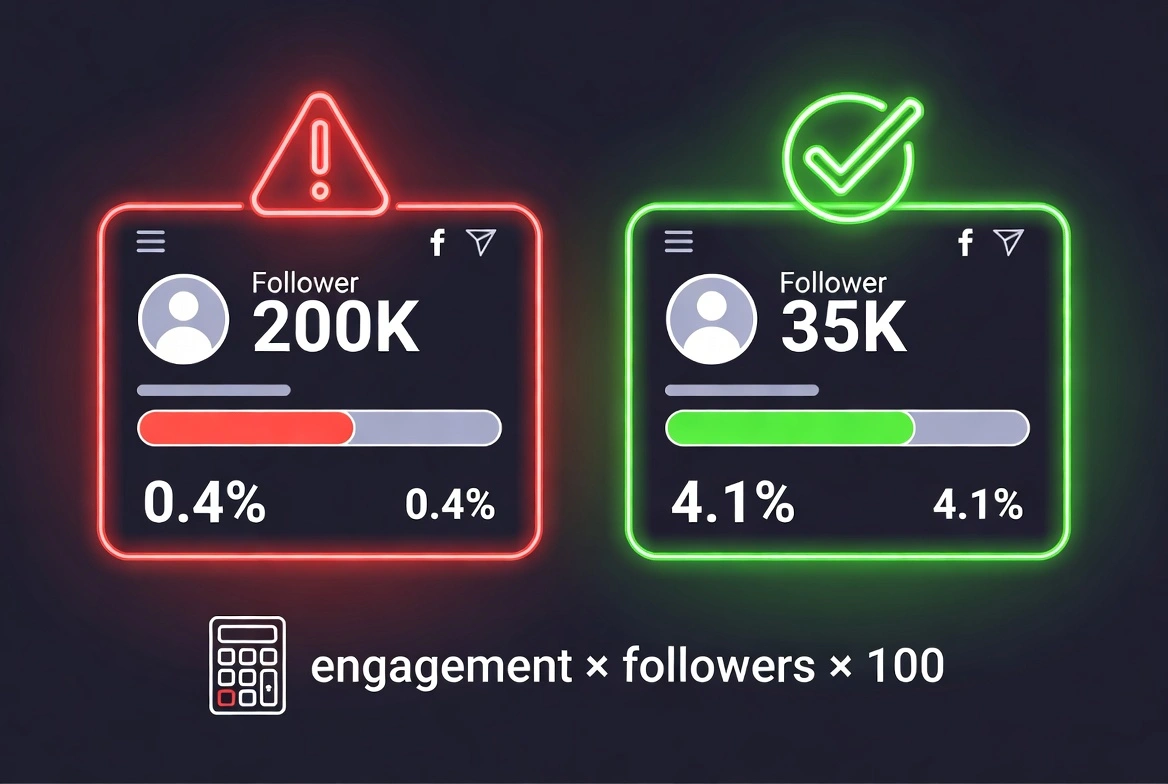
Here's the metric that tells you the truth faster than anything else: engagement rate.
Calculate it manually:
Take the average number of likes and comments across the last 15–20 posts
Divide by the total follower count,
Multiply by 100
That gives you the engagement rate as a percentage.
Benchmark reference by follower tier (2026):
Account Size | Healthy Engagement Rate | Average in Market | Red Flag Below |
1K–10K followers | 4–8% | 3.5% | 1.5% |
10K–50K followers | 2–5% | 2.5% | 1% |
50K–200K followers | 1.5–3.5% | 1.8% | 0.8% |
200K–1M followers | 1–2.5% | 1.2% | 0.5% |
1M+ followers | 0.5–1.5% | 0.8% | 0.3% |
An account with 180,000 followers and a 0.4% engagement rate is worth substantially less than one with 35,000 followers and a 4.1% engagement rate. For brand deal negotiations, influencer marketing campaigns, and affiliate conversions, the 35K account outperforms by every practical measure.
The large-follower-count fixation is one of the most common and costly mistakes buyers make. Sellers know this and price accordingly. Don't pay for size. Pay for attention.
Buy aged Instagram accounts: Why account age is a real asset
Direct answer: An aged Instagram account, typically one created before 2022, with consistent posting history and no major policy strikes, carries meaningful algorithm trust advantages, lower suspension risk after transfer, and higher monetization potential. Age itself is a proxy for verified, authentic behavior over time.
Instagram's internal scoring systems reward longevity. An account that's been active, consistent, and violation-free for four years has built something that a recently created account simply cannot replicate, regardless of its current follower count.[Read about 8 Instagram proxy providers]
What age specifically unlocks:
Algorithm trust. Content from older, established accounts gets distributed more generously than content from new ones. The reach ceiling is higher.
Lower post-transfer detection risk. Aged accounts have demonstrated behavioral consistency over the years. A single ownership change, handled carefully, is a smaller anomaly in a long history than it would be for a six-month-old account.
Credibility signals. The account's creation date is visible to followers and brands. A 2019 account in a niche carries inherent authority that a 2023 account can't claim, even with equivalent followers.
Feature access. Aged accounts are more likely to have already unlocked features, Creator Marketplace eligibility, Shopping, and Subscriptions that younger accounts haven't yet qualified for.
How to verify true account age:
Request a screenshot of the account's Instagram Insights showing historical data back at least 12 months
Check the earliest posts visible on the profile
Use Social Blade to review the full follower history timeline
Ask the seller to provide the account creation date via a screenshot of the account settings page
One subtle thing to check: niche consistency over time. An account that started as a travel photography profile in 2019 and pivoted to cryptocurrency content in 2022 has a fractured relationship with its audience. The followers accumulated during the travel era are unlikely to engage with crypto content, meaning the historical age and the current audience relevance are essentially decoupled.
How to spot fake followers before handing over money
This is where buyers consistently get burned, and it's almost always preventable. The fake follower ecosystem in 2026 is more sophisticated than it was three years ago. The obvious bot profiles, no photo, random username, zero posts, are largely gone because sellers know buyers check for them. What replaced them is harder to spot without the right tools.
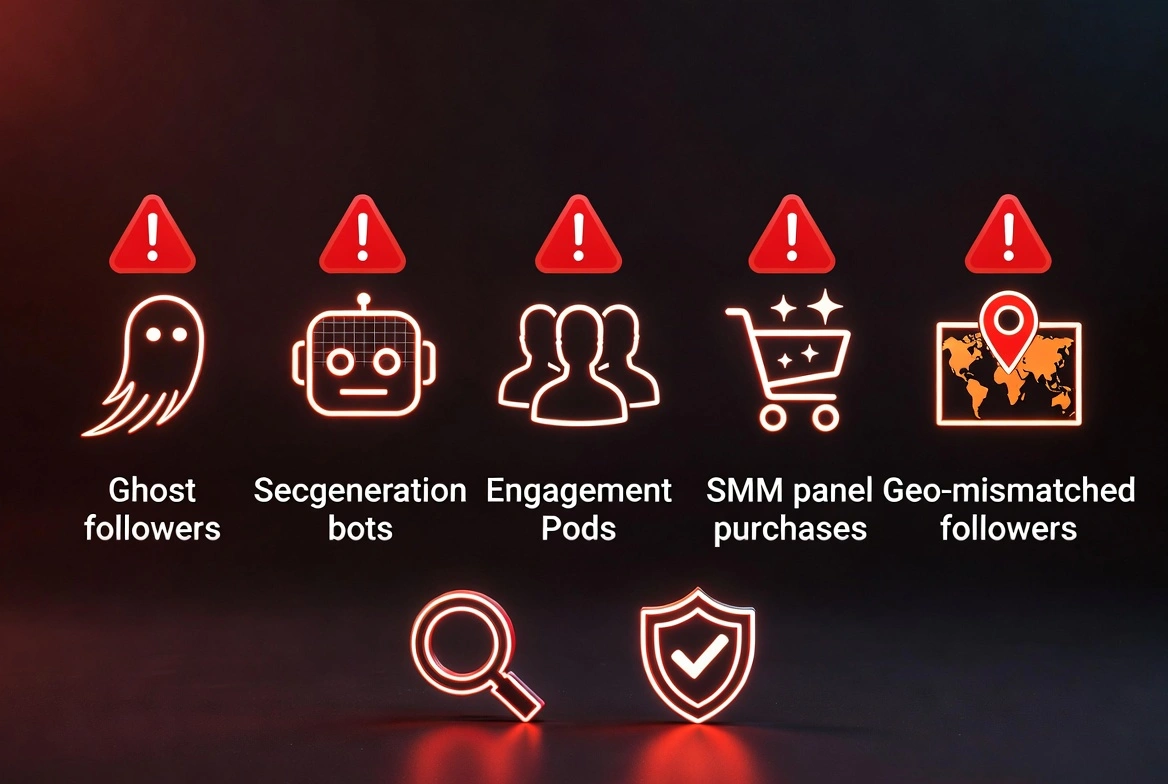
The five types of inauthentic followers:
1. Ghost followers. Real accounts from real people who followed years ago and became inactive. They technically aren't "fake"; they were genuine once. But they contribute zero engagement and artificially inflate follower counts. No seller discloses these because they're hard to prove intentional. They're simply dead weight.
2. Second-generation bots. Automated accounts are built to look real. These have profile photos (scraped from other accounts), a handful of posts, and normal-looking usernames. More expensive to generate than first-gen bots, but widely used by sellers looking to pass surface-level audits.
3. Engagement pod followers. The hardest category to detect. These are real humans in coordinated groups who like and comment on each other's content reciprocally, inflating engagement metrics artificially. Red flag: posts that receive 200 comments within 30 minutes of publishing, followed by almost zero activity afterward.
4. Purchased followers from SMM panels. The classic bulk-follower purchase. Often, a mix of inactive accounts and second-gen bots. The telltale pattern: a sharp vertical spike in follower growth on Social Blade, completely disconnected from any content milestone, followed by a gradual decline as the bots get deleted by Instagram's own cleanup systems.
5. Geo-mismatched followers. An account claiming a US-based lifestyle audience with 65% of followers from India, Pakistan, or Brazil is misrepresented, even if every follower is technically real. Brand deals and ad revenue depend on the audience's geography and align with the stated demographics.
Verification toolkit:
HypeAuditor: The most comprehensive paid tool. Provides an Audience Quality Score (AQS) from 1–100, follower authenticity breakdown, geographic distribution, and demographic analysis. Any account scoring below 60 AQS warrants serious scrutiny.
Social Blade: Free. Invaluable for reading follower growth patterns over time. The chart shape tells you almost everything about whether growth was organic.
Modash: Strong for niche and influencer account verification, particularly useful for B2B and professional niches.
Instagram Insights (direct): Request temporary view access to the account's native analytics before purchase. A seller who genuinely has nothing to hide will provide this without hesitation.
One practical test most buyers overlook: manually scroll through the comments on the last 20 posts. Genuine audience engagement is varied, personal, and contextual. Bot-adjacent engagement is uniform, repetitive, and generic. "Amazing content" appearing 40 times across 10 posts from accounts with 0 posts and no profile photos is a definitive red flag that no tool is needed to identify. [Read more about aged Amazon and aged Facebook accounts]
How to value an aged Instagram account: A real framework
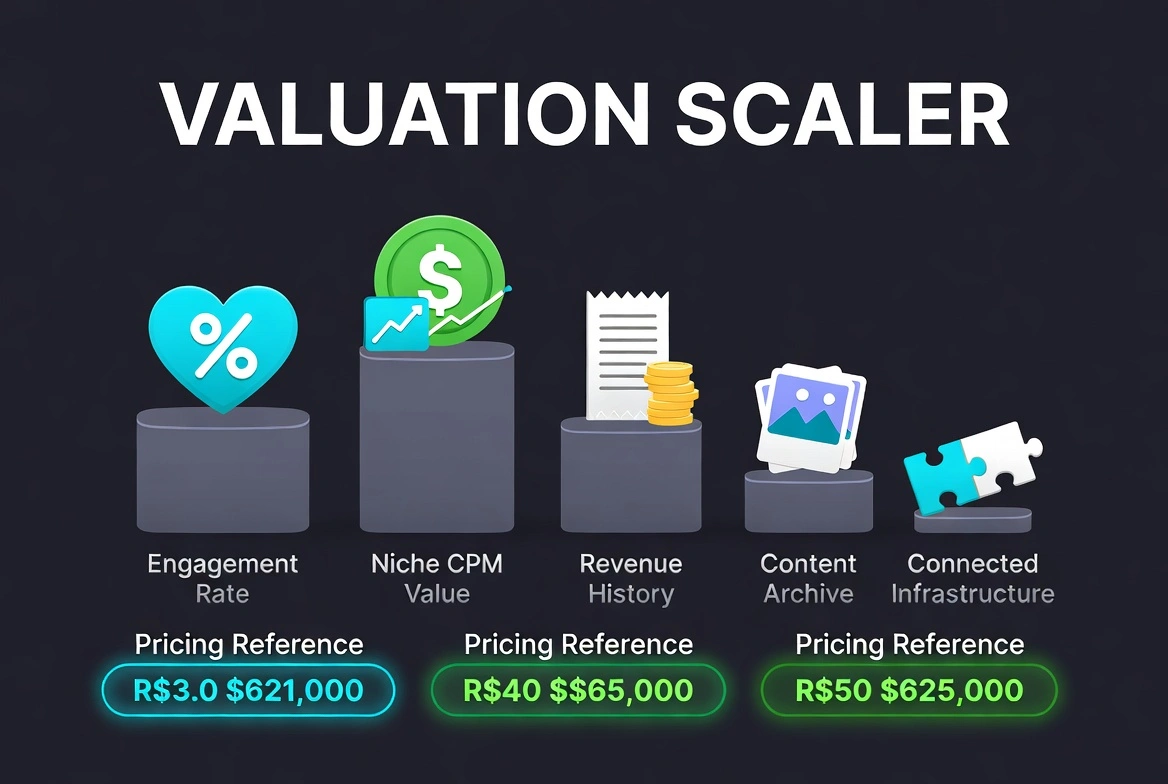
Most buyers use "price per follower" as their primary metric. This is how inexperienced buyers overpay for garbage accounts. A meaningful valuation framework considers multiple weighted factors:
Engagement rate (highest weight)
The single most important metric.
An account with 3% engagement among 50,000 followers is producing more genuine audience interaction than one with 0.5% engagement among 300,000 followers and will command significantly higher brand deal rates.
Calculate engagement rate independently; never trust seller-provided numbers.
Niche CPM value
Different niches command dramatically different advertising rates.
Finance, SaaS, B2B services, legal, health, and luxury consistently operate at the highest CPMs.
An account in personal finance with 40,000 followers may generate more monetization revenue than a comedy account with 200,000 followers.
Revenue history
If the account is already generating income through sponsored posts, affiliate commissions, Subscriptions, or linked products, that revenue stream is part of the asset.
Ask for documentation: screenshots of payment history, affiliate dashboard data, or brand deal contract records.
Content archive quality
Hundreds of pieces of original, high-quality content represent genuine intellectual property and aesthetic authority.
An account with 600 original photography posts has a deeper asset base than one with 600 reshared memes, regardless of the follower count.
Connected infrastructure
A linked Facebook Business Page, a verified email, an active phone number, a Meta Business Account connection, and a Creator Marketplace enrollment all add transferable value.
Platform feature access
Shopping tags, Subscription capability, Creator Badges, and Brand Collabs Manager eligibility are worth real money to buyers who plan to monetize.
Reference pricing framework (2026 market):
Category | Follower Range | Expected Price |
Micro (high engagement) | 1K–10K | $100–$1,000 |
Growing (verified niche) | 10K–50K | $600–$6,000 |
Established | 50K–150K | $4,000–$30,000 |
Authority (monetized) | 150K–500K | $20,000–$80,000 |
Macro/Mega | 500K+ | $50,000–$500,000+ |
These ranges reflect the current market but fluctuate significantly based on niche, engagement quality, and monetization history. Finance and business accounts consistently trade at the upper end of their range. Entertainment and meme accounts trade at the lower end.
Why your login location matters more than most buyers realize
When you take ownership of an aged Instagram account and log in for the first time, Meta's security infrastructure evaluates several signals simultaneously:
Your IP address
The device fingerprint
The browser or app version
Geographic relationship of the login location to the account's history.
An account that's been operated from Hamburg, Germany, for three years, suddenly accessed from a data center IP in Toronto, Canada, using credentials that changed 10 minutes ago, triggers every automated fraud signal Instagram has. It's the most common single cause of post-purchase account loss.
CyberYozh
CyberYozh provides residential and mobile proxy services specifically suited to this problem.
Their residential proxies route connections through genuine residential IPs, real addresses from real ISPs in real cities, making login activity appear geographically consistent with the account's operational history.
For buyers managing accounts in a different country than the seller's, the math is simple:
You're spending real money on a real asset, and the single most preventable failure point is a login from the wrong IP type.
Residential Instagram proxy infrastructure costs a fraction of what most accounts cost and eliminates this specific risk almost entirely.
CyberYozh's proxies are particularly effective for:
First login after account transfer (the highest-risk moment)
Ongoing management from a different geographic region than the account's history
Managing multiple purchased accounts from one device without cross-account IP association triggering Meta's linked-account detection
Gradual account warming with consistent, locationally appropriate traffic behavior
If you've purchased an account in New York and you're managing it from Nairobi, your connection should appear to be coming from New York, or, at a minimum, from a US residential IP, for the first several weeks of the transition. CyberYozh's geo-targeting options make this straightforward.
This isn't optional infrastructure for serious account buyers. It's basic asset protection.
The secure transfer process: Every step, in order
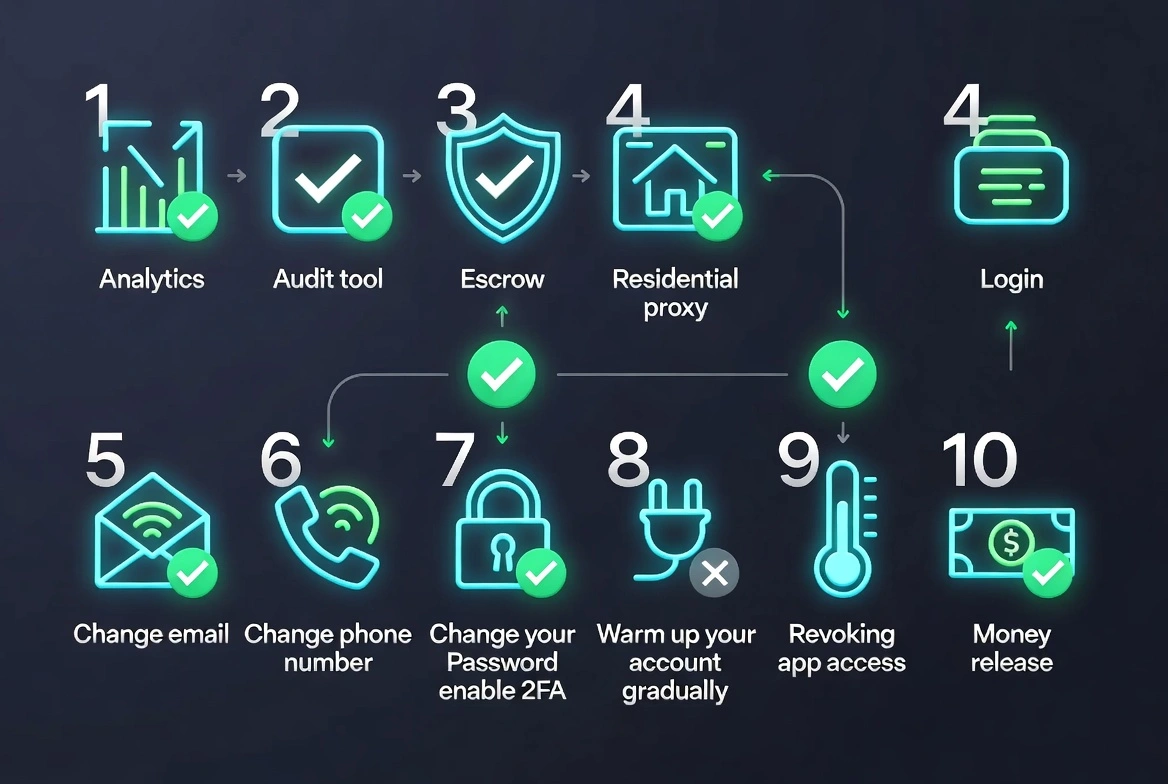
This sequence matters. Doing these steps out of order is one of the most common causes of losing account access.
Step 1: Get analytics access before payment
Request a screenshare or screenshot access to Instagram Insights.
Look at the last 60 days of reach, follower demographics, top posts, and Story views.
A legitimate seller agrees to this without hesitation.
Step 2: Run an external follower audit
Enter the account username into HypeAuditor or Social Blade.
Check the Audience Quality Score, follower growth trajectory, and top follower geographies.
Don't skip this step.
Step 3: Set up escrow
Use the marketplace's built-in escrow service or a reputable third-party provider.
Never transfer payment directly to a seller's personal account, bank account, or crypto wallet without escrow.
The escrow holds your funds and releases them only after you confirm successful access to your account.
Step 4: Receive login credentials and verify access
Log in using a residential proxy IP aligned with the account's geographic history. Confirm you can access the account and that it is not restricted, shadowbanned, or under review.
Step 5: Change the connected email first
This is the most important step.
Update the email address linked to the account to one you own and exclusively control.
Whoever controls the recovery email controls the account; this takes priority over everything else.
Step 6: Update the phone number
Replace the seller's phone number with yours.
This completes the authentication handover.
Step 7: Change the password
After both the email and phone are updated, change the password.
Immediately enable two-factor authentication using an authenticator app rather than SMS.
Step 8: Revoke third-party app access
Go to Settings > Security > Apps and Websites.
Revoke authorization for every connected app you don't recognize.
Former sellers sometimes retain access through OAuth connections even after password changes.
Step 9: Warm up the account gradually
Over the next 14–21 days, maintain the existing posting frequency and content style.
Make any profile changes incrementally, not all at once.
Gradual behavioral consistency is what keeps automated systems from flagging the account.
Step 10: Release escrow funds.
Only after confirming stable account access for 48–72 hours should you authorize escrow release.
Red flags that should end the conversation
Not every seller is acting in bad faith. But some patterns are clear enough that no due diligence will make them safe:
Seller refuses Insights access before any payment is made
Follower growth shows an unexplained vertical spike in the last 60 days
Engagement comments are generic across the board ("Great post! ✔️"), especially from accounts with no profile photos
Seller demands cryptocurrency payment only, no escrow
Account shows policy violation notifications in the Insights dashboard
The follower geography dramatically mismatches the stated niche audience
Seller claims to offer a Meta-verified blue checkmark transferable with the account (this is not how verification works; it cannot be transferred, and any claim to the contrary is false)
Price is more than 60% below the market rate for equivalent accounts, with no explanation
Seller resists a 48-hour post-transfer verification window before escrow release
The verified badge point deserves emphasis. Instagram's verification status is tied to identity, not the account itself. Meta has made this explicit. If a seller is advertising verification as part of the deal, they're either misinformed or lying, and either situation removes them from consideration.
After the purchase: Building on what you've bought
The purchase is the beginning. What happens in the first 30 days determines whether the account appreciates or deteriorates in value.
Maintain content continuity
Keep the existing posting cadence for at least two weeks.
If the previous owner posted Monday, Wednesday, and Friday, you post Monday, Wednesday, and Friday.
Consistency is the signal the algorithm rewards and the one that keeps existing followers engaged.
Engage the existing audience.
If the account has an active comment section, respond. Acknowledge DMs. Show up.
Existing followers don't know (or necessarily care) about ownership changes, but they do notice when an account they liked suddenly goes quiet or impersonal.
Monetization timing
Resist the impulse to start sponsored posts in week one.
It looks jarring to existing followers and signals inauthenticity.
Establish yourself with the audience first, typically a minimum of four to six weeks, before introducing commercial content.
2026 content strategy note
In 2026, Instagram's algorithm heavily weights Reels performance when amplifying account reach.
If the account you've purchased has an established aesthetic but minimal Reels content, introducing a consistent Reels strategy during your onboarding period can meaningfully expand reach using the existing follower base as social proof infrastructure.
Security hygiene going forward.
Review login activity monthly via Settings > Security > Login Activity. Any unrecognized location or device should be immediately removed, and your password should be rotated.
One last thing before you buy
The buyers who lose accounts aren't the ones who chose the wrong platform or paid too much. They're the ones who had a perfectly good account and lost it during the transition window due to avoidable technical mistakes.
Run the due diligence checklist. Use escrow. Secure the account credentials in the right order. And if your management location doesn't match the account's history, or if you're running multiple profiles from a single device, invest in residential proxy infrastructure before your first login. Not after.
The account is only as valuable as your ability to keep it.