
Should Your Business Invest in an Enterprise Proxy Service: 8 Checks for 2026

TL;DR
Pay for a commercial proxy network when blocked requests, CAPTCHAs, or location limits already cost your team time or data. For internal web filtering, it isn’t worth it.
Compare the price of a successful request, not the headline price per GB.
Since Google and the FBI moved against hijacked residential networks in 2026, IP sourcing is now a buying question, not a footnote.
Independent 2026 tests put average residential prices at about $3–$4/GB for small and mid-size plans.
CyberYozh’s sharpest price advantage is mobile: unlimited traffic from $1.7/day, against a market average of roughly $4.31 per GB for pooled mobile traffic.
Quick Answer: Invest in an enterprise proxy service if a task you depend on keeps failing without a different IP. Choose the proxy type that matches the task, run a two-week paid test on your real targets, and scale only what passes.
Not sure which setup fits your volume? Request a free business consultation with CyberYozh, and we'll send a tailored offer within 24 hours.
What is an Enterprise proxy service
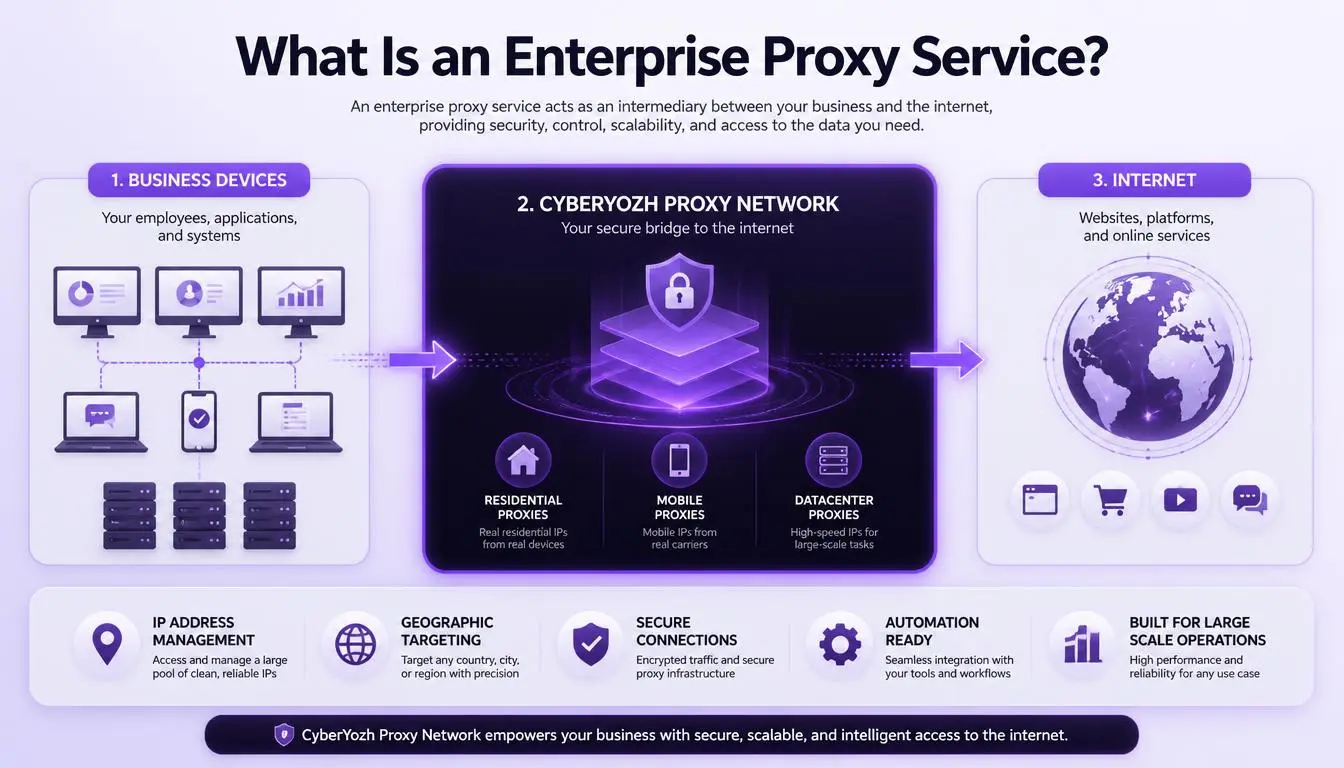
An enterprise proxy service is a paid network of IP addresses your team routes traffic through, so websites see an ordinary local visitor rather than your company server. Businesses use it to collect public data, check what customers in other countries see, and keep separate accounts on separate identities.
Proxy business definition in plain words: you rent IP addresses by the gigabyte, by the IP, or by the day, and your tools send requests through them.
The 2022 article that still ranks for this topic blends this with something else: the corporate firewall proxy that caches pages and blocks staff from social media. That belongs to your network security stack. If filtering employee browsing is your only goal, you don’t need a commercial proxy provider.
Expert Insight: Before you budget anything, write down the task that fails today without a different IP. If you can’t name one, wait. If you can name three, you’re probably already losing money.
Proxy use cases that justify the spend
Proxyway’s 2026 market research found e-commerce (price comparison and stock tracking) is still the top use case, with AI data collection now the fastest-growing one. Ad checks, SEO rank tracking, and managing several brand or client accounts round out the list.
You likely don’t need a proxy if you pull a few pages a week, or if the site already offers an official API for the data you want.
8 checks before you invest in an Enterprise proxy service
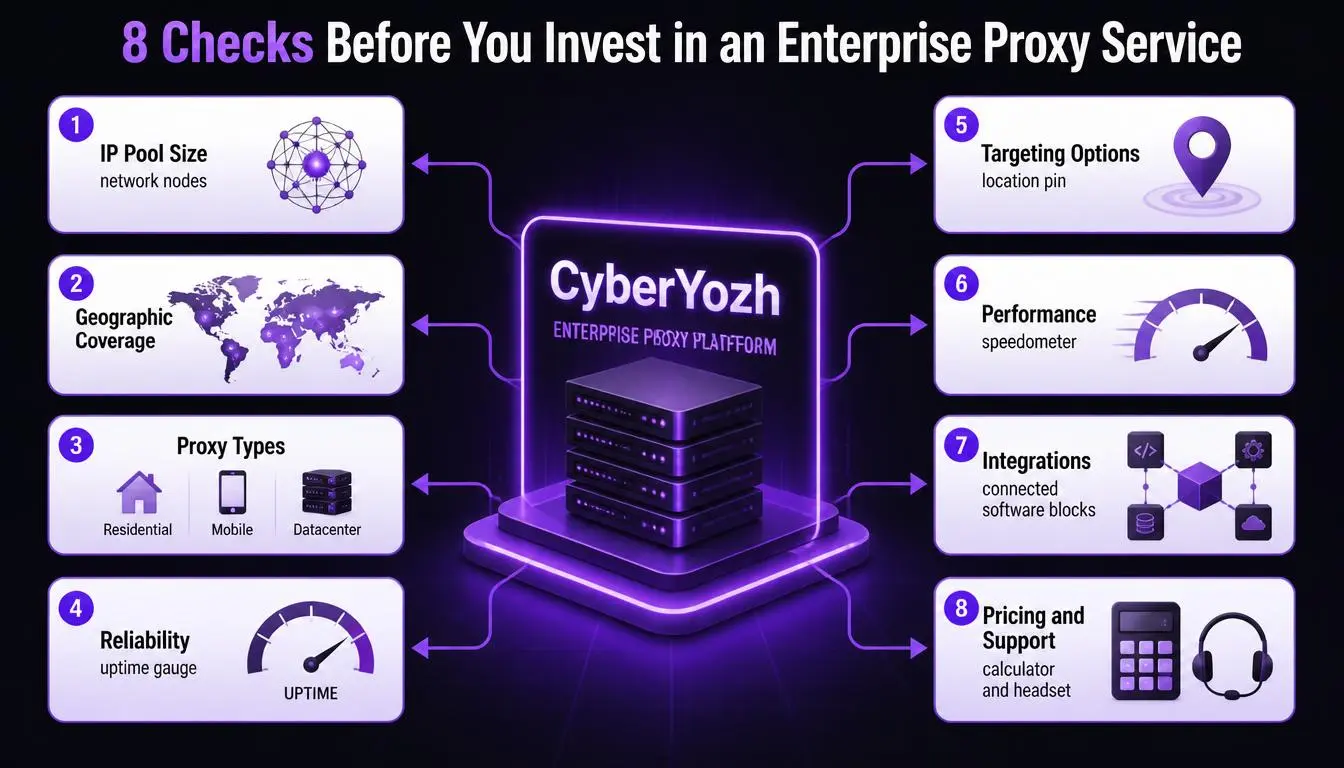
Most proxy budgets go to waste for the same reasons: the wrong proxy type, prices that look cheap until you count failed requests, and IPs from sources nobody checked. These eight checks take about 5 minutes and help you choose an enterprise proxy service that works on your real targets before you pay for a full plan.
1. Match the proxy type to the job
Most wasted proxy budgets come from buying the wrong type. Here are the main types of proxies, side by side:
Proxy type | Best for | Billed by | CyberYozh from |
Rotating residential proxy | Scraping, AI data, SEO, price checks | GB | 2/GB standard (1.8/GB Business) |
Static ISP residential proxy | Long sessions, account work, QA | IP, monthly | $5.29/month |
Mobile LTE/5G proxy | Social media, ads, strict platforms | Day, unlimited traffic | $1.7/day shared, $3.5/day dedicated |
Datacenter proxy | Fast automation, unprotected sites | IP, monthly | $1.77/month shared, $2.18/month dedicated |
What is a dedicated proxy? An IP reserved for you alone during the rental period, so its reputation depends only on your activity. A shared proxy server spreads IPs across customers. It costs less, but one careless neighbour can get the address flagged.
Not sure which proxy fits your task? Compare every CyberYozh proxy side by side in the proxy catalogue: rotating residential, static ISP, LTE/5G mobile, and datacenter, covering 100M+ IPs in 195+ countries, from $1.77/month.
2. Price the successful request not the gigabyte
Proxy forums are full of the same complaint: the cheap plan ended up costing more. The fix is simple arithmetic. Divide the price per GB by your success rate on the real target.
Plan A: $2.00/GB at 70% success works out to $2.86 per useful GB
Plan B: $2.50/GB at 97% success works out to $2.58 per useful GB
(Illustrative numbers. Your targets will differ.)
The “expensive” plan wins, before you even count the hours lost to retries.
Common Mistake: Comparing “starting from” prices. Those usually apply only to the biggest tier. Ask each provider for the rate at your own monthly volume.
3. Ask where the IPs come from
Older buying guides skipped this check. In 2026 you can’t:
In January, Google’s threat team disrupted IPIDEA, a residential proxy network running on millions of hijacked consumer devices, as The Register reported. Two months later, the FBI issued a public warning about residential proxy networks that enroll devices without clear consent.
A pool like that poses legal and reputational risks for any business that uses it. It can also vanish overnight when it gets taken down.
Warning: Treat unusually cheap “unlimited residential” plans as a red flag. Ask how residential IPs are sourced and whether the provider runs an abuse desk.
4. Trust test results over advertised ones
Nearly every provider advertises 99%+ success. Independent testing tells a more useful story. In Proxyway’s 2026 benchmarks, connection success across 13 major residential networks ranged from about 95% to 99.9%. On hard targets like Amazon, Google, and Instagram, the median fell to about 74%.
So run your own test: same target, same volume, same hours, two or three providers side by side for two weeks.
5. Check session control
Data collection needs IPs that rotate. Logins need sticky sessions that hold one IP for a while. Accounts that must look identical every day need a static IP. A good enterprise proxy service should offer all three without a new contract. CyberYozh’s rotating plans hold sticky sessions for up to 24 hours, and its static ISP proxies keep one IP for the full rental.
Explore CyberYozh rotating residential proxies $1.8/GB for businesses
6. Confirm the API and tool fit
Your proxies have to work with the scripts and browsers your team already runs. Look for HTTP and SOCKS5 support, sub-users, and an API that creates credentials and reports usage.
Pro Tip: Push one real script through a trial proxy before you sign. A day-one setup headache becomes a weekly cost by month three.
7. Look beyond the IP for account work
For business accounts, the IP is only one signal among several. Phone verification and IP reputation decide just as much. Getting the proxy, SMS number, and fraud check from one platform means one bill and one support team to call instead of three.
8. Read the support and scaling terms
Ask who answers when a target starts blocking you late on a Friday. Ask whether a dedicated account manager or a private IP pool is available once you grow, and whether there’s a contract minimum or you can pay as you go.
Enterprise proxy solutions compared: 2026 prices and test results
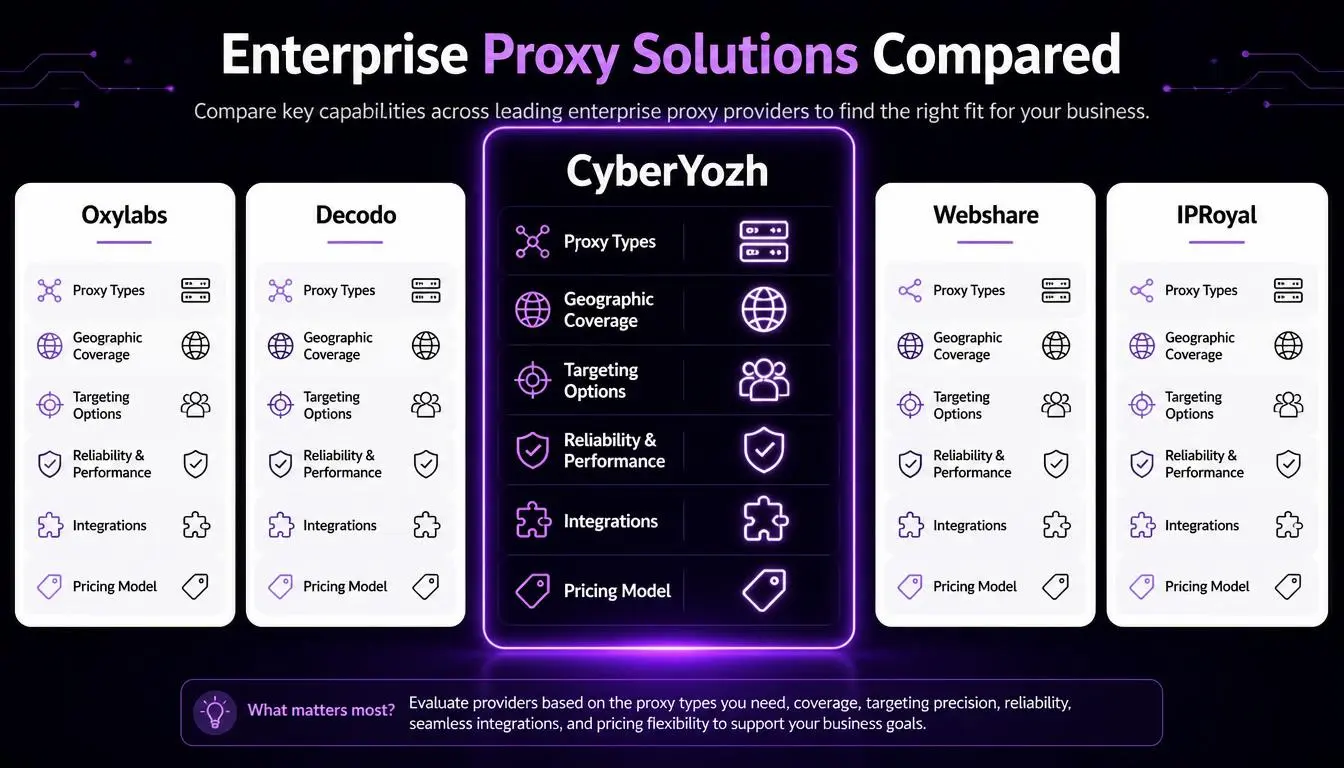
The table below compares CyberYozh’s live prices with four well-known providers, using Proxyway’s 2026 report for the others. Proxyway gathered most of that data in March and April 2026.
Provider | Segment (Proxyway) | 5 GB | 50 GB | 100 GB | Global success (Proxyway test) |
CyberYozh | Not rated | $4.00/GB | $3.20/GB | $2.50/GB | 99.98% |
Oxylabs | Enterprise | $6.00/GB | $5.00/GB | $4.50/GB | 99.93% |
Decodo | Mid-market | $3.75/GB | $3.00/GB | $2.75/GB | 99.92% |
IPRoyal | Mid-market | $5.95/GB | $4.90/GB | $4.55/GB | 96.11% |
Webshare | Entry-level | $3.50/GB | $2.60/GB | $2.25/GB | 99.28% |
What the table shows: for residential traffic alone, CyberYozh sits in the middle of the pack. It’s cheaper than Oxylabs and IPRoyal at every volume and close to Decodo, while Webshare is cheaper still. CyberYozh also rolls over unused traffic to the next month, so you don’t lose what you paid for.
The gap widens on mobile: Proxyway’s 2026 average for pooled mobile traffic was about $4.31 per GB at 50 GB, which comes to roughly $215 a month. A shared CyberYozh mobile channel with unlimited traffic costs $1.7 a day, about $51 a month.
The models aren’t identical: a pool gives you many rotating IPs, while a channel gives you one connection whose IP you can change on demand. But if you run social media or ad accounts that need a steady mobile identity and lots of traffic, per-day billing is far cheaper. CyberYozh offers unlimited traffic for a budget-friendly option compared to other proxy providers.
Where CyberYozh fits
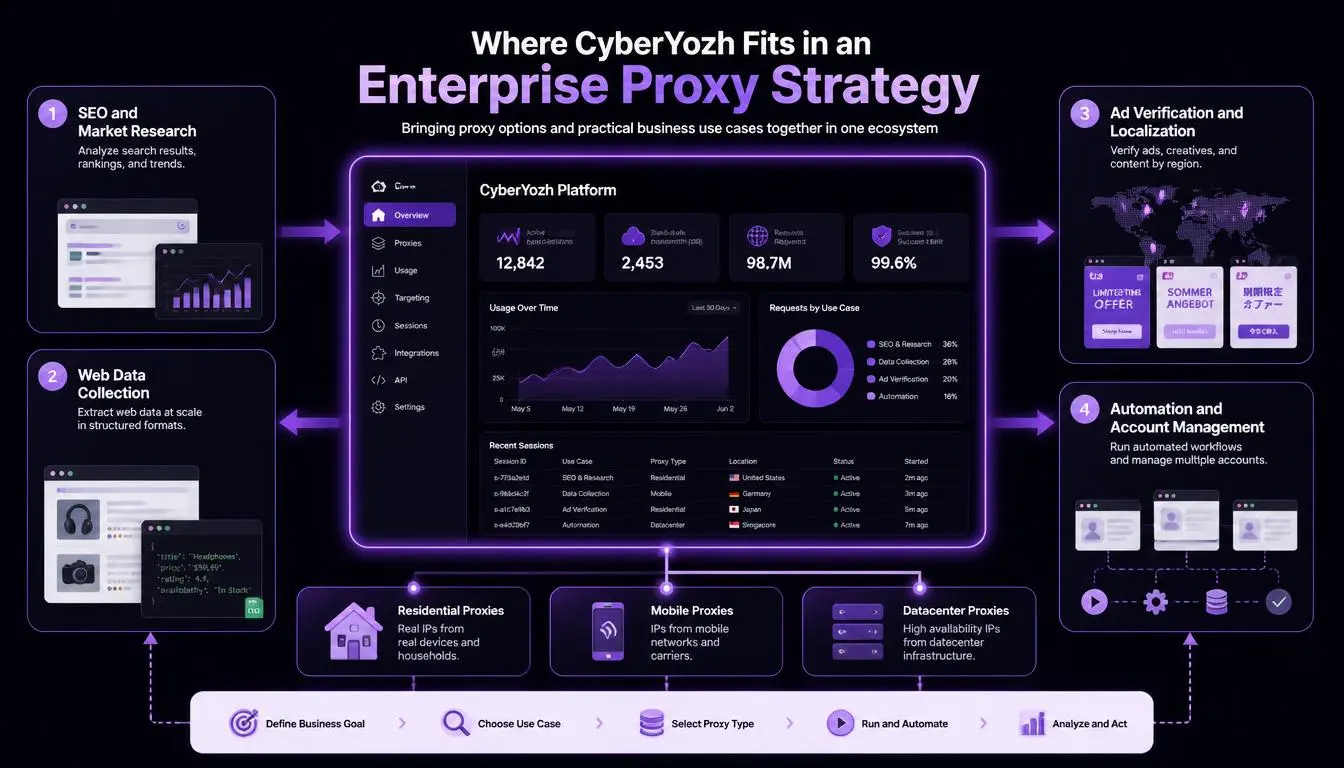
CyberYozh suits teams that want several proxy types and the account tools around them in one dashboard. Prices as listed on the live catalog, October 2026:
100M+ residential IPs in 195+ countries, with IP quality filtering, free geo-targeting and monthly traffic rollover
Static ISP residential proxies from $5.29/month: one dedicated IP, unlimited traffic, HTTP and SOCKS5
LTE/5G mobile proxies from $3.5/day dedicated, with unlimited traffic and IP changes by button or API
Datacenter proxies from $2.18/month dedicated, for fast automation
API access that works with Scrapy, Selenium, Playwright, Puppeteer, Postman, and the major antidetect browsers
Fraud score checker to test an IP’s reputation before a campaign goes live
SMS verification numbers and virtual cards for setting up business accounts
Business plans with a private proxy pool, custom terms, priority support and a dedicated account manager
“CyberYozh App is straightforward and doesn’t overcomplicate things.”
— Verified G2 reviewer
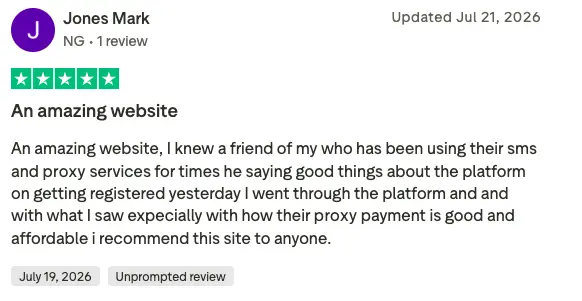
CyberYozh is rated 4.7/5 across Trustpilot.
The bottom line
Proxy infrastructure benefits only show up when it fixes a task that’s already failing. Choose the right type for the task, compare the cost of successful requests, check where the IPs come from, and test before you scale. For residential traffic, CyberYozh is priced in line with the market. For mobile, per-day billing makes it one of the cheapest ways to run high-traffic accounts.
Ready to try it on your own targets? Start with CyberYozh rotating residential proxies and scale once your results hold up.