
Instagram Scraping in 2026: How to Collect Data Without Getting Blocked

TL;DR
Instagram scores every request based on IP reputation, TLS fingerprint, request velocity, and account behavior; a single weak signal can get you rate-limited or blocked.
Datacenter IPs fail almost immediately; rotating residential handles standard volume; mobile IPs are needed for the hardest endpoints.
A 2024 federal court ruling (Meta v. Bright Data) confirmed that logged-off scraping of public Facebook/Instagram data doesn't breach Meta's terms, though contract and privacy law risks still apply.
CyberYozh's rotating residential proxies start at $0.90/GB and mobile at $1.70/day, both with full API access and built-in fraud-score checking.
Quick Answer: Instagram scraping in 2026 requires residential or mobile proxies; Instagram's anti-bot systems almost instantly flag datacenter IPs. Start by rotating residential proxies for volume (profiles, hashtags), escalate to mobile proxies only for endpoints where residential proxies get rate-limited, and keep requests to 20-40 per minute per IP to stay under detection thresholds.
Instagram scraping fails for one recurring reason: the IP behind the request gets flagged before the data ever loads. Meta's anti-bot stack scores every request against IP reputation, request velocity, and behavioral fingerprint, and datacenter IPs fail that check almost immediately.
This guide covers what you can legally collect, why proxy choice decides success or failure, and how to build a pipeline that survives past a few hundred requests.
What you can actually scrape from Instagram
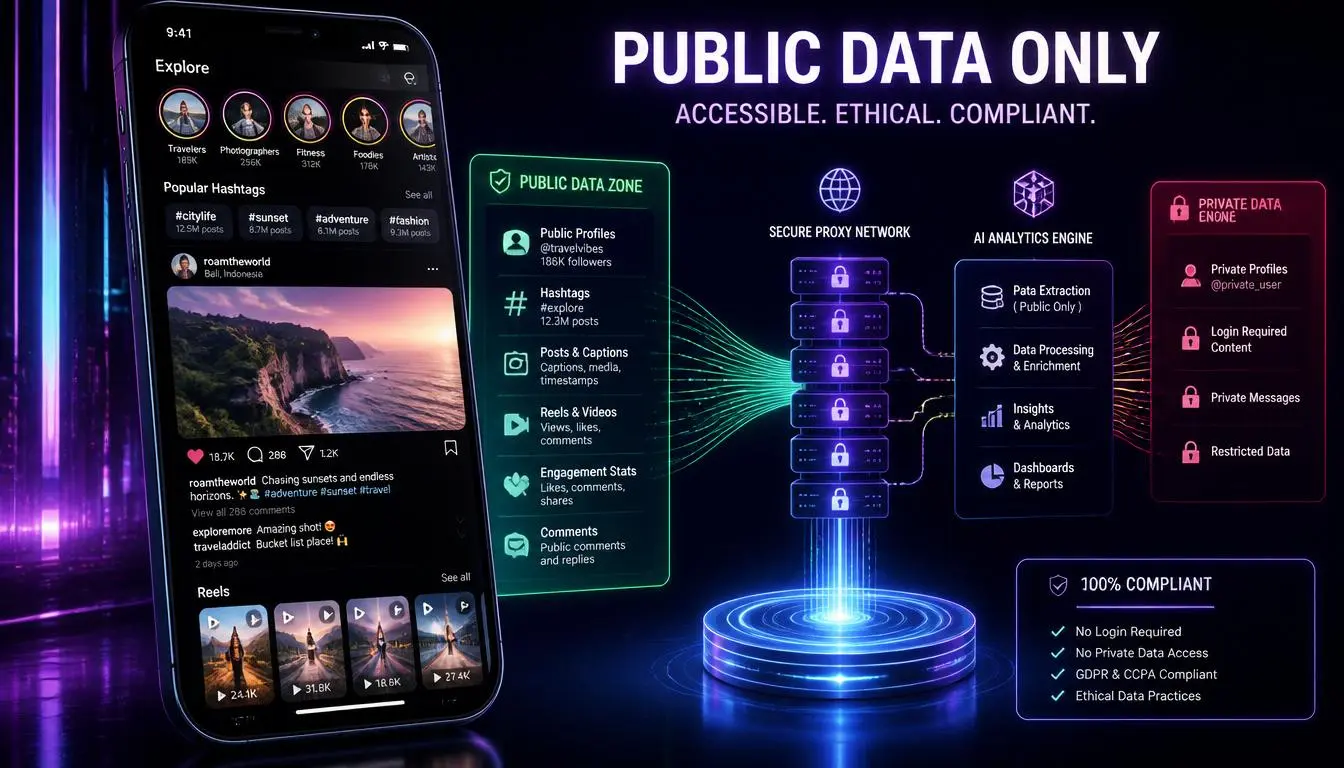
Public profile data, post captions, hashtag results, follower/following counts, engagement metrics, and public comments are all fair game for competitor monitoring, influencer vetting, market research, and lead generation. Private accounts, login-gated content, and personal data behind authentication are not; scraping those creates real exposure under GDPR/CCPA and Instagram's own terms.
Warning: "Public" doesn't mean "unregulated." Bios, emails, and other personal data you collect at scale are still subject to GDPR/CCPA handling obligations even when the source data was publicly visible.
Why most Instagram scraping gets blocked within hours
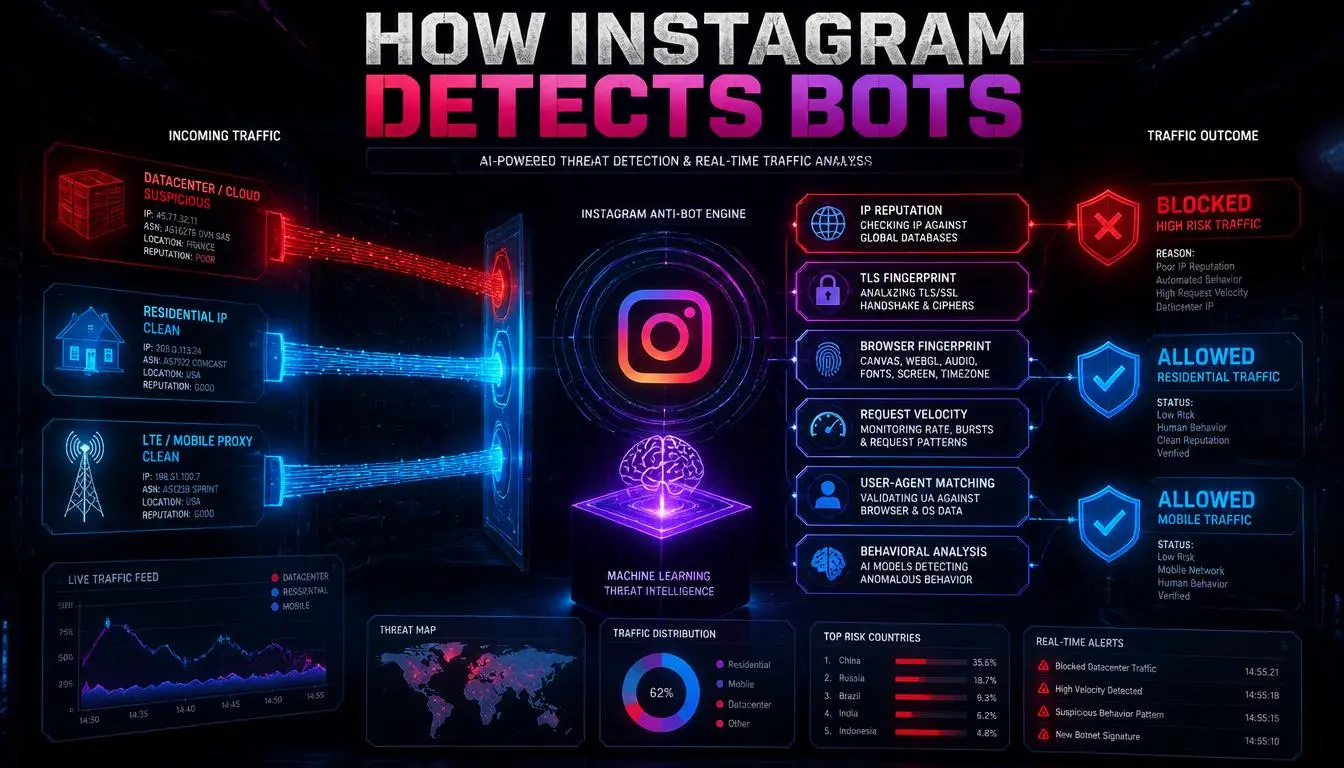
Instagram runs requests through layered detection: IP reputation, TLS/browser fingerprint, request velocity, and account behavior patterns. A request only needs to fail one layer to get rate-limited or blocked outright.
Detection Layer | What Trips It | Fix |
IP reputation | Known datacenter ranges (AWS, GCP, DigitalOcean) | Use residential or mobile IPs instead |
Request velocity | Bursts over ~30 requests/minute on one IP | Pace requests, randomize delays |
TLS/browser fingerprint | User-Agent mismatched to IP origin | Match headers to your proxy's device type |
Account behavior | Robotic, uniform request timing | Add randomized delays, human-like patterns |
Pro Tip: If you're building on an LTE/5G mobile proxy, your User-Agent and header set need to match those of a real mobile device; an iOS Safari header on a desktop scraper is a fingerprint mismatch that gets flagged just as quickly as a bad IP.
Common Mistake: Scraping through a single static IP at high volume "because it's cheaper." One IP burning through thousands of requests a day is exactly the velocity pattern Instagram's detection is built to catch; rotation isn't optional past small-scale testing.
Matching proxy type to Instagram scraping volume
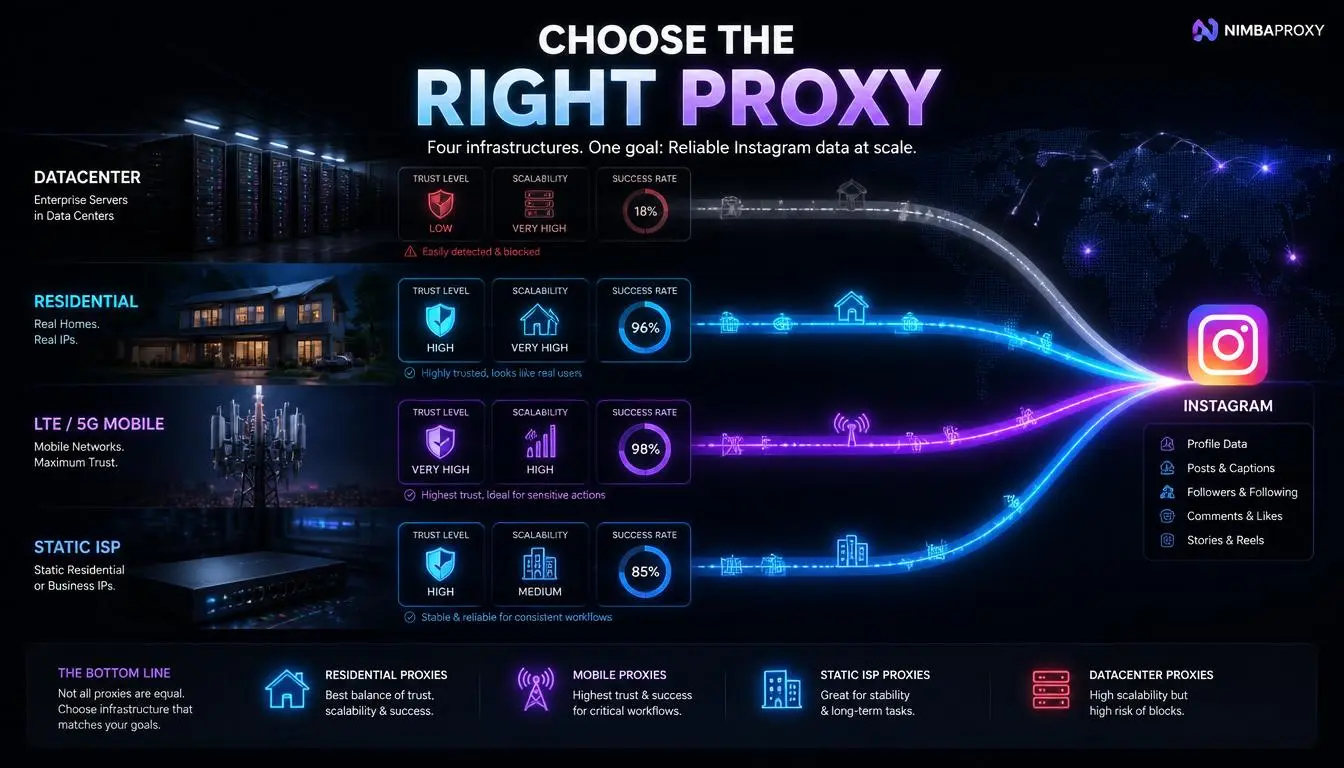
Use Case | Recommended Proxy | Why |
Testing / small samples (under 10 pages) | Datacenter | Cheap, fine for low-stakes testing only |
Profile & hashtag collection at scale | Rotating Residential | Spreads requests across real consumer IPs, standard for volume work |
Hardest endpoints, stubborn accounts | LTE Mobile (4G/5G) | Highest trust score; Instagram is mobile-first, so mobile traffic blends in |
Competitor/ad verification by region | Static ISP Residential | Needed for geo-specific, consistent sessions |
Need the right proxy for the job? Browse CyberYozh's full proxy catalogue, mobile, residential, ISP, and datacenter, all under one account, with API access and unlimited-traffic plans starting at $1.70/day.
Practical rule: start with rotating residential for volume, and escalate to mobile-only when residential starts failing, mobile costs more per GB, and isn't necessary for every endpoint.
CyberYozh vs. Other Proxy Providers for Instagram Scraping
Most Instagram scraping guides point you toward one of two extremes: enterprise proxy networks (Bright Data, Oxylabs) built for teams with large, dedicated budgets, or budget data center providers that get burned within a day of real use.
CyberYozh sits between the two, offering rotating residential proxies at $2/GB and dedicated mobile proxies at $1.70/day with unlimited bandwidth, real carrier- and ISP-sourced IPs rather than datacenter ranges, at a fraction of enterprise pricing.
The practical edge for scraping workflows specifically: CyberYozh's API ships with full Swagger documentation and direct integration guides for Scrapy, Selenium, Playwright, and Puppeteer, plus a built-in fraud-score checker so you can verify an IP's reputation before burning requests on it, a step most budget providers skip entirely.
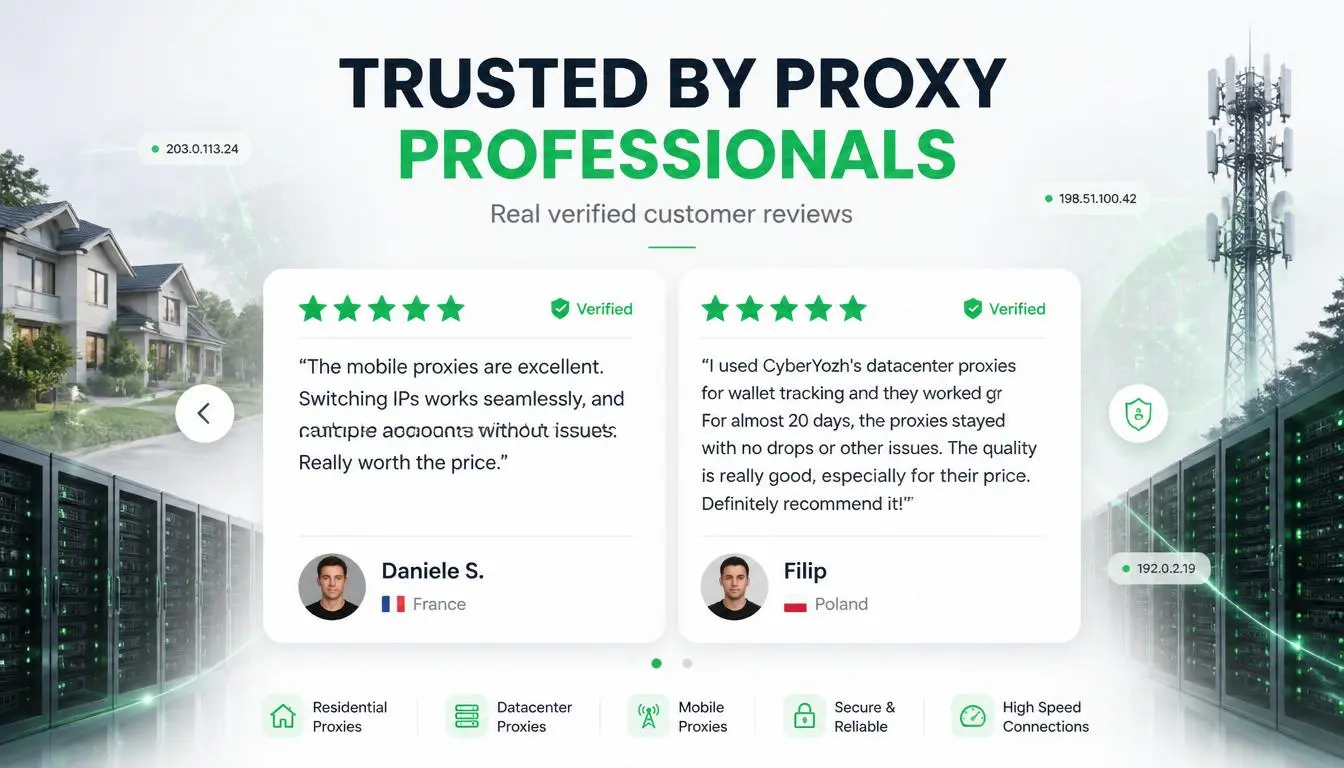
One recent reviewer described CyberYozh's support and IP stability as consistently reliable over months of proxy use, which aligns with the platform's 4.7 "Excellent" rating on Trustpilot.
Verifying a new account or platform? Get a virtual number through CyberYozh SMS activation for fast, reliable verification codes.
Expert Insight: The biggest cost lever in a scraping pipeline isn't the proxy price per GB; it's your retry rate. A cheap proxy that fails 30% of requests costs more in wasted bandwidth and re-runs than a slightly pricier one with a 95%+ success rate. Factor reliability into cost-per-successful-request, not just cost-per-GB.
Building the pipeline for Instagram scraping
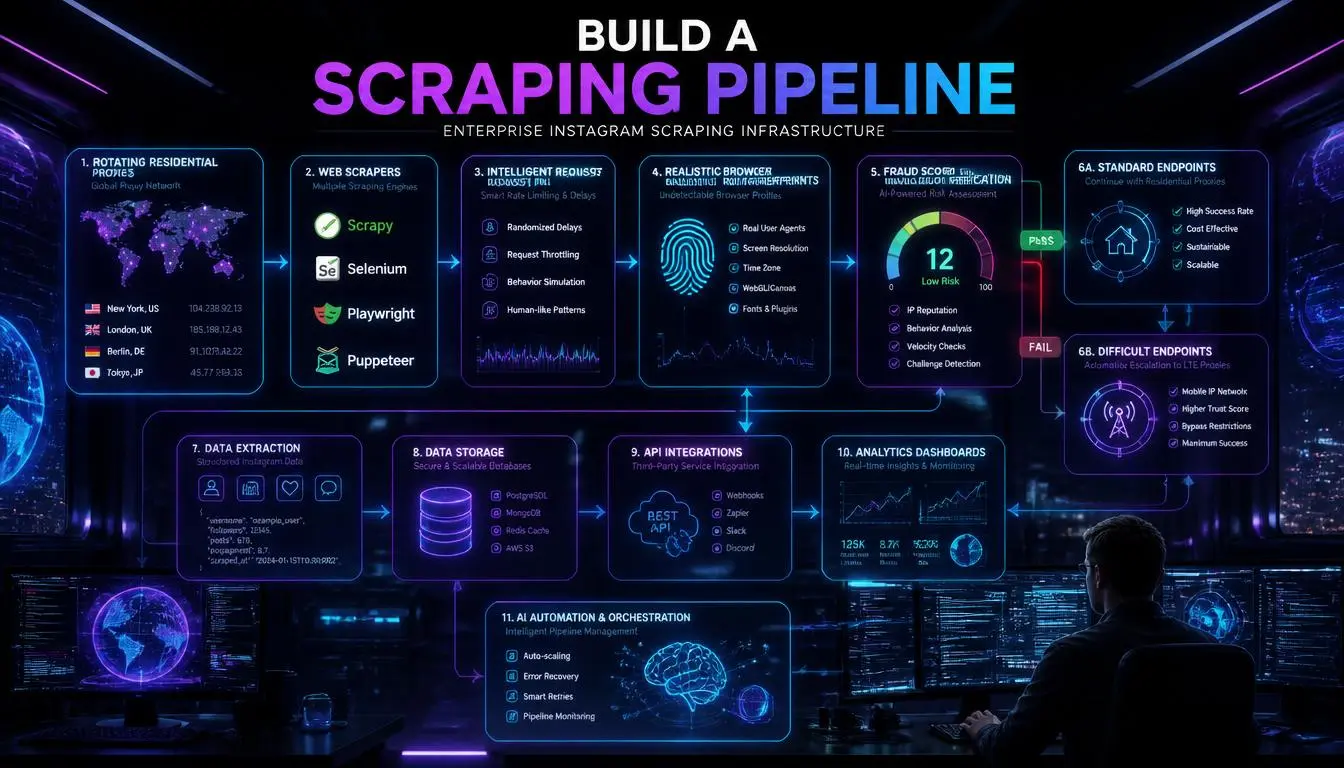
Start with rotating residential proxies for standard profile/hashtag collection.
Pace requests; 20-40 per minute per IP is a safe range; bursts are the fastest way to get flagged.
Randomize delays between requests to avoid predictable, bot-like timing
Match your User-Agent to your proxy's origin (mobile IP → mobile browser headers)
Escalate to mobile proxies only for endpoints where residential gets rate-limited
Run a fraud-score check on new IPs before deploying them at scale
Collect public data only, and respect robots.txt and Instagram's rate structure
Staying on the right side of the law with social media scraping
The legal ground here shifted meaningfully in January 2024, when a U.S. federal court ruled in Meta v. Bright Data that logged-off scraping of public Facebook and Instagram data did not breach Meta's terms of service; the court found the terms bind logged-in users, not logged-out visitors collecting public data. This builds on the earlier hiQ v. LinkedIn precedent, in which the Ninth Circuit held that the automated collection of publicly accessible data doesn't violate the Computer Fraud and Abuse Act.
That said, this doesn't mean unlimited legal cover: Instagram scraping while logged into an account, collecting non-public data, or ignoring state privacy laws (GDPR, CCPA) still carries real risk. Stick to public, logged-off collection and handle any personal data you gather in line with those laws.
Ready to build a scraping pipeline that actually holds up? Start with rotating residential proxies from $0.90/GB or explore mobile proxies from $1.70/day, both API-ready with Swagger docs, rated 4.7 "Excellent" on Trustpilot.