
What Are Mobile Proxies: And Why You Probably Need One
TL;DR
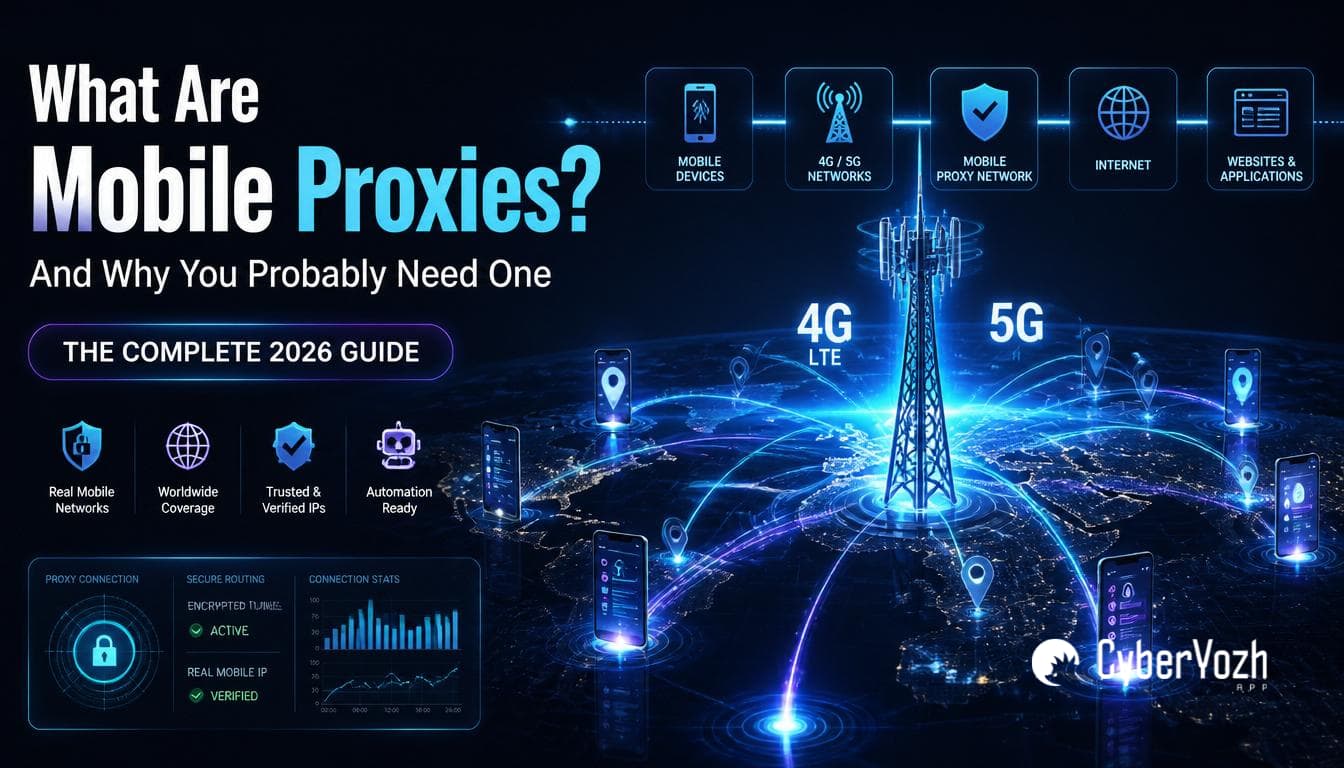
Mobile proxies route your traffic through real 4G/5G carrier IPs; websites see a genuine phone, not a bot.
They achieve 85–95% success rates on protected sites vs. 25–35% for datacenter proxies.
Dedicated mobile proxies keep one fixed IP for account trust; rotating ones give you a fresh IP per request.
Main use cases: social media automation, web scraping, sneaker bots, ad verification, multi-account management
CyberYozh mobile proxies start at $1.70/day with unlimited traffic, real carrier IPs, and 99.8%+ uptime.
Quick answer: What is a mobile proxy
A mobile proxy is a server that routes your internet traffic through a real IP address assigned to a mobile device by a real carrier network, 4G LTE or 5G. When you connect through one, websites see a genuine smartphone user, not an automated tool or a data center server. That's why they're the hardest proxy type to block, and the most trusted by platforms that aggressively filter traffic.
The problems mobile proxies solve
You've been there. You spend hours setting up a scraper, a social media tool, or an automation workflow, only to have it blocked within minutes. Or your ad verification tool returns data from the wrong region. Or you manage 30 client accounts and three get flagged in a single day.
The root cause is almost always the same: your IP looks suspicious.
Datacenter IPs are on blocklists before you even use them. Residential IPs are better, but years of misuse mean many are already flagged. Neither looks like what platforms actually trust most in 2026: a real person on a real phone.
That's the gap mobile proxies fill.
Expert Insight: Over 6.8 billion people now browse the internet primarily on smartphones. Platforms have built their trust systems around mobile traffic patterns. Any tool that mimics this traffic gets the highest trust score by default.
How mobile proxies actually work
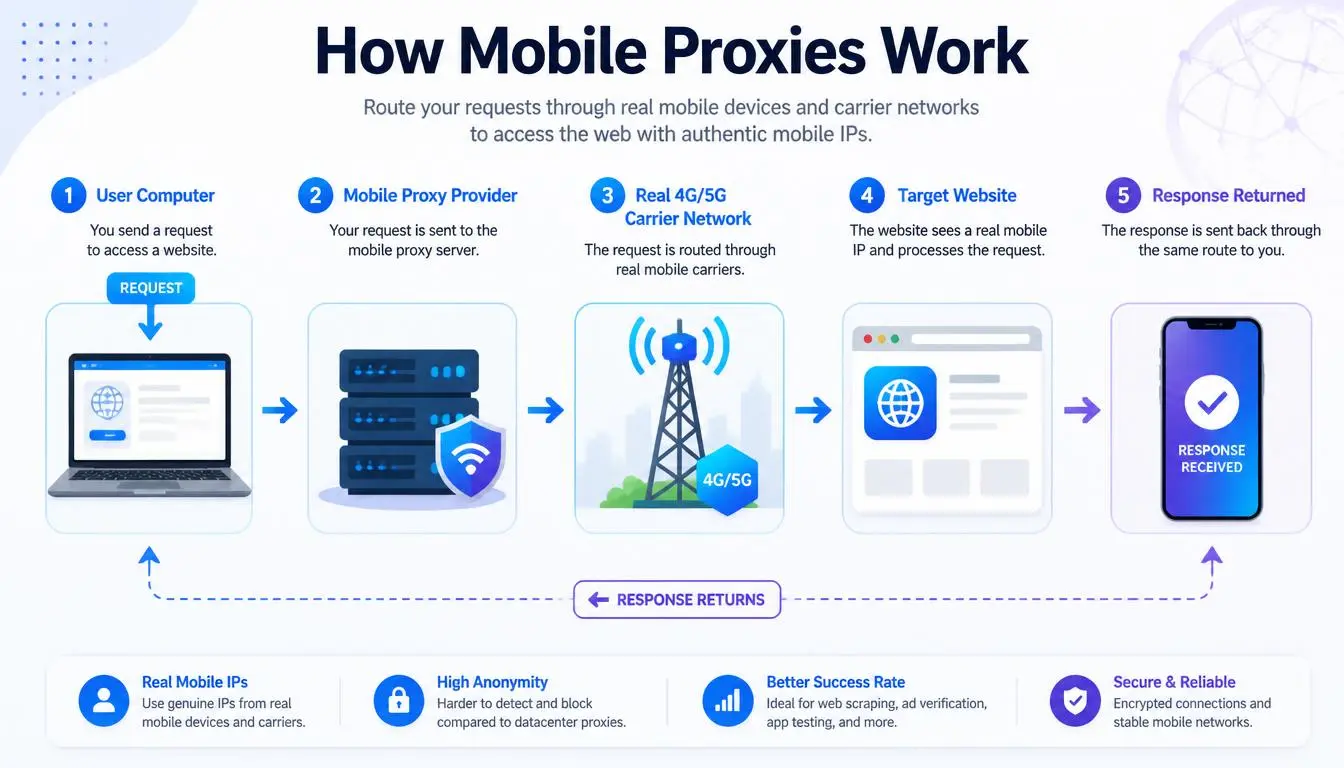
Here's the simple version:
You send a request through a mobile proxy provider
That request exits through a real mobile device's IP, assigned by a carrier like AT&T, T-Mobile, Verizon, or Vodafone
The target site sees a legitimate mobile user, not your real IP
The response comes back to you through the same path
The device on the other end is real. The carrier network is real. The IP is real. That's what separates mobile proxies from every other type.
They support standard protocols, HTTP, HTTPS, and SOCKS5, and most good providers also let you control when the IP rotates, either on a timer, per request, or manually via API.
Why websites can't block them: The CGNAT advantage
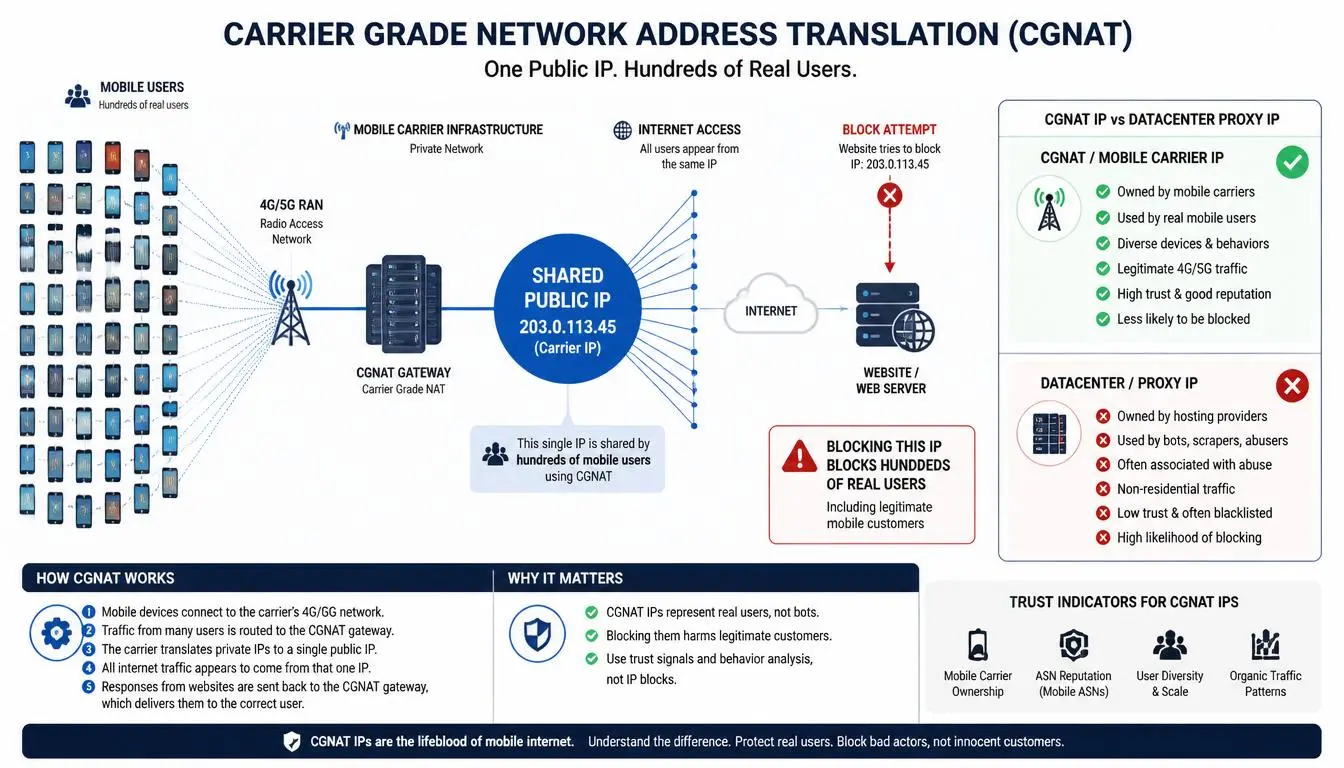
This is the technical reason mobile proxies are so hard to block, and it's worth understanding.
Mobile carriers use something called CGNAT (Carrier-Grade Network Address Translation). It's a system in which a single IP address is shared among dozens, sometimes hundreds, of real users simultaneously.
Here's the implication: if a website blocks that IP, it accidentally blocks all those real people too. No platform wants to do that. So mobile IPs get a level of protection that no other proxy type receives.
The result: Mobile proxies achieve 85–95% success rates on even the most aggressively protected sites, compared to 55–60% for residential proxies and 25–35% for datacenter proxies.
Common Mistake: Assuming residential proxies are "good enough" for social media and account management. Residential IPs look like home broadband rather than mobile. Platforms that specifically look for carrier-level IP patterns, such as Instagram, TikTok, and Facebook, will still flag them.
Mobile proxy vs. Residential vs. Datacenter: Which do you need
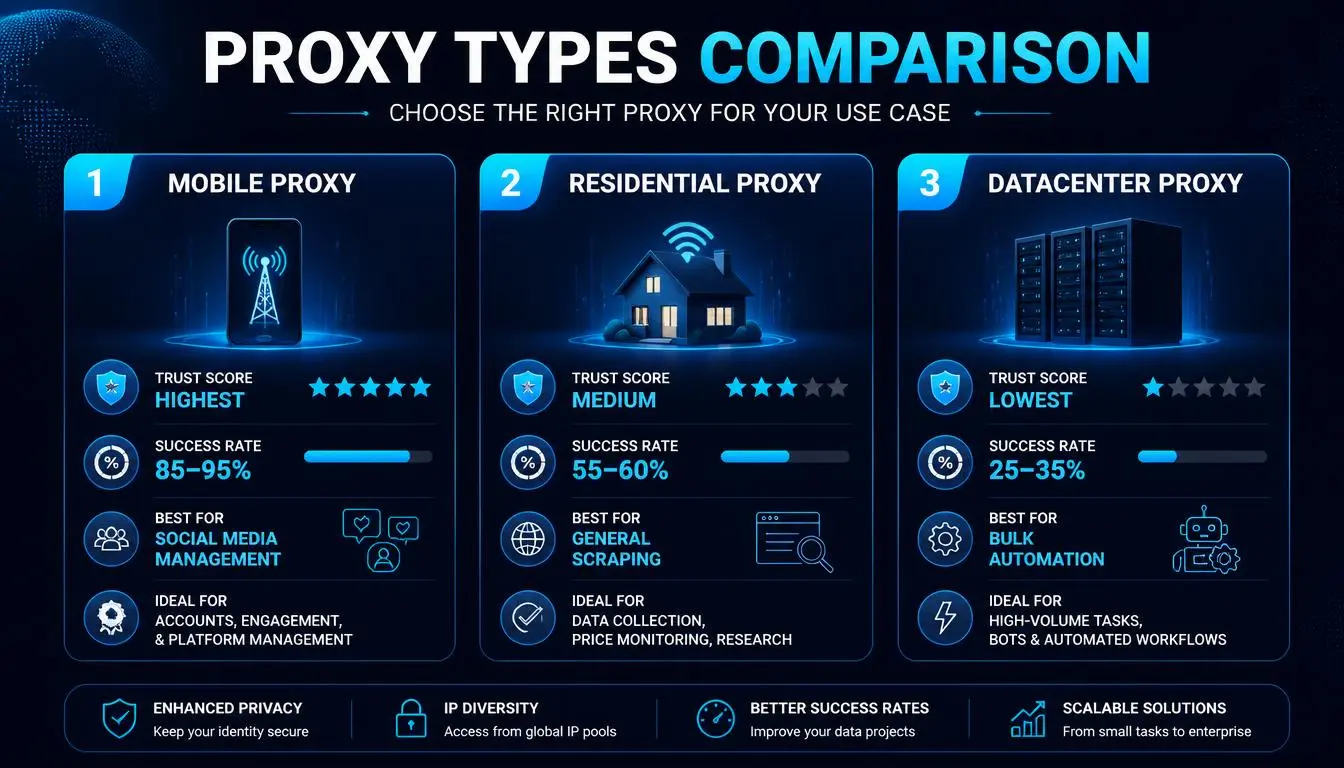
Mobile Proxy | Residential Proxy | Datacenter Proxy | |
IP source | Real carrier networks (4G/5G) | Real home ISPs | Server infrastructure |
Trust level | Highest | Medium–High | Low |
Block rate | Near zero | Low–Medium | High |
Success rate on protected sites | 85–95% | 55–60% | 25–35% |
Best for | Social media, account management, sneaker bots | General scraping, geo-research | High-speed, unprotected targets |
Typical cost | Higher | Mid | Lowest |
The practical rule of thumb:
Unprotected sites and APIs? Datacenter proxies are fast and cheap.
General scraping and market research? Residential proxies hit the right balance.
Social platforms, account management, sneaker drops, strict anti-bot targets? Mobile proxies only.
Not sure which fits your use case? CyberYozh offers all three proxy types →
Dedicated vs. Rotating mobile proxies
This is where most buyers make the wrong choice because they don't think about the task first.
Dedicated mobile proxies give you one exclusive IP that only you use. You control exactly when it rotates. No one else's behaviour contaminates the IP's reputation.
Use dedicated when:
You're managing social media accounts long-term (each account needs its own trusted, consistent IP)
You're running sneaker bot sessions where carrier signatures need to persist across a drop
You're verifying ads over time from the same simulated location
Rotating mobile proxies pull from a large pool and automatically assign a fresh IP per request or session.
Use rotating when:
You're scraping large datasets where fresh IPs prevent pattern detection
You're running price monitoring at high volume
You're doing multi-site data collection where variety matters more than consistency
Pro Tip: A social media account that switches IP every few minutes looks more suspicious than one that stays on the same IP for weeks. Platforms see IP consistency as a trust signal. For account work, dedicated beats rotating every time.
4G vs. 5G mobile proxies: What's the difference
Both use real carrier networks. The difference is in speed, latency, and specific use cases.
4G mobile proxies:
Available in virtually every country, with the broadest geo-coverage
Speeds of 10–50 Mbps, sufficient for most scraping and automation
More affordable than 5G
Mature, well-understood trust profiles on all major platforms
Best for: general automation, social media management, ad verification, bulk scraping
Latency under 10ms, critical for time-sensitive tasks
Peak speeds up to 150 Mbps with better concurrency under load
Newer IP ranges with less anti-bot mapping
Best for: sneaker bots where milliseconds matter, high-volume parallel scraping, markets with strong 5G coverage
For most teams in 2026, 4G covers 90% of needs. Choose 5G specifically when you're operating in speed-critical or latency-sensitive environments.
The best use cases for mobile proxies
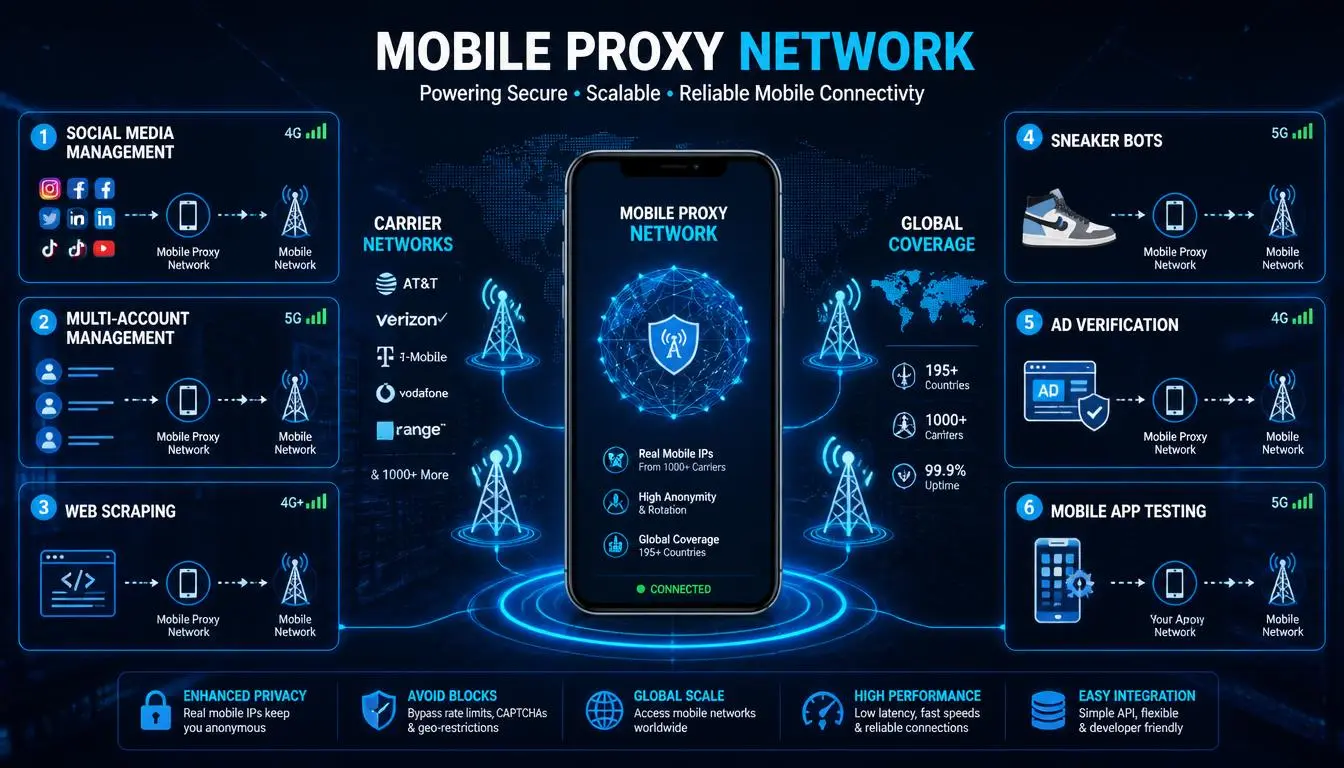
Social Media Automation & Multi-Account Management
Each account gets its own dedicated mobile IP that looks like a separate real phone. Platforms like Instagram, TikTok, and Facebook see distinct mobile users — not a single machine running 50 accounts. This is the single most common reason businesses switch from residential to mobile proxies.
Real example: A social media agency managing 80 client accounts switched from residential to CyberYozh mobile proxies. The account ban rate dropped significantly because each profile maintained a consistent carrier-level IP identity.
Start managing accounts without bans →
Web Scraping on Protected Sites
Major e-commerce platforms, search engines, and social networks run advanced anti-bot systems. Mobile proxies get through where datacenter and many residential IPs fail. If your scraper keeps hitting CAPTCHAs or 403 errors, the proxy type is almost certainly the problem, not your scraper.
Sneaker Bots & Limited-Release Drops
Nike SNKRS, Adidas, StockX, and similar platforms closely monitor carrier-level IP signatures during high-traffic drops. An LTE/5G mobile proxy with the right carrier fingerprint gives your bot a meaningful advantage in timing and authenticity.
Check out Cyberyozh sneaker proxies for sneaker bot drops→
Ad Verification
Brands and agencies need to see exactly what a real mobile user in a specific city sees, not a filtered or manipulated view. Mobile proxies deliver accurate, unaltered ad placements from genuine carrier IPs in the exact region you're targeting.
Common Mistake: Using VPNs for ad verification. VPNs share IPs across thousands of users and are heavily flagged by ad networks. Mobile proxies give you a clean, unique IP that reflects real user conditions.
Traffic Arbitrage & Affiliate Marketing
Mobile proxies let you run campaigns across multiple ad platforms without triggering fraud detection. Carrier-grade IPs have the trust scores ad networks look for, keeping your campaigns live and your accounts clean.
Mobile App Testing
Testing how your app performs across different carriers, speeds, and regions requires actual mobile network conditions. Mobile proxies replicate this without needing physical devices in every location.
Why businesses choose CyberYozh in 2026
Most proxy providers sell you IPs and leave you to figure out the rest. CyberYozh is built differently; it's a complete infrastructure platform for teams that run real operations. Here's what that means in practice:
One platform. Every proxy type.
LTE Mobile (4G/5G) from $1.70/day: real carrier IPs, unlimited traffic, manual or API-triggered rotation
Rotating residential from $0.90/GB, 100M+ IPs across 100+ countries
Static residential (ISP) from $5.29/month, dedicated IPs for stable, session-based tasks
Datacenter from $1.90/month, for high-speed, cost-efficient bulk work
Technical depth that competitors miss:
CyberYozh mobile proxies support HTTP, HTTPS, SOCKS5, UDP, VPN, and even Vless/Xray protocols. You can change the p0f fingerprint, set dedicated DNS per proxy, and handle VoIP use cases that most providers simply can't.
Built for automation teams:
Full API access. Native integration with Playwright, Puppeteer, Scrapy, Selenium, and Postman. Sticky sessions and rotation control. IP reputation checks before use.
Antidetect browser ready:
Works directly with Dolphin Anty, Multilogin, GoLogin, Adspower, Kameleo, and OctoBrowser out of the box.
Fraud Score tools:
Pre-screen every IP before it goes live. Know which IPs are clean before they touch your campaigns or accounts. Check every IP's quality score before deployment.
SMS verification built in:
Virtual numbers from 140+ countries for account registration, no need to juggle a separate provider.
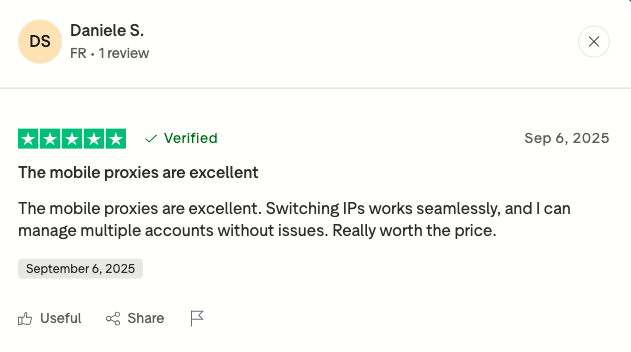
What users say on Trustpilot (4.7/5 from 127+ reviews):
Try CyberYozh mobile proxies from $1.70/day → No risk, transparent pricing. Real carrier IPs.