
Price Scraping Infrastructure: How to Track Competitor Prices Safely
Competitors adjust their retail tags multiple times a day. Tracking these metrics manually is impossible. It burns too many hours. But the second you deploy automated scripts, target storefronts drop your connection. Your terminal immediately fills with timeout errors.
Retailers protect their pricing matrices aggressively. They watch every single request. Their security firewalls easily detect high-frequency data pulls originating from commercial data centers. They drop that traffic instantly. Because real consumers do not browse retail sites from an AWS server farm. Sometimes, security algorithms do something much worse. They quietly feed your scripts fabricated pricing data instead of terminating the socket. You end up adjusting your own inventory based on completely wrong numbers.
You cannot extract raw market intelligence using basic scripts on cheap hosting. You need dedicated price scraping software running on an authentic network layer. Your infrastructure must simulate real human traffic perfectly. This is the only way to execute high-volume price scraping and pull accurate market numbers safely.
TL;DR: The core of price scraping infrastructure
Extracting competitor pricing at scale breaks standard scripts. Retail firewalls drop sterile datacenter traffic instantly. To survive in production, your pipeline needs an industrial foundation:
Ditch cheap hosting. Standard servers ruin your data accuracy. Security filters drop the connection or quietly feed your database incorrect numbers.
Deploy smart extraction. Basic HTML parsers pull blank text. You need dedicated price scraping software like the free Yozh Scraper. It renders dynamic JavaScript and fixes broken CSS selectors natively.
Protect your network footprint. Route requests through a massive residential IP pool. This aligns your physical location and keeps your traffic looking strictly human.
Offload the heavy lifting. Stop building custom proxy rotators. A complete e-commerce data scraping service like the CyberYozh App ecosystem handles the entire stack. You access authentic mobile LTE/5G proxies, 50 million residential IPs spanning over 195+ countries, real SMS verification, virtual payment cards and Fraud Score checker directly from one dashboard.
Why modern price scraping requires JS rendering
Static HTML parsing is dead. You cannot send a simple HTTP request and expect a clean price tag in the response. Prices no longer live in the raw source code. More than 80% of top-tier retail platforms now rely entirely on client-side rendering frameworks like React, Vue, or Next.js. The initial HTML you download is just an empty shell.
Retail algorithms generate dynamic metrics in milliseconds. They digest your cookies, your device footprint, and your historical search behavior. Then they decide the exact number to show you. Grabbing this data requires more than a library call you need an architecture that simulates a real user journey.
Your e-commerce scraper must handle these three technical hurdles to pull accurate data:
DOM materialization: The price does not exist in the initial response. You must wait for the browser to render the full Document Object Model (DOM) in memory, triggering the hidden XHR or Fetch requests that actually serve the pricing data.
Stateful session persistence: Retailers monitor session continuity. Break the context midway, and the site drops your cookies. It immediately serves you a "safe" fallback price, which usually hides the real local promotions you need.
Network request analysis: Modern sites hide pricing behind asynchronous API calls. You must sniff the network traffic, identify the specific JSON endpoint, and isolate that data from the visual noise of the page.
Generic scraping tools fail here. They lack the memory management needed to handle thousands of concurrent DOM trees without crashing the server. Extracting dynamic data requires a highly specific, headless browser architecture.
We detailed how to configure these isolated browser instances in our comprehensive e-commerce scraper production guide. Read that to build your foundational parsing logic before you scale your tracking operations.
Overcoming location-based price discrimination
Geography dictates the price tag. A server connecting from Germany pulls entirely different flight costs and hotel rates than a home user connecting from Texas. Retail algorithms map your exact IP address to a specific economic zone. They adjust the markup instantly based on presumed local income levels. We documented this exact tracking mechanism in our recent analysis of how airlines and hotels use price discrimination to hike rates based on your digital footprint.
Extracting accurate data requires physical network alignment. You cannot pull a localized catalog from a generic overseas server. You must deploy granular city and ZIP-code targeting directly within your proxy configuration. The target server responds with the exact regional numbers.
This architectural shift delivers the precise local price tag. You monitor hyper-local competitor promotions accurately without leaking weird geographic anomalies in your browser headers. Utilizing strict city, region, and state-level targeting ensures you see exactly what the local consumer sees. And because you access the web through a real local node, these exact same endpoints double as native tools for localized campaign testing to verify your own regional ad placements safely.
👉 Align your network location: Deploy our rotating residential proxies to extract precise regional data. Use free city and ZIP-code targeting to map local inventory exactly as the consumer sees it.
Protecting your price scraping infrastructure
You monitor a competitor's top 1,000 SKUs. You check them every hour. That equals 24,000 network requests a day. Sending that volume from a single IP address triggers firewall alarms instantly. Retail security algorithms track request velocity meticulously. A normal consumer clicks a product page every few seconds at most. When your script hits a server ten times a second from the exact same node, the firewall blacklists your digital footprint.
You fix this by changing how you distribute the load. Route your traffic through a massive global residential IP pool. This completely masks your origin point. Instead of slamming the target server from one static machine, you spread the requests across real home internet connections. Configure your scraper to use automatic per-request IP rotation. Every single web call exits through a different household. The retailer sees 24,000 different people looking at one product each, rather than one automated script looking at 24,000 products.
This authentic network structure ensures exceptionally high proxy success rates. Clean traffic keeps your data extraction pipeline stable and prevents IP bans naturally. You also stop fighting security walls. When your connection originates from an ethically sourced home network, the target site trusts the session from the first byte. This handles CAPTCHA triggers natively by preventing the algorithm from ever showing the challenge in the first place.
Handling hardware fingerprints and identity isolation
Changing your IP address only secures the network layer. You still have a massive blind spot. Modern retail algorithms do not just look at where your traffic originates. They interrogate the physical hardware rendering the page.
When your scraper connects, the target server executes aggressive JavaScript challenges. It synthesizes dozens of internal browser attributes to generate a highly accurate device hash. Research from the Electronic Frontier Foundation (EFF) shows that these combined hardware signals can identify a unique device with over 99% accuracy, even if you clear your cookies completely.
Retail security filters actively inspect your:
Canvas and WebGL graphics rendering hashes.
Installed system fonts and AudioContext signatures.
Screen resolution and precise viewport dimensions.
WebRTC configurations and hardware media devices.
If your residential IP registers a home user in Dallas, but your browser engine broadcasts a sterile Linux server graphics card, the firewall drops the socket immediately. The mismatch destroys your network trust score.
Because of this, you need strict hardware alignment to keep your requests looking like real buyers. But toggling a few user-agent settings in standard headless Chrome does not work. You need automatic fingerprint rotation and masking built deeply into the browser engine.
Professional operators stop fighting these hardware mismatches manually. They deploy integrated anti-detect browsers for proxies to manage this natively. These platforms handle the complex hardware rendering in the cloud. You assign one specific network node to one isolated browser container. This creates full digital identity isolation per profile. If a retailer flags one specific data pull, the security trigger stays contained. It never infects your broader infrastructure. Your digital identity remains completely clean, and your heavy extraction runs continue without interruption.
Scaling your price monitoring operations
Monitoring a million SKUs every hour creates a massive distributed systems problem. Pushing ten requests a minute is simple. Pushing ten thousand requests a minute breaks things. Cheap proxy networks crash under this severe concurrency load. Their shared servers run out of available sockets. Your connections timeout. Your crawlers stall. You lose critical market data right in the middle of an extraction run.
You cannot scale a broken foundation. Tracking dynamic retail tags at this volume requires an architecture built explicitly for heavy automation. You must build enterprise-grade performance for production pipelines. This requires two tightly integrated components: a resilient extraction engine and an industrial network layer.
Deploy a resilient extraction engine
Scaling headless browsers devours server RAM. Writing custom asynchronous retry logic and fixing broken CSS selectors takes months of engineering. We solved this architectural bottleneck with the open-source Yozh Scraper. Instead of fighting rigid code, you deploy this visual web scraping studio to manage the entire extraction lifecycle natively.
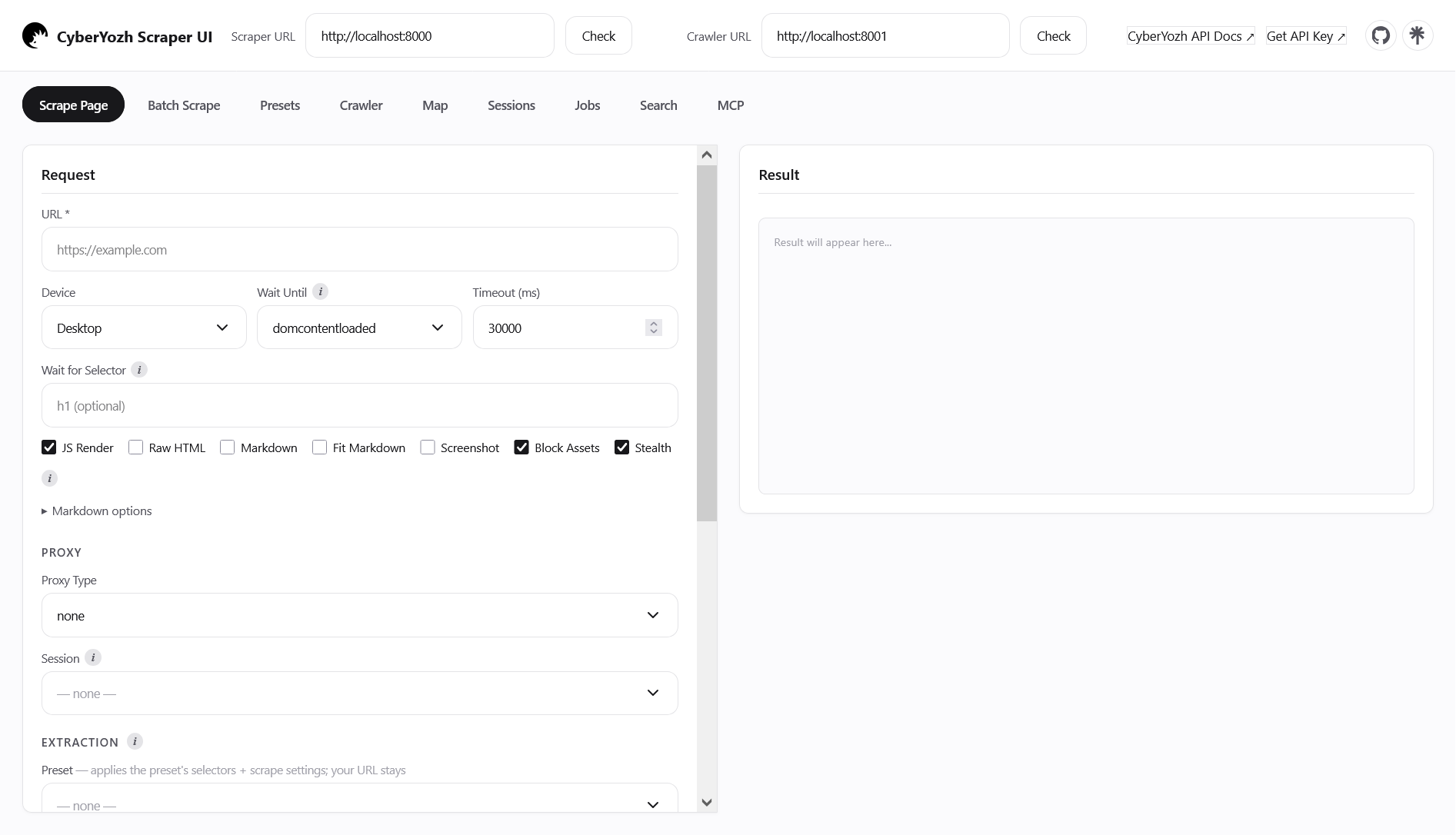
It handles layout changes automatically through these core functions:
Activate AI-driven self-healing: The built-in LLM fallback takes over instantly if a retailer runs an A/B test and mutates their pricing layout mid-crawl.
Fix schemas on the fly: The engine reads the raw DOM and locates the missing price tag without manual intervention.
Extract LLM-ready datasets: Your pipeline never stops. You pull structured, noise-filtered Markdown directly to your database without writing manual code updates.
👉 Stop fighting broken parsers: Download the free Yozh Scraper. Generate CSS schemas visually and let AI self-healing handle dynamic DOM changes automatically.
Scale through an industrial network layer
A smart parser means nothing if the target server drops your socket. When you pair this autonomous engine with a massive, rotating pool of residential IP addresses, you unlock true scale. This combined infrastructure handles millions of concurrent sessions seamlessly. You distribute your scraping load across a vast global footprint. This prevents the target application from detecting your massive request volume.
But raw volume fails if the data arrives late. Retail pricing is highly volatile. Store algorithms drop prices the exact second a competitor runs out of inventory. If your crawler takes fifteen seconds to render a heavy product page, your market intelligence is already outdated by the time it reaches your database.
You must optimize your network for absolute speed:
Maintain extremely low latency response times: Process heavy JavaScript catalogs instantly to track flash sales before they end.
Deploy high-speed proxy connections: Pull the exact price tag the moment it shifts to give your analytics team real-time visibility into the market.
Choosing an e-commerce data scraping service
Building a stable parser is only the first step. Maintaining the network infrastructure behind it consumes massive engineering time. Your developers end up managing proxy pools, swapping out dead nodes, and rotating hardware fingerprints instead of analyzing competitor pricing. Retailers update their security filters constantly. When they do, your developers stop building features and start patching broken network rules. The engineering backlog just keeps growing.
Offloading the heavy lifting to a professional e-commerce data scraping service stops this drain on resources. You stop fighting connection timeouts. You just query the API and receive the structured data.
The CyberYozh App ecosystem delivers this complete operational stack natively. We built a single unified endpoint architecture to handle every aspect of web automation, identity masking, and data extraction. You control a strict no-logs environment, backed by private payment systems and 24/7 technical support, directly from one interface. This all-in-one ecosystem for multi-accounting and extraction provides high-throughput dashboards to match your exact extraction goals.
How to choose the best proxies for price scraping
An autonomous scraper remains only as effective as its underlying network. Your choices directly impact your cost per SKU and your overall extraction success rate. You must match the proxy tier to the security level of your target platform.
Rotating residential proxies
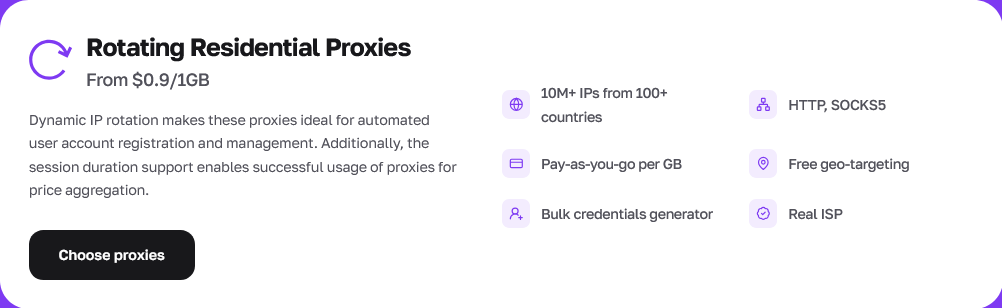
The blueprint: A dynamic pool spanning 195+ countries. The network routes your scraper requests through real household internet connections, altering your IP address automatically based on your specific rotation rules.
Pricing: From $0.90 per GB (pay-as-you-go with no minimum contracts; traffic never expires).
Core features: Free granular geo-targeting down to city and region levels. Includes sticky session support to lock a single household identity for up to 24 hours.
Primary use case: Pulling prices from thousands of open URLs simultaneously. You also route bulk auto-registration scripts through these pools to avoid IP bans.
The trade-off: You pay for every gigabyte you consume. You must optimize your browser code to drop heavy media files and image payloads to keep operational costs highly profitable.
👉 Scale your data aggregation: Access 50 million rotating residential IPs with pay-as-you-go billing and stop paying for unused data at the end of the month.
Static residential (ISP) proxies
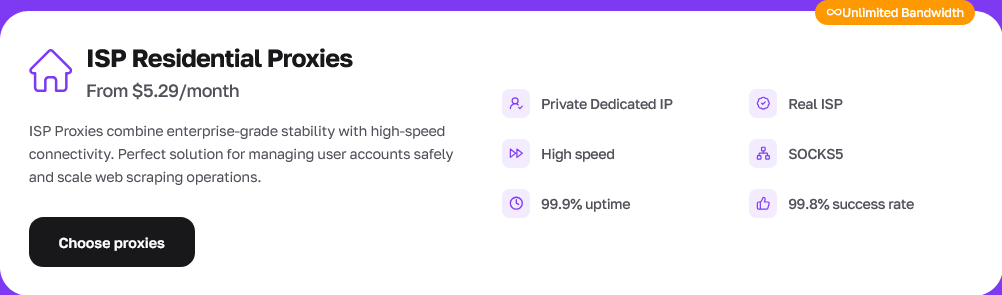
The blueprint: Dedicated, private IP addresses assigned directly by authentic consumer internet service providers. They provide the appearance of a real resident sitting at home with a laptop, combined with server-grade uptime.
Pricing: From $5.29 per month.
Core features: 99.8% extraction success rates, private non-shared addresses, 99.9% network uptime, and completely unmetered traffic.
Primary use case: Keeping a single login session alive all day. You need these nodes to manage real merchant profiles or scrape behind strict customer login walls.
The trade-off: The IP address remains completely fixed per billing cycle. It is not built for massive global rotation across millions of disparate target URLs.
👉 Maintain persistent sessions: Secure dedicated ISP nodes today to keep your scraper logged into protected merchant profiles 24/7.
Mobile LTE / 5G proxies
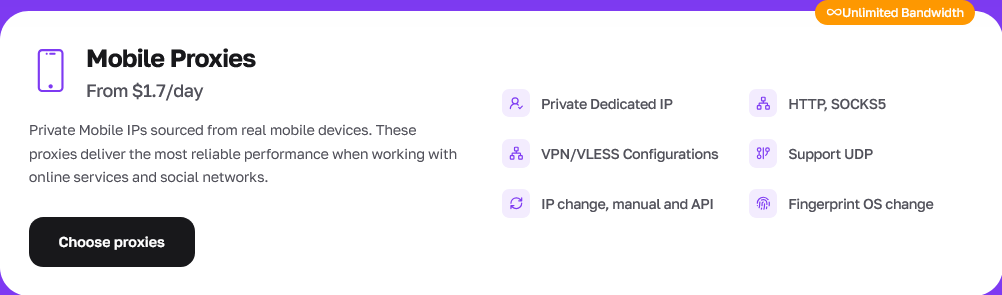
The blueprint: Real cellular network endpoints routed directly through mobile devices connected to 4G and 5G carrier towers (e.g., AT&T or Verizon).
Pricing: From $1.70 per day.
Core features: Native OS hardware fingerprint substitution, unlimited bandwidth, and API-triggered IP resets. We also integrate the VLESS/Xray protocol directly into these nodes. This advanced tunneling structures your proxy connection to look exactly like standard HTTPS web traffic, protecting your footprint from deep packet inspection (DPI) natively.
Primary use case: Navigating hyper-strict anti-scraping filters, extracting localized smartphone-only retail tags, and auditing mobile ad campaigns.
The trade-off: They carry a premium flat daily rate. Save these specific nodes for your absolute toughest target platforms.
👉 Overcome strict filters: Deploy authentic mobile nodes when standard gateways fail and maintain maximum trust for sensitive extraction tasks.
Datacenter proxies
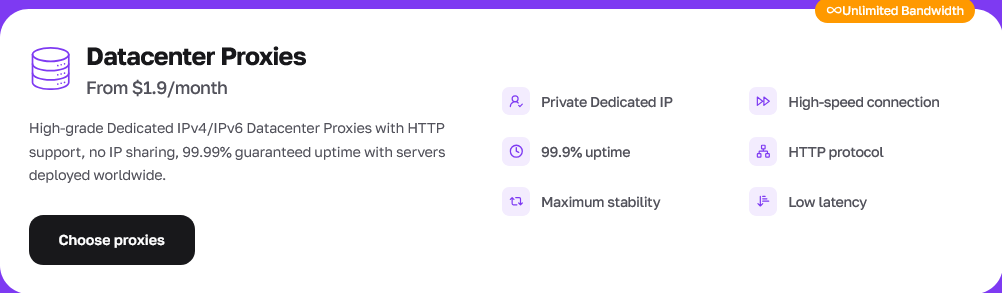
The blueprint: Premium, dedicated corporate server infrastructure delivering raw execution speed and immense bandwidth capabilities.
Pricing: From $1.90 per month.
Core features: Ultra-low ping (latency) response times, zero traffic caps, wide global geographic coverage, and completely private, non-shared allocations.
Primary use case: Scanning open public APIs, monitoring unprotected wholesale directories, basic ad verification, and processing high-velocity scraping on sites with relaxed firewall rules.
The trade-off: Datacenter ASNs stand out. Modern firewalls spot them instantly. Never route traffic through these servers if you need to extract data from a protected checkout page.
👉 Accelerate public API monitoring: Utilize premium datacenter infrastructure for high-velocity scraping where raw speed is your primary requirement.
Isolating buyer profiles: Numbers and virtual cards
Scraping public catalogs is simple. Extracting data behind strict login walls takes more work. Target platforms lock their most valuable metrics behind authenticated buyer profiles. You cannot build these profiles using temporary emails anymore. Retailers demand hard identity verification. To maintain access, your extraction infrastructure must include secure identity assets.
SMS verification and residential numbers
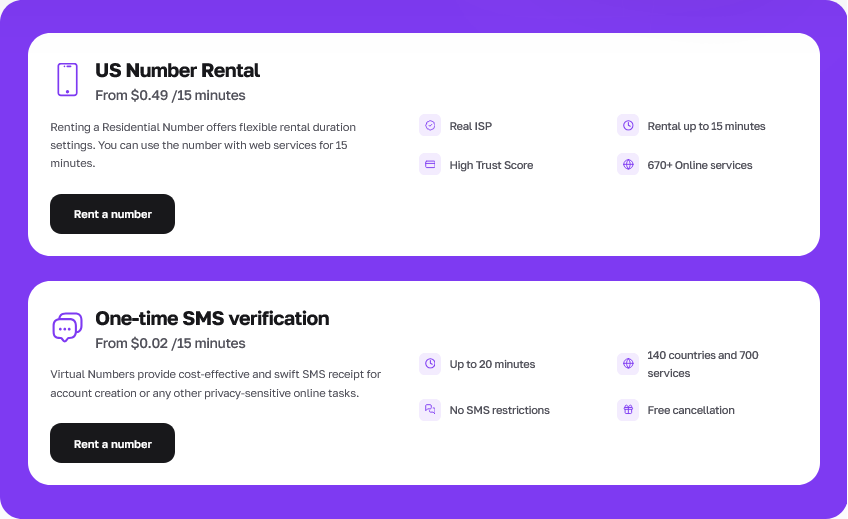
Standard VoIP numbers trigger immediate security flags during account creation. You overcome these validation checks using real ISP-backed residential phone numbers. The CyberYozh ecosystem provides disposable numbers (from $0.02) for standard automated registrations. For highly strict platforms, you rent real local operator lines (from $0.49) to secure accounts across 700 different services. This delivers maximum trust rates without exposing your actual physical smartphone.
Virtual banking and localized payment cards
Monitoring regional ad campaigns or managing international developer accounts requires localized payment methods. If your network node sits in London but your credit card registers to a bank in Texas, the platform blocks the transaction immediately. You align your billing profile with the target market by issuing tokenized virtual payment cards directly from your dashboard.
You create dedicated cards linked to specific geo-parameters instantly. Set hard spending caps per card. You can even bind them straight to Apple Pay or Google Pay. This isolates your real financial footprint while keeping your active buyer profiles fully localized and compliant with regional platform rules.
Controlling bandwidth costs for price monitoring
High-frequency price tracking burns through gigabytes fast. Rendering thousands of product pages daily drains standard budgets. Because a single modern retail listing easily packs over 5MB of heavy JavaScript bundles, tracking scripts, and high-resolution media. Scale that to a modest 50,000 daily requests across your competitor's catalog. You just pulled down 250 gigabytes of data in 24 hours.
You must protect your profit margins by attacking this expense from two distinct angles.
First, optimize your extraction payload right at the code level. Instruct your headless browsers to intercept and abort all unnecessary network requests natively. Drop the custom web fonts. Block the product images entirely. You only need the raw DOM and the XHR JSON streams to read a price tag. Stripping these heavy graphical assets cuts your bandwidth consumption by up to 80% instantly.
But code optimization only solves half the equation. You must secure cost-effective enterprise-grade reliability on the billing side. Legacy proxy vendors lock developers into rigid, use-it-or-lose-it monthly subscriptions. If you buy 500GB and only consume 300GB, the provider wipes your remaining balance on the 30th of the month. That business model actively penalizes your code efficiency. It forces you to overpay for infrastructure you never actually touched.
Stop paying for data you do not use. The CyberYozh App proxy ecosystem eliminates this financial friction entirely because it operates on strict pay-as-you-go pricing with no minimums. You tap into our 50-million rotating residential IP pool spanning 195+ countries using aggressively low $1/GB-level pricing options - starting at exactly $0.90 per GB.
Most importantly, we structure our network to keep your market intelligence permanently profitable by offering traffic and bandwidth that never expires. Your unused gigabytes roll over indefinitely to the next month. You pay only for the exact, verified pricing data you actually extract.
👉 Cut your operational costs: Stop losing unused data at the end of the month. Access 50 million residential IPs starting at $0.90/GB with traffic that never expires.
Pre-flight infrastructure auditing
Getting blocked is not the worst outcome. Getting spoofed is. If you launch your price trackers blindly through a contaminated network node, advanced retail firewalls often choose not to drop your connection. Instead, they silently feed your scraper fake pricing data to ruin your analytics. You end up repricing your own inventory based on algorithmic traps.
You fix this by running real-time IP reputation and location checks before your script executes its very first action. Corporate security systems like IPQualityScore, ThreatMetrix, and PerimeterX evaluate your digital footprint instantly. You need to see exactly what they see.
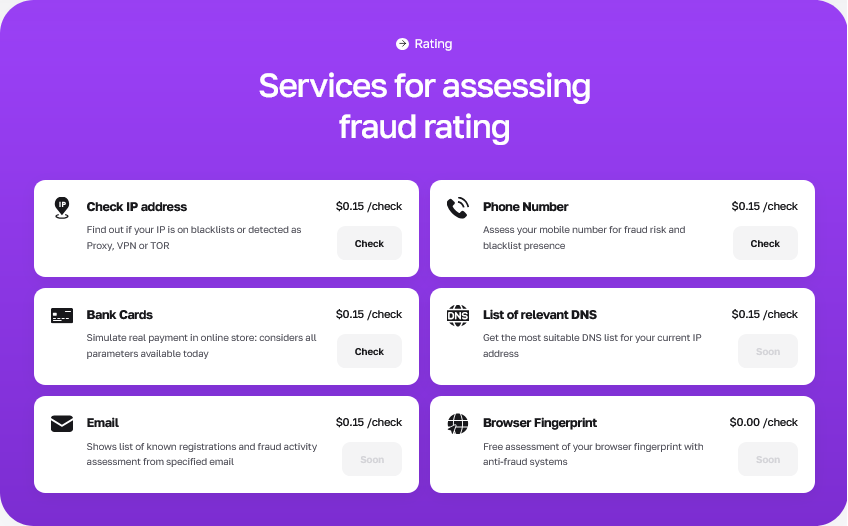
The CyberYozh App Anti-Fraud checker executes this exact evaluation (starting at $0.15 per check, or via a premium subscription for high-volume pipelines). It scores your assigned proxy on a 0 to 100 scale. It flags datacenter contamination, identifies high Abuse Velocity, and detects hidden VPN/TOR nodes. If a network node scores above 75, your script should drop the IP immediately and request a fresh one.
Professional data teams run these audits constantly to protect their operations. Because residential IPs belong to real households, their reputation fluctuates naturally. A teenager in that house might have downloaded malware yesterday, temporarily spiking the IP's risk score. Running a pre-flight audit simply filters out these anomalies before your crawler connects.
But network auditing is only one piece of the puzzle. We built a comprehensive Checker API so you can programmatically audit your entire automation stack through a single interface:
Check SOCKS/IP addresses: Submit your assigned endpoints to built-in IP blacklist and reputation checkers to drop high-risk nodes programmatically.
Validate phone numbers: You need stealth buyer profiles to scrape behind strict login walls. Retailers instantly block VOIP numbers. Submit rented numbers here to verify they register as physical mobile devices (Wireless) before you execute the SMS flow.
Audit credit cards: Regional mismatches suspend corporate ad accounts fast. Submit a virtual card here to run an AVS (Address Verification System) check. You verify the billing details match the local market perfectly before a real transaction fails.
Retrieve task history: Pull up old fraud reports and API checks on demand. You see exactly how your network health trends month over month.
Validating your assets programmatically guarantees your data pipeline runs exclusively on exceptionally clean high-reputation IP pools. Clean traffic forces the target server to lower its defenses. This ensures you extract the real market numbers your business actually needs.
👉 Audit your infrastructure programmatically: Integrate the Checker API into your pipeline. Score your residential endpoints and drop high-risk IP addresses before you execute your first request.
Protect your price tracking pipeline now
Standard hosting solutions destroy your data accuracy. Running your scraping scripts from a cheap datacenter node guarantees failure. Target firewalls spot the commercial ASN instantly. They drop the socket. Or worse, they silently feed your crawler fabricated pricing metrics that corrupt your internal analytics.
You cannot build reliable market intelligence on a fragile network layer. You must lock down your digital footprint completely. Route your traffic through high-trust residential proxies. This single architectural shift forces retail security algorithms to treat your automated requests like legitimate local buyers. You stop fighting connection timeouts. You access local content seamlessly.
The CyberYozh App ecosystem provides this exact enterprise infrastructure. We secure your data extraction with a strict no-logs policy, private payment gateways, and 24/7 technical support. You get the raw speed and the network protection required to track competitor pricing safely at any scale.
👉 Check your IP Fraud Score: See your digital footprint exactly how corporate platforms see it before you deploy your price scraper.
👉 Start with $0.90 Now: Deploy high-trust rotating residential proxies today and lock down your market data operations natively.
FAQs about price scraping infrastructure
Why do my price scraping tools pull blank pages instead of numbers?
Static HTML parsing is obsolete. Modern stores build their frontends using client-side rendering frameworks like React or Vue. The initial page load delivers an empty shell. You need a headless browser that waits for the DOM to fully materialize. This forces the hidden JavaScript APIs to execute and display the actual price tag.
How do I control bandwidth costs during daily price scraping?
Product pages pack heavy graphical assets. Pulling 5MB per page drains a small budget instantly. Optimize your crawler code to block images, custom fonts, and unnecessary CSS natively. Then switch to a pay-as-you-go proxy provider. Buying $0.90/GB rotating residential traffic with no expiry dates keeps your data pipelines strictly profitable.
Why choose an e-commerce data scraping service over building a custom setup?
Maintaining infrastructure eats massive engineering time. Target sites update their security filters constantly. If you build the network layer yourself, your developers spend all day patching proxy rotators and fixing timeouts. Offloading this stack gives you a single unified endpoint. You query the API and receive clean data directly without managing the proxy pool.
What is the best price scraping software to handle dynamic JavaScript?
You need tools that manage memory efficiently. Standard parsing libraries crash under heavy DOM loads. We recommend deploying the open-source Yozh Scraper. It handles stateful sessions and fixes broken CSS schemas on the fly using AI self-healing. You extract noise-filtered Markdown directly to your database without writing manual code updates.
How do I extract localized competitor pricing safely?
Geography directly dictates the markup. A server in Germany pulls entirely different numbers than a buyer in Texas. You solve this through physical network alignment. Route your extraction scripts through rotating residential proxies. You apply exact city or ZIP-code targeting to map local inventory exactly as the consumer sees it.
How do I track prices hidden behind customer login walls?
Retailers lock their best wholesale rates inside authenticated buyer profiles. You cannot register these accounts using temporary emails or VoIP lines. You must rent real ISP-backed residential phone numbers to pass SMS verification. Connect tokenized virtual payment cards to isolate your financial footprint and keep the account active.
How do I stop target stores from feeding my scraper incorrect numbers?
Advanced firewalls rarely block you outright. They quietly serve manipulated pricing metrics to ruin your market analytics if they detect a commercial datacenter IP. You fix this by running a pre-flight IP reputation audit. Hit an Anti-Fraud checker before executing the crawl. Drop any assigned network node that returns a high risk score.
Which proxy type works best for continuous price scraping?
It depends heavily on your target. Use rotating residential IPs for mass data aggregation across thousands of open URLs. Switch to static ISP nodes if you need to keep a single merchant profile logged in all day. Save mobile LTE/5G proxies for navigating the most aggressive security filters on strict retail platforms.