
Antidetect browser
Octo Browser
Integration with CyberYozh App
Fully Supported
Browser Support
Chromium
Team Collaboration
Team collaboration
Security
End-to-end encryption
Starting Price
€7/month
Built for Stable Multi-Account Operations
CyberYozh provides mobile, residential, and datacenter proxies for Octo Browser users managing multiple accounts, isolated sessions, scraping, automation, and operational environments at scale.
• Mobile & residential proxies with unlimited bandwidth • 100M+ residential IPs worldwide • Sticky and rotating sessions • Device and browser fingerprint support • API-ready infrastructure

CyberYozh proxies support Octo Browser environments with mobile LTE/5G and residential networks built for profile isolation, stable sessions, multi-account operations, scraping, and automation.
Clean Residential IPs
Advanced Session Control
Precise Geo Targeting
Automation Ready
High Success Rate
API Access
Octo Browser users choose CyberYozh because profile isolation works better when each environment has its own network layer. Mobile and residential proxies help keep profiles separated while supporting account operations, team environments, and larger browser setups.
• Separate proxy per profile • Real carrier mobile traffic • Profile-level session control • Support for team environments • Built for account isolation
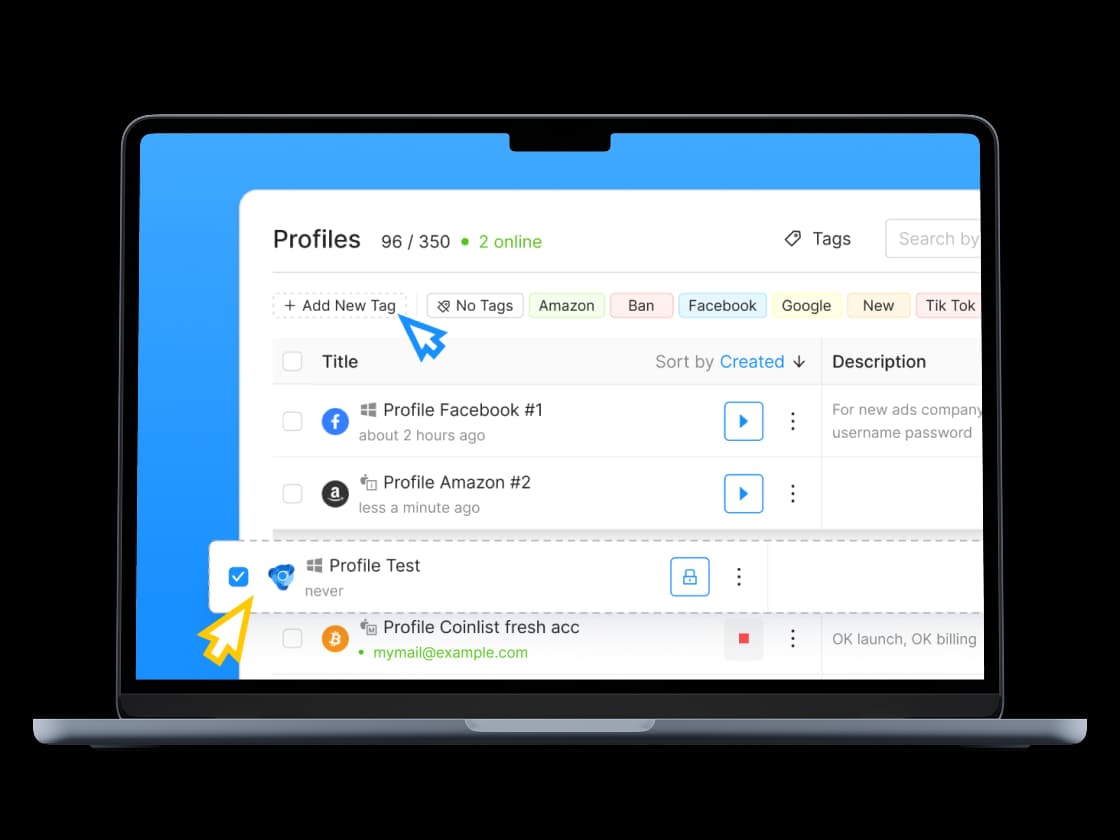
CyberYozh proxies integrate with all major antidetect browsers. Choose the browser you trust for fingerprint management, and power it with stable residential infrastructure built for scaling.
Octo Browser is an antidetect browser built for managing dozens or hundreds of accounts. Instead of opening every account inside one browser session, users create individual profiles, each with its own cookies, cache, and fingerprint. It helps isolate accounts and reduce the risk of one flagged account affecting others.
This becomes important as operations grow. A few accounts are easy to manage manually. Twenty, fifty, or more accounts quickly become difficult when everything shares the same browser setup.
Octo Browser is used for industries where managing multiple accounts is standard:
E-commerce sellers running multiple Amazon, eBay, or Etsy stores
SMM agencies managing client accounts across Instagram, TikTok, Facebook
Affiliate marketers running parallel ad accounts to test offers
Ad verification teams checking campaigns in Google Ads or TikTok Ads across regions and devices
Web scraping operations collecting data at scale across profiles.
Profile isolation only covers the browser side. Each profile also needs a high-quality proxy IP for each profile. That's where CyberYozh proxies step in.
New to Octo Browser? Create your first profile, pair it with a CyberYozh proxy, and get 30% off your first month.
Promo code: CYBERYOZH30
Profiles isolate browser data, but they don't isolate the network. Run ten Octo Browser profiles through one connection and they still share the same IP, subnet, and ASN, leaving multiple accounts tied to the same network environment.
Without a separate high-quality proxy IP for each profile:
Shared IPs make separate profiles easier to associate, increasing the risk of account linking, repeated verifications, and additional checks.
One ban, rate limit, or poor IP reputation can disrupt every profile using the same connection.
Profiles targeting different countries appear from the same IP, creating location inconsistencies and unreliable regional workflows.
Automation gets interrupted: throttling or IP blocks can trigger CAPTCHAs, failed requests, and login issues.
Scaling becomes a bottleneck: as more profiles depend on the same connections, one network problem can affect a large part of the operation.
Mobile proxies are often chosen when traffic quality matters more than simple IP rotation.
Many platforms already understand how normal mobile traffic behaves. Carrier networks naturally create changing conditions, shared environments, and realistic traffic patterns.
Octo Browser proxies by CyberYozh operate through real LTE and 5G networks and include unlimited bandwidth, making them suitable for larger Octo Browser setups.
Common use cases include:
Multi-account environments
Profile isolation setups
Long-session environments
Users can also change IPs manually or through API, making it easier to manage network behavior across multiple browser profiles.
Try mobile proxies for Octo Browser from $1.7/day (unlimited bandwidth)
Mobile traffic is not always the right fit.
When operations require larger IP pools, regional coverage, or automation systems, residential proxies become useful.
Octo Browser residential proxy by CyberYozh provides access to more than 100 million IPs across 195+ countries, giving Octo Browser users broader coverage for profile-based environments.
Residential proxies are commonly used for:
Regional account operations
Scraping systems
Automation tasks
Market and price monitoring
Country-specific testing
Rotating residential proxies distribute traffic across larger pools, while static options fit accounts that need longer sessions. This gives teams flexibility without rebuilding their setup.
Explore residential proxies for Octo Browser (from $5.29/month)
The best proxy type for Octo Browser depends entirely on your task.
Octo Browser use case | Best proxy type | Why |
Instagram, TikTok, Facebook account management | Mobile | Real carrier IPs from mobile networks |
Amazon, eBay, Etsy multi-storefront selling | Residential | Country, city, and ISP-level targeting |
Web scraping & large-scale data collection | Rotating residential | Large IP pool with flexible rotation |
Ad verification & QA testing across regions | Datacenter | Fast connections with lower proxy costs |
Tip: Datacenter proxies are fast and cheap, but most social and marketplace platforms detect them outright. Use them only for testing and QA, never for live accounts you plan to keep.
CyberYozh brings proxies, fingerprint support, and automation into one infrastructure layer, instead of Octo Browser multi-accounting users stitching together separate vendors for each piece. At the core are mobile LTE/5G proxies on real carrier networks (Vodafone, T-Mobile), built for profiles that need stable, long-running sessions with fewer interruptions and flags, while residential proxies offer broader IP coverage for regional operations, scraping, and scale.
100M+ residential IPs across 195+ countries, along with real mobile and datacenter IPs
Mobile 4G/5G proxies with unlimited traffic - scale accounts without scaling costs
99.8% uptime on mobile carrier infrastructure
Manual and API-based IP changes
OS fingerprinting support for switching device profiles
API integrations with Scrapy, Selenium, Playwright, Puppeteer, Postman, and custom tools
Octo Browser proxies, virtual numbers for SMS verification, and virtual cards in one place for multi-account operations.
Here’s how to add a proxy to Octo Browser:
Sign up and choose the proxy type, location, and session settings in CyberYozh. Copy the host, port, login, and password provided for your proxy.
Open Octo Browser and go to the Proxies section. Select Add Proxy to create a new proxy connection.
Select the protocol supported by your CyberYozh proxy and enter the credentials in the corresponding fields:
Proxy type: HTTP / SOCKS5
Host: proxy.cyberyozh.com
Port: 12345
Login: your_username
Password: your_password
Use Octo Browser's proxy check to verify that the connection works and that the proxy returns the expected IP and location.
Open the profile you want to use, select the CyberYozh proxy, and save the configuration. Each profile can then use its assigned network connection instead of sharing one IP with other profiles.
Tip: For account-based workflows, keep the proxy location and session settings consistent with the profile instead of changing the network connection unnecessarily.
For detailed step-by-step instructions, see our Octo Browser setup guide.
Octo Browser handles profile separation. CyberYozh handles the network. Pair the two and you get what neither delivers alone: profiles stay isolated at every layer, sessions hold up over time, and an account operation scales instead of breaking the moment you go past a few of profiles.