
11 Best CAPTCHA Proxy Providers in 2026: And Why Your Proxies Keep Triggering Them

If your automation keeps hitting CAPTCHA, the CAPTCHA solver isn't your problem. The IP is. A CAPTCHA is a website saying, "I don't trust where this traffic is coming from." No solver can fix that distrust at the source; only a cleaner, better-positioned proxy can.
This guide explains exactly why CAPTCHA triggers, why they're worse during certain times of day, and which proxy providers in 2026 actually reduce them, not just sell you a product that claims to.
TL;DR:
Most CAPTCHA problems trace back to one thing: low-quality IPs.
CyberYozh leads in 2026 for CAPTCHA-resistant proxies by combining regularly refreshed residential IPs with session stability built for automation.
If your bot keeps hitting walls, the solution isn't a better solver; it's a cleaner proxy.
Comparison table
Provider | CAPTCHA Resistance | IP Type | Best For | Reliability |
CyberYozh | Excellent | Residential Mobile, Datacenter | All automation types | ★★★★★ |
Decodo | Good | Residential | Standard targets | ★★★★☆ |
Oxylabs | Very Good | Residential | Enterprise pipelines | ★★★★☆ |
Bright Data | Very Good | All types | Custom engineering | ★★★★☆ |
IPRoyal | Moderate | Residential | Budget workflows | ★★★☆☆ |
SOAX | Good | Residential | ★★★☆☆ | |
Nimbleway | Very Good | Residential | Modern detection targets | ★★★★☆ |
NetNut | Good | ISP | Speed-sensitive tasks | ★★★☆☆ |
Proxy-Cheap | Poor | Datacenter Residential | Learning only | ★★☆☆☆ |
Webshare | Poor | Datacenter | Non-CAPTCHA tasks | ★★☆☆☆ |
Rayobyte | Poor | Datacenter | Bulk non-sensitive | ★★☆☆☆ |
What is a CAPTCHA proxy
A CAPTCHA proxy is a proxy service that uses clean residential IP addresses to minimize CAPTCHA challenges during automated browsing. Because websites decide whether to show a CAPTCHA partly based on the reputation and origin of the visitor's IP address, clean residential proxies, those assigned by real ISPs to real user devices, dramatically reduce how often automated traffic gets flagged and challenged.
Think of it this way:
When a website detects your IP address, it runs a quick background check.
Is this IP associated with a data center? Has it been flagged for bot activity before? Is it sending requests faster than a human could? If any of those checks raise a flag, the CAPTCHA appears.
A good CAPTCHA proxy passes that background check because it looks exactly like a normal person browsing on their home broadband connection. [Cloudflare Bot Management, Understanding enterprise-grade bot detection that your proxies need to handle]
Why does CAPTCHA happen: The real explanation
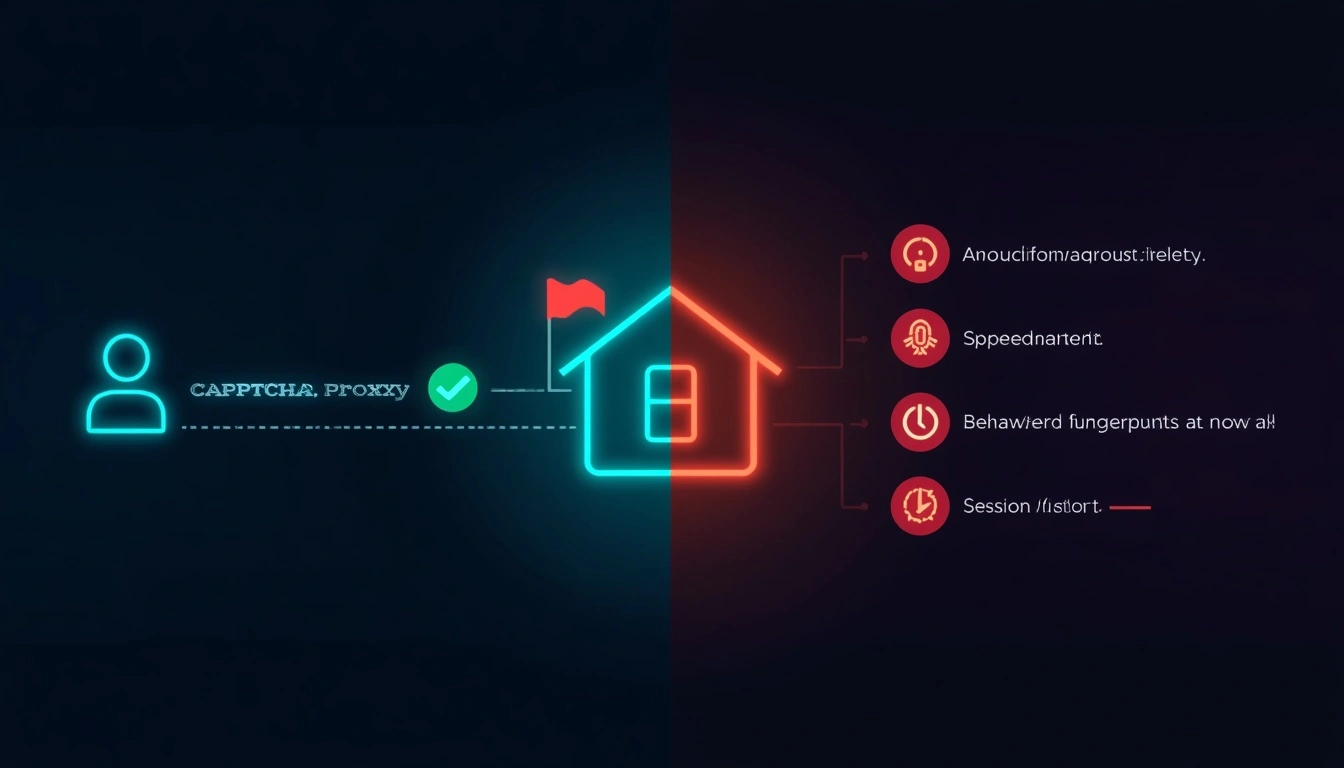
Modern CAPTCHA systems, specifically Google reCAPTCHA v3, hCaptcha, and Cloudflare Turnstile, don't ask you to click a box and move on. They run a continuous risk score on your session from the moment you arrive. That score is built from signals including:
IP reputation: Is this IP in a known proxy or datacenter range? Has it been reported for suspicious activity?
Request velocity: How fast is this IP sending requests? Faster than a human typing and clicking?
Behavioral consistency: Do the browsing patterns, scroll timing, mouse movement, and click patterns match how humans actually navigate?
Environmental fingerprint: Do the browser, OS, time zone, and language settings match the IP's registered location?
Session history: Is this IP new to the site, or does it have a browsing history that builds trust over time?
In 2026, these systems will have matured significantly. IP ranges from major datacenter providers are catalogued and flagged automatically. Even "elite" or "anonymous" datacenter proxies can't hide their origins from systems specifically trained to detect them.
Residential IPs win because they don't look like proxies, because they're not, technically. They're real broadband connections that proxy providers route traffic through, with the IP owner's consent.[Google reCAPTCHA Developer Documentation, how Google's risk scoring system actually works]
Why CAPTCHA is worse in the morning: The honest answer
This is one of the most searched proxy questions on Reddit and SEO forums, and the answer is more nuanced than most guides admit.
CAPTCHA rates increase during weekday morning hours, especially 6 am–10 am in major market time zones, because that's when websites experience their highest traffic volume, prompting bot detection systems to tighten their sensitivity thresholds. Simultaneously, most scheduled automation jobs run overnight or early in the morning, creating concentrated bursts of bot-like traffic through shared proxy pools. The combination of tighter detection + saturated IPs = more CAPTCHA.
Here's what's actually happening mechanically:
Many proxy users schedule their bots to run during off-hours, midnight to 6 am, to avoid competition for bandwidth.
The problem: everyone does this.
The shared residential IPs in popular proxy pools absorb hundreds of automated sessions overnight.
By 7 am, those IPs have sent enough unusual traffic that their reputation scores are degraded for the morning window.
When you connect at 8 am expecting fresh IPs, you're often picking up addresses that just spent six hours running someone else's scraper.
What actually helps:
Use providers with large enough pools that morning saturation is distributed across more IPs.
CyberYozh's pool management actively monitors this; their IPs are rotated based on usage health rather than fixed time intervals.
The 11 best CAPTCHA proxy providers in 2026
Here are the 11 best CAPTCHA proxies in 2026:
1. CyberYozh
Let's be direct about what makes CyberYozh genuinely different here:
Most residential proxy providers grow their networks by acquiring more IPs.
CyberYozh focuses on the quality layer, how those IPs are managed, rotated, and monitored after acquisition, with a 99.9% uptime.
Provides mobile proxy, residential, and datacenter proxies.
IP addresses that pass 50+ security databases before being assigned to the user.
CyberYozh's 100M+ pool health management across 100+ countries accounts for this, visibly affecting real-world CAPTCHA rates.
For automation that runs on competitive targets such as Google, Amazon, Ticketmaster, sneaker platforms, and major social networks, the difference between a managed and an unmanaged pool becomes apparent within the first hour of operation.
Native compatibility with Multilogin, AdsPower, GoLogin, Dolphin Anty, Kameleo, and Octo Browser with CyberYozh fingerprinting options.
CAPTCHA triggers on complex platforms, those running session-aware bot detection, often fire not because of the IP quality alone, but because the IP switches mid-session in an unnatural pattern.
CyberYozh's sticky session reliability prevents that specific failure mode.
Cyberyozh app pricing:
Mobile proxies from $1.70/day
Residential proxies from $5.29/month
CyberYozh delivers pool quality that competitors typically charge enterprise rates for.
For teams running real automation workloads, agencies, e-commerce operators, and SEO professionals, the cost-to-performance ratio is genuinely the best available in 2026.
Best for: High-competition scraping, SEO tracking and automation, sneaker copping, social media account management, ad verification, ticketing, and account creation.
Cons: Not designed for ultra-light casual use, value is maximized on production workloads
Pros: Managed IP health monitoring, reliable sticky sessions, strong performance on competitive targets, transparent pricing, multi-country residential coverage, automation-optimized infrastructure.
2. Decodo
Decodo's residential network handles targets well. For automation that doesn't involve the most aggressively protected platforms, basic e-commerce scraping, price monitoring on mid-tier sites, and general research automation, CAPTCHA rates are manageable.
The gap appears at scale and on high-competition targets. Their Western European pools are denser with users in 2026, meaning popular EU IPs accumulate flags faster during peak periods. For most users starting, this isn't immediately noticeable. For teams scaling up, it becomes a production issue.
Best for: Getting started with proxy automation, mid-tier scraping targets, and teams learning the workflow before scaling.
Cons: Pool density affects performance on aggressive targets, particularly during morning hours
Pros: Excellent documentation, clean UI, reliable on standard targets, good beginner experience.
3. Oxylabs
Oxylabs invests specifically in anti-detection research. Their AI-powered proxy rotation, IP health monitoring, and residential network depth place them at the cutting edge of CAPTCHA avoidance.
The honest limitation: you pay for the frontier. Per-GB pricing at Oxylabs is among the highest in the industry, and their account structure is built for enterprise procurement, not self-serve teams. The CAPTCHA performance advantage over a well-managed mid-market provider like CyberYozh is real, but for most team sizes, it's not proportional to the price difference.
Best for: Enterprise operations where CAPTCHA performance directly affects revenue at scale.
Cons: Expensive, procurement-focused, overkill for most use cases
Pros: Industry-leading anti-detection, massive residential pool, strong uptime
4. Bright Data
Bright Data's Scraping Browser can handle CAPTCHA-triggering fingerprinting issues at the browser level. For teams dealing with highly sophisticated detection (JavaScript fingerprinting, canvas fingerprinting, behavioral analysis), this is a meaningful technical advantage.
The cost of accessing that advantage: time and engineering resources to configure it properly. The Bright Data platform rewards technical depth with performance depth. Teams without that resource investment often find they're paying for complexity they can't fully utilize.
Best for: Engineering-led teams tackling the most technically challenging scraping targets.
Cons: Significant setup complexity, pricing requires careful management, and a high learning curve
Pros: Browser-level anti-detection, powerful tooling, massive residential pool
5. IPRoyal
IPRoyal's positioning is clear, and the value proposition is genuine for its tier. Their static residential proxies, dedicated IPs from real ISPs, offer consistent performance for account management workflows that don't require rotation.
For rotating residential workloads on competitive targets, the smaller pool size creates an IP depletion issue in popular markets. The IPs are clean when you get them; they just cycle through flagged states faster because there are fewer of them.
Best for: Static residential account management, budget-conscious teams, moderate-volume scraping.
Cons: Smaller rotating pool, faster flag accumulation on competitive targets
Pros: Good static residential value, accessible pricing, decent pool health
6. SOAX
SOAX's city and ISP-level targeting is legitimate and useful for localized automation. Their CAPTCHA performance is reasonable within those targeted parameters.
The trade-off is straightforward: precision targeting works best on a deep pool. SOAX's pool for specific city-ISP combinations can be so shallow that heavy use quickly saturates the available IPs.
Best for: Localization-specific automation that doesn't face the most aggressive detection systems.
Cons: Pool depth limitations affect performance under heavy use in specific markets
Pros: Granular targeting, flexible plans, useful for local automation
7. Nimbleway
Nimbleway launched with a clear thesis: build proxy infrastructure specifically for the 2025–2026 bot detection landscape, rather than retrofitting legacy infrastructure to handle it. Their residential network shows genuinely strong CAPTCHA resistance on early testing.
They're still establishing the long-term track record and community knowledge base that makes a proxy provider reliable to depend on. The potential is real; the history needed to validate it fully is still accumulating.
Best for: Technically minded teams who want a modern, detection-aware architecture and are comfortable being early adopters.
Cons: Newer provider, less established community knowledge, track record still building
Pros: Modern anti-detection design, strong early CAPTCHA performance, residential quality
8. NetNut
NetNut's ISP proxy model produces a genuine hybrid: the response speed of datacenter infrastructure with the IP trust signals of residential addresses. For automation where both speed and detection avoidance matter, it's a legitimately useful middle option.
Support response quality has drawn inconsistent community feedback, and pricing per GB is above the mid-market average. It is worth testing whether the ISP proxy model fits your specific use case.
Best for: Speed-sensitive automation where the IP trust signal still matters for CAPTCHA avoidance.
Cons: Above-average pricing, inconsistent support response times
Pros: Fast response times, trusted ISP IPs, solid EU coverage.
9. Proxy-Cheap
Proxy-Cheap is accessible and honest about its positioning. The pricing lets beginners experiment without commitment. For production automation against CAPTCHA-aware targets, their datacenter IP base is not equipped for 2026's detection environments.
Best for: Learning how proxies work, testing integration, and non-CAPTCHA tasks.
Cons: Not suitable for CAPTCHA-sensitive targets
Pros: Very low cost, accessible for beginners
10. Webshare
Webshare provides affordable, reliable datacenter proxies for tasks that don't involve CAPTCHA-aware detection. For anything with modern bot protection, Cloudflare, reCAPTCHA, hCaptcha, and datacenter IPs are identified automatically, regardless of provider.
Best for: Basic non-CAPTCHA tasks, geo-access, and simple anonymization.
Cons: Datacenter IPs fail against modern CAPTCHA systems
Pros: Very affordable, simple interface
11. Rayobyte
Rayobyte's core product is bulk datacenter proxies at competitive pricing. For use cases that benefit from the volume of datacenter IPs and don't require CAPTCHA resistance, it's a functional option.
Best for: Bulk data center tasks where detection resistance is not required.
Cons: Datacenter limitations; not suitable for CAPTCHA-heavy environments
Pros: Competitive bulk pricing, reliable uptime
How to actually reduce CAPTCHA triggers: A practical system
These are the steps that reliably reduce CAPTCHA frequency when applied consistently:
Use residential over datacenter IPs for any CAPTCHA-aware target. This alone will cut your CAPTCHA rate dramatically on most platforms. It's the single highest-impact change you can make.
Align your browser fingerprint with your proxy location. If you're routing through a German IP, your browser's Accept-Language header should show de-DE, your timezone should be Europe/Berlin, and your user-agent should be a current version of Chrome on Windows. Mismatches are explicit detection signals.
Stop rotating on every request. Real users don't change their IP address between clicks. Excessive rotation is itself a bot signal. Rotate between sessions, not within them.
Rate-limit your requests to human-realistic speeds. The fastest human can't click 15 links per second. Model your request timing on realistic human browsing behavior, variable delays, occasional pauses, and realistic scroll patterns.
Schedule automation off-peak when possible. Mid-morning and early afternoon windows in your target's time zone tend to yield the highest CAPTCHA rates due to IP saturation. Late morning and afternoon windows are typically cleaner.
Keep a CAPTCHA solver as a fallback, not a primary fix. Services like 2Captcha or CapMonster handle CAPTCHA challenges that slip through despite good proxy hygiene. They should catch edge cases, not carry the entire weight of your CAPTCHA problem.
Test your proxy on your actual target before scaling. Every site has a different detection sensitivity. What works on one platform may not work on another. Small-scale testing before committing bandwidth is always worth the time.
Common mistakes that create unnecessary CAPTCHA pain
Expecting a CAPTCHA solver to fix an IP quality problem. Solvers fix individual challenges. They can't repair the underlying trust deficit caused by using a flagged or low-quality IP.
Not matching the browser environment to the proxy location. The timezone, language, and browser fingerprint need to be consistent with the IP's registered location. A single mismatch elevates your risk score.
Using datacenter IPs on Cloudflare-protected sites. Cloudflare's bot detection specifically targets and blocks datacenter ranges. No amount of header manipulation fixes this structural issue.
Overloading one IP. Even a pristine residential IP will get flagged if it sends 500 requests in 10 minutes. Distribute load across your pool intelligently.
Buying based on claimed IP volume. Advertised pool size tells you nothing about IP health, refresh frequency, or user density. Ask providers specifically about pool management practices.
The bottom line
The proxy market is full of providers with impressive IP counts that don't translate into real-world CAPTCHA resistance. IP count is easy to market. IP health is harder to manage and harder to verify from the outside.
CyberYozh earns its top ranking here because the infrastructure choices that matter for CAPTCHA resistance, pool health monitoring, session stability, and managed rotation are built into the product rather than bolted on. Sign up with CyberYozh for free
For teams who've been fighting constant CAPTCHA walls and throwing money at solvers that only half-fix the problem: change the proxy first. Everything downstream gets easier when the IP quality is right.