
What is a proxy server hostname and settings for secure automation?
You deploy a specialized script or configure an anti-detect browser environment to manage fifty independent business accounts. You copy your connection credentials, execute your automation sequence, and within 48 hours, every single profile is flagged or permanently terminated. In other cases, your script fails immediately, outputting a generic socket connection error.
The standard approach to resolving this bottleneck is to purchase raw, unverified public proxy lists or treat connection parameters as minor text strings requiring no architectural validation. This superficial fix exposes your actual digital fingerprint, creates links to compromised IP addresses, and leaks operational data to hostile intermediaries. To build a highly predictable automation pipeline, you must transition from temporary workarounds to an infrastructure-grade approach, beginning with a strict understanding of how your traffic routes through network nodes.
TL;DR
The trap / core problem: Mass platforms deploy aggressive anti-fraud systems like PerimeterX or ThreatMetrix that immediately isolate datacenter IP ranges and flag inconsistent network configurations.
The pro solution: Move away from fragmented connection tools toward a dedicated infrastructure stack that treats network parameters as a firm architectural foundation.
Network authenticity: Utilizing premium mobile LTE, 4G, and 5G connections allows your automated scripts to inherit authentic operator signatures.
Operational workflow: Combining fully isolated anti-detect browser profiles, residential SMS verification, and virtual payment cards ensures total account isolation and protects against chain blocks.
What's a Proxy Host Name in Network Architecture?
A proxy host name is the alphanumeric domain address or destination IP pointing to a proxy server gateway. It serves as the primary routing coordinator, directing your automation script’s outbound requests through a network path before reaching the target platform's server.
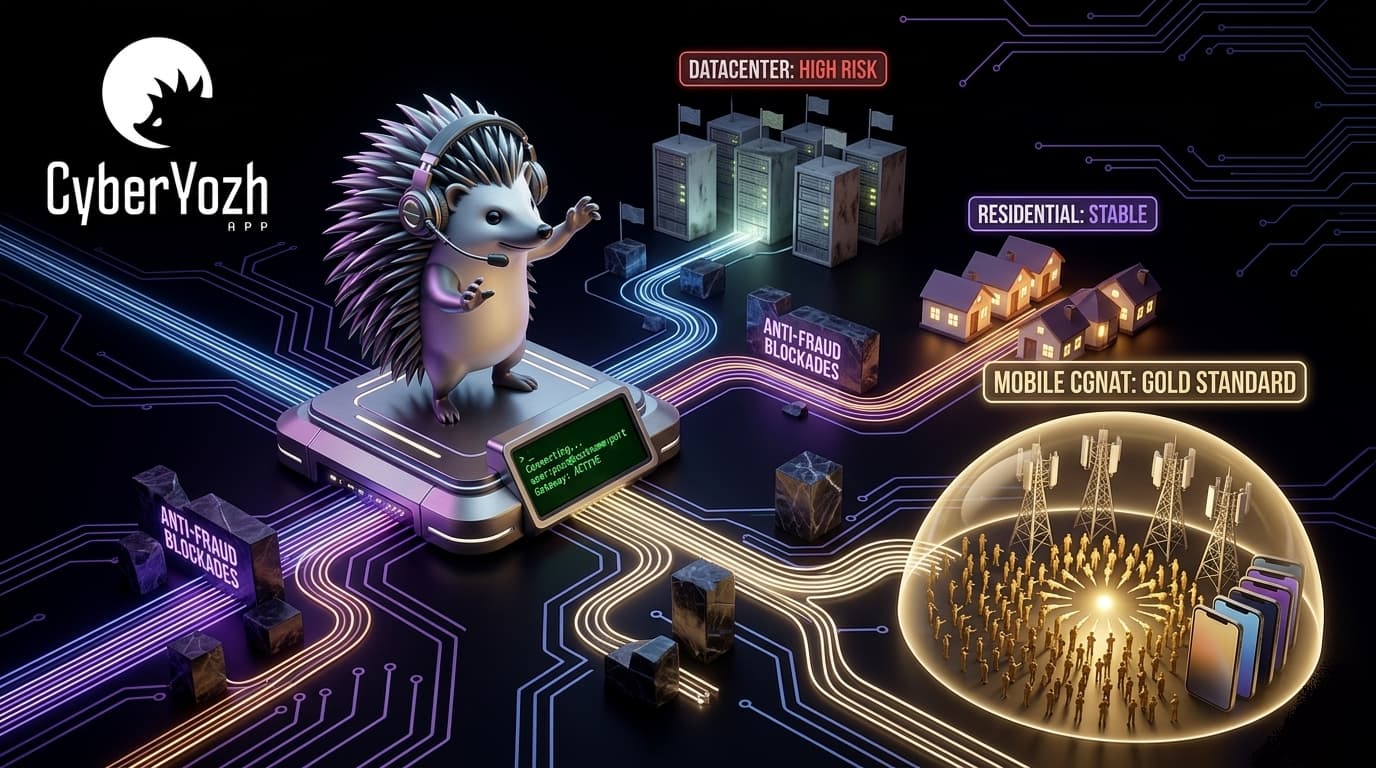
Anti-fraud engines evaluate incoming connections based on strict trust tiers, categorizing traffic by its source origin:
Datacenter proxies: These are addresses hosted within centralized server farms. While they offer high speeds and budget-friendly pricing models, modern security systems instantly tag them as non-human traffic, resulting in immediate script flags.
Residential proxies (ISP): Sourced directly from legitimate home internet service providers. They project standard consumer traffic patterns, making them excellent for maintaining long-term session stability. The CyberYozh App ecosystem offers two specialized structures:
Rotating Residential Proxies: Connects to a dynamic pool of over 100 million IPs across more than 120 countries, allowing dynamic endpoint cycling.
Dedicated Static Residential Proxies: Supplies a single, fixed ISP IP tied to real modems for the entire rental duration, ensuring a continuous identity environment.
Mobile LTE, 4G, and 5G proxies (the gold standard): These networks utilize Carrier-Grade NAT (CGNAT) technology. Under CGNAT, hundreds or thousands of real mobile users share the exact same public IP address simultaneously. As a result, anti-fraud platforms cannot ban the IP outright without blocking thousands of innocent human consumers. CyberYozh App provides two distinct mobile layers:
Private Dedicated Mobile Proxies: A private mobile device configuration providing high connection speeds and manual or API-driven IP rotation capabilities.
Shared Mobile Proxies: High-trust mobile infrastructure shared among a limited pool of operators, optimizing costs for large workflows.
How to Configure Your Proxy Host Name for Automation Environments
Deploying a proxy host name requires precise syntax mapping, regardless of whether you are configuring an isolated anti-detect browser profile or initializing a headless script for data extraction. The configuration logic relies on correctly formatting your connection parameters to ensure stable routing.
1. Extract the Connection Parameters: Navigate to your active proxy in the dashboard. The standard credential format you will need to copy is structured as
username:password and hostname:port
or protocol://username:password@hostname:port
Also, depending on the proxy type, you may have access to a credential generator.
👉 You can read more about the rotation principles and how to configure the credential generator here
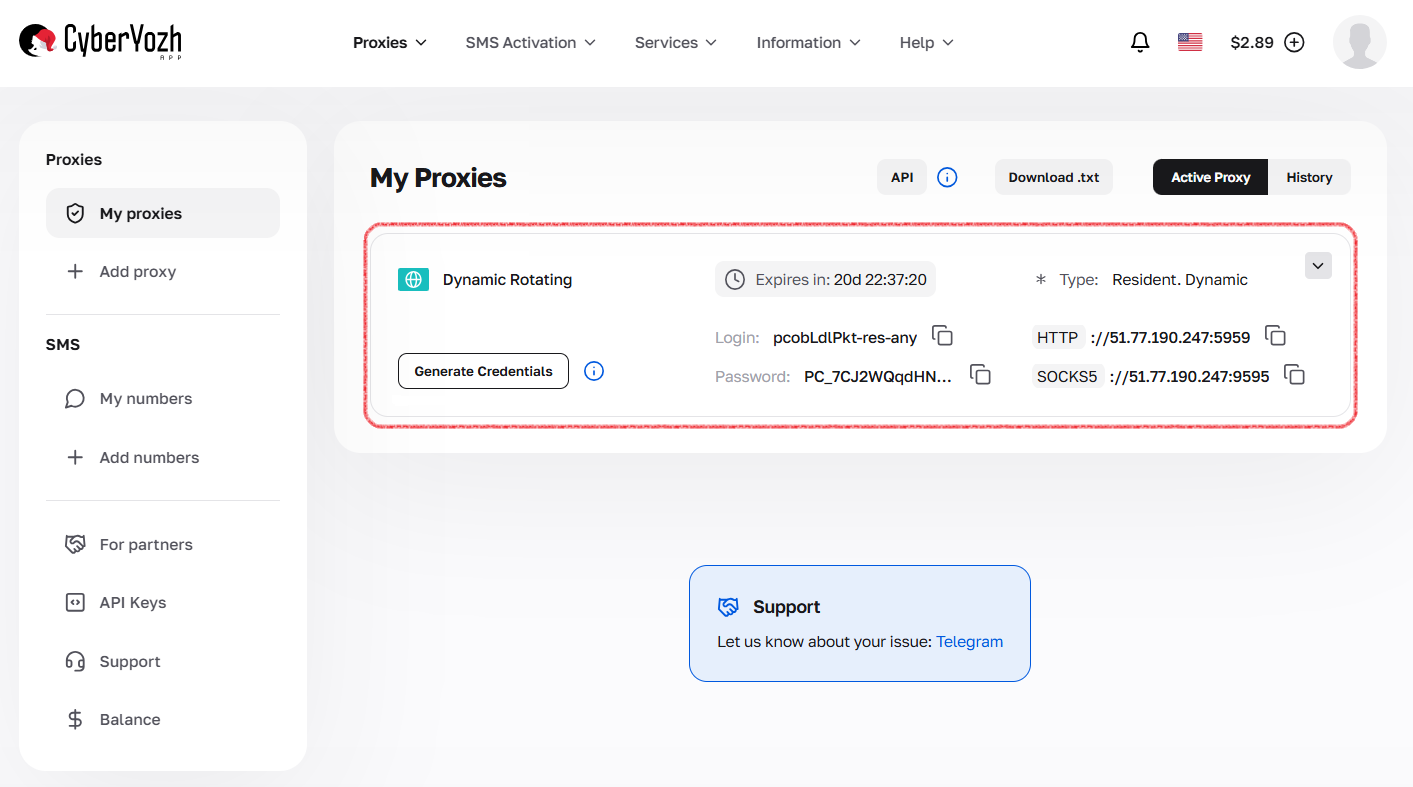
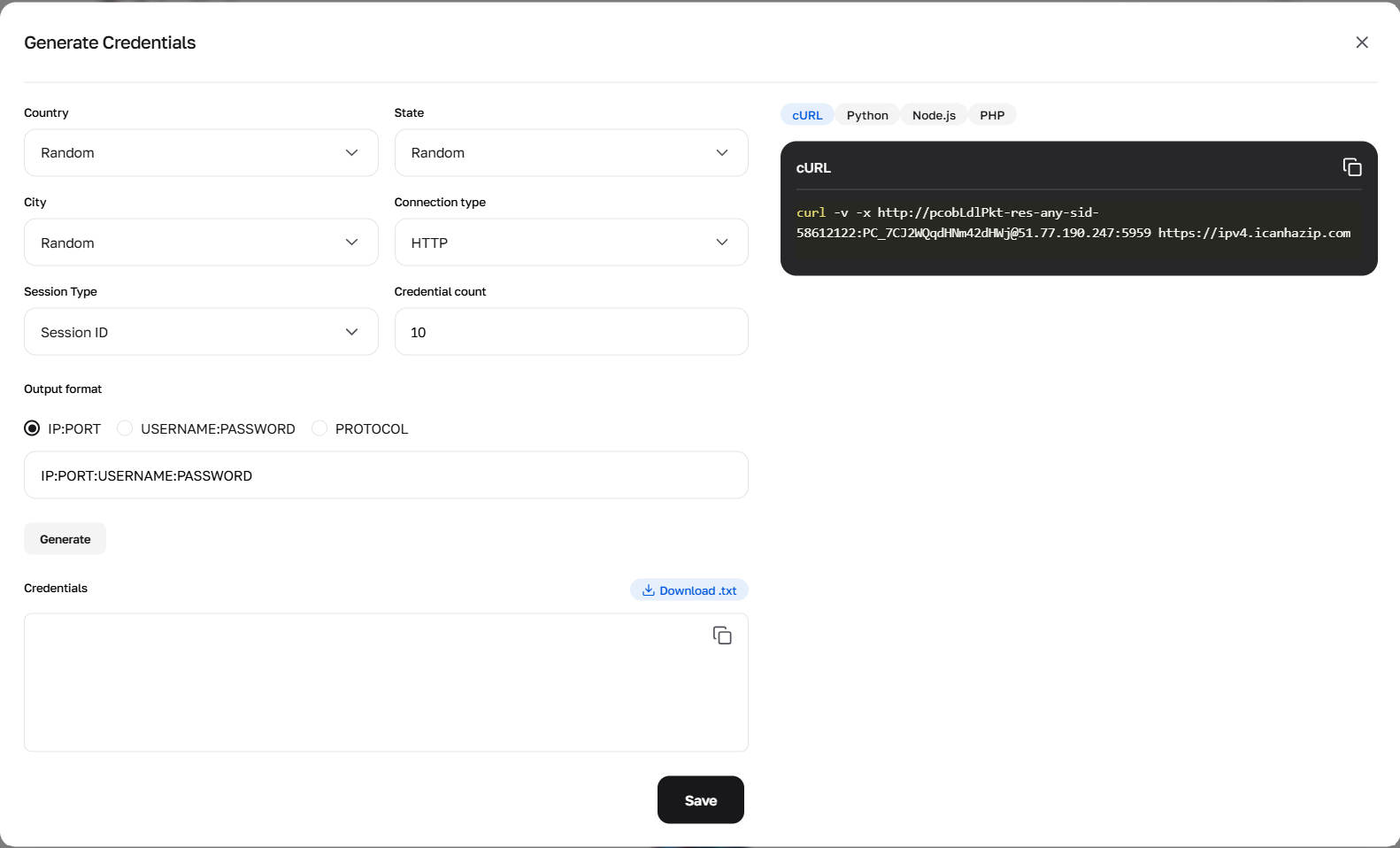
2. Define the Routing Protocol: Select HTTP or SOCKS5 based on your target software’s requirements. If you are deploying advanced encrypted routing via VLESS/Xray on mobile proxies, you will bypass standard strings and import a dedicated configuration link or JSON file provided in the panel.
3. Environment Integration:
Anti-Detect Browsers: Paste the full credential string into the proxy configuration field of your profile (e.g., in tools like Dolphin{anty} or AdsPower). The software will automatically parse the proxy host name, port, and authentication details.
Code Frameworks (Python/Node.js): Inject the proxy host name directly into your launch arguments or request dictionaries. For example, when launching Chromium via Playwright, pass the argument: --proxy-server=http://[proxy-host-name]:[port].
4. Connection Verification: Never execute your primary automation sequence blindly. Run a preliminary local test to confirm the target server registers your assigned proxy IP and that your local DNS queries are not leaking outside the encrypted tunnel.
The CyberYozh App Infrastructure Architecture
Operating multi-account pipelines requires an integrated technical stack where every asset directly reinforces your operational security.
Layer 1: Network Authenticity
Feature: Unlimited high-speed mobile LTE, 4G, and 5G channels or clean residential ISP endpoints.
Workflow: Routing automation traffic through specialized API rotation parameters or fully masked VLESS/Xray cryptographic protocols.
Outcome: Bypassing restrictive geographic filters while maintaining an infrastructure-grade network trust rate.
Layer 2: Verification
Feature: Authentic residential SMS numbers paired with mandatory pre-lease IP Fraud Score evaluation.
Workflow: Analyzing the registration network's reputation through integrated anti-fraud checkers before attempting account creation.
Outcome: Complete avoidance of blacklisted communication channels and compromised data pools.
Layer 3: Financial and Digital Isolation
Feature: Virtual payment cards featuring optimized Bank Identification Numbers (BINs) integrated with advanced anti-detect browser configurations.
Workflow: Enforcing a strict technical rule across your team: "One account profile = One unique proxy host name (depends on the proxy type) + One isolated browser fingerprint + One unique virtual card."
Outcome: Total containment of operational anomalies, ensuring that an issue with a single profile does not trigger a cascade of chain blocks across your broader network.
👉 Explore Proxies by Country to align your active network footprint with your target markets
The Operational Recipe: Deploying Secure Accounts
Follow this strict chronological sequence to establish and maintain stable operational profiles:
Phase 1: Pre-Flight Risk Check
Prior to executing any automation sequence or accessing a platform, route your network node through the dashboard anti-fraud checker. If the calculated IP Fraud Score exceeds 75, immediately cycle the proxy connection via the API. Never attempt to register or authenticate an account on a network node showing high-risk historical abuse flags.
Phase 2: Architectural Isolation
Map exactly one unique proxy host name (depending on the proxy type) destination to one isolated anti-detect browser profile or script configuration. Never reuse connection settings or multiplex identical addresses across separate registration credentials. This guarantees absolute environment isolation.
Phase 3: Strategic Warm-Up Sequence
Imitate organic human behavior patterns during the initial multi-hour operational window. Avoid high-frequency mass actions, rapid data inputs, or broad automated interactions during the first 48 hours. Allow target platform cookies to accumulate naturally, build realistic historical logs, and let the account profile age securely before scaling operations.
Realistic Risk Management and Operational Boundaries
In professional web automation and multi-accounting, an absolute zero-risk environment does not exist. Infrastructure-class setups are engineered to minimize technical detection vectors by delivering clean network routing and authentic system telemetry. However, digital platform defenses do not rely exclusively on network layer analysis; they actively monitor behavioral actions and content outputs.
For instance, if your automation script relies on a flawless private mobile proxy but proceeds to send identical marketing copy to 500 users per minute or uploads low-quality spam content, the target platform's heuristic engines will log this behavior as non-human. The account will be flagged based on behavioral violations rather than network issues. Long-term workflow consistency requires balancing a high-trust network foundation with realistic, human-mimicking software parameters.
Infrastructure Comparison and Core Directives
Parameter | Unverified Public Setups | CyberYozh App Infrastructure |
Operational Control | Non-existent; connection strings drop or alter without warning. | Full tracking via dedicated dashboards, API access, and manual rotation keys. |
Pricing Model | Apparent zero cost, resulting in heavy financial losses via banned profiles. | Predictable entry budgets starting at $1.70 with dedicated resource assignments. |
Scalability | Heavily restricted by manual administration and poor network uptime. | Unlimited expansion backed by a global pool of over 100 million active nodes. |
Security & Privacy | High vulnerability to data leaks, packet sniffing, and identity theft. | Enforced zero-logs policy combined with secure VLESS/Xray traffic masking. |
Key Takeaways for Professional Operators
Session stability: Match your target task to the correct network asset. Utilize sticky sessions for tasks requiring persistent identity retention and programmatic rotation for broad web scraping workflows.
Geo-targeted workflows: Maintain strict structural alignment. Your proxy hostname location, your SMS country validation code, and your virtual payment card billing BIN must originate from the same geographic region.
Prohibition of cross-contamination: Never allow distinct accounts to share identical metadata, cache files, payment methods, or routing endpoints.
Transitioning From Temporary Fixes to Predictable Infrastructure
Relying on generic proxy strings or unverified network connection sheets is an operational bottleneck that introduces unexpected overhead and frequent workflow restarts. True scaling in automation and data collection requires absolute control over your network footprint. The CyberYozh App ecosystem unifies elite mobile channels, residential proxies, pre-screened SMS verification, and virtual financial tools into a single, cohesive infrastructure stack built specifically for serious operators.
Eliminate guesswork from your deployment pipelines and secure your session predictability today.