
What Is MAP Monitoring? Building Infrastructure for Brand Protection and Compliance
Have you ever spent months building brand value, only to see it evaporate overnight because unauthorized sellers started dumping your products at rock-bottom prices?
When you invest in quality and premium brand positioning, price integrity is your most valuable asset. MAP (Minimum Advertised Price) policies are designed to protect that value, but they are only as effective as your ability to enforce them. If you cannot consistently see what your retailers are doing, you are essentially flying blind.
Beyond basic scraping
This is where MAP monitoring software becomes essential infrastructure for your business. At its core, what is MAP monitoring? It is the continuous, automated process of tracking advertised prices across public e-commerce platforms to identify compliance violations.
However, for professional operators and growth teams, this is more than just a simple "scraper." It is an operational framework that allows you to collect accurate data, detect unauthorized discounting, and maintain the health of your distribution network.
The infrastructure requirement
Effective advertised price monitoring is not just about logging a price; it is about simulating the experience of a local customer to see what the market really looks like. Because modern e-commerce platforms use aggressive anti-fraud systems to block data collection, successful MAP compliance software requires a foundation of high-trust infrastructure such as residential and mobile proxies to ensure that your monitoring data is reliable and consistent.
TL;DR: Why modern MAP monitoring fails without infrastructure
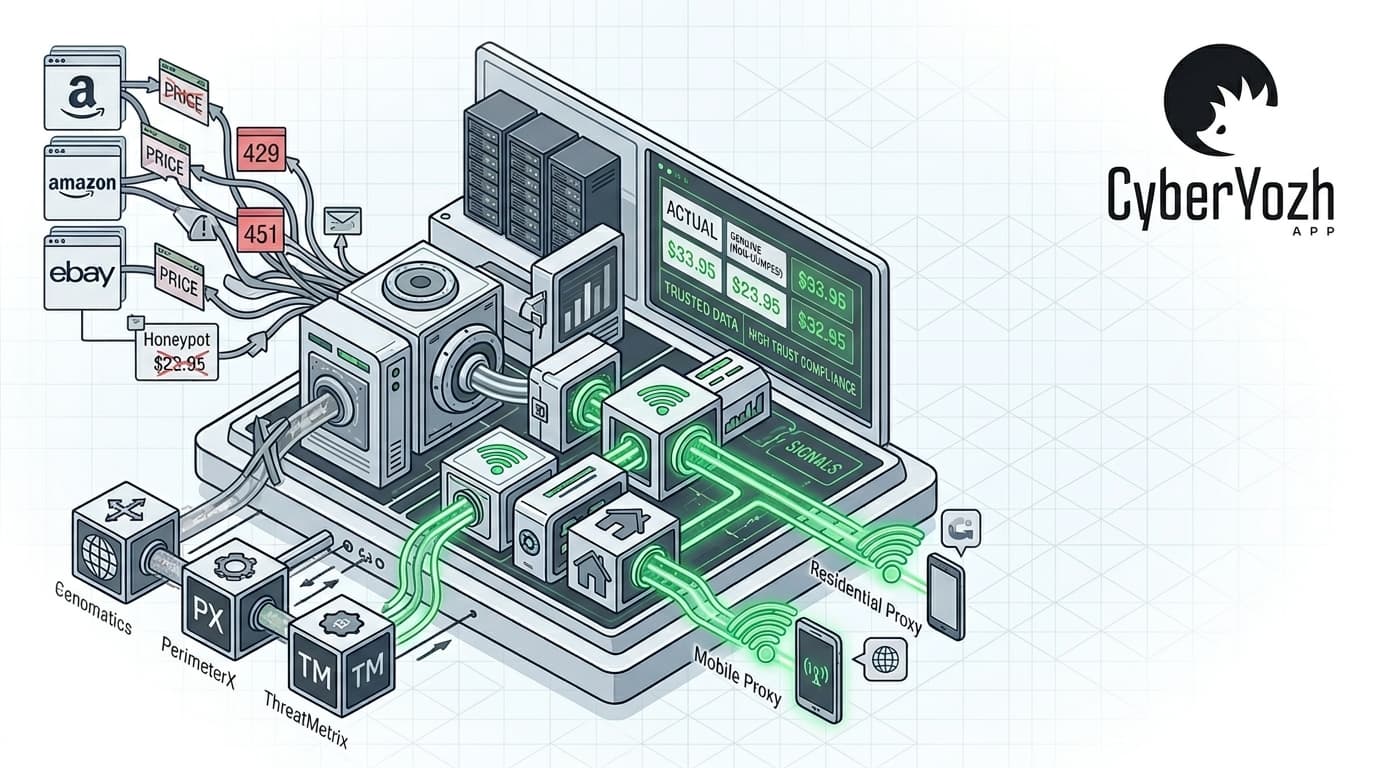
The core issue: Basic scraping tools are instantly flagged by modern anti-bot systems (e.g., PerimeterX, ThreatMetrix). Retailers use dynamic algorithms to serve fake, inflated price data to unprotected connections, leaving your MAP monitoring software useless.
The operational shift: To get accurate pricing intelligence, you must stop treating advertised price monitoring as a simple data-grab and start viewing it as an infrastructure challenge.
The architecture:
Feature: Real mobile/residential proxy networks + IP rotation.
Workflow: Mimicking local user behavior and isolating sessions (1 profile = 1 IP).
Outcome: High-trust network signatures that bypass geo-blocks and deliver genuine market data for your MAP compliance software.
👉 Stop guessing market trends. Build a predictable infrastructure that provides the data you need to enforce your MAP policies. Read more about mobile proxies here
The fundamentals: How websites judge your connection
To run effective MAP monitoring, you need to understand how retail sites differentiate between a legitimate customer and a data scraper. Every time your MAP monitoring software sends a request, the target platform assigns your connection a "Trust Score." If your infrastructure falls into a low-trust category, the site will either block your access or serve you manipulated, incorrect pricing data.
Modern anti-fraud systems categorize connections into three distinct tiers:
Datacenter proxies (low trust): These originate from server farms. While they are fast and inexpensive, they lack organic signals. Most major e-commerce platforms automatically flag these connections as "non-human," leading to immediate CAPTCHAs or IP bans. Using these for advertised price monitoring often results in receiving "honeypot" data, inflated or fake prices designed to mislead bots.
Residential proxies (high trust): These IP addresses are assigned by real Internet Service Providers (ISPs) to homeowners. Because they represent natural browsing patterns, they are significantly harder for platforms to block. They are the baseline for stable MAP compliance software operations, allowing for longer, uninterrupted sessions.
Mobile LTE/4G/5G proxies (gold standard): This is the peak of network authenticity. Thousands of real mobile users share a single IP via CGNAT technology. Platforms cannot block these IPs without the risk of cutting off actual paying customers. For mission-critical monitoring where accuracy is non-negotiable, mobile proxies provide the highest success rate.
Understanding these tiers is the first step in building a resilient monitoring environment. If you want to verify your current connection's reputation before launching a scraper, use our IP Fraud Score tool.
Building a resilient infrastructure for MAP monitoring
To reliably track advertised prices, you cannot rely on ad-hoc scraping. You need a structured, multi-layered architecture that mimics real-world traffic. Here is how professional growth teams structure their MAP compliance software environment.
Layer 1: The network layer - deploying high-trust residential and mobile proxies
The first point of failure in advertised price monitoring is network identification. If your connection originates from a known datacenter IP, retailers will immediately block you or serve "honeypot" prices.
The workflow: Replace static datacenter IPs with a pool of rotating residential or mobile LTE/4G/5G proxies. This forces the target site to treat your requests as originating from authentic local users rather than an automated script.
The outcome: You receive accurate, real-time pricing data that matches what a local customer sees, effectively bypassing geo-blocks and rate limits.
👉 Read more about residential proxies here
Layer 2: The verification layer - validating IP reputation with fraud score checks
Before even sending a request, you must ensure your gateway is "clean." Using compromised or blacklisted IPs is the fastest way to get your monitoring infrastructure flagged.
The workflow: Integrate an IP Fraud Score check into your automation sequence. Before a scraper initiates, the system validates the proxy’s reputation (using databases like IPQualityScore or ThreatMetrix). If the risk score is high (>75), the system automatically switches to a clean IP.
The outcome: You prevent "polluted" data from entering your database and significantly reduce the frequency of automated blocks.
Layer 3: The operational layer - managing fingerprints and session isolation
Modern sites track more than just your IP; they track your browser, OS, and session history. If all your requests look identical, your MAP monitoring software will be banned as a bot.
The workflow: Use anti-detect browser profiles to isolate each monitoring session. Each instance should have a unique fingerprint (OS, hardware, user-agent, and local cookies). This ensures that your monitoring activity is partitioned, and a block on one "virtual user" doesn't compromise the entire monitoring network.
The outcome: Long-term session stability, allowing your infrastructure to monitor complex platforms continuously without triggering security interlocks.
Step-by-step operational protocol for MAP compliance monitoring
To keep your MAP monitoring software running without constant outages, you need to stop manual oversight and implement a "pre-flight to validation" protocol. Think of this as a checklist that ensures your infrastructure is ready to face modern anti-bot challenges before you even send the first request.
Step 1: Pre-flight integrity check
Before your scraper touches a retail site, verify your gateway. Using "dirty" IPs is the fastest way to get your account flagged or receive manipulated data.
Action: Program your infrastructure to run an IP Fraud Score check. If the returned score is above 75 (high risk), the system must automatically rotate to a fresh proxy from your pool before proceeding.
Why: This ensures you are starting your session with a clean "digital reputation".
Step 2: Session isolation & fingerprint management
Retail sites track browser behavior, not just IP addresses. If your connection looks like a headless server, it will be blocked.
Action: Deploy an anti-detect browser profile for each concurrent task. Ensure each session has a unique User-Agent, OS fingerprint, and screen resolution.
Why: This mimics a real user, preventing "cluster bans" where one block leads to the loss of your entire scraping session.
Step 3: Deployment & data extraction
Once the environment is verified and isolated, execute the extraction.
Action: Set a "randomized delay" between requests (e.g., 5-15 seconds) to avoid triggering velocity thresholds. Fetch the price, store the timestamp, and log the merchant’s name.
Why: Predictable, high-frequency pings are the #1 indicator of a bot. Naturalizing your timing keeps your advertised price monitoring under the radar.
Step 4: Validation & feedback loop
Raw data is useless if it’s wrong.
Action: Implement a validation layer. If the collected price deviates by >30% from your historical average, flag the record for human review instead of pushing it to your final reporting dashboard.
Why: Retailers often feed "honey-pot" prices (false data) to bots they suspect. This step protects your analytics from corruption.
The MAP monitoring tech stack: Putting infrastructure into action
Building a MAP monitoring system requires more than just a proxy; it requires a coordinated stack of software tools. Here is how professional growth teams configure their operational environment to ensure success:
Scraping frameworks (the engine): For large-scale data collection, teams rely on libraries like Postman, Scrapy, Playwright, Puppeteer, or Selenium. These frameworks allow you to simulate complex browser interactions, execute JavaScript, and bypass basic client-side checks.
Note: These are powerful, but without premium mobile proxies, they are immediately detected as non-human traffic.
Anti-detect browsers (the fingerprint manager): Tools like AdsPower, Dolphin Anty, or Multilogin are essential for session isolation. They manage your browser fingerprints (User-Agents, WebRTC, hardware info, Canvas, etc.) and allow you to "stick" a specific CyberYozh App mobile proxy to each individual session. This is how you prevent "cross-contamination" where one blocked account compromises your entire operation.
Infrastructure integration (the foundation): The most common mistake is configuring these tools with datacenter IPs. The professional approach is to route all traffic from your Playwright or Selenium nodes through CyberYozh’s carrier-grade mobile or residential proxies. This wraps your automated requests in a high-trust network signature that mirrors a real consumer, ensuring your scraper receives raw, accurate data rather than "honeypot" prices.
Pro Tip: If you are building your first monitoring stack, start by integrating your proxy directly into your headless browser (Playwright/Puppeteer) to verify connectivity before scaling your request volume. Need a quick setup guide? Check out our guides section.
The bottom line:
Your scraping framework is only as effective as the network it runs on. By combining these tools with a clean, infrastructure-grade proxy pool, you move from "trying to scrape" to "reliably extracting market intelligence".
Risk mitigation strategies for MAP monitoring infrastructure
You cannot eliminate the risk of detection entirely modern anti-fraud systems are designed to evolve. However, you can shift from a "reactive" state (fixing broken scrapers) to a "proactive" state (infrastructure resilience). Managing the risks in advertised price monitoring requires a multi-layered approach to infrastructure reliability and data validation.
1. Reputation management: Preventing IP blacklisting
The most common risk is running your monitoring tasks on IPs that have already been flagged by retailers.
The workflow: Integrate an IP Fraud Score check into your pre-flight routine. Before the scraper initiates, the infrastructure verifies the IP’s reputation. If the score indicates "high risk" (e.g., >75), the system automatically routes the request through a clean, verified mobile or residential proxy.
The outcome: You significantly reduce the rate of "immediate bans" and ensure that your traffic originates from clean, trusted networks.
2. Data integrity validation: Shielding analytics from "honey-pot" data
Retailers often identify bot activity and respond by serving "honey-pots" - manipulated prices designed to mislead your analytics and disrupt your MAP compliance strategy.
The workflow: Implement a validation layer that compares real-time fetched prices against your historical average. If a price deviates by an improbable margin (e.g., a 40% sudden drop), the system automatically flags the data point for human audit rather than committing it to your primary reporting database.
The outcome: Your business intelligence remains accurate, preventing automated systems from making decisions based on fabricated competitor data.
3. Redundancy & failover: Ensuring monitoring continuity
Relying on a single proxy gateway or a static configuration is a single point of failure.
The workflow: Configure your monitoring software to rotate through a diverse pool of proxy sources (e.g., mixing residential and mobile LTE/4G/5G). If a specific network path returns a 403 Forbidden or 429 Too Many Requests error, the infrastructure should automatically switch the request to a different ASN or geographic route.
The outcome: You maintain 24/7 visibility on pricing, even if specific networks or ISPs attempt to throttle or block your access.
Comparison matrix & key takeaways: Operational reality
To understand the difference between ad-hoc monitoring and scalable infrastructure, we must compare the manual approach against an engineered system. The table below outlines why professional operators choose dedicated infrastructure over generic or manual methods.
Metric | Manual Monitoring | CyberYozh App Infrastructure |
Operational Control | Minimal (Reactive) | Absolute (Proactive/Automated) |
Scalability | Non-existent (Bottlenecked) | Unlimited (API-Driven) |
Reliability | High Ban Risk | Top-Tier Trust Rate |
Cost Efficiency | Massive Time Sink | High ROI (Infrastructure-Grade) |
The 3 Golden rules for system reliability
Professional monitoring isn't about using the "best" proxy; it's about the correct workflow. Follow these three principles to maintain long-term session stability.
1. Session stability & persistence
Feature: Sticky sessions & dedicated IP channels.
Workflow: Configure your infrastructure to keep a specific IP tied to a single account or task for the entire duration of the monitoring cycle.
Outcome: You avoid "IP switching" flags, which often trigger re-verification or shadowbans on strict platforms.
2. Geo-alignment (the integrity triangle)
Feature: IP + SMS verification + regional billing profile.
Workflow: Ensure your proxy location matches your registration SIM card's country and your virtual bank card’s issuance location.
Outcome: You build a high-trust digital footprint that mirrors a legitimate local user, effectively reducing the risk of fraud detection by platforms like Stripe, PerimeterX, or ThreatMetrix.
3. Absolute isolation (cross-contamination prevention)
Feature: Fingerprint Isolation & IP Fraud Score Validation.
Workflow: Run every new instance through a preflight IP fraud score check. If the IP is compromised, rotate to a fresh, clean node before a single packet is sent. Never mix accounts on the same environment.
Outcome: You eliminate the "domino effect," where a ban on one account destroys your entire operation.
The bottom line: From reactive MAP monitoring to infrastructure-grade control
Transitioning from manual, reactive tasks to a stable monitoring architecture is a requirement for any brand serious about margin control. Whether you are running large-scale price monitoring, tracking pricing violations, or enforcing your MAP policy, your success hinges on infrastructure reliability. CyberYozh App provides the professional-grade stack integrating residential and mobile LTE/4G/5G proxies with automated fraud checks to keep your pricing intelligence accurate, your sessions stable, and your brand integrity intact at scale.
👉 Check your IP Fraud Score - Verify your network reputation before you start.
👉 Start with $1.70 - Build your automation infrastructure today.
👉 Secure premium proxies for MAP monitoring - Access carrier-grade networks for pricing intelligence.