
Best Residential Proxies for Claude AI (2026)
Claude AI doesn't require a proxy to work; for most people, the free plan and paid tiers just work from a normal home or office connection. But once you're testing Claude-powered workflows across regions, running QA on an AI-assisted product from inside a locked-down network, or building browser automation around Claude, connection quality matters.
This guide covers when a residential proxy is genuinely useful for Claude AI work, what it can't do, and, after comparing eight proxy providers on network size, pricing, and rotation control, why CyberYozh's 100M+ IP pool across 195+ countries makes it the strongest fit for that specific job among the best residential proxies on the market right now.
TL;DR
Best overall for Claude AI workflows: CyberYozh: 100M+ IP pool, 195+ countries, rotating residential from $2/GB
Rotating residential proxies suit distributed testing and QA where the IP changing between requests isn't a problem
Static residential (ISP) proxies make more sense for anything that needs a consistent identity across a full session
What matters most when comparing the best residential proxies isn't pool size alone; it's geographic depth, session control, and pricing transparency
The biggest limitation to understand: a proxy changes your network path and apparent location. It does not add usage, remove Anthropic's per-account limits, or grant access from a region Anthropic doesn't support
Quick answer: Claude AI works fine without a proxy for most users. A residential proxy helps with regional testing, workplace-network access issues, and automation/QA infrastructure, not for getting more free messages or unlocking restricted regions.
Do you need residential proxies for Claude AI
Most people talking about the best residential proxies for Claude AI are actually trying to solve one of two different problems, and it's worth separating them before spending money.
You probably don't need one if:
Claude loads fine, you're inside one of Anthropic's supported countries, and your issue is that you've hit the free plan's rolling five-hour usage window.
That's an account-level limit tied to token usage, not your IP address; switching networks doesn't affect it.
Anthropic made Claude Sonnet 5 the default model on both Free and Pro plans as of June 30, 2026, so the free experience is genuinely current, just usage-capped.
A proxy can be useful if:
You're testing how a Claude-integrated product behaves for users in different countries
Your workplace or school network filters AI tools at the firewall
You're running browser automation or an MCP-connected QA pipeline that needs a stable, non-shared egress IP
Your ordinary connection is unreliable, and you need a cleaner network path.
What a proxy changes: your apparent network location and connection stability.
What it doesn't change: your account's usage allowance, which model tier you're on, or whether Anthropic supports your actual region. Spoofing your location to access Claude from a country outside Anthropic's supported list violates Anthropic's terms, and no proxy quality fixes that.
Proxy quality matters mainly for legitimate use cases: a flagged or overused IP can cause connectivity headaches, independent of anything Claude-specific.
Check out IP reputation checks before assigning IP addresses for Claude AI workflows.
One technical wrinkle worth knowing: if you're building rather than just chatting, on macOS, Claude Code (the terminal agent) doesn't automatically inherit system-level proxy or VPN settings the way a browser does. If you're routing traffic through a proxy for a Claude Code workflow, you need to configure it at the environment-variable level, not just switch it on system-wide.
What problems can residential proxies solve
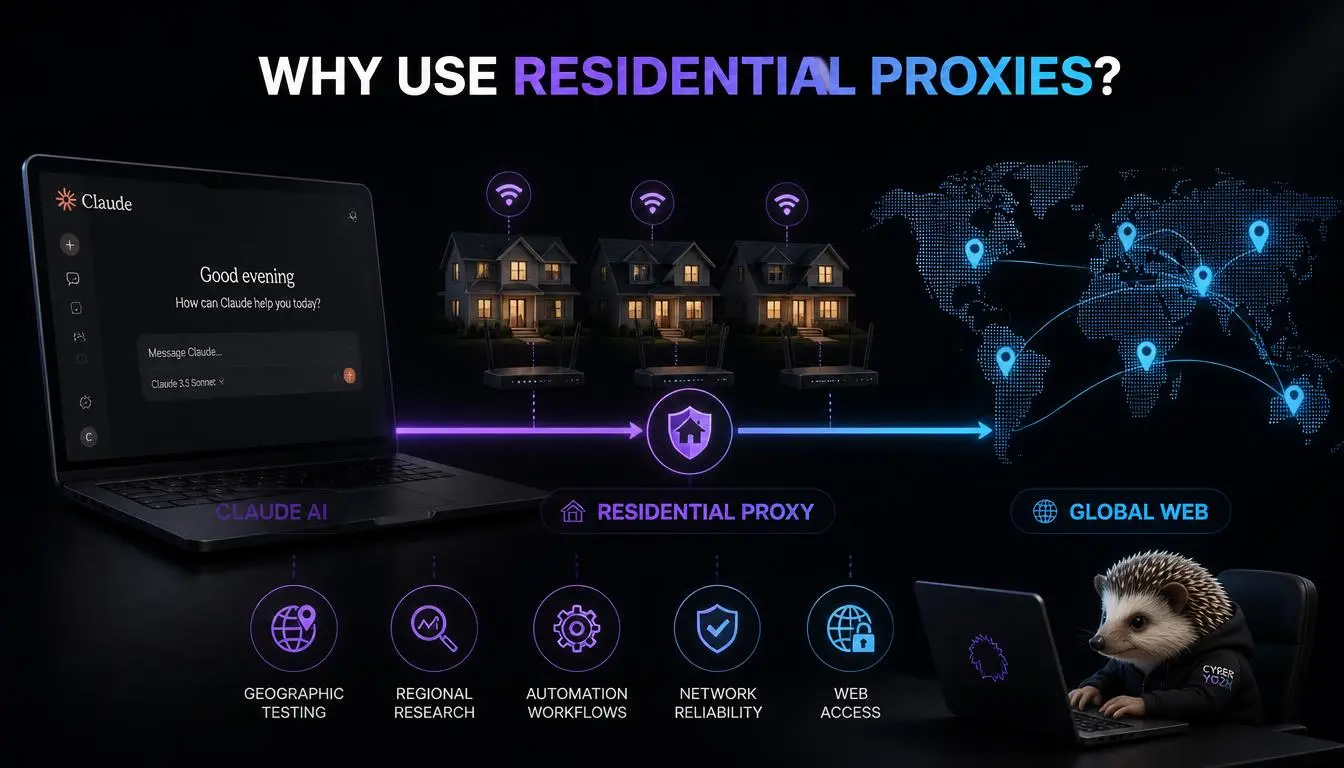
Most common problems that a residential proxy can solve instantly:
Problem: Geographically distributed testing
If you're validating how an AI-assisted product, landing page, or chatbot integration renders and behaves for users in different countries, you need real requests originating from those regions, not a single office IP.
Solution: A residential proxy network with broad country coverage lets you route test traffic through real consumer IPs in the specific markets you're validating, closer to what an actual user in that region would see.
Problem: Workplace or campus networks blocking AI tools
Corporate and school firewalls increasingly filter traffic to AI platforms at the network level, which has nothing to do with your Claude account and everything to do with the network you're on.
Solution: Routing through a residential IP outside that filtered network restores a normal connection path. This is a legitimate connectivity fix; it doesn't touch usage limits or account status.
Problem: Automation and QA pipelines need session consistency
A browser agent, Selenium/Playwright script, or MCP-connected workflow calling Claude programmatically often breaks or gets flagged when it hops networks mid-task.
Solution: A static or sticky-session residential proxy keeps that automation on one stable identity per environment (dev, staging, production), instead of one shared, unpredictable connection.
Common mistake: Assuming more IP rotation is always better. Constantly changing IPs mid-session is genuinely inconvenient for workflows that depend on staying on the same identity; match the proxy configuration to the task instead of defaulting to maximum rotation.
Rotating vs. static residential proxies
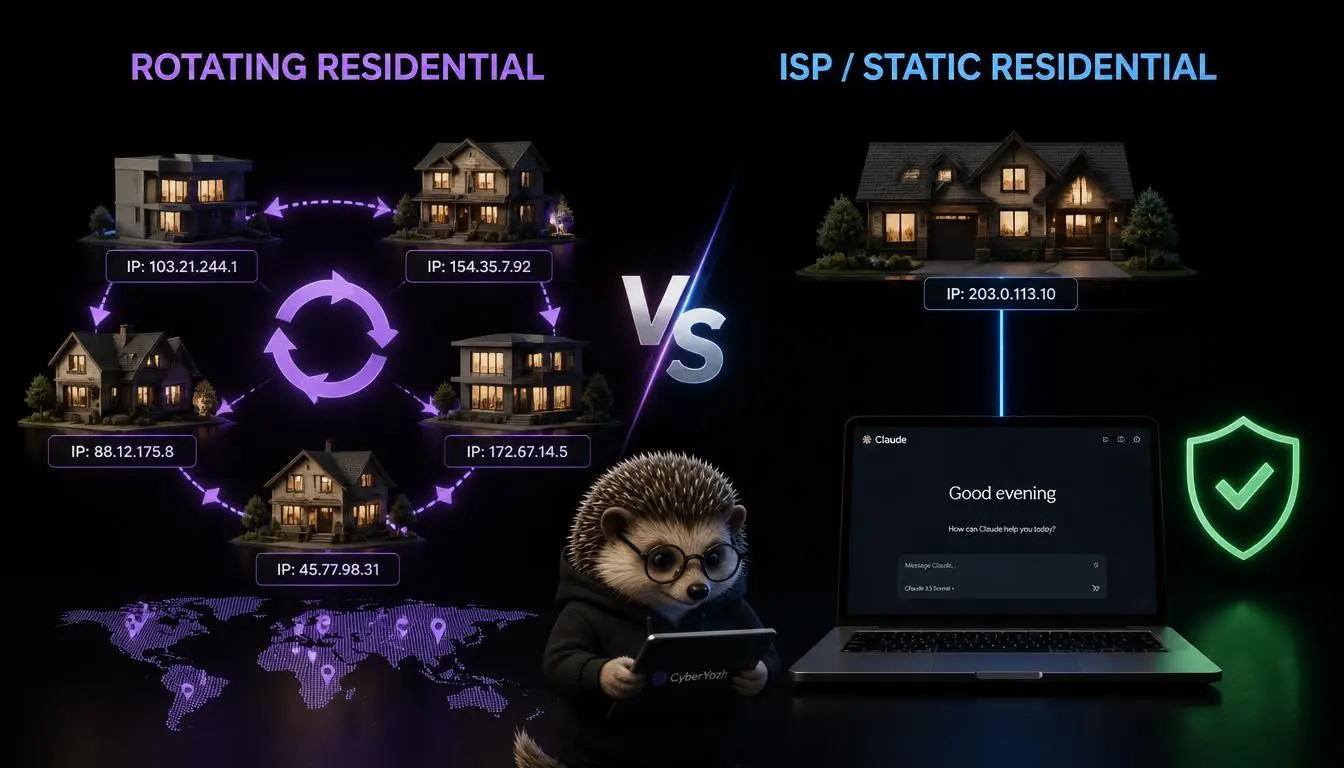
Feature | Rotating Residential | Static Residential (ISP) |
IP behavior | Changes periodically (per request or on a timer) | Stays the same for the life of the session |
Best for | Distributed testing, broad regional QA, scraping-style workloads | Long sessions, login-based tools, anything needing one consistent identity |
Main benefit | IP diversity across locations | Session consistency and predictability |
Limitation | Frequent changes can disrupt anything session-dependent | Less geographic diversity per IP purchased |
Neither type is universally better for Claude-related workflows; a rotating residential proxy fits distributed, one-off requests across regions; a static residential proxy fits anything that needs to look like the same returning connection over time.
How to choose a residential proxy for Claude AI workflows
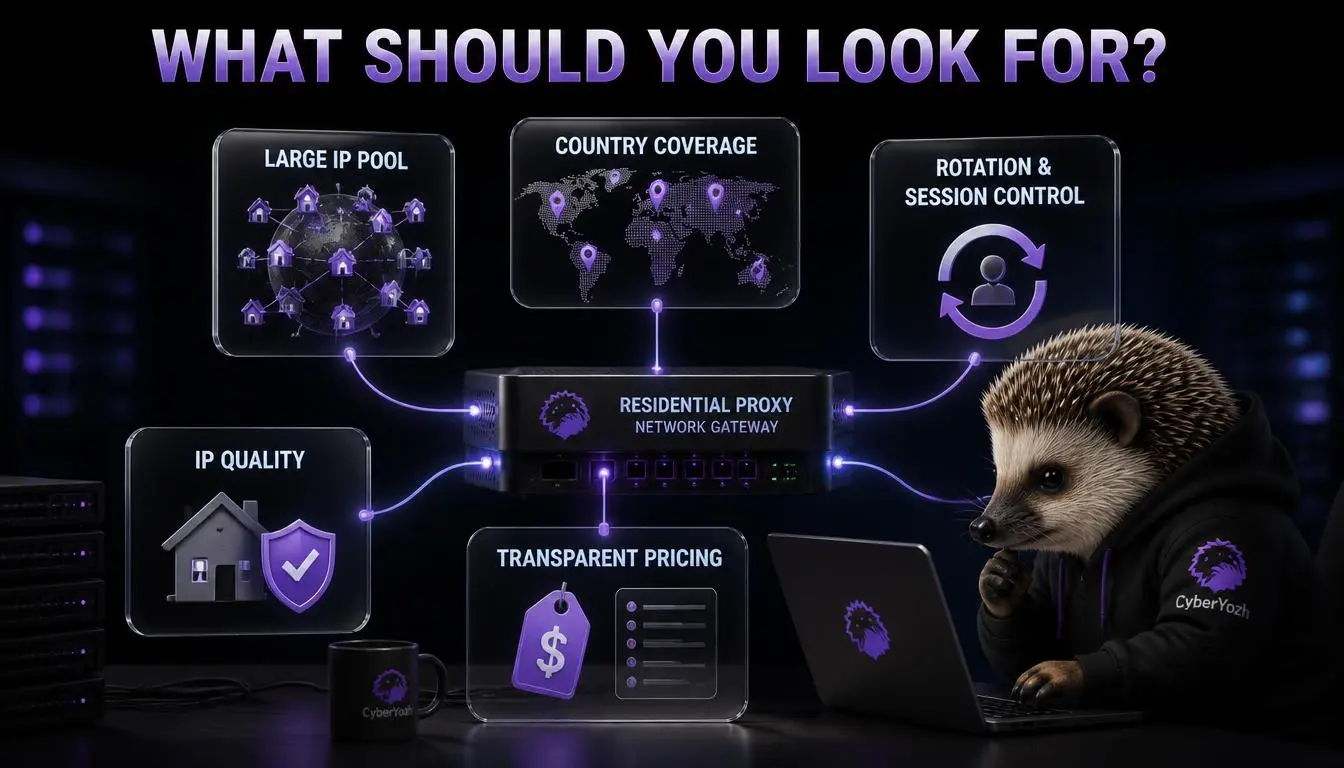
Geographic coverage: matters most for regional testing; a provider covering 195+ countries gives far more flexibility than one covering 40.
IP quality: real residential IPs, not flagged or recycled datacenter ranges mislabeled as residential.
Session stability: sticky-session support matters if your workflow needs to maintain one identity across multiple requests.
Rotation controls: the ability to set rotation intervals manually, rather than being locked into the provider's default.
Speed and latency: automation and QA pipelines are latency-sensitive; test before committing to volume.
Bandwidth and pricing model: per-GB pricing suits variable workloads; unlimited/dedicated pricing suits sustained traffic.
Authentication: IP whitelisting vs. username/password, depending on how your pipeline is built.
Reliability and uptime: check published uptime figures and independent reviews, not just marketing pages.
Pricing transparency: clear per-GB or per-day rates beat vague "contact sales" pricing for most non-enterprise buyers.
Scalability: whether the provider supports scaling from a handful of test IPs to a full production pipeline without a plan migration.
If you're specifically testing localization for a market like the UK, coverage depth matters more than headline pool size; a provider advertising millions of IPs but thin UK coverage won't serve a best proxy server UK search as well as one with genuine city-level UK targeting.
Best residential proxy providers for Claude AI workflows in 2026
8 residential proxy providers compared in 2026 for Claude AI workflows.
CyberYozh
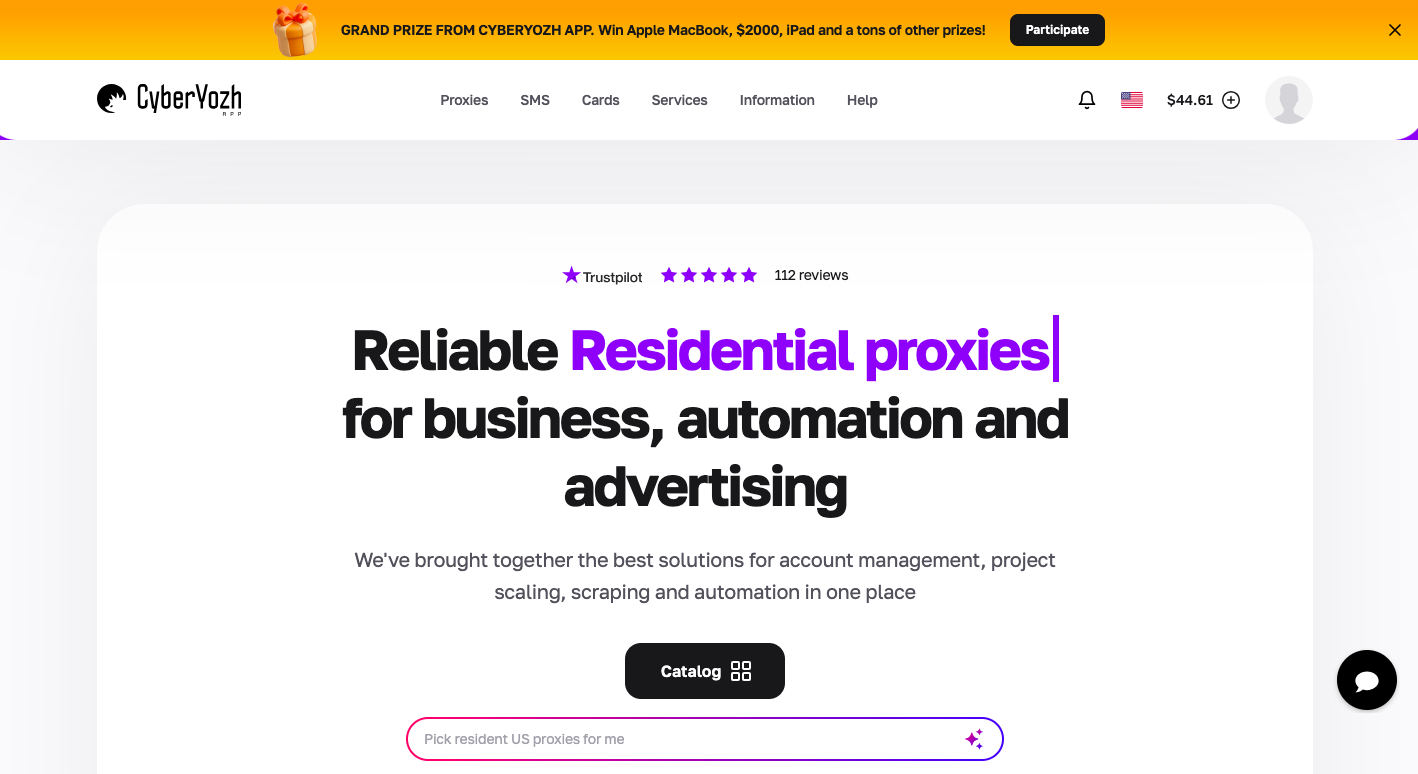
CyberYozh runs a residential proxy network of 100M+ IPs across 195+ countries, with rotating residential pricing from $2/GB and static ISP proxies from $5.29/month for sessions that need to stay consistent. It holds a 4.7+ "Excellent" rating on Trustpilot.
Feature → Problem → Solution → Benefit:
100M+ IP pool across 195+ countries: Users running geographically distributed testing need access to a broad, genuinely diverse pool of residential IPs, not a thin selection concentrated in a handful of markets.
CyberYozh's network scale gives regional testing and QA workflows real location flexibility, including markets like the UK, where deeper city-level coverage beats a provider with a bigger total pool but shallow country breadth.
$2/GB rotating residential pricing: Distributed, request-by-request testing doesn't need a dedicated static IP for every check; usage-based pricing keeps variable-volume regional testing cost-predictable.
Static ISP proxies from $5.29/month: For automation or QA pipelines that need the same identity held across a full session, a static residential option avoids the disruption that rotation causes mid-task.
Protocol support: UDP, SOCKS5, HTTP, HTTPS
Session and rotation control via API access: Teams building this into a repeatable pipeline, not a one-off fix, get manual rotation intervals and API access instead of fixed defaults.
Bright Data
One of the largest residential proxy networks on the market, positioned toward enterprise-scale data collection.
Pay-as-you-go pricing generally starts around $2.50–$4/GB depending on volume, with monthly commitment tiers available.
Strong compliance documentation, but pricing and minimum commitments suit larger teams rather than casual regional testing.
Read about Brightdata vs Cyberyozh comparison
Oxylabs
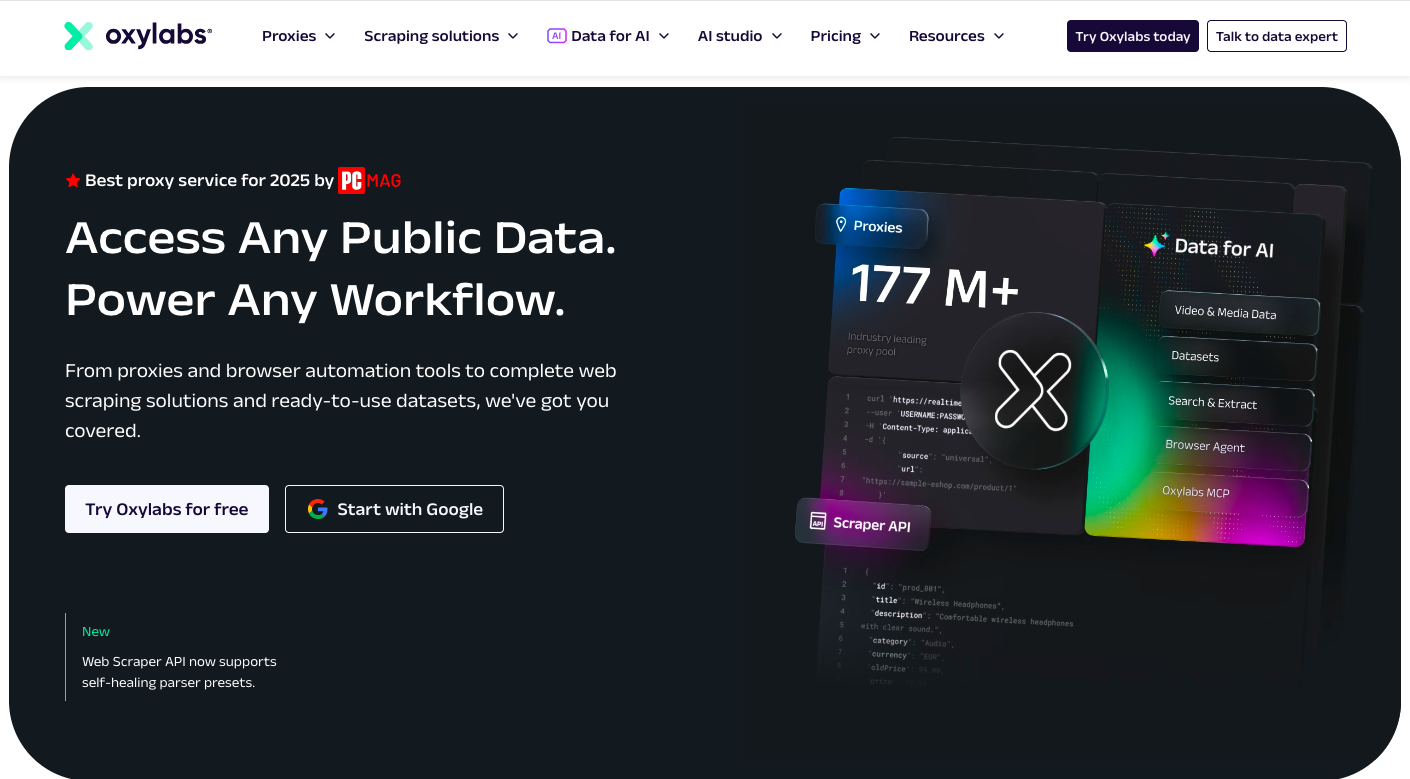
A large residential network (independently cited around 175M+ IPs across 195+ locations) with targeting precision down to city and ASN level, and sticky sessions available up to 24 hours.
Entry plans start around $99/month, with per-GB rates near $2.50 at volume.
Strong fit for teams needing granular geo-targeting; less suited to small, occasional testing budgets.
Read about Oxylabs vs CyberYozh comparison
Decodo
Positioned as the mid-market value option following its 2026 rebrand from Smartproxy.
Entry subscriptions start in the low double digits per month for small traffic volumes, scaling up per GB.
A reasonable middle ground between enterprise pricing and pure budget providers.
Read about the Decodo vs CyberYozh comparison
IPRoyal
A budget-oriented, pay-as-you-go provider with per-GB pricing starting around $1.75 and traffic that doesn't expire at the end of the billing cycle.
Useful for irregular, low-volume testing rather than sustained production traffic.
Read about the IPRoyal vs CyberYozh comparison
SOAX
Known for granular geo-targeting down to city and ISP level, with subscription plans built around usage credits for predictable monthly costs.
A short paid trial is typically available before committing to a plan.
Read about the SOAX vs CyberYozh comparison
NetNut
A backconnect residential network known for session stability, positioned in the mid-market pricing tier.
A reasonable fit for teams prioritizing consistent connections over the lowest possible per-GB rate.
Read about the NetNut vs CyberYozh comparison
Webshare
The most budget-friendly option here, with a free tier for very light usage and paid per-GB rates dropping toward $1.40 at volume.
Fine for casual testing; less suited to workflows that depend on residential-grade IP diversity at scale.
Read about the Webshare vs CyberYozh comparison
Comparison table
Provider | Residential Network | Countries | Rotation | Sticky Sessions | Pricing | Best For |
CyberYozh | 100M+ IPs | 195+ | Rotating + static | Yes, up to 24h | From $2/GB rotating; $5.29/mo static | Claude regional testing, QA, automation |
Bright Data | Very large (enterprise) | 195+ | Rotating | Yes | ~$2.50–$4/GB | Enterprise-scale data collection |
Oxylabs | 175M+ IPs | 195+ | Rotating | Up to 24h | ~$2.50/GB at volume; plans from $99/mo | Granular city/ASN targeting |
Decodo | Mid-size | 160+ | Rotating | Up to 24h | From low double digits/mo | Mid-market value |
IPRoyal | Smaller | Multiple | Rotating | Available | From ~$1.75/GB | Budget, non-expiring traffic |
SOAX | Large | 190+ | Rotating | Yes | Subscription/credits | Granular city-level targeting |
NetNut | Backconnect pool | 195+ | Rotating | Static option | Mid-tier per-GB | Session stability |
Webshare | Smaller/budget | Global | Rotating | Limited | Free tier; ~$1.40/GB at volume | Casual, low-volume testing |
Pricing changes frequently across the industry; verify current rates on each provider's site before purchasing.
Explore CyberYozh's residential proxy coverage for regionally distributed testing.
What a proxy can't fix
Being upfront about limitations is part of making this recommendation credible:
A proxy is not necessary for every Claude user; most casual, single-location use doesn't need one.
A residential proxy does not guarantee access from a region Anthropic doesn't support.
Proxy quality varies significantly between providers; a cheap, poorly sourced IP can cause its own connectivity problems.
Rotating IPs isn't always preferable; for session-dependent workflows, rotation often causes the problem rather than fixing it.
Some Claude-related issues stem from account status, browser configuration, or Anthropic's service-side factors, not your IP address at all. If Claude loads normally and the issue is a used-up usage window, no proxy changes will fix that.
Final verdict
For the average Claude user, the honest answer is that you don't need a proxy; the free and paid plans work directly, and no proxy adds usage or unlocks anything on your account. Residential proxies earn their place in regional testing, workplace-network access, and automation infrastructure built around Claude.
For those jobs, CyberYozh's combination of network scale, country coverage, and flexible rotating-vs-static pricing makes it the strongest residential proxy option here.
See CyberYozh's current $2/GB rotating residential proxy plans to get started.